Icebreaker bingo is a get-to-know-you game where each player gets a bingo card with squares like "speaks more than one language" or "has been on a cruise." Players find coworkers who match each square and get them to sign it, and the first person with five in a row wins.
- Home
- Leadership Games
- Icebreaker Bingo
Icebreaker Bingo for Work: Get to Know Your Team
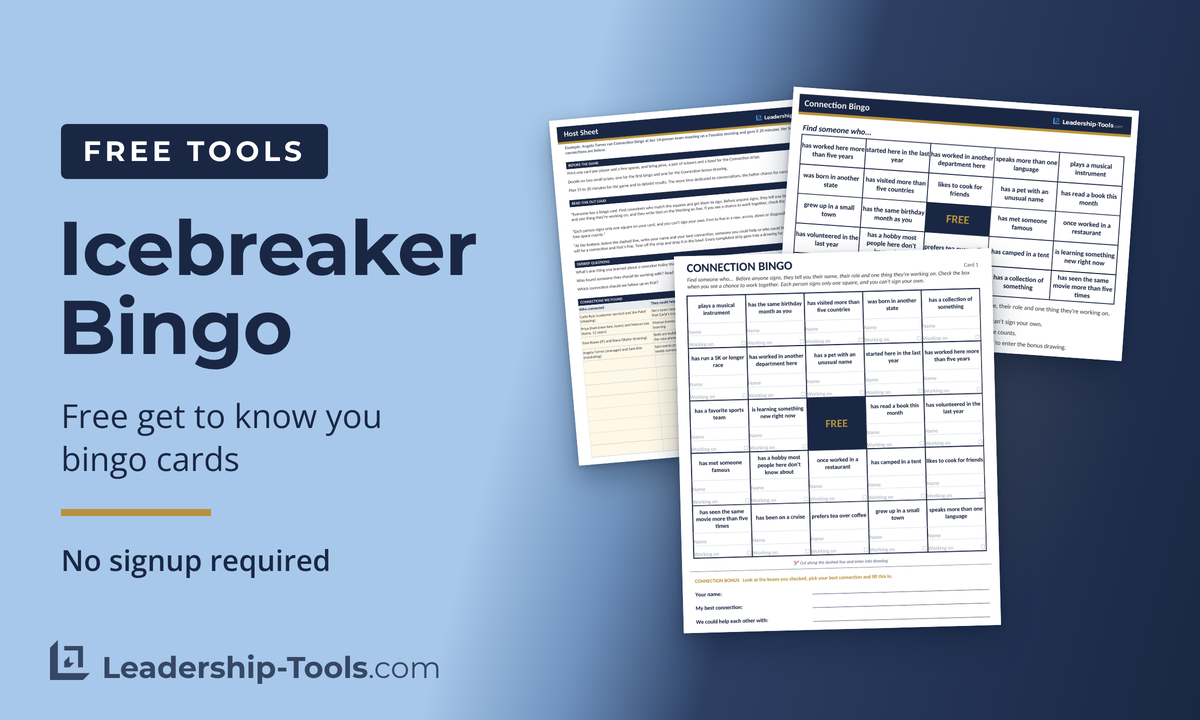
This free icebreaker bingo game gives everyone on your team a card full of "find someone who" squares and a reason to talk with coworkers they don't know well. Each card has 24 squares, like "speaks more than one language" or "has been on a cruise," and players move around the room getting a different coworker to sign each one. The first person with five in a row wins.
Download Free Icebreaker Bingo Template
Our version adds one rule. Before anyone signs your card, they tell you their name, their role and one thing they're working on, and if the two of you see a chance to work together, you check a box. By the end of the game your team has a short list of connections worth following up on, and the game becomes something you can use the next week.
You can print the ready-made cards today, or type your own squares once and print up to 50 cards, each with the squares in a different order. The game comes as an Excel workbook, a Google Sheet and a PDF, and a Quick setting drops the extras when you only have ten minutes.
Icebreaker bingo at a glance
| Formats | Excel, Google Sheets, PDF |
| Ideal for | Team meetings, new-hire groups and cross-department meetings |
| Includes | 24 ready-made squares, your own version, a wall card and a host sheet |
| Cards | 1 for a practice round, or 5 to 50, each in a different order |
| Pairs with | Jeopardy Game Template, Fun Team Activities |
Which version should you play?
| Play Connection Bingo when you want people to learn what their coworkers do and find ways to work together. Plan 15 to 30 minutes. | |
| Play the Quick version when you only have ten minutes or the group already knows each other well. | |
| Either way, the practice round comes first. Print 1 card and try it with a coworker. |
Jump To: How to Play | Connection Bingo | Which Version | 48 Squares | Your Own Squares | Practice First | Virtual | Prizes | Mistakes | FAQ | Download
How to Play Human Bingo at Work
Hand every player a card and a pen, read the rules out loud and give the room a set amount of time. The host sheet in the download has the rules written out, so you can read them word for word.

- The 30-second hello. Before anyone signs your card, they tell you their name, their role and one thing they're working on. They sign the square that fits them and write that one thing on the Working on line.
- One square each. A person can sign only one square on your card, and you can't sign your own, so you'll talk with at least five people to win.
- Bingo. The first player with five signatures in a row, across, down or diagonally, calls out "Bingo!" The free space in the middle counts.
- Checking the card. Read the winning row out loud and ask two or three of the signers to tell their story. This is where the room learns the most about each other.
- Keep going. If you have time, play on for a second winner or a full card.
Connection Bingo: How It Helps Your Team Work Together
Every square on a Connection Bingo card has a small box at the end of the Working on line. When two people realize they could help each other, the player checks it. At the bottom of the card, below a dashed line, each player writes their name, their best connection and how the two of them could help each other, then cuts the strip off for a drawing.
ANGELA'S TUESDAY TEAM MEETING
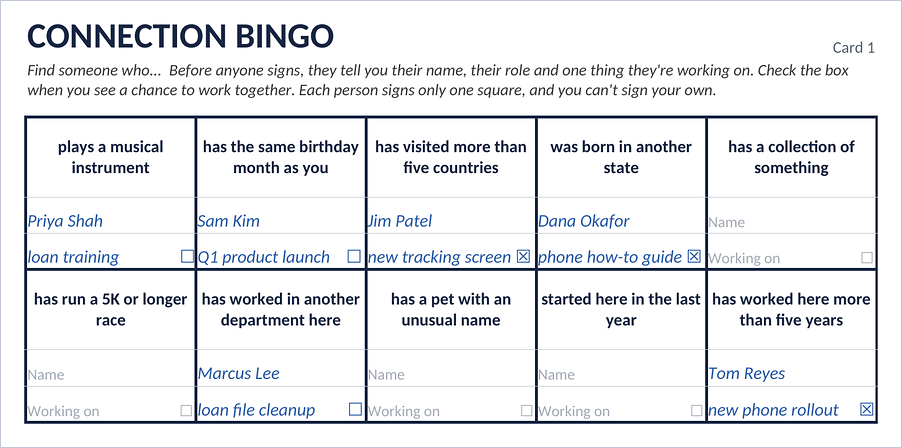
The game: Angela Torres gave Connection Bingo 20 minutes at her 14-person team meeting. Carla Ruiz from customer service needed a signature for "has visited more than five countries," and found Jim Patel from shipping. Before he signed, Jim gave his 30-second hello: he runs the shipping desk, and his team just rolled out a new tracking screen. Carla checked the box, because her customers call every day asking where their deliveries are.
The surprise: When Angela read the Connection strips, she found that Tom Reyes in IT and Dana Okafor in training were each building a how-to guide for the new phones, and neither one knew the other had started.
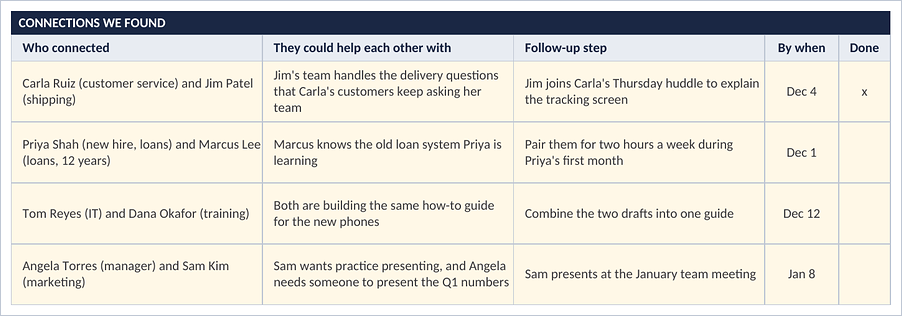
The follow-up: Angela wrote four connections on the host sheet, each with a follow-up step and a date. Tom and Dana combined their drafts into one guide, and Priya Shah, who just started, now spends two hours a week with Marcus Lee learning the old loan system.
The next week, Jim was at Carla's Thursday huddle walking her team through the tracking screen.
Most icebreaker bingo games end when someone calls bingo. With the 30-second hello, your game also leaves you with a list of people who should be talking, and those follow-ups fit right into your one-on-ones. The host sheet has a Connections We Found table for exactly that, with columns for who connected, how they could help each other, the follow-up step and a date.
Connection or Quick: Which Version to Play
Both versions use the same cards, and one setting switches between them. Pick Connection or Quick from the Style dropdown on the first tab, and the cards, the wall card and the host sheet all change to match.
| Connection Bingo | Quick | |
| Time | 15 to 30 minutes, with the debrief | About 10 minutes |
| Before signing | A 30-second hello: name, role and one thing they're working on | Nothing extra, just the signature |
| On the card | Name and Working on lines, a check box in each square and a tear-off Connection strip | Name lines only |
| Prizes | One for the first bingo and one drawn from the Connection strips | One for the first bingo |
| Best for | New-hire groups, cross-department meetings and teams that don't work together every day | A quick warm-up for a team that already knows each other |
48 Get to Know You Bingo Questions for Coworkers
These are the 24 squares on the ready-made cards, plus 24 more you can swap in. Each one finishes the sentence "Find someone who..." and they're all things most people are glad to share at work.
The 24 squares on the ready-made cards
- has worked here more than five years
- started here in the last year
- has worked in another department here
- speaks more than one language
- plays a musical instrument
- was born in another state
- has visited more than five countries
- likes to cook for friends
- has a pet with an unusual name
- has read a book this month
- grew up in a small town
- has the same birthday month as you
- has met someone famous
- once worked in a restaurant
- has volunteered in the last year
- has a hobby most people here don't know about
- prefers tea over coffee
- has camped in a tent
- is learning something new right now
- has a favorite sports team
- has run a 5K or longer race
- has been on a cruise
- has a collection of something
- has seen the same movie more than five times
24 more to swap in
- is left-handed
- has lived in more than three states
- has been to a live concert this year
- gets up before 5 a.m.
- grows a garden
- has been to a professional sports game
- knows how to change a tire
- has a nickname most people don't know
- has been on TV or in a newspaper
- has taught a class
- was a team captain in school
- has won a contest or raffle
- makes a great dessert
- has ridden a horse
- has a family recipe they still make
- has hiked more than five miles in a day
- is a night owl
- has worn a uniform at a job
- can say hello in three languages
- had a first job before age 16
- has visited a national park this year
- has a favorite board game
- has taught a coworker something new
- has the same first job as you
Writing Your Own Icebreaker Bingo Squares
The ready-made squares work for most teams, and you'll get even more out of the game with squares written for the reason you're playing. For a new-hire group, try "has worked in our call center." For a cross-department meeting, try "has worked on a project with another team." Squares like these start the conversations that lead to a connection.
Type your 24 squares on the 1 Your Bingo tab, and the cards, the wall card and the host sheet fill in for you. Keep each square to about 45 characters so it fits on two lines, and make sure most of them fit at least one or two people in the room, with a few rare ones mixed in. Too many rare squares and nobody gets bingo before time runs out, and too many easy ones end the game with no stories.
Practice Before You Play
Print 1 card and play a short round with a coworker, family member or friend before you run the game with your team. You'll find out how long a 30-second hello takes and how the Working on line and the strip work, and it's a lot easier to learn that with one person than in front of fifteen.
The practice round also tests your squares. Swap any square nobody could sign, and any square everybody could, and you'll have the confidence to run the game smoothly.
Playing Icebreaker Bingo in a Virtual Meeting
Give each player their own card from the Google Sheets version, or share the wall card on screen. Players ask their questions in the chat or in breakout rooms and type names into their squares. Breakout rooms of three or four people, changed every three minutes, keep the conversations moving, so allow a few extra minutes for the switches.
Prizes for Icebreaker Bingo

Connection Bingo has two prizes, one for the first bingo and one drawn from the Connection strips. The drawing gives quieter players who never get five in a row a way to win by making a good connection.
Keep prizes small and quick, like first pick of the next team lunch spot or a small gift card. If your company has rules about gifts or gift cards, check with HR before you announce it.
Five Icebreaker Bingo Mistakes to Avoid
| Mistake | What to do instead |
| Too many rare squares | Make sure most squares fit at least one or two people in the room, so someone can reach five in a row. |
| Rushing past the hello | Read the 30-second hello rule out loud before you start, and give the game enough time for it. |
| Squares that are too personal | Leave out health, religion, money, age and family details, and keep squares to things people are glad to share. |
| Skipping the debrief | Save five minutes at the end to hear two or three Connection strips read out loud. |
| Forgetting the follow-up | Record the connections on the host sheet with a follow-up step and a date, and check on them in your one-on-ones. |
Icebreaker Bingo FAQ
The questions below address what leaders most commonly ask about icebreaker bingo.
Click on the (+) sign below to expand each question. Click the (-) sign to collapse it again.
What is icebreaker bingo?
Is icebreaker bingo the same as human bingo?
Yes. The same game also goes by human bingo, find someone who bingo, get to know you bingo, people bingo and mingle bingo. The rules are the same under every name.
Is the icebreaker bingo template free?
Yes. The Excel workbook, the Google Sheets version and the PDF are free to download, with no signup and no password.
How long does icebreaker bingo take?
Plan 15 to 30 minutes for Connection Bingo and the debrief, because the 30-second hello slows the game down on purpose. The Quick version takes about 10 minutes.
How many people do you need to play?
The game works best with about eight people or more. For a smaller group, let each person sign two squares on a card, or play until someone fills the whole card.
Can you play icebreaker bingo in a virtual meeting?
Yes. Give each player their own card from the Google Sheets version, or share the wall card on screen. Players ask their questions in the chat or in small breakout rooms and type names into their squares.
What is Connection Bingo?
Connection Bingo is our version of icebreaker bingo. Before anyone signs your card, they tell you their name, their role and one thing they're working on, and you check a box when you see a chance to work together. A strip at the bottom of each card names your best connection and goes into a drawing for a second prize.
How many bingo cards can I print?
Pick 1 card for a practice round, or 5 to 50 in steps of 5. Every card puts the 24 squares in a different order, so no two players are chasing the same row.
Download Icebreaker Bingo Template

Icebreaker Bingo Template:
Want the entire leadership tools library? Subscribe to our free newsletter and we'll send you a link to every tool on this site, all on one page, sorted by leadership phase. Every tool is free to download on its own page. The library just puts them in one place. Plus, you'll never miss out on updated or new tool announcements.
Your privacy is important to us. We never share or sell email addresses.
Leadership Tools Newsletter
Subscribe Free - See All Tools on One Page - Get New Tool Alerts
More Ideas for Team Meetings




Richard Gorham has led teams in financial services for more than 30 years, from retail branches and operations to investments and insurance, and he still leads a team today.
He founded Leadership-Tools.com in 2002 to give managers free, practical tools like the ones he used in his various leadership roles. Every tool here has been used in a real workplace and comes with a filled-in example you can follow.

Contact Information:
phone
(503) 970-9777
Email Customer Service
helpsupport@leadership-tools.com
Email Richard
richard@leadership-tools.com

By Richard Gorham
Leadership-Tools.com
2879 Riverwalk Loop, Eugene, Oregon, 97401
Copyright (c) 2002 - 2026 All Rights Reserved