- Home
- About Richard Gorham
Richard Gorham: Practical Leadership Tools for Managers, Team Leaders, and Aspiring Leaders

Hello, I'm Richard Gorham. I've been leading teams in financial services for more than thirty years, and I built Leadership-Tools.com because the tools that helped me most early in my career cost more than most managers will ever get to spend.
So in 2002 I started building my own library of leadership tools and resources. Every tool here has been used in real work situations, and through that work, the tools are regularly improved. Every tool is free, and you can download it right now in whichever format you prefer.
In plain terms, it's a working manager's leadership toolbox.
Everything on this site is meant to be used, not just read. Whether you're dreading a performance review, trying to define a role nobody has written down, or staring at a project list longer than your team, find the template that fits, download it, and make it yours. Use it for yourself, with one employee, or with your whole team.
Jump To: Who This Site Is For | How Leadership-Tools.com Helps | Why I Started This Site | What You Can Expect Here | About Richard Gorham | Why the Site Continues to Evolve | Start With One Tool
Who This Site Is For
This site is for people who want to grow as leaders in a meaningful and practical way.
That includes:
- aspiring leaders preparing for greater responsibility
- supervisors and managers leading people day to day
- business owners building stronger teams
- HR partners supporting leadership development
- leadership coaches looking for practical tools and templates
Some visitors come here because they want to improve how they lead themselves. Others need help coaching an employee, giving feedback, clarifying roles, strengthening accountability, or aligning a team. The common thread is simple: they want something useful they can put to work right away.
How Leadership-Tools.com Helps
Leadership-Tools.com takes a different approach from other leadership websites. I don't approach leadership primarily as an academic researcher, celebrity speaker, or paid consultant or trainer.
I have a full-time career that I enjoy, and it pays the bills. For years I charged a small fee for the master files and asked people to subscribe first. I dropped both. Every tool here is now free to download with no signup, because that's the version of the site I always meant to build.
If a best practice worked for another leader, you can tweak it and make it yours in a fraction of the time it takes to build from scratch. That's what every tool here is for.
I've sat on the manager's side of the desk for more than thirty years, and I still feel the pressure and anxiety in the moments leading up to a hard conversation. Six mergers and countless reorganizations have taught me what that looks like up close.
Each one meant sitting across from people I'd hired and telling them their role was changing, or in some cases going away.
What I've learned is that most of the stress comes from walking in unprepared. That's why so many of the tools here are built to help you get ready for those key moments.
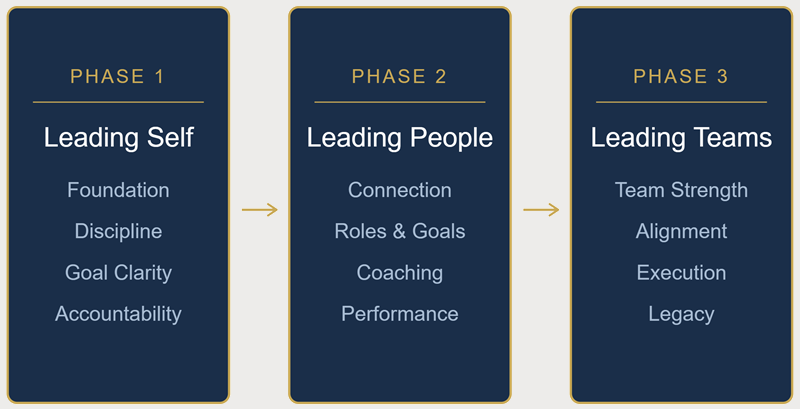
Today, the site organizes leadership development tools around a simple framework:
That progression is part of a broader system called The Leadership Standard. The order isn't arbitrary.
Early in my career I could lead an individual or a small team on effort and personal attention alone. Once I was managing managers, that became more difficult. I couldn't be in every conversation, so I needed systems I knew would reinforce my standards whether I was in the room or not. The Growth Roadmap is one example: I've used it at multiple organizations, and each time it gets tweaked with small improvements that benefit my team as well as my readers.
The Leadership Standard framework follows that same path: lead yourself well, then develop other people, then build the structure that keeps a larger team aligned and accountable without you always needing to be present.
Why I Started This Site
I started Leadership-Tools.com in 2002 because I recognized a problem firsthand.
At the time, it was early in my career working for a large regional bank. One thing about large organizations is they tend to have large training budgets, and I benefited greatly from that. I recall taking the Myers-Briggs analysis, and also a 360-degree leadership assessment.
Both tools showed me things I couldn't see on my own: what my natural instincts were, and whether people saw me the way I intended. I realized how valuable leadership tools could be for both personal and professional growth.
My manager at the time made me aware of the significant financial investment the company was making in me. I felt very lucky to be in that position, but I realized that not everyone was as fortunate. Many of the most valuable leadership assessments, programs, and development resources were far too expensive, and therefore inaccessible for everyday managers, business owners, and aspiring leaders.
So I built my own. One of the first tools I put on the website was a Leadership Assessment for new and existing leaders, my own version of the kind of self-assessment the bank had paid a consultant to run for me. It wasn't fancy. It was a document you could print, fill out, and use in a one-on-one that same week.
People downloaded it, and some of them wrote back. One reader asked for a version her team could fill out about her. Another wanted a way to turn the results into goals. Those two requests became the 360-degree feedback tool and the master action plan templates. That's how the site has grown ever since: a real leader runs into a leadership challenge, and I build something for it. The same rule still applies to every tool here. If you can't use it in a real workplace situation, it doesn't go on the site.
What You Can Expect Here
Everything on this site is built around practical use.
You'll find resources such as:
- leadership assessments
- 360-degree feedback tools
- coaching resources
- role and goal-setting tools
- action-planning templates
- project prioritization and tracking tools
- succession-planning resources
- team-development materials
Many of these tools grew out of needs I encountered in my own work and were refined over time through my own use in the workplace.
I recall once when starting a new leadership position, I immediately needed to hire a new branch manager. The first thing I asked for was a copy of the current job description. A quick scan revealed the word sales was nowhere in the description. Neither were the words referral, growth, or goals. "How could this be?" I thought.
I quickly realized I needed to clearly define each of the roles within my team. I wanted each team member to know the purpose of their role, the qualities that are key to being successful, their primary responsibilities, and specific activities they are expected to perform. That is how the Role Clarity template was created.
By involving my team to be part of the role-defining process, I discovered employees took greater ownership of their role. Once all roles were defined, I had our HR team use that information to update the formal job descriptions.
About Richard Gorham
I still have a day job that I fully enjoy. I lead a large team of retail managers in financial services, and I'm measured on the same things most managers reading this are measured on: sales and growth numbers, projects delivered on time and on budget, and whether my people are better at their jobs this year than they were last year.
I've served in a variety of leadership positions within the financial services industry (retail, operations, marketing, merchant services, investment, commercial lending, just to name a few).
I always say one of my superpowers is surviving mergers and acquisitions, six in all.
I've spent more than twenty years building and refining leadership-development resources for this site.
The problems I help with most haven't changed much in thirty years. New managers try to lead a team before they've gotten their own habits, calendar, and, yes, finances under control. Experienced managers avoid the feedback conversation until a small issue has become a performance plan. And leaders of larger teams find out in a quarterly review that two of their managers spent the quarter chasing different priorities, and nobody flagged it because nobody was complaining.
Most of those three problems myself, and the version you'll download is the one that got me through it.
I still use many of these tools on a regular basis. The project prioritization template and the project calendar and tracker, for example, are tools I update regularly with my current team. Marking a project complete in front of the whole team, with the person responsible for leading it named right there on the tracker, does more for accountability than any status email I've ever sent.
Why the Site Continues to Evolve
Leadership challenges change. Good tools should improve too.
Leadership-Tools.com continues to be updated as existing resources are improved and new tools are added. As the site has grown, the broader structure behind the tools has also become clearer through The Leadership Standard framework.
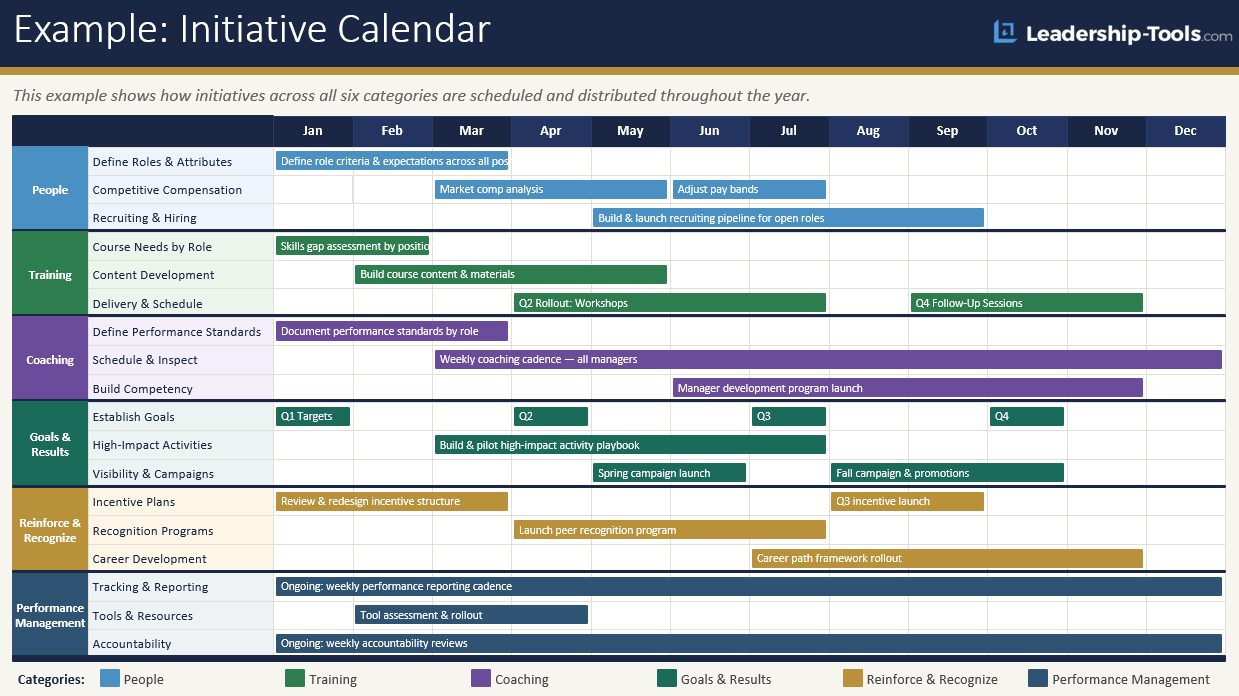
The growth roadmap on this site is on its fourth version, one for each organization I've used it in. The project tracker isn't far behind. Each one was good enough to use the day I posted it. None of them were good enough to leave alone.
Start With One Tool
Don't try to take in the whole library all at once. Pick the one thing that's bothering you this week and start there.
If it's a conversation you keep putting off, start with the coaching and feedback tools. If nobody on your team could write down what their job is, start with role clarity. If you have more projects than people, start with the project tracker. And if you're not sure where to begin, take the leadership assessment. It's the first tool I ever posted, and twenty minutes with it will tell you whether your biggest gap is in how you lead yourself, your people, or your team.
If you want easier access to the entire library in one place, you can also subscribe free to the Leadership Tools newsletter to see all the tools together on a single page and you'll be alerted when new tools are added or existing resources are improved.
Wishing you all the best,
Richard Gorham
Contact Information:
phone
(503) 970-9777
Email Customer Service
helpsupport@leadership-tools.com
Email Richard
richard@leadership-tools.com

By Richard Gorham
Leadership-Tools.com
2879 Riverwalk Loop, Eugene, Oregon, 97401
Copyright (c) 2002 - 2026 All Rights Reserved