


No. Every template comes as a printable PDF and as a spreadsheet, and the spreadsheets work in Excel, Google Sheets, and free apps like LibreOffice. If you'd rather plan on paper, print the PDF and fill it in by hand.
- Home
- Leading Self
- Debt Payoff Planner Templates
Free Debt Payoff Planner Templates (Excel + Printable) + 10-Step Plan
Leading yourself is hard enough. Carrying personal debt shouldn’t be another daily stressor. This page gives you free debt payoff planner templates (spreadsheet + printable options) plus a practical 10-step plan to help you organize your debts, choose a payoff method (snowball or avalanche), and track real progress.
If you’re a busy leader, solopreneur, or frontline manager, this toolkit is built to be simple, fast to set up, and easy to stick with.
Here’s the promise: you’ll be able to download a debt payoff planner template, list your debts in one place, and walk away with a clear next action.
The templates are designed to make your plan visible: what you owe, what you’ll pay next, how much extra you can realistically add, and how progress will look month by month. This page is intentionally a hub. It gives you the big-picture structure (what to do and in what order), then routes you to the specific template pages for more detail.
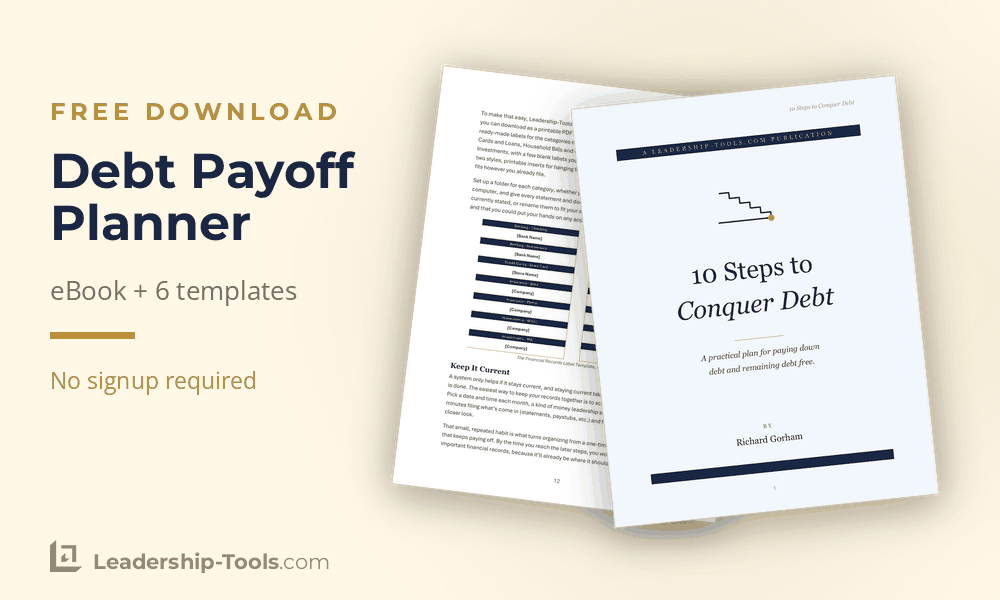
For extra guidance, use the 10 Steps to Conquer Debt ebook, and just take things one step at a time.
Download eBook + Free Debt Payoff Planner Templates
Choose Format and Enjoy Our Free Course and Templates
Jump To: Why Get Out of Debt | Why Eliminating Debt Is So Hard | 10 Step Plan to Conquer Debt | Free Templates That Support Your Debt Free Plan | Examples |A Final Thought | FAQ | Get Updates Free | Download ebook
Why You Should Get Out of Debt
"Becoming debt-free is about more than just paying off debt. It's about discovering freedom, flexibility, and control over your life, your finances, and your future."
Paying off all your debt isn't just a "nice to think about" or "someday wouldn't it be nice if" financial goal. Becoming debt free creates a major self-leadership advantage.
As debt responsibilities shrink, you regain personal and financial freedom: more options, less stress, and more freedom to make decisions based on priorities instead of pressure. This makes a significant difference in the quality of your life as you focus on being your best - whether you’re leading a team, building a business, or managing a household.
What Being Debt-Free Really Buys You
Mental Capacity
You stop re-running money problems in your head. That attention comes back to your work, your relationships, and your health.
Flexibility and Resilience
A smaller monthly debt load makes it easier to handle surprise expenses (car repairs, medical costs, slow sales months) without immediately reaching for a credit card. Using our free monthly debt planner templates, you shield yourself from Murphy's Law - "Anything that can go wrong, will go wrong."
Faster Progress on Other Goals
Debt payoff often unlocks faster savings, investing, or business reinvestment, because you’re no longer financing past purchasing decisions.
A Practical “Why” That Keeps You Going
Write one sentence you can revisit:
“My goal is to reduce debt so I can lead with clarity and have options when life changes.”
Debt payoff is a compounding win: every balance you eliminate reduces stress and increases your options for the future. The templates and plan provided on this page exist to make that goal possible and practical, not just inspirational.
Why Eliminating Debt Is So Hard
If paying off your debt feels harder than it “should,” it’s usually because the problem is partly emotional and partly logistical.
Most people don’t fail in their debt reduction efforts due to laziness. Rather, they fail due to lack of having a clear plan - unclear numbers, inconsistent routines, and surprise expenses that derail momentum.
The 5 Common Reasons Debt Reduction Stalls
1) Unclear Starting Point
If you don’t have every balance, APR, and minimum payment in one place, you’ll constantly second-guess the plan.
2) Decision Fatigue
Choosing what to pay “this month” over and over is exhausting. A specific debt reduction method (snowball or avalanche) removes the need to make repeated decisions.
3) Cash Flow Timing Issues
Even with a decent income, mismatched timing (bills due before payday) can create late fees and stress. Cash flow visibility matters. So, use our free daily cashflow template!
4) Motivation Drops When Progress is Slow
If you can’t see (or feel) early progress, you stop believing the plan is working. A debt payoff tracker makes progress visible.
5) Life Happens
Unexpected costs, irregular income, family needs: none of these mean you’re failing. They mean your plan needs a buffer to cover emergencies, and a specific routine.
You don’t need a perfect plan; you need a simple system you can stick with when life is busy. Up next is a clear 10-step payoff roadmap, followed by free debt payoff planner templates you can use to put the plan into action right away.
10 Step Plan to Conquer Debt
This plan is designed for busy leaders and solopreneurs: simple, repeatable, and focused on execution. Use it with your free debt payoff planner templates so the plan becomes visible and trackable.
Step 1: The Power of “I Will” (Own the Outcome)
Use the words “I will” as your personal commitment statement. This isn’t about blame, it’s about control.
Suggested line to write at the top of your tracker:
“I will follow my debt payoff plan every month until I’m debt-free.”
Step 2: Get Real-ly Organized! (Set Up Your Money System)
Organize your financial records so you always know where to find what you need (bills, logins, due dates, statements).
Goal: reduce stress by creating one “home” for your finances (digital folder, binder, or both).
Step 3: Let’s Get Specific! (Face the Full Picture)
Gather every bill and statement and complete a personal financial statement so you can see reality clearly. You can’t improve what you refuse to measure.
Goal: Replace vague worry with clear information.
Resource: Personal Financial Statement Template
Step 4: You Must Know Your Cash Flow (Daily In vs. Out)
Track daily money in and money out using a Daily Cash Flow tool.
Purpose: avoid overdrafts and late fees, and stop surprises from wrecking your plan.
Resource: Daily Cash Flow Template
Step 5: Stack Your Debt (Put Debts in the Right Order)
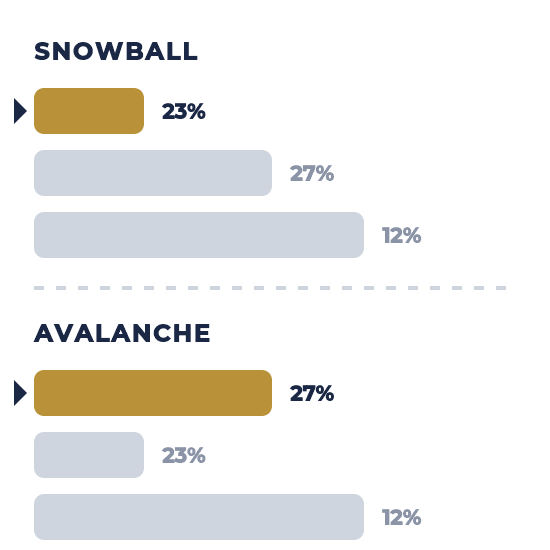
Use our debt reduction calculator to order your debts properly. There are multiple strategies for paying down debt.
Choose your payoff strategy:
- Debt snowball (Recommended): pay off the account with the smallest balance first. This enables you to gain momentum quickly, which motivates you to keep paying down the next debt.
- Debt avalanche: this strategy has you paying off the account with the highest APR first, for maximum interest savings
Resource: Debt Snowball Calculator
Step 6: Attack Your Debt! (Budget for One Target at a Time)
Create a budget that protects minimum payments and then attacks one debt at a time in your chosen order.
Track your progress using your budget spreadsheet and your debt payoff tracker so your next move is always obvious.
Resource: Household Budget Template
Step 7: CASH Creates Clarity (Change Spending Behavior Fast)
Switch key spending categories to cash (or a cash-like envelope system) to make spending more intentional.
Build a simple cash envelope system to create instant guardrails where you typically overspend.
Resource: Cash Envelope System Template
Step 8: Expect the Unexpected (Build a Small Emergency Buffer)
Save a small emergency fund so normal life events don’t send you back into debt.
Even a modest cushion helps you stay consistent when something breaks, spikes, or surprises you.
Step 9: Automate to Eliminate Debt (Make Consistency Easier)
Set up auto-pay for minimum payments and automate bill routines where possible.
Automation reduces willpower requirements and keeps your plan running even when you’re tired, busy, or traveling.
Step 10: Create New Income (Turbo-Boost Your Payoff)
Look for ways to increase income with spare hours: side work, services, selling unused items, or a new income stream.
Extra income is one of the fastest, cleanest ways to accelerate debt reduction, because it increases your “extra payment” capacity without squeezing essential expenses.
These steps are designed to give you immediate actions you can start today: commit (“I will”), get organized, get specific, control cash flow, stack and attack debt, and then protect progress with cash habits, a buffer, automation, and added income.
If you want the full guided version in one place, download the complete eBook.
Free Financial Templates That Support Your Debt-Free Plan
"Living a debt free life" is the headline, but it’s supported by a few key templates that reduce surprises and increase consistency.
Think of this as a debt reduction toolkit: one core system, "10 Steps to Conquer Debt", plus a few free debt payoff planner templates that helps to protect you from the usual things that can derail your progress.
Personal Financial Records Label Template
Getting organized is about more than cleaning off your desk or taking out the garbage. Organization of your finances is a critical step in reducing the amount of stress you are experiencing.
When your personal finances are carefully organized, and when you know you have a plan in place to conquer your debt, the fear and worry you're feeling is dramatically reduced.
Personal Financial Statement Template
It's time you get specific about your financial plan. Collect all your financial paperwork and lay it out on the kitchen table. Yes, all those bills and statements must now be opened so you can effectively deal with them.
Don't worry, we'll be there with you every step of the way, helping you to complete a personal financial statement so you will finally have a clear picture of your current financial condition.
Daily Cash Flow Template
You must be in firm control of your cash flow. No longer will you experience the shame of being charged multiple overdraft fees or receiving late notices in the mail.
Using our Daily Cash Flow tool, you'll never again be surprised to learn that a bill is past due. Understanding how your money flows from day-to-day is essential to being a responsible money manager.
Debt Snowball Calculator
Paying off debt won't happen overnight, but once you've lined up your debt in the proper order, you'll be positioned to conquer your debt with a specific plan that tells you precisely how to do it and how long it will take.
Choose either the Debt Snowball or Debt Avalanche approach to "super-charge" your debt reduction results.
Household Budget Template
Establish a budget plan to attack your debt one credit card at a time. Eliminate stress, worry and fear by having a clear action plan for your money.
Track your progress with our free personal budget spreadsheet. Discover how quickly the process of debt reduction can occur once you have a plan that is clear and actionable.
Cash Envelope System Template
Cash creates clarity. It's much easier for people to spend using plastic than cold hard cash. For some reason, cash is inherently more highly valued than all those shiny credit cards. Thus, cash is harder to part with.
While you may not even blink when swiping a credit card, you tend to feel the pain of spending more personally when paying with cash. You can use this force to your advantage. We will show you how to create a simple cash budget envelope system.
"One of the tests of leadership is the ability to recognize a problem before it becomes an emergency."
- Arnold Glasow
Examples of Common Debt Reduction Scenarios
Most people don’t fit neatly into a single category or scenario, and that’s okay. The three examples below are simply meant to help you visualize how other people have utilized these tools for successful results.
Here's a thought: Pick the example who feels closest to your situation right now and follow the same first steps for a week and give yourself permission to improve the system as you go; the goal is to build a routine you can keep running even when work is busy, family needs pop up, or motivation comes and goes.
Meet Jordan: Frontline Manager (needs quick wins)
Background: Jordan manages a busy team and carries a lot of responsibility. Money stress tends to show up as “one more thing” at the end of a long day.
Main Challenge: Too many balances to think about at once. The overwhelm is real, and motivation drops when progress feels slow.
What To Do First Week:
- Gather statements and list every debt (balances, minimums, APRs).
- Use our debt snowball calculator to stack debts for quick wins.
- Choose one small, realistic extra payment amount and commit to it for 30 days.
Tools Used:
- Personal Budget Worksheet (to free up extra payment money)
- Cash Envelope System (optional, for the categories that tend to drift)
- Personal Financial Statement (to see the big picture and stay encouraged)
- Debt Snowball Calculator (to stack debts and get a payoff path)
Tracking Schedule: Weekly 10-minute check-in to stay encouraged, plus a monthly balance update after statements post.
Common Challenge: “I’m trying, but it feels like nothing’s changing.”
Fix: Keep the first target small enough to finish soon. One successful payoff win changes everything - momentum is a real asset.
Meet Casey: Solopreneur (income comes in waves)
Background: Casey runs a small business and wears every hat: sales, delivery, admin. Income is solid over time, but it doesn’t arrive on a predictable schedule.
Main Challenge: Timing. Bills can be due before income clears, which leads to late fees, overdrafts, or using credit “just to get through the week.”
What To Do First Week:
- Track daily money in/out for 7 days using the Daily Cash Flow tool.
- Identify “pinch points” (dates where timing causes stress).
- Use our debt snowball calculator to set a payoff order, then choose a steady baseline extra payment that works even in a lighter week.
Tools Used:
- Daily Cash Flow tool (to prevent timing surprises)
- Personal Budget Worksheet (simple baseline so “good months” don’t disappear)
- Personal Financial Statement (to track the overall direction)
- Debt Snowball Calculator (to order debts and estimate payoff progress)
Tracking Schedule: Quick daily cash flow check, plus a monthly debt check-in to update balances and adjust for the next month’s income cycle.
Common Challenge: “One weird week knocks me off track.”
Fix: Build a small buffer and keep cash flow visible. This isn’t a willpower problem, it’s a timing issue, and timing can be managed.
Meet Taylor: Professional/Owner (wants the most efficient plan)
Background: Taylor has a stable income and a practical mindset. The goal isn’t just “less debt”, it’s paying the least interest possible and staying consistent without obsessing over it.
Main Challenge: High-interest debt is expensive, and Taylor doesn’t want to waste money on interest. The challenge is avoiding over-optimization that turns into inaction.
What To Do First Week:
- List all debts and APRs, then confirm minimum payments are covered.
- Use our debt snowball calculator to prioritize the highest-cost debt first (avalanche-style decision-making if available).
- Turn on auto-pay for minimums and schedule the extra payment for the same day each month.
Tools Used:
- Personal Financial Statement (big-picture clarity and net worth direction)
- Personal Budget Worksheet (to decide a consistent extra payment)
- Debt Snowball/Avalanche Calculator (to choose an efficient payoff order)
- Automation habits (setup auto-pays + schedule extra payments)
Tracking Schedule: Monthly update only (keep it simple), plus a quarterly review to see if any rates or minimum payments changed.
Common Challenge: “I keep tweaking the plan and lose momentum.”
Fix: Automate and limit changes to one monthly decision point. A steady plan beats a perfect plan you keep redesigning.
Whichever scenario fits you best, the pattern is the same: get clear, pick an order, and run a simple routine.
You’re not starting from zero. You're starting with the knowledge of how others have used our free debt payoff planner templates and resources to reclaim their financial wellbeing. Now you’re just putting a system around it.
A Final Thought of Encouragement
"There are two ways of paying debt more quickly: Increase production through greater efficiency, and increase thrift to lessen expenditures."
- Based on quote by Carlyle
Too often, debt relief programs promise the moon and deliver very little in terms of results. If this has happened to you, you must not allow yourself to feel defeated. Instead, refuse to let past experiences cloud your optimism for future opportunities.
Don't allow yourself to waste time talking about depressed markets, government bailouts or hard times. This kind of thinking will never help you to move toward financial success.
It's time to talk UP about your financial future. 10 Steps to Conquer Debt is a great tool to get you started. Download it, read it, and start applying our top 10 financial management tips while using each of our free personal finance tools.
Frequently Asked Questions (FAQ)
Are these debt payoff planner templates really free?
Yes. Every template on this page is free to download with no email required, and so is the 10 Steps to Conquer Debt eBook. Each template has its own page with the download links and instructions for using it. Subscribing to the newsletter is optional and gets you the whole library on one page, but you never need it to get any individual tool.
Do I need Excel?
How often should I update my tracker?
Monthly updates are enough for most people. Weekly check-ins are helpful if you’re stabilizing spending or cash flow.
Which payoff method is better: snowball or avalanche?
Snowball is usually better for motivation and follow-through. Avalanche is usually better for minimizing interest. The best method is the one you will execute consistently.
What if I can only add a small extra payment?
That’s fine. Use the templates to lock in consistency, then focus on one lever (budget leak, bill negotiation, small side income) to increase the extra payment later.
Will these templates give me a precise debt-free date?
They can estimate a target date based on the information you enter. Treat it as a helpful target, and update if your income/expenses change.
Download 10 Steps to Conquer Debt eBook

Want the entire leadership tools library? Subscribe to our free newsletter and we'll send you a link to every tool on this site, all on one page, sorted by leadership phase. Every tool is free to download on its own page. The library just puts them in one place. Plus, you'll never miss out on updated or new tool announcements.
Your privacy is important to us. We never share or sell email addresses.
Leadership Tools Newsletter
Subscribe Free - See All Tools on One Page - Get New Tool Alerts
More Self-Leadership Tools



Richard Gorham has led teams in financial services for more than 30 years, from retail branches and operations to investments and insurance, and he still leads a team today.
He founded Leadership-Tools.com in 2002 to give managers free, practical tools like the ones he used in his various leadership roles. Every tool here has been used in a real workplace and comes with a filled-in example you can follow.

Contact Information:
phone
(503) 970-9777
Email Customer Service
helpsupport@leadership-tools.com
Email Richard
richard@leadership-tools.com

By Richard Gorham
Leadership-Tools.com
2879 Riverwalk Loop, Eugene, Oregon, 97401
Copyright (c) 2002 - 2026 All Rights Reserved