A personal financial statement is a snapshot of your financial position at a specific point in time. It lists your assets, liabilities, income, and expenses so you can calculate your net worth and better understand your overall financial health.
- Home
- Leading Self
- Debt Payoff Planner Templates
- Personal Financial Statement Template
Personal Financial Statement Template (Free Excel, PDF & Sheets)
Need a personal financial statement template you can actually use right now? Download the free Excel or PDF version below to list your assets, liabilities, income, and expenses and calculate your net worth in minutes. This personal financial statement form works for personal planning and is also commonly used when applying for a bank loan, especially when a lender asks for a “net worth statement” or “personal balance sheet.”
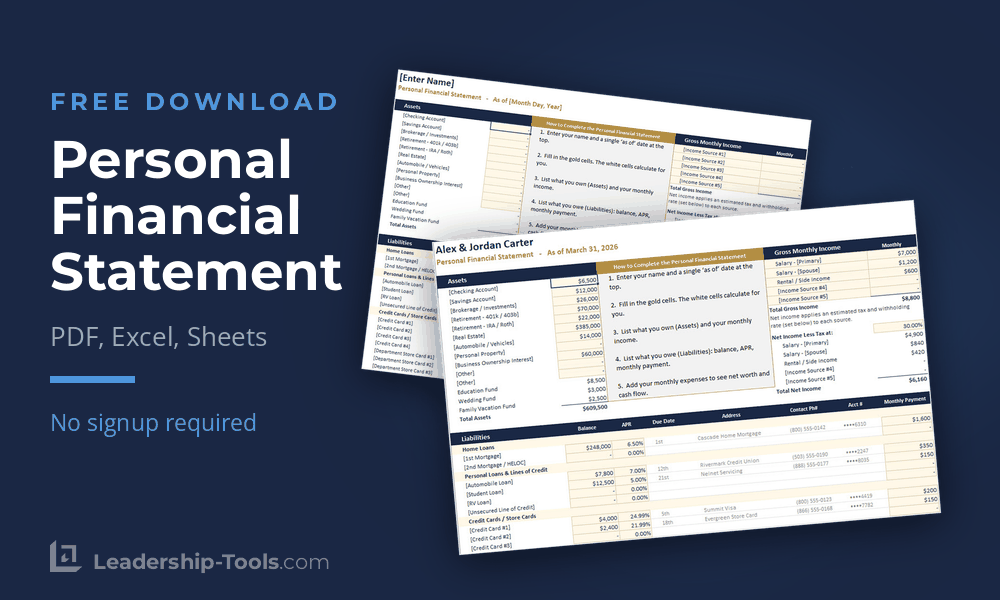
Special Note: If you’re completing this for a loan application (including SBA-related lending), read the short lender section below before you fill anything in. It will help you avoid the most common problems lenders flag (missing as-of date, undocumented values, and incomplete debt details).
Our personal financial statement template is free and one of the most powerful tools you can use to get control of your money. On this page you can download a free Excel or PDF template and follow simple steps to list what you own (assets), what you owe (liabilities), and your current net worth.
In Step Three of our free 10 Steps to Conquer Debt eBook, you will create a clear statement of what you own, what you owe, what you earn, and where your money goes.
Whether you’re applying for a loan, creating a debt‑reduction plan, or simply want to understand your true net worth, this template will help you see your full financial picture on a single, organized page.
A personal financial statement is a snapshot of your financial health - assets, liabilities, and net worth. Knowing exactly where you stand reduces stress and frees mental energy for better leadership decisions. Use this free template to get clear fast.
Jump to: Download Template |Personal Financial Statement vs Balance Sheet | Documents Checklist | Why It Matters | 5 Simple Steps | Best Practices | How Often to Update | Completed Example | Common Mistakes | Lender/SBA Section| FAQ | Get Updates Free | Download Free eBook
With this free personal financial statement template, you can:
- List all of your assets and liabilities in one place
- Calculate your net worth quickly and accurately
- Spot problem areas, such as high-interest debt or underused assets
- Track your progress as you pay down debt and build savings over time
Our free template provides more than a simple financial statement. We have created a unique format for organizing your financial information, which makes this a more valuable tool - more on that in a minute.
"Your net worth to the world is usually determined by what remains after your bad habits are subtracted from your good ones."
- Benjamin Franklin
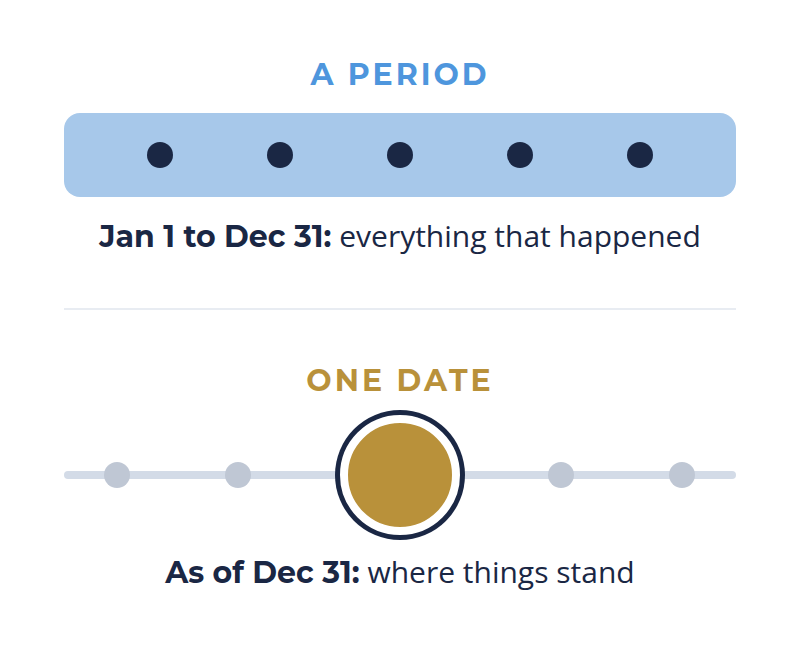
Think of your financial statement as a snapshot in time. Only at the time you complete the form are the values you write down 100% accurate.
For example, balances in various accounts can change daily so it is important that you update your personal financial statement monthly to track your progress. Each time you update our financial statement template, compare it to the prior month's statement to learn if you are moving in the right direction or not.
The most common obstacle people face in completing this step is... DENIAL.
People simply don't want to admit that their financial troubles are as bad as they really are. These people know deep-down that if they complete the process of accounting for every dime of income and debt, they will finally have to face the truth about their poor spending habits.
Many people avoid creating a personal financial statement because they're concerned about what they might discover.
The reality is that financial clarity reduces stress.
Once you understand where you stand financially, you can begin making informed decisions and tracking meaningful progress. Every positive financial change begins with understanding your current situation.
Download Our Free Personal Financial Statement Template
Before you can improve your finances, you must first see your complete financial picture. That’s exactly what our Personal Financial Statement template helps you do. In one place, you’ll list everything you own and everything you owe so you can clearly understand where you stand today.
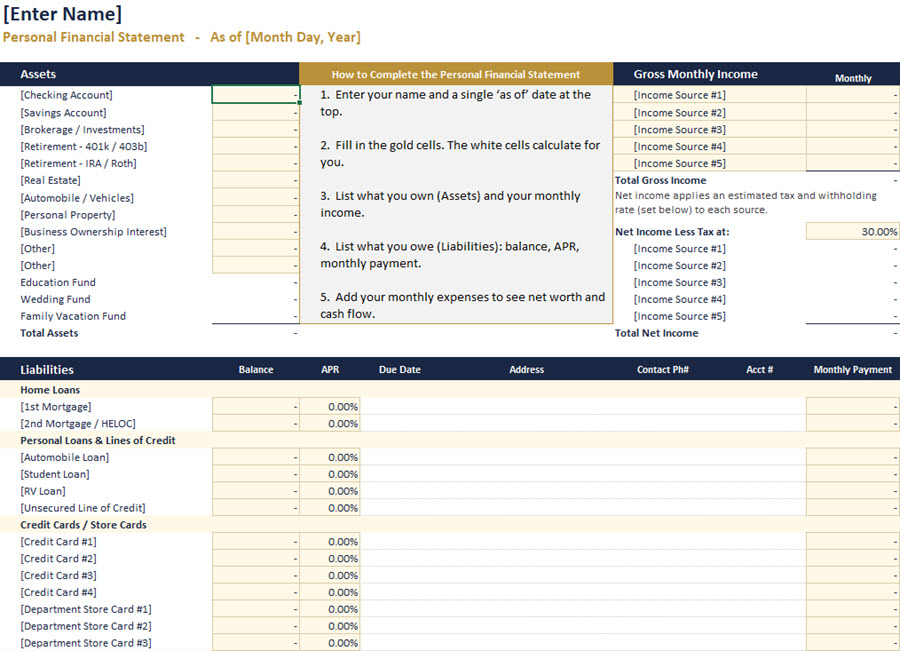
This free tool is part of our Leadership Tools library, which is available free to subscribers of our Leadership Tools Newsletter. For your convenience you can also download the template at the top of this page.
Personal Financial Statement vs Personal Balance Sheet
Many people wonder whether a personal financial statement and a personal balance sheet are the same thing.
In practice, the two statements are very similar.
A personal balance sheet focuses primarily on assets, liabilities, and net worth.
A personal financial statement often includes those same items but may also include income, expenses, contingent liabilities, and supporting information.
Many lenders, accountants, and financial advisors use the terms interchangeably.
The goal of both documents is the same: to provide a clear picture of your overall financial position.
What Documents You’ll Want Before You Start
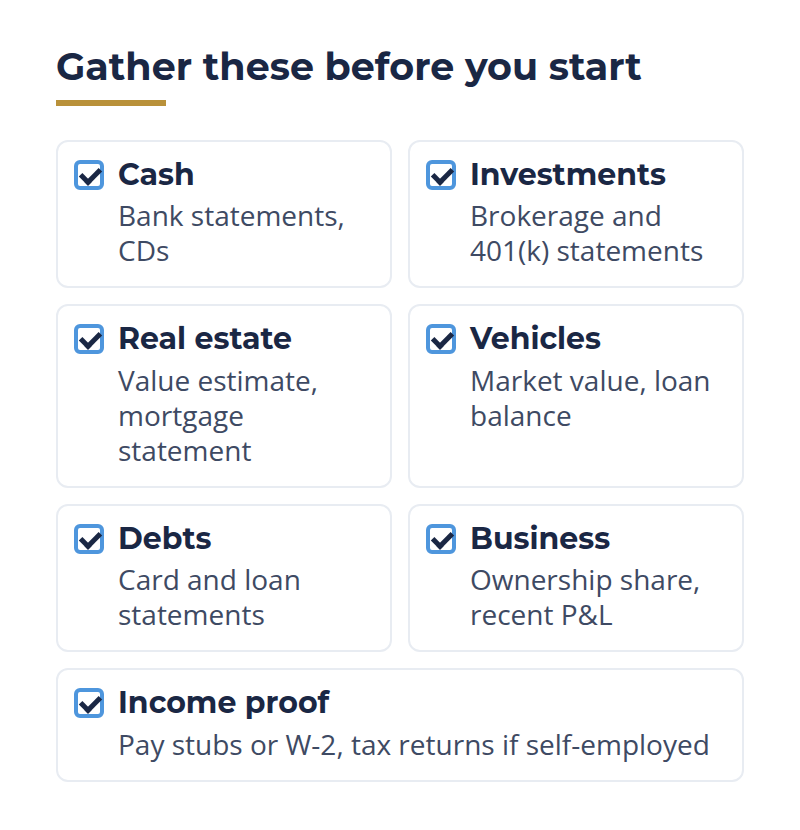
To fill out your personal financial statement template quickly, and to make sure your numbers hold up if a lender requests verification, gather the items below first.
You don’t need every document for every line item but having them ready prevents delays and guesswork.
Why Documentation Matters
Whether you're creating a personal financial statement for your own planning or for a lender, having supporting documents improves accuracy and reduces mistakes.
Gathering statements before you begin also makes future updates easier because you'll know exactly where each number originated.
Cash & Bank Accounts
- Recent bank statements (checking, savings, money market)
- Any certificates of deposit (CDs) with current balances
Investments & Retirement Accounts
- Brokerage statements (stocks, bonds, ETFs, mutual funds)
- Retirement statements (401(k), IRA, Roth IRA), showing current value
- Notes on any restrictions or early-withdrawal penalties (if relevant)
Real Estate
- Estimated property value (recent appraisal, comps, or a reasonable online estimate)
- Mortgage statement showing current balance and payment amount
- Home equity line of credit (HELOC) statement (if applicable)
- Property tax and insurance amounts (helpful for payment accuracy)
Vehicles & Other Major Assets
- A reasonable market-value estimate (e.g., current private-party value)
- Any loan statement tied to the asset (balance + payment)
Debts & Monthly Obligations
- Credit card statements (current balances and minimum payments)
- Installment loan statements (auto, student loans, personal loans)
- IRS/state tax payment plans (if any)
- Child support/alimony obligations (if applicable)
Business Ownership (If You Own Part of a Business)
- The percentage you own (and whether it’s personally guarantee-backed)
- A recent balance sheet and profit/loss statement (or tax return) to support valuation
- Any business loans you personally guarantee (important for contingent liabilities)
Income Proof (Often Requested With a Loan Application)
- Recent pay stubs and/or a W-2
- If self-employed: recent tax returns and a year-to-date profit/loss summary
Why a Personal Financial Statement Matters (Especially for Leaders and Solopreneurs)
When you take the time to complete a Personal Financial Statement, you’re doing far more than filling out a form. You’re giving yourself clarity, control, and the ability to respond wisely to whatever life sends your way.
Once you have all of your key financial information on one sheet, you are no longer in the dark about your money. You’ll always know where you stand.
Our personal financial statement template helps you replace vague worry about your financial condition with specific knowledge, which helps you to lead yourself better, plan more clearly, and make decisions that match your desired outcome.
The following provide several powerful reasons to complete a Personal Financial Statement:
1. Protection in a Crisis
If your identification is ever stolen, or you need to react quickly to a financial emergency, having a current Personal Financial Statement becomes invaluable.
With all of your account numbers, balances, and creditor contact information organized in one place, you can immediately contact your banks and credit card companies to close accounts, re‑issue cards, and limit any damage.
This benefit alone makes maintaining a Personal Financial Statement worth your time.
2. Confidence and a Sense of Control
"He who will not economize will have to agonize."
- Confucius
Most people feel stressed about money because they don’t really know their true financial position. Once you see everything clearly on a single page, that anxiety begins to fade.
You gain confidence knowing that you are facing reality and taking responsibility for your financial destiny. Instead of avoiding the numbers, you’re leading yourself through them.
3. Better, More Thoughtful Decisions
When you have a complete picture of your assets, debts, income, and expenses, you can make decisions based on facts instead of guesswork.
You’ll be better prepared to:
- Evaluate new opportunities
- Decide which debts to attack first
- Set realistic savings and investment goals
- Talk with lenders, advisors, or family members about your situation
A clear Personal Financial Statement becomes a self-leadership tool that helps you pause, think, and choose wisely instead of reacting on emotion.
4. Turning Failure into Fuel for Success
If you’re deep in debt, it’s easy to feel like a failure. But being in debt is not who you are – it’s simply a result of past choices and circumstances.
The difference between people who stay stuck and those who turn things around is how they respond to setback:
- The unsuccessful person lets failure define them, avoids the truth, and repeats the same mistakes.
- The successful person studies what went wrong, accepts responsibility, and takes new, better actions.
Completing a Personal Financial Statement is a powerful act of self‑leadership. You are choosing to look at the truth, learn from it, and use that knowledge to build a better future. Our Personal Financial Statement template helps you identify financial shortcomings, understand what led you there, and create a clear plan to move forward.
5. A Foundation for Long‑Term Change
The purpose of completing a Personal Financial Statement is simple:
- To give you the knowledge you need to manage your money wisely
- To expand your ability to overcome financial challenges
- To improve the overall condition of your life
As you work through this process, you’re practicing self‑leadership: taking ownership, making conscious choices, and guiding yourself toward your goals.
Combined with our other self-leadership tools and our “10 Steps to Conquer Debt” system, your Personal Financial Statement becomes the foundation for conquering debt, increasing your income, and changing the financial future of your family for years to come.
Financial Clarity Is a Form of Self-Leadership
Strong leaders understand their current reality before making decisions about the future.
The same principle applies to personal finances.
When you understand your assets, liabilities, income, and obligations, you can make better decisions, set realistic goals, and take ownership of your future.
If you'd like to evaluate other important areas of your life, consider using our Leadership Assessment and Life Balance Success Wheel tools as part of your overall self-leadership journey.
Best Practices for an Accurate Statement
Getting a clear picture of your finances is one of the most powerful steps you can take toward financial freedom and stronger self-leadership.
When you know exactly where you stand, money stops feeling overwhelming. You gain control, reduce stress, and free up mental energy for what matters most.
These 5 simple steps will help you complete your personal financial statement template quickly and confidently. No complicated math, just honest numbers and a clear template.
Once you finish, you’ll see your full financial snapshot: assets, liabilities, net worth, income, and expenses. That clarity becomes your roadmap for smarter decisions and faster progress.
Ready to start? Let’s go - one step at a time.
1. Gather Key Documents
Use the documents checklist above to pull together your most recent statements and records: bank and investment accounts, mortgage and home equity loans, auto and other loans, credit cards, insurance policies, and any other significant assets or debts.
2. List Your Assets
Open the template and start by entering all of your assets:
- Cash in bank accounts
- Investment and retirement balances
- Real estate and vehicles
- Other valuable property you own
Don’t worry about being perfect on the first pass. Use your best current numbers, and if you can't find a statement at the moment go ahead and fill it in with your best estimate.
Once you've completed a first pass of the information, you'll have a good idea of your total assets but come back later with the actual numbers as soon as you can.
3. List Your Liabilities
Next, enter all of your debts and obligations:
- Mortgages and home equity loans
- Auto loans and student loans
- Credit card balances
- Personal loans and any other outstanding debts
Be sure to include the current balance, interest rate, and minimum monthly payment whenever possible. This information will be very useful as you create your debt‑reduction plan.
4. Capture Your Income and Expenses
Use the income and expense areas of the template to record:
- All regular income sources (paychecks, side income, benefits, etc.)
- Your main monthly expenses (housing, utilities, food, transportation, insurance, and so on)
This gives you a practical view of your cash flow: how much is coming in, how much is going out, and where you might free up extra money.
5. Review the Totals and Insights
Once you’ve filled in the template, review your totals:
- Your total assets
- Your total liabilities
- Your current net worth (assets minus liabilities)
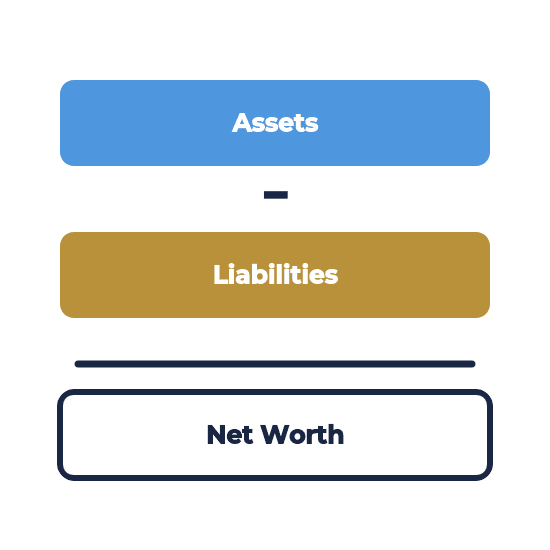
For many people, this is a powerful wake‑up call, and the perfect starting point for positive change. You’ll quickly see which debts are costing you the most, where you may be overextended, and where you have opportunities to save or invest more.
By taking a thorough inventory using our Personal Financial Statement template, you lay the foundation for smarter money management. In our 10 Steps to Conquer Debt system, this inventory becomes the roadmap you’ll use to prioritize debts, set realistic goals, and track your progress over time.
How to Complete a Personal Financial Statement
Once you’ve gathered your information and started using the template, a few simple best practices will ensure your Personal Financial Statement is accurate, useful, and easy to keep up-to-date.
Follow these guidelines as you complete your statement:
1. Choose A Specific “As Of” Date
Decide on a single date that your numbers represent (for example, “As of March 31, 2026”).
Use that same date for all balances so your assets, liabilities, income, and expenses reflect one consistent point in time.
2. Use Realistic, Documented Values
Whenever possible, base your entries on actual statements, not guesses.
- For bank accounts and debts, use current statement balances.
- For investments, use recent market values.
- For physical assets (home, car, etc.), use conservative estimates, not inflated “wishful thinking” numbers.
Realistic values give you a true starting point and help you measure real progress over time.
3. Separate Personal from Business Finances
If you own a business, keep your personal financial statement focused on your personal finances.
- Include your ownership interest in the business as an asset.
- Keep day‑to‑day business income/expenses on separate business records.
This keeps your personal picture clear and makes it easier for lenders, advisors, and partners to understand your situation.
4. Classify Assets and Debts Correctly
Place each item in the right category:
- Short‑term assets: cash, checking, savings
- Long‑term assets: retirement accounts, investments, real estate
- Short‑term debts: credit cards, small personal loans
- Long‑term debts: mortgage, auto loans, student loans
Accurate classification helps you see how liquid (accessible) your resources are and how heavy your long‑term obligations may be.
"Make a decision to be successful right now. Most people never decide to be wealthy and that is why they retire poor."
- Brian Tracy
5. Double‑Check for Missing Items and Duplicates
As you enter data, ask yourself:
- “Am I missing any account, card, or loan?”
- “Have I counted any asset or debt twice?”
It’s common to overlook an old card, a store account, or a small loan. Take the time to catch these now so your statement is truly complete.
6. Pay Attention to Key Indicators, Not Just Totals
Your Personal Financial Statement is more than a list; it’s a decision‑making tool. As you review it, note:
- Your net worth (assets minus liabilities)
- How much of your debt is high‑interest (such as credit cards)
- How much of your monthly income is already committed to fixed payments
These insights will guide your priorities as you work to reduce debt, increase savings, and strengthen your overall financial position.
7. Update Your Statement on a Regular Schedule
A one‑time snapshot is helpful, but real progress shows up over time.
- Choose a regular update schedule (monthly or quarterly works well).
- Save each version so you can compare and see your net worth grow and your debts shrink.
When you complete your Personal Financial Statement carefully and review it regularly, you gain a level of clarity that most people never achieve. That clarity becomes the foundation for our 10 Steps to Conquer Debt process and every major money decision you make going forward.
How Often Should You Update a Personal Financial Statement?
A personal financial statement is most valuable when it is updated regularly.
Monthly
- Ideal for individuals actively reducing debt, building savings, or tracking major financial goals.
Quarterly
- A good balance between effort and visibility for most households.
Annually
- At a minimum, review and update your statement once per year.
Update your statement before making any major financial decisions:
- Applying for a mortgage
- Applying for a business loan
- Purchasing a major asset
- Starting a business
- Planning for retirement
- Meeting with a financial advisor
Regular updates help you identify trends, track progress, and make more informed financial decisions.
Completed Example (with Lender-Style Notes)
Examples remove uncertainty. Below is a simplified example showing how a completed personal financial statement might look. Your numbers will differ, but the structure is what matters: clear categories, current balances, and values you can support with documentation.

Example Snapshot (As of: [Month Day, Year])
Cash (checking + savings): $18,500
- Lender note: This should match your latest bank statements. Avoid rounding up “because it’s close.”
Brokerage/investments: $26,000
- Lender note: List liquid investments separately from retirement when possible, since liquidity matters.
Retirement accounts (401(k), 403(b) IRA): $92,000
- Lender note: Use the current statement value. If your plan has restrictions, be prepared to explain them.
Primary residence (estimated market value): $385,000
- Lender note: A reasonable estimate is fine unless the lender requires an appraisal. Don’t ignore selling costs if asked for “net proceeds.”
Vehicle(s): $14,000
- Lender note: Use a realistic market value, not what you paid originally.
Business ownership interest: $60,000
- Lender note: Be conservative unless you can support a higher valuation. Expect follow-up questions.
Goal savings funds (education, wedding, vacation): $14,000
- These are earmarked savings balances. List them as assets, and show the monthly contributions with your expenses.
Total Assets: $609,500
Liabilities (Examples)
Mortgage balance (primary residence): $248,000
- Lender note: Use the current payoff/balance from your mortgage statement (not original loan amount).
Credit cards (total): $6,400
- Lender note: Don’t omit cards you “pay off monthly.” Lenders still want current balances and minimum payments.
Auto loan balance: $7,800
- Lender note: Include the monthly payment; it affects debt-to-income.
Student loans: $12,500
- Lender note: Ensure this matches your latest loan dashboard/statement.
Taxes payable/payment plans: $0
- Lender note: If you owe back taxes or are on a payment plan, disclose it—this is a common underwriting tripwire.
Contingent liability (personal guarantee on business line of credit): $25,000 (not included in Total Liabilities)
- Lender note: List this separately and do not subtract it from net worth, which matches how lenders treat guarantees. Disclose co-signed or guaranteed obligations even if the business is currently paying.
Total Liabilities: $274,700
Net Worth (Total Assets minus Total Liabilities): $334,800
Income & Expense Example (Monthly)
Income
- Salary income: $8,200
- Rental / side income: $600
Total gross monthly income: $8,800
Total monthly debt payments (mortgage + auto + student + cards): $2,450
- Lender note: If you’re using this for a loan application, consistency between this number and your credit report matters more than perfection.
Common “Red Flag” Fixes Before You Submit
- Add an as-of date and keep it consistent across all totals.
- If a number is estimated (like real estate or business value), note the method you used.
- Don’t hide debts that are “almost paid off.” Lenders still count obligations.
- If you co-signed or guaranteed something, treat it as disclosable—even if you’re not making payments today.
Keeping the example in mind, you can quickly see how to calculate your current Net Worth and understand how to influence the balance by increasing Assets; decreasing Liabilities; or ideally, doing both at the same time.
Next, let’s make the template even more useful by avoiding a few common mistakes that can distort your net worth and your decisions.
Common Mistakes When Using a Personal Financial Statement Template (and How to Avoid Them)
Most problems with filling out a personal financial statement aren’t math problems, they’re classification issues. These quick checks help your personal financial statement stay accurate and useful, especially if you’re using it to guide debt payoff decisions or financial goal planning.
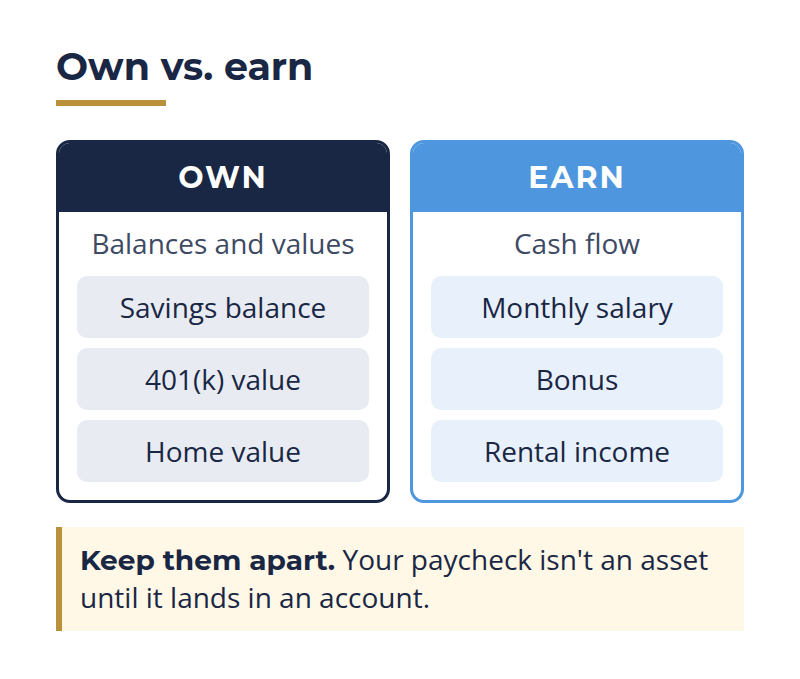
Mistake 1: Mixing “What You Own” with “What You Earn”
Assets are what you own (balances and values). Income is what you earn (cash flow). Keep them in their proper sections so your financial snapshot stays clean.
Mistake 2: Using Unrealistic Values (or avoiding estimates entirely)
Perfection isn’t required when filling in your initial values. Use reasonable estimates for items like a car or home value, and update later if needed.
Simple approach: note the source (e.g., “estimated via online valuation tool”).
Mistake 3: Forgetting Recurring Debts or “Small” Balances
Small debts add up and can change behavior. Include everything up front so your plan is based on reality.
Mistake 4: Updating Inconsistently (so you can’t see progress)
When updates are inconsistent, it’s hard to see real progress. Your numbers appear to "jump around" instead of showing a clear trend. Pick a cadence (monthly or quarterly) and stick to it. At the very least, you should be completing a personal financial statement on an annual basis to ensure you are making solid progress in your financial life.
By avoiding these common errors, your personal financial statement will provide you with a reliable dashboard, not just a one-time worksheet. Next, let’s connect it to why it matters for leadership, focus, and personal momentum.
Using This for a Loan? (SBA Form 413 + Bank Requirements)
If you’re searching for a personal financial statement template because a lender requested it, you’re not alone.
Many banks (and lenders involved in SBA-related financing) ask for a personal financial statement to confirm your overall net worth, liquidity, and monthly obligations.
Important: Some lenders require their own personal financial statement form, or they may specifically request SBA Form 413 (Personal Financial Statement).
If your lender provides a form, use theirs. If they do not, this template is a strong starting point because it captures the same core categories lenders review.
How This Template Maps to Typical Lender Forms (Including SBA Form 413)
Most lender versions (including SBA Form 413) look for the same information:
- Assets: cash, retirement accounts, brokerage accounts, real estate, vehicles, business ownership, other assets
- Liabilities: mortgages, installment loans, credit cards, personal loans, taxes payable, other debts
- Net worth: total assets minus total liabilities
- Income and expenses: monthly or annual totals (varies by lender)
- Contingent liabilities: co-signed debts, guarantees, pending tax obligations, legal judgments (if applicable)
What Lenders Commonly Look For (Quick Pass/Fail Checks)
Before submitting your personal financial statement form, quickly verify:
- You included an “as of” date (lenders treat this as a snapshot in time).
- Values are realistic and documentable (statements, payoff letters, reasonable estimates).
- Debts show current balances (not original amounts), and credit card totals aren’t missing.
- Real estate includes the property, current estimated value, mortgage balance, and payment.
- You disclosed anything you’re personally guaranteeing (business loans, co-signed notes).
If Your Lender Mentions “SBA Form 413”
If your lender specifically asks for SBA Form 413, you should complete that exact form. You can still use our personal financial statement template to gather your numbers first and file for future reference, then transfer the totals into the SBA document to reduce errors and speed up completion of the loan process.
Frequently Asked Questions
Click on the (+) sign below to expand each question. Click the (-) sign to collapse it again.
What is a personal financial statement?
Is a personal financial statement the same as a balance sheet?
They're very similar. A business balance sheet summarizes a company's assets and liabilities, while a personal financial statement focuses on an individual's or family's finances. Both are designed to show net worth by subtracting liabilities from assets.
What should be included in a personal financial statement?
Most personal financial statements include cash accounts, investments, retirement accounts, real estate, vehicles, business interests, and other assets. On the liability side, include mortgages, auto loans, student loans, credit card balances, personal loans, and any other debts. The goal is to create a complete picture of your financial position.
How do I calculate my net worth?
Calculate your total assets, calculate your total liabilities, and subtract liabilities from assets.
Net Worth = Total Assets − Total Liabilities
A positive number means you own more than you owe. A negative number means your debts exceed the value of your assets.
How often should I update my personal financial statement?
For most people, updating it every six to twelve months is sufficient. However, you may want to update it more frequently if you're applying for a loan, purchasing a home, starting a business, planning for retirement, or experiencing significant financial changes.
Do lenders require a personal financial statement?
Many lenders request a personal financial statement when evaluating loan applications, especially for business loans, commercial real estate loans, lines of credit, and other larger borrowing requests. The statement helps lenders assess your financial strength, liquidity, and overall risk profile.
Can I use this template instead of SBA Form 413?
This template follows the same general principles as many lender and SBA financial statement forms, but individual lenders may require their own specific documents. If you're applying for an SBA-backed loan, always verify whether the lender requires SBA Form 413 or another approved version.
Should I include my home and mortgage?
Yes. Your home's estimated market value should typically be listed as an asset, while the remaining mortgage balance should be listed as a liability. Including both provides a more accurate picture of your overall net worth.
Should I include retirement accounts?
Yes. Retirement accounts such as 401(k)s, IRAs, Roth IRAs, pensions, and other retirement savings generally represent significant assets and should be included in your statement at their current value.
Should I include my small business as an asset?
In many cases, yes. If you own all or part of a business, the ownership interest may have value and can be listed as an asset. Determining the appropriate value can be challenging, so many people use a conservative estimate or consult a financial professional when valuing a privately held business.
If you’re ready to turn this financial snapshot into action, we encourage you to download our free ebook, 10 Steps to Conquer Debt, along with our entire collection of personal finance statement templates.
Begin a journey of financial education that will lead to greater confidence in your decision making. Especially if your next goal is to reduce debt and build financial momentum.
Download 10 Steps to Conquer Debt eBook

Want the entire leadership tools library? Subscribe to our free newsletter and we'll send you a link to every tool on this site, all on one page, sorted by leadership phase. Every tool is free to download on its own page. The library just puts them in one place. Plus, you'll never miss out on updated or new tool announcements.
Your privacy is important to us. We never share or sell email addresses.
Leadership Tools Newsletter
Subscribe Free - See All Tools on One Page - Get New Tool Alerts
More 10 Steps to Conquer Debt Tools




Contact Information:
phone
(503) 970-9777
Email Customer Service
helpsupport@leadership-tools.com
Email Richard
richard@leadership-tools.com

By Richard Gorham
Leadership-Tools.com
2879 Riverwalk Loop, Eugene, Oregon, 97401
Copyright (c) 2002 - 2026 All Rights Reserved