No. Most people use cash for variable spending categories and keep fixed bills digital. Use cash where it changes behavior, and keep the rest simple and automated.
- Home
- Leading Self
- Debt Payoff Planner Templates
- Cash Envelope System
Free Cash Envelope System Template (PDF/Excel/Sheets) + 5-Step Setup
Want a simple, hands-on way to control day-to-day spending so you can lead yourself with more discipline and less stress? This page gives you a free cash envelope system template (PDF/Excel/Sheets) plus a 5-step setup you can start this week to keep discretionary spending on track and redirect leftover cash toward your goals (like debt payoff or savings).
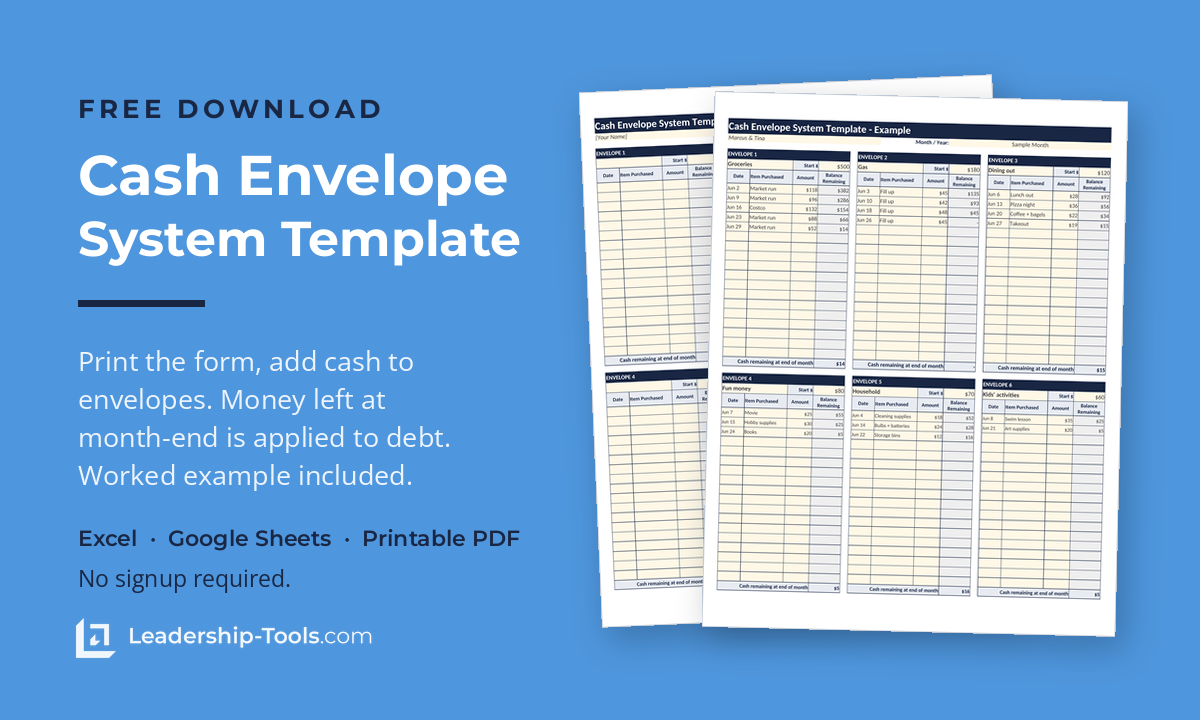
Download Cash Envelope System Template:
The goal is straightforward: control day-to-day spending categories (the ones most likely to drift), reduce financial stress, and redirect leftover cash toward bigger priorities like debt payoff, savings, or investing; without needing complex apps or spreadsheets.
In the prior step we introduced our household budget template, which allows you to create your monthly household budget. Most people would stop there and believe they had done all they could to ensure they would live within their means.
Learn step-by-step how easy it is to start using this powerful money management system today.
Start in Under 5 Minutes
Want the short version? Here's the whole cash envelope system template in four moves. The full setup, examples, and troubleshooting are below.
- Download the free template (PDF, Excel, or Google Sheets). Print it, cut out a strip, and tape one to the back of each cash envelope.
- Pick 5 to 8 spending categories that are easy to overspend, like groceries, gas, dining out, and fun money.
- Set an amount for each, write the starting cash at the top, and put the cash inside.
- Log every purchase as you go. When an envelope is empty, that category is done until you refill.
That's it. Whatever cash is left at month-end goes straight to your debt.
Free Cash Envelope System Template
To make this easy, we’ve created a free Cash Envelope System Template for you. If you want the envelope system to stick, you need something simple you’ll use consistently.
That’s what the template is for: it turns “good intentions” into a repeatable routine you can follow every week or every payday.
What you get with the template (free):
- Printable PDF strips you print, cut out, and tape to the back of each cash envelope
- An Excel and Google Sheets tracker that keeps a running balance for every envelope, so you always see what's left
- A Month-End total that adds up the cash you didn't spend and shows exactly how much to send to your debt
- A finished example you can copy before you build your own
- Quick-start instructions, the same five steps laid out on this page
- Optional: the free "10 Steps to Conquer Debt" eBook, if you're pairing envelopes with a payoff plan
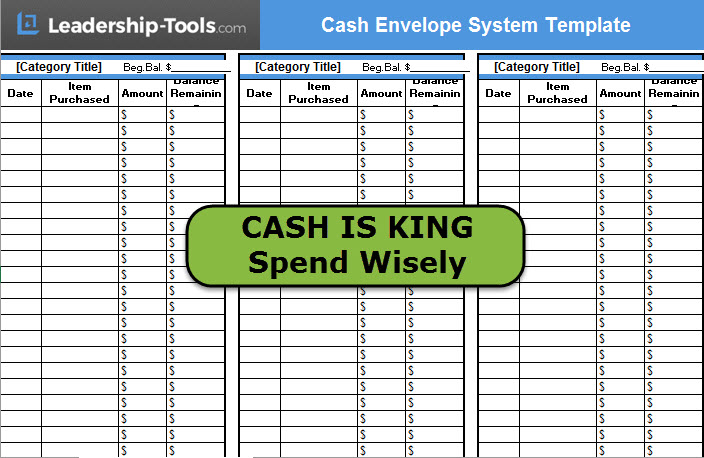
After printing off the desired number of cash envelope templates, cut out the form, then glue or tape the template to the back of each cash envelope.
Write the total amount of budgeted cash at the top of each template. As you make a purchase, keep a running total of how much cash is being spent.
Download the cash envelope budget template first, then come back here and follow the quick-start steps below. You’ll be set up in under an hour, and the weekly routine typically takes just a few minutes.
What Is the Cash Envelope System?
The cash envelope system is a budgeting method where you allocate cash to specific spending categories; knowing you must then stop spending in that category when the cash is gone. It replaces “I think we’re okay this month” with a clear, physical boundary that’s hard to ignore.
Definition:
The cash envelope system is a budgeting approach that uses labeled envelopes for spending categories (like groceries or dining out). You put a set amount of cash in each envelope and track spending so you don’t exceed your plan.
Why it works (especially for busy people):
- It makes trade-offs visible (spend here, save there).
- It reduces impulse purchases (cash creates a pause).
- It builds self-leadership habits: planning, discipline, and review.
Think of envelopes as “training wheels” for your budget. Once you can consistently stay within category limits, you can decide whether to keep using cash, switch to a hybrid system, or move to a digital approach with the same discipline.
Who the Envelope Method Works Best For / Not Ideal For
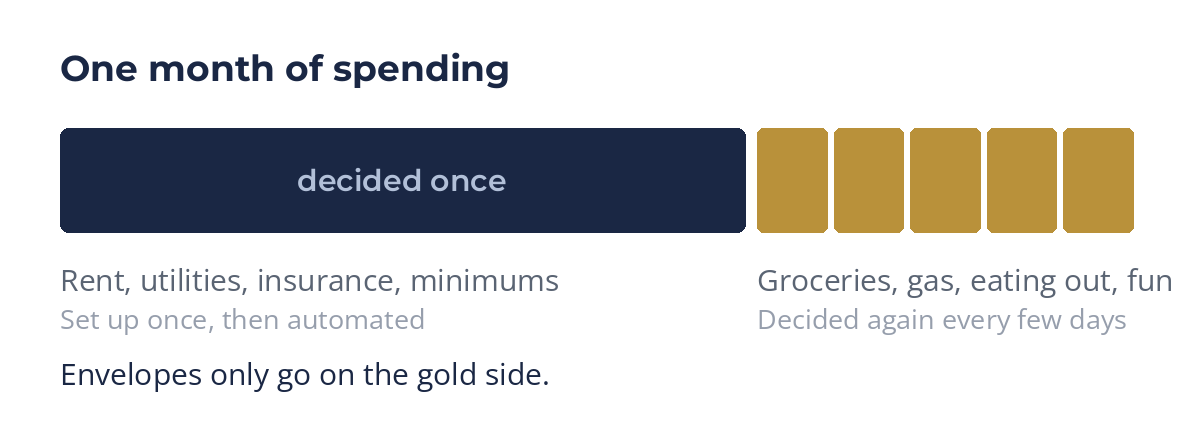
The cash envelope system isn't meant for every expense, and that's its strength. When you use it for the right categories (the “easy-to-overspend” ones), it quickly tightens discretionary spending without making you feel deprived or forcing you to track every purchase across multiple apps.
Best for (ideal envelope categories):
- Groceries
- Dining out / coffee runs
- Gas / transportation
- Personal spending / fun money
- Household items (small purchases that add up)
- Kids’ activities (if spending is frequent)
Not ideal for (keep these digital or automated):
- Rent/mortgage
- Utilities
- Debt payments
- Insurance
- Subscriptions (better handled by reviewing and canceling, not cash)
If you share finances:
- Agree on category rules.
- Decide how you’ll handle “miscellaneous.”
- Choose one refill schedule (weekly or per-paycheck).
- Pick one tracking method (the printable tracker or the Excel tracker).
Use envelopes for the categories where habits can quietly sabotage your plan, such as frequent purchases and easy impulse spending. Keep your fixed bills on autopilot, so you’re not wasting willpower on decisions that don’t change month-to-month.
This way, you can focus your attention where it truly matters: the handful of everyday choices that create real momentum. Even small wins like staying within your grocery or dining-out envelope, add up fast and make it easier to hit bigger goals like debt payoff, savings, and long-term stability.
The Full 5-Step Setup (How to Set Up Your Envelopes)
In the previous step of the “10 Steps to Conquer Debt” system, you used our Household Budget Template to create your monthly budget. Most people stop there and hope they’ll stay “within the numbers” on a screen.
The cash envelope system is the next step that turns your written budget into daily behavior.
Use these five steps to get started now:
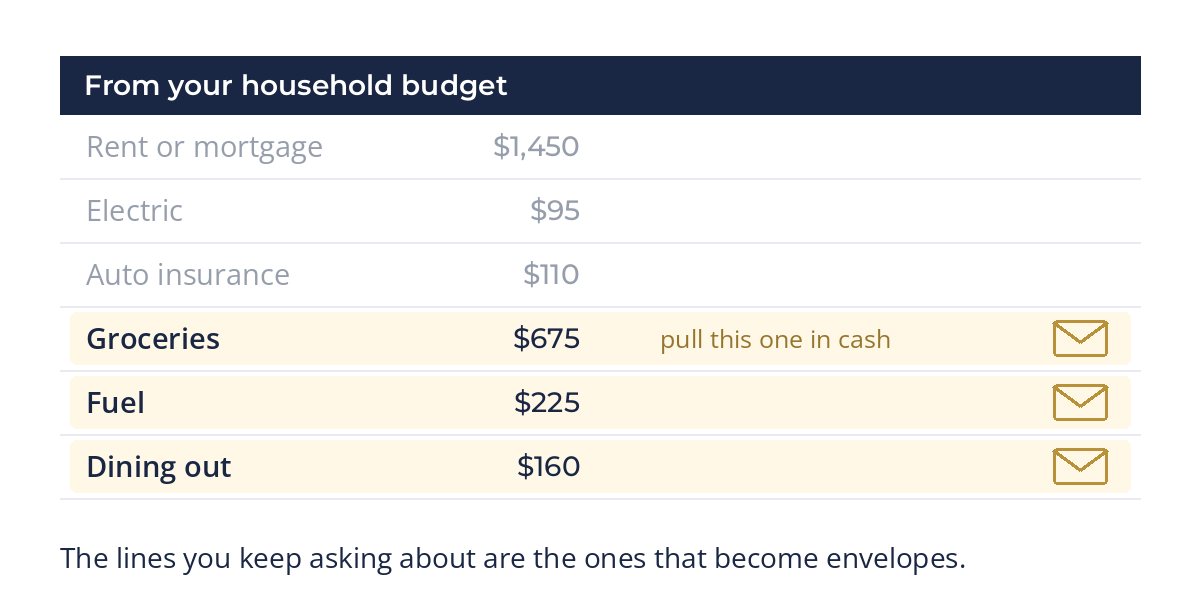
Step 1: Identify Your “Cash‑Friendly” Categories
Look at your household budget and highlight the categories that are easy to pay in cash. If you're not sure, pick the ones where you most often ask, "Where did our money go?" Those are your first envelopes.
Typical choices include:
- Groceries
- Gas
- Clothing
- Entertainment
- Birthday / Holiday gifts
- Charity / Donations
- "Mad money" (small, guilt-free spending)
The more you pay through cash envelopes, the better, but keep it manageable to start. Begin with 5 to 8 envelopes, not 12.
Step 2: Decide How Much Cash Goes in Each Envelope
This is where your budget becomes real. Your numbers need to be intentional and based on what you can afford after bills and debt minimums.
For each category, ask: "How much can I reasonably spend this month and still hit my debt and savings goals?"
- Let your household budget show you what's realistic
- Write the starting amount at the top of each envelope
- Example: Groceries $500, Gas $180, Dining out $120, Fun money $80
Your first month is a test run. The goal is to be honest and work the system. You'll adjust next cycle with better information.
Step 3: Prepare, Withdraw, and “Stuff” Your Envelopes
Get your envelopes ready:
- Print your Cash Envelope System Templates
- Attach one template to the back of each envelope (regular white envelopes or free drive‑up envelopes from your bank work fine)
- Write the category name and starting cash amount on each one
Choose a refill cadence that matches your life. Most people do best with either weekly stuffing or per-paycheck stuffing.
Two simple refill options:
- Weekly: good for tighter control and faster habit-building.
- Per paycheck: good for predictable pay cycles and fewer bank runs.
- Security tip: only carry what you need for the week. Keep the rest at home in a secure spot.
Divide the money and “stuff” your envelopes according to your allocated monthly budget for each category. Consistency matters more than the exact day you withdraw cash. Pick a schedule you’ll stick with.
Step 4: Track Every Spend (Use the Template)
Tracking is what turns the cash envelope system template into a valuable pathway to success. Without it, envelopes become "guessing with cash."
Here's how it works in the template:
- Write the starting cash at the top of each envelope.
- Log every purchase on its own line: the date, what you bought, and the amount.
- In the Excel and Sheets versions, the Balance Remaining updates on its own, so you see what's left at a glance. On the printed strips, you keep the running total by hand.
When an envelope reaches zero, that category is done for the cycle.
Step 5: Review Weekly and Adjust Monthly
You don’t need a perfect plan to manage money well; you need a simple repeatable process. When you take just 10 minutes each week to review your envelopes, you catch small problems early and avoid that end-of-month “Where did it all go?” surprise.
Weekly review questions:
- Which envelope ran low too early?
- Which envelope had money left?
- What triggered off-plan spending?
- What rule do we need to tighten (or loosen) next week?
This last rule is what makes the system work. The envelope doesn’t negotiate with you. When it’s empty, you’ve hit your limit.
At month’s end:
- Celebrate any cash left over (use a small portion as a reward)
- Apply the bulk of leftover cash directly toward your debt reduction plan
Your first month is about learning. Your second month is about refining. That’s how you build a budget that lasts.
A Realistic Example: How Much to Put in Each Envelope
A common question is: “How much should I put in each envelope?” The best answer is based on your income, bills, and goals, but an example can make it easier to start.
Example Allocation (Per Paycheck)
Here’s a simple per-paycheck example using common categories. Adjust amounts up or down based on your situation.
Example (stuff twice per month):
- Groceries: $250 per paycheck (=$500/month)
- Gas: $90 per paycheck (=$180/month)
- Dining out: $60 per paycheck (=$120/month)
- Fun money: $40 per paycheck (=$80/month)
- Household items: $35 per paycheck (=$70/month)
- Kids' activities: $30 per paycheck (=$60/month)
If you’re working on debt payoff, the envelope system helps you “find money” by reducing the categories that quietly expand. The leftovers can become a predictable extra payment.
These are the same amounts you'll see filled in on the Completed Example tab of the cash envelope system template, for a household we call Marcus and Tina. They start with $1,010 across their envelopes, come in a little under in several categories, and send the $55 left over straight to their target debt.
That's the whole point: the envelopes turn small wins into a real extra payment.
"There's nothing wrong with cash, it gives you time to think."
- Robert Prechter Jr.
Hybrid Envelope Budgeting: Online Bills, Debit Cards, and Real Life
You don’t have to go “all cash” to benefit from the cash envelope system template. In fact, most people do best with a hybrid system: cash for frequent discretionary spending and digital payments for fixed bills.
Keep Fixed Bills Digital (and Boring)
Your fixed bills, like rent, utilities, insurance, and minimum debt payments, belong on auto-pay, not in envelopes.
We covered which categories fit cash best up in "Who the Envelope Method Works Best For." Let automation handle what's predictable, and use envelopes where your choices need to be highlighted before you go over budget.
Handling Online Purchases Without Breaking the System
Online spending is the easiest way to “accidentally” break the envelope rules. The fix is to create a clear process you’ll follow every time.
Two workable options:
Option A (cash-first):
- Take the cash out of the envelope.
- Set it aside in a “pending online purchases” mini-envelope.
- Place the order.
Option B (weekly reconcile):
- Use a dedicated card for discretionary spending.
- Record the purchase immediately on the envelope tracker.
- Remove the matching cash during your weekly review.
The goal is consistency. Choose one process and stick to it so your envelopes remain truthful.
Why This Money Management System Matters
Cash is a tangible item of value you can see and hold, so it's harder to part with than a quick swipe of a card.
When you pay with cash:
"Happiness is a positive cash flow."
- Fred Adler
- You feel the trade‑off. Handing over bills makes you pause and ask, “Is this worth it?”
- You become more aware. Seeing the balance drop on the envelope keeps your budget front‑and‑center.
- You gain respect for your money. Recording each purchase reinforces that every dollar represents your time and effort.
Most budgets fail because nothing connects the plan on paper to the choices you make all week.
The cash envelope system is that connection: a simple behavior-change tool disguised as a budget helper.
Build a Habit for Money Management Success
At first, using the cash envelope system template can feel awkward and even inconvenient. That’s normal. Any new habit requires a bit of friction at the start.
Use these habit‑building tips for the first 3–4 months:
1. Commit to a Trial Period
Promise yourself you’ll use the system consistently for at least two full months before deciding whether to keep it. The first few weeks are about learning and adjusting.
2. Make It Part of Your Daily Routine
Every payday, follow the same steps in the process:
- Update your household budget
- Withdraw the amount of cash you'll need until the next payday
- Stuff your labeled envelopes with the budgeted cash amount
- Place the envelopes in your designated safe spot
3. Keep Things Simple
Start with a manageable number of categories (5 to 8 envelopes)
- Use round numbers that are easy to track
- Schedule 5–10 minutes once a week to review balances and make small adjustments
4. Use Cash Where It Counts
Not every expense belongs in an envelope, and that's fine. Use cash for the everyday, in-person spending that tends to drift, like groceries, gas, and dining out. Leave fixed bills on auto-pay. We covered which categories fit best up above.
5. Turn Leftover Cash into Momentum
At month-end, send the cash you didn't spend straight to your target debt. Keep a small amount as a reward if that helps you stay consistent. Those leftovers are how the cash envelope system template pays you back, and the more you practice it, the less it feels like work.
Common Problems (and Quick Fixes)
Most envelope systems fail for a small number of predictable reasons.
The good news: each has a simple fix; usually a rule, a routine, or a smaller set of categories.
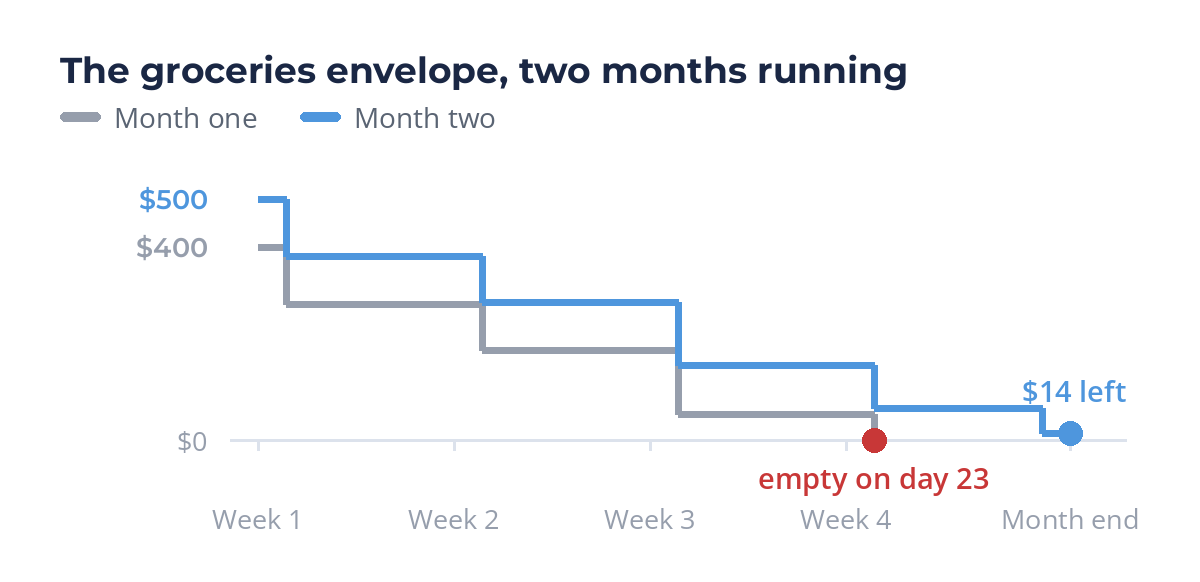
“My envelope ran out early.”
This usually means the category amount is too low, the refill cadence is too slow, or spending isn’t being tracked consistently.
Quick fixes:
- Switch to weekly refills for tighter control.
- Reduce the number of categories (start simpler).
- Use a “pause rule”: when the envelope is empty, you must wait 24 hours before buying.
- Adjust next month’s allocation based on reality.
Conclusion:
Running out early isn’t failure, it’s feedback. Use it to tighten your plan, not abandon it.
“I keep borrowing from other envelopes.”
Borrowing quietly destroys the system because it hides the trade-off.
Quick fixes:
- Add a clear rule: “No borrowing. If we choose to spend, we must choose where it comes from.”
- If you must move money, write it down as a transfer (so the trade-off is visible).
- Limit “miscellaneous” to a small amount so it doesn’t become a loophole.
Conclusion:
Your envelope rules should protect future you from stressed-out you. Keep them simple and enforceable.
“I’m worried about carrying cash.”
Security matters. You can still use the envelope method without carrying the full month’s cash.
Safer approach:
- Carry only one week of cash.
- Keep the rest secured at home.
- Consider a small envelope wallet/binder that stays out of sight.
- If safety is a serious concern, use the hybrid method + Excel tracker.
Conclusion:
The method is meant to reduce stress, not create it. Adjust the process so it fits your environment.
Rules of the Envelope System (Keep It Simple)
A few clear rules make the envelope system feel easy because when using cash, you either have it available or you don't. You never have to debate with yourself in the moment.
The 5 Core Rules
These are the rules that keep the system clean and effective.
Rules:
- Fund envelopes on a schedule (weekly or per paycheck).
- Track every spend (immediately or same day).
- When an envelope is empty, spending stops.
- No borrowing, unless you record it clearly as a trade-off.
- Leftover cash goes to a purpose (debt, savings, sinking fund).
Rules reduce decision fatigue. Once your rules are set, the system runs on habit, not willpower.
Frequently Asked Questions (FAQ)
Click on the (+) sign below to expand each question. Click the (-) sign to collapse it again.
Do I need to use cash for everything?
How many envelopes should I start with?
Start with 5 to 8 envelopes. More isn't better; consistency is better. Once you're consistent for a month, add categories only if it truly improves clarity.
How much should I put in each envelope?
Start from your household budget. Look at what you realistically spent in each category over the last month or two, then set an amount you can live with after your bills, minimum debt payments, and a little savings. Your first month is a test run. You'll adjust with better information next cycle.
What do I do with leftover money in an envelope?
You have three good options: roll it over, move it to savings, or apply it to debt. The best choice depends on your goal. If debt payoff is your priority, sending leftovers to debt creates fast momentum.
How does the cash envelope system help me pay off debt faster?
Every dollar you don't spend in an envelope is a dollar you can send to debt. At month-end, the cash envelope system template totals your leftover cash so you can add it to your payment. Over time, those small surpluses turn into a real head start on your payoff plan.
Do I still need a budget if I use cash envelopes?
Yes. The envelopes don't replace your budget, they carry it out. Your household budget decides how much goes to each category. The envelopes keep your day-to-day spending inside those numbers.
Can I do "cash stuffing" with a debit card?
Yes. Use a hybrid approach: track debit card purchases against the envelope category and remove matching cash during your weekly review. The system still works as long as you keep the envelope balance truthful and updated.
How often should I refill envelopes?
Weekly and per-paycheck are the most common options. Choose the schedule you'll follow reliably. Consistency beats optimization.
What if my income is irregular?
Fund your envelopes from each paycheck as it lands, rather than from a fixed monthly amount. Cover your most important categories first, like groceries and gas, then fill the rest when the next check arrives.
Does the cash envelope system template really work?
It works because it changes behavior, not because cash is magic. Handing over physical cash makes you pause, and an empty envelope is a limit that's hard to argue with. For the variable, easy-to-overspend categories, that small bit of friction is what keeps your spending in line.
Next Steps: Debt Payoff + More “Leading Self” Tools
The envelope method is powerful on its own, but it’s even stronger when you pair it with a clear goal, like debt reduction.
The Cash Envelope System is one strategic piece of the larger plan you receive in our free eBook, “10 Steps to Conquer Debt.”
Here’s how it fits into the overall system:
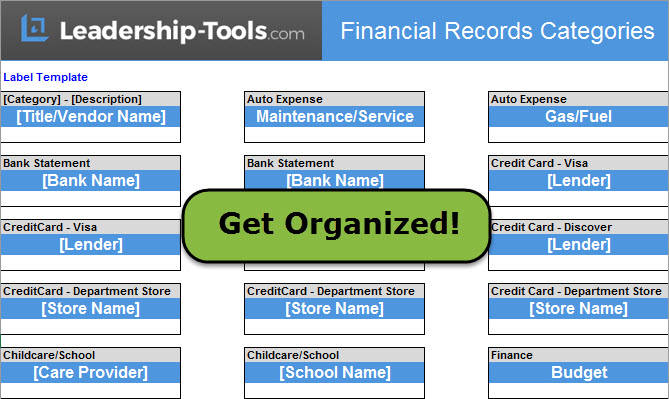
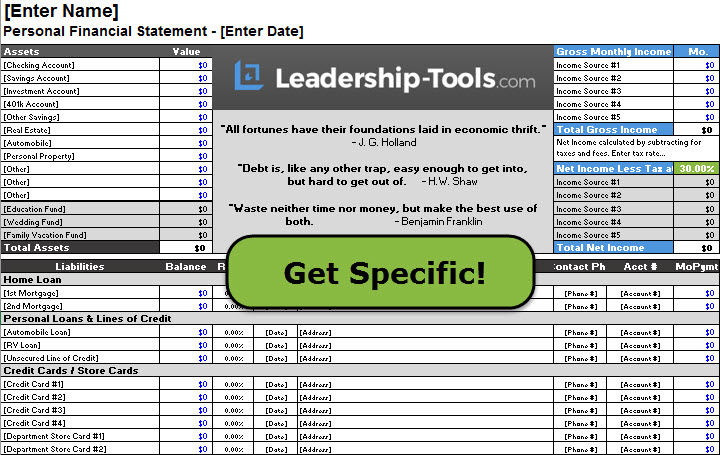
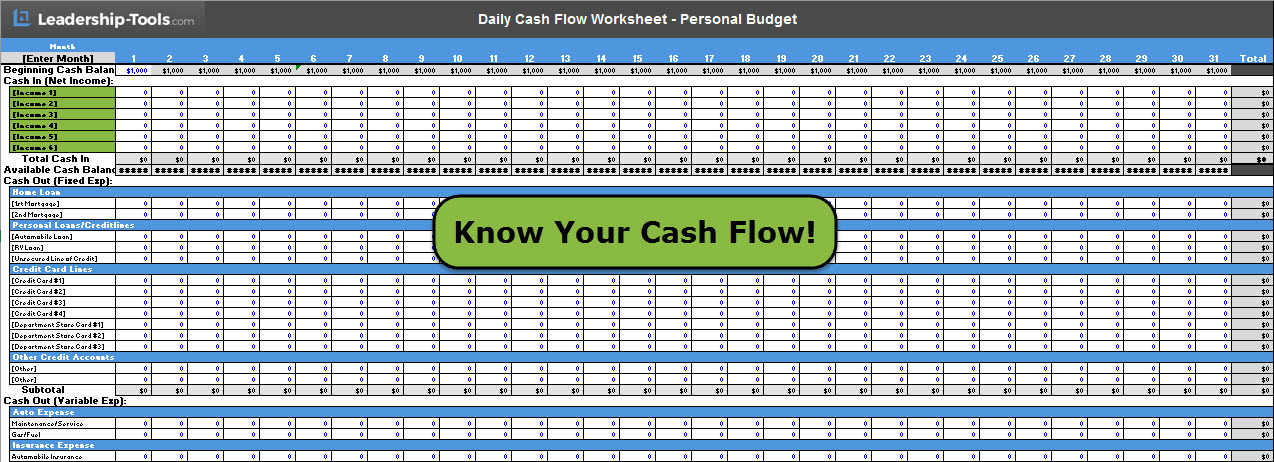
Earlier Steps Help You Get Organized: You learn to organize your financial records, understand your net worth, and create your monthly household budget using our other tools (Financial Record Labels, Personal Financial Statement, Household Budget Template, Daily Cash Flow Tool, etc.).
The Household Budget Establishes Your Plan: You decide, on paper, how much will go toward living expenses, debt, and savings. This is where most people stop, and where many budgets quietly fail.
The Cash Envelope System Turns Your Plan into Daily Behavior: This page, and the Cash Envelope System Template, sits right in the middle of the process. It takes the numbers from your household budget and builds a simple, real‑world system for sticking to them.
The Extra Cash Fuels Faster Debt Reduction: When you come in under budget in your envelope categories, you free up cash you can send straight to your debt. Add it to the steady extra payment from your household budget, then put both to work in your Debt Stack Calculator. The steady payment keeps your payoff timeline predictable, and every under-budget month gets you there a little faster.
Download 10 Steps to Conquer Debt eBook & Template

Want the entire leadership tools library? Subscribe to our free newsletter and we'll send you a link to every tool on this site, all on one page, sorted by leadership phase. Every tool is free to download on its own page. The library just puts them in one place. Plus, you'll never miss out on updated or new tool announcements.
Your privacy is important to us. We never share or sell email addresses.
Leadership Tools Newsletter
Subscribe Free - See All Tools on One Page - Get New Tool Alerts
More 10 Steps to Conquer Debt Tools

Contact Information:
phone
(503) 970-9777
Email Customer Service
helpsupport@leadership-tools.com
Email Richard
richard@leadership-tools.com

By Richard Gorham
Leadership-Tools.com
2879 Riverwalk Loop, Eugene, Oregon, 97401
Copyright (c) 2002 - 2026 All Rights Reserved