An employee exit survey is a short written form a departing employee completes in their last week. It asks how things were in seven areas of the job, why they're leaving, and what would have kept them. The answers go to someone other than the person's manager, and the manager hears the pattern once two or more people from the team have said the same thing.
- Home
- Leading Teams
- Employee Exit Survey
Employee Exit Survey: Find Out Why Good People Leave
An employee exit survey is a short questionnaire that a departing employee completes in their last week. It asks about their experience in seven areas of the job to determine why they're leaving, and what would have kept them.
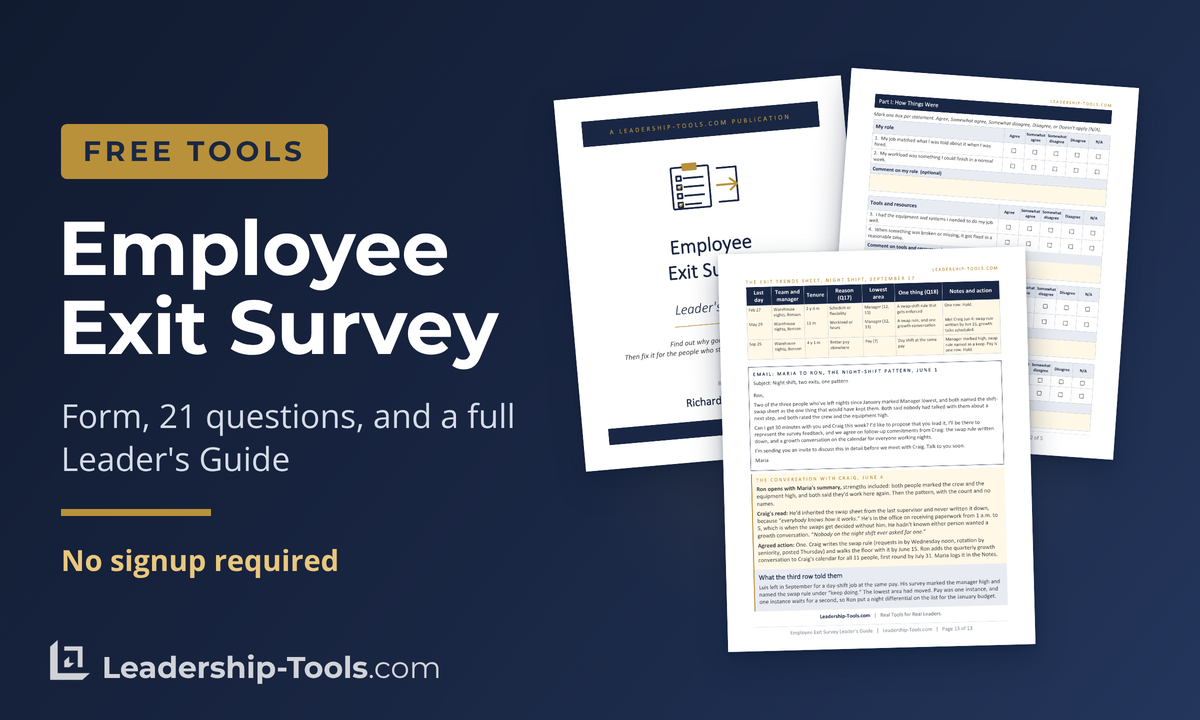
Our free employee exit survey has 21 questions and takes about 10 minutes. The Leader's Guide covers who administers the survey, issues of confidentiality, and what to do with the answers you receive.
When someone resigns, often the first instinct is to fill the position to stabilize staffing. The reason the person left goes unexamined, and the next person hired into that role inherits the same conditions that caused the last one to leave.
An exit survey is a paper form, and it's an easy way to gather valuable information about your workplace, because the person giving it has nothing left to protect. An exit interview is the one-on-one conversation version of the same thing, and this page covers when each version is the best approach.
Employee Exit Survey:
Employee Exit Survey Leader's Guide:
Employee exit survey at a glance
| Formats | PDF, Word, Google Docs |
| Ideal for | HR partners, leaders of managers, and business owners with no HR |
| Includes | Employee Exit Survey (4 pages, 21 questions) + Leader's Guide (14 pages) |
| Takes | About 10 minutes for the employee |
Which file do you need?
| Send the Employee Exit Survey to the person who's leaving. It carries the cover note, the confidentiality promise, 16 rated statements, and five questions to be answered in their own words. | |
| Read the Leader's Guide once before the first survey goes out. Choose your route, and edit to fit the situation. | |
| If you're the owner and there's no HR, start with Option 2 in the Guide and the section on this page by the same name. |
Jump To: What It Does | The 21 Questions | Survey or Interview | Which Option Fits | What You Can Promise | If You Have HR | If You're the Owner | Outside Provider | Reading the Results | Taking Action | Five Mistakes | Example | FAQ | Download
What an Employee Exit Survey Does
Most people won't tell their manager the real reason they're leaving, because sometimes the reason is the manager, and the rest of the time it's simpler to say "a better opportunity came up" and keep the reference intact. A written form that is administered to ensure confidentiality, with that same promise printed on the form, will help leadership uncover opportunities to improve the workplace for remaining staff and future new hires.
Ideally, the completed survey will go to someone other than the person's manager, and the manager will only hear about an issue when a pattern is identified, which requires two or more people from the team having said the same thing. One survey is just one person's impression. Two or more employees reporting the same experience is a pattern, and that's why this page spends as much time on what happens after the survey comes back as on how to send it out.
| Use an exit survey to | Don't use it to |
| Find out why people leave, as a pattern over several departures | Talk someone out of leaving. That's a different conversation, and it's already late. |
| Hear how a manager is experienced, from people with nothing to protect | Build a case against a manager from one person's answers |
| Spot the fixable things: workload, tools, a schedule, a missing conversation | Collect feedback and file it. If nothing changes, the next person to leave will know. |
| Give the person a respectful last word | Hand a form to someone on their last day and call it done |
Employee Exit Survey Questions: All 21
Part I of the survey contains 16 statements in seven areas, scored Agree, Somewhat agree, Somewhat disagree, or Disagree, plus Doesn't apply (NA). Each statement names something the person could have seen in a normal week, so a Disagree points at a specific thing you can verify. Each area has room for a comment, and any comments provided should be reviewed closely.
| Area | Statements (Agree, Somewhat agree, Somewhat disagree, Disagree, or N/A) |
| My role | 1. My job matched what I was told about it when I was hired. 2. My workload was something I could finish in a normal week. |
| Tools and resources | 3. I had the equipment and systems I needed to do my job well. 4. When something was broken or missing, it got fixed in a reasonable time. |
| Training and growth | 5. I was trained well enough to do my job on my own within my first 90 days. 6. I could see a next step for myself here, and someone talked with me about it. |
| Pay and benefits | 7. My pay was fair for the work I did. 8. My benefits met my needs, and I understood what they were worth. |
| My team | 9. I could count on my coworkers when the work got heavy. 10. Problems between people on the team got dealt with rather than ignored. |
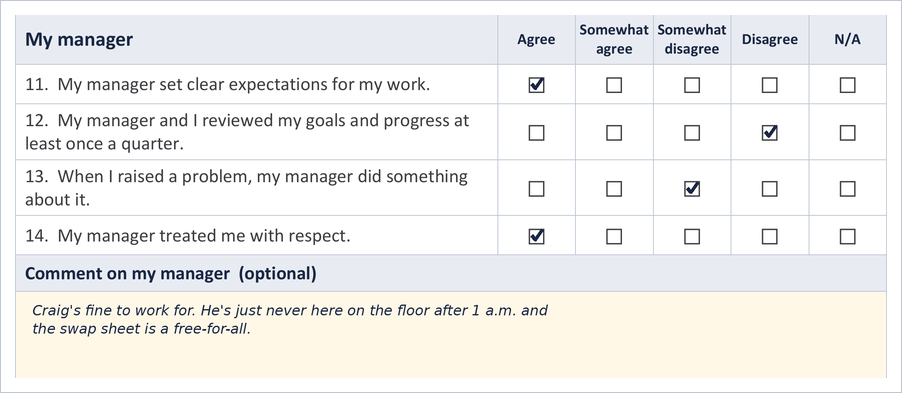
| My manager | 11. My manager set clear expectations for my work. 12. My manager and I reviewed my goals and progress at least once a quarter. 13. When I raised a problem, my manager did something about it. 14. My manager treated me with respect. |
| The company | 15. I would recommend this company to a friend as a place to work. 16. I would consider working here again. |
These are Devon's four answers from the example later on the page, with the comment that turned a score into something the administrator could check.
Part II is five questions in the employee's own words. Question 18 is the one the administrator reads first, and the Exit Trends Sheet has a column for capturing key details.
| Part II, in their own words | |
| 17 | My main reason for leaving. Pick up to two from fourteen: better pay or benefits elsewhere, a better role or opportunity elsewhere, no room to grow or advance here, my manager, workload or hours, schedule or flexibility, relocation or commute, returning to school, retirement, family or personal needs, health, the work environment or culture, change of career or industry, or other. |
| 18 | What is the one thing that, had it been different, would have kept you here? The question the administrator reads first. |
| 19 | Could we have done anything to prevent your decision to leave? Yes, No, or Not sure, and room to explain. |
| 20 | What should we keep doing? |
| 21 | What should we stop doing? |
Exit Survey or Exit Interview?
The exit survey: It's consistent, so every person who leaves answers the same 21 questions and you can track patterns as multiple people share their experience, and that's what the Exit Trends Sheet is built for. An exit interview is a conversation, which is better than nothing, but a conversation with the owner won't produce as much feedback.
The exit interview: A conversation with the departing employee happens in two cases only. The first is when it's a small business with no HR, and no third-party administrator is available. The second is a short call from the administrator when an answer needs clarifying after a survey is completed. Nobody else follows up. A conversation requested by the manager or the manager's leader once the form has been submitted may make the employee feel pressured, regardless of the intent.
Which Option Fits Your Company
There are three options for delivering the employee exit survey and the form is the same in all three. What changes is who collects it, what you can promise, and who follows up. Pick the option below that matches your company.
| Who collects it | What you can promise | Who follows up | |
| Option 1. You have HR | HR collects it, keeps it, and reports themes to the manager and the manager's leader. | The full promise on the form, as written. | HR, and only to clarify something on the form. The survey otherwise stands on its own. |
| Option 2. You're the owner, no HR | A neutral person you already work with, or you, in person. | Depends on the route. The Guide gives you the honest wording for each. | Nobody, on Route A. You, in the conversation itself, on Route B. |
| Option 3. An outside provider | The provider collects it and sends you a summary. | Confirm with the provider what the promise is before you sign. | The provider, by whatever process you agreed with them. |
Who collects the form? The cover note on the survey says the person named in the Return row collects and keeps it, and the manager never sees it. That line works for an HR partner, an outside bookkeeper, or a third-party provider. Whoever you name there has to be someone who isn't the employee's manager, or the promise on the form is false. Be certain this survey is administered with integrity.
What You Can Promise About Confidentiality

Confidential and anonymous are different promises, and this form promises confidentiality.
Confidential means the administrator knows who wrote it but nobody else will. Anonymous means nobody in the organization knows, including you, which also means you can't follow up with the employee about anything said on the survey.
Confidential is the more useful approach, and it's the promise you can keep if you do four things consistently.
| The four things that keep the promise | |
| The manager never sees the form | Not the scores, not the comments, not a photocopy. The manager and their leader only hear about themes that are identified by multiple employees. |
| Two or more before you share | A theme reaches the manager once two or more people from the team have raised it. One survey stays with the administrator until a second one agrees. On a small team that can take time, and that's fine. |
| Comments are paraphrased | Never share a specific comment because the sentence written may be recognized. “Two people said one-on-ones stopped after the spring” is a theme statement. |
| One exception to confidentiality | Anything involving safety, harassment, discrimination, or ethics gets looked into. No pattern is required and the administrator tells the employee up front. The form discloses the same promise, so it's clear to everyone. |
Read it with the context you already have. If HR collects the survey, HR also knows whether the person was on a performance plan, had a complaint filed against them, or was passed over earlier in the year. That context doesn't cancel what they wrote. It sits alongside it. A person who left under a corrective action is still a person who worked there, and if their survey says the schedule-swap policy is broken, the policy is the thing to question, not the person.
The promise is printed on the form's first page: the person named collects and keeps this survey, the manager will not see it, the manager and their leader receive only a summary of themes once two or more people from the team have shared similar feedback. Again, the one exception is anything involving safety, harassment, discrimination, or ethics.
“Always treat your employees exactly as you want them to treat your best customers.”
- Stephen R. Covey
Option 1: You Have an HR Department
HR owns the survey. The manager owns making a smooth transition for everyone involved. Two people, two jobs, and the one thing that breaks the process is when the manager tries to do both.
| When | What happens |
| Day 1 to 2 | Resignation accepted. HR sends the survey by email a week before the final day of employment. Never on the last day, and not before any counteroffer conversation is settled. |
| Day 3 to 7 | The manager works to support a professional exit for the employee, and posts the open position to recruit a replacement. If the employee shares reasons for leaving, the information should be shared with HR and the manager's supervisor. |
| Day 7 to 9 | Survey comes back. HR reads it once, logs a row on the Exit Trends Sheet, and checks it against the rows already there. |
| Day 8 to 12 | No follow-up conversation. The survey stands on its own. If something on it needs clarifying, HR reaches out to the employee, and nobody else does. |
| Last day | Nothing. The person says goodbye to their team. |
| Within a month | If two or more surveys agree, HR takes the theme to the manager and their leader to discuss any opportunities for improving the employee experience. |
HR will send an email to the employee requesting they complete the employee exit survey. This is the first time the employee is hearing that their feedback is kept confidential.
Keep the message short, name the person it goes to, and say in plain words that the manager won’t see the form. The email version below is written for an HR partner and comes from the Leader’s Guide. You can edit to fit your situation as you see fit.
If the survey isn't returned, send one reminder two days before the employee's last day and then let it go. A survey written under pressure on the last day of employment isn't worth having, and a person who didn't return it has told you something too. Log the row with "declined" in the reason column.
Option 2: You're the Owner and There's No HR
Many leaders who download this tool don't have an HR department. If that's you, the full promise on the form is one you can't make alone, because you're the manager, or the manager's boss. You have two alternative routes, and the first one is better.
| How it works | What to expect | |
| Route A. Borrow a neutral party | Someone you already pay for who isn't in the building: your outsourced HR service, or your bookkeeper, accountant, or attorney. They receive the form and pass you a summary. | Best. The promise holds, and it costs an email and a phone call. Their name goes in the Return row. |
| Route B. Have the conversation yourself | Sit down with the person in their last week, with the form as your agenda, and say up front that you would appreciate honest feedback on how things can improve. | Honest, and better than nothing. You'll hear about the schedule and the workload. Don't expect to hear about you, but be open to it. |
Route A: Identify a Neutral Party
Replace the first sentence of the cover note with: "[Name], our [accountant / HR service / attorney], collects and keeps this survey. Nobody inside the company sees the form itself." Then change "your manager and their leader" in the second paragraph to "the owner." Everything else stays as printed.
Ask your neutral party to administer the employee exit surveys on your behalf. They will be responsible for sending you a short summary once two surveys agree, and for telling you plainly if a single survey meets the exception rule. This may require you to pay the neutral party a small fee per survey, but the feedback you'll receive is worth the investment.
Route B: The Owner Initiates a Conversation
When it's solely up to the owner. Open with an invitation for honest feedback, choose the questions from the survey in advance that you feel work when you are the one asking, and skip the ones that don't fit the situation.

Example of Route B in practice. Dale Ferris owns a 14-person HVAC company. His best installer, Marcus, gives notice in March for a job at a bigger outfit across town. Dale's first thought is that they must have offered more pay. Dale prepares his questions and schedules time to sit down with Marcus on the Wednesday of his last week and opens with the script.
To Dale's surprise, Marcus says the pay is about the same. What he wanted was a four-day week in the summer, which the bigger company offers, and he'd mentioned it to Dale "a couple of times" the previous year. Dale doesn't remember it, which is something he makes note of. Marcus also says the newer installer has been doing jobs alone that he shouldn't be, and someone's going to get hurt.
Dale writes down both comments and thanks Marcus for his feedback and for his time at the company. Dale goes on to invite Marcus back if things don't work out with the new employer.
The safety issue gets addressed that same day. The issue Marcus mentioned about summer hours is something he will research to see if the company can afford that same type of schedule. If they can, he will consider implementing it to help retain his staff.
Option 3: An Outside Provider
Paying someone to run exit interviews makes sense in two specific cases:
- you lose more than ten people a year
- there's a pattern you suspect and can't get to the bottom of because nobody will tell anyone internally
For a company losing two or three people a year, paying an outside provider may not be worth the cost, and Route A above gets you most of the same thing. If you do go outside, ask these four questions before you sign.
| Ask them | Why it matters |
| Live interviews, or a form? | Some providers send a link only. Some will schedule a call with the person. A call is better because you're more likely to get the example behind the score. Calls will cost more per employee exit survey because they take more time but produce more valuable feedback. |
| Who sees names, and what does the report look like? | Ask whether the report names anyone and whether managers can see individual responses. You want themes only, with two or more reports to back them up. |
| Paid per employee exit survey, or a paid subscription? | Paying per exit survey suits a company with a handful of departures. A subscription works only if there is a steady flow of turnover. Don't sign a year subscription for only two or three surveys. |
| What's the exception process for confidentiality? | If a departing employee reports harassment or a safety issue to the provider, how fast does it reach you? |
Reading the Results: One Survey, Then the Exit Trends Sheet
For whoever is administering the employee exit survey process: Read the survey once it's received. Resist the urge to act on anything immediately unless a comment is made that fits the exception rule for confidentiality. Log the results on the Trends Sheet. Check it against the feedback already there and look for trends.
Keep in mind that a single survey is one person's account. The person who feels wronged marks the manager low. The person who got a better offer marks everything fine. Both are true for them.
| Reading one survey | |
| Find the lowest area | Of the seven areas in Part I, which one has the most Disagree or Somewhat disagree marks? That's the row's “lowest area.” |
| Read question 18 first | The one thing that would have kept them. It's the most useful sentence on the form, and the Trends Sheet has a column for it. |
| Check the reason against the scores | If question 17 says “better pay elsewhere” and Part I marks pay as fine, don't assume one answer over the other. This alone is not worth reaching out for clarification. |
| Look for the exception | Safety, harassment, discrimination, or ethics, anywhere on the form. If it's there, the two-or-more rule doesn't apply. Act on it the same day and tell the employee you're doing so. |
| Then wait | One survey is simply one person's account. Put the survey results on the Exit Trends Sheet and read it again when the next one from that team arrives. |
The one case where you act on a single survey. The exception rule for confidentiality, and nothing else. Everything else on one form waits for a second one. If a single survey says the manager is a problem and you move on it alone, you've taught every manager that one unhappy employee can end a career, and you've taught every team that the form is a weapon they can use against a manager. Neither helps you.
The Exit Trends Sheet
The administrator fills in the exit trends sheet the day the survey comes back: enter the last day, team and manager, tenure, the main reason from question 17, the lowest area in Part I, the one thing from question 18, and notes and action.

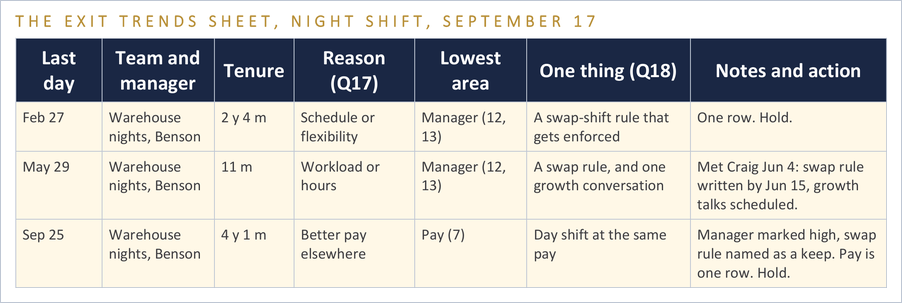
Keep the log for the whole company, sorted by team. The blank sheet is page 11 of the Leader's Guide, and this is what three rows from one team might look like.
Sorting by team is what makes the sheet work, because the question is never whether one person was unhappy. It’s whether the people leaving the same manager keep naming the same thing. Read down a team’s rows and the lowest-area column will tell you in a glance whether you have a pattern or a collection of individual stories.
The three rows below come from one night shift over seven months. The first two agree, which is the moment the administrator acts. The third reads differently, which is the test of whether the action taken after the second one worked.
Turning a Trend into Action
When two surveys from the same team agree, it's a coaching conversation. The manager hears about the collective feedback from their own leader. The leader, in partnership with HR, shares reported patterns. The manager's leader carries the conversation.
Patterns shared may include both areas of strength and opportunities for improvement. They hear the manager's side of things and take that into account. They agree on any action steps to be taken and assign ownership with a date.
| Turning a trend into action | |
| 1. Name the pattern | Two of three people who left this year marked Training lowest, and both said nobody talked with them about a next step. That's the whole opening. No quotes, no names, no dates that point to a person. |
| 2. Give what's strong | Those same surveys marked Team and Tools high, and both people said they'd work here again. Say it, because it's true and because it's what makes the manager more open to hearing feedback for improvement. |
| 3. Ask for the manager's read on areas for improvement | |
| 4. Agree on action steps | At least one action for follow-up, with an owner assigned and a date due. Log it however you log coaching conversations, and put the date in the Trends Sheet's last column. |
| 5. Watch the next row for improvement | The next person who leaves that team is the test. If the lowest area has moved, the action worked. If it hasn't, you have three former employees sharing the same experience. This now requires more investigation and possibly a different conversation with the manager. |
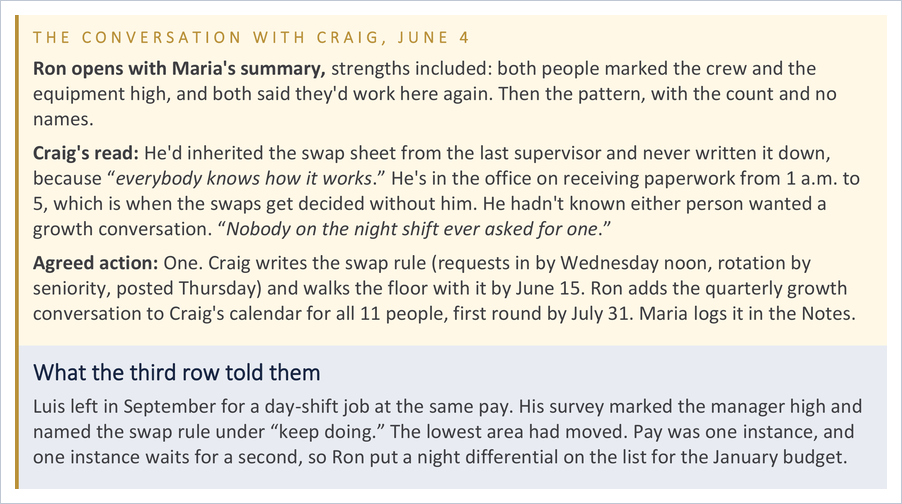
The example below is the June 4 conversation from the Leader’s Guide. Maria had two surveys from Craig Benson’s night shift that were similar, Ron Alvarez is Craig’s supervisor, and the meeting ran as described above. Notice what Craig’s read turned up that neither survey reported, and that the one action they agreed on came from his explanation as much as from the surveys.
Close the loop with the people who stayed. The team saw a colleague leave and may be aware that an employee exit survey was submitted. If something changes because of it, tell them in general terms at the next team meeting: "We heard that growth conversations weren't happening consistently, so starting this quarter they're on the calendar to ensure they occur."
No details are shared that point to the person(s) who reported the gap. That's how the next departing employee learns the form is safe to fill in, and how the people who stayed learn they don't have to leave to be heard and effect change.
Five Mistakes That Waste an Exit Survey
| Issue | Resolution |
| Handing it over on the last day | A survey written under pressure on the last afternoon isn't worth having. Send it a week prior to their last day of employment. |
| Letting the manager collect it | With the manager's name in the Return To box, the promise on the form is false. The employee will see that and is less likely to provide honest feedback. |
| Acting on one survey | Everything on a single form waits for a second one, except the safety, harassment, discrimination, and ethics exception. One unhappy employee does not warrant judgment, and the form shouldn't become a weapon against a manager. |
| Sharing a specific comment with the manager | A paraphrase is a theme. The sentence the person wrote may be recognized by the manager. |
| Promising anonymity you can't deliver | Confidential means the administrator knows who wrote it but nobody else will. If you share details specific to an individual with someone else, you've broken the promise, which erodes your credibility and the credibility of the employee exit survey process. |
Employee Exit Survey Example: Maria, Craig, and the Night Shift
Maria Delgado is the HR Business Partner at a 140-person regional distribution company. Craig Benson supervises the warehouse night shift, 11 people. Three of them leave between February and September, and this is what Maria did with the three surveys. The second one, Devon's, is the one that turned a story into a pattern.
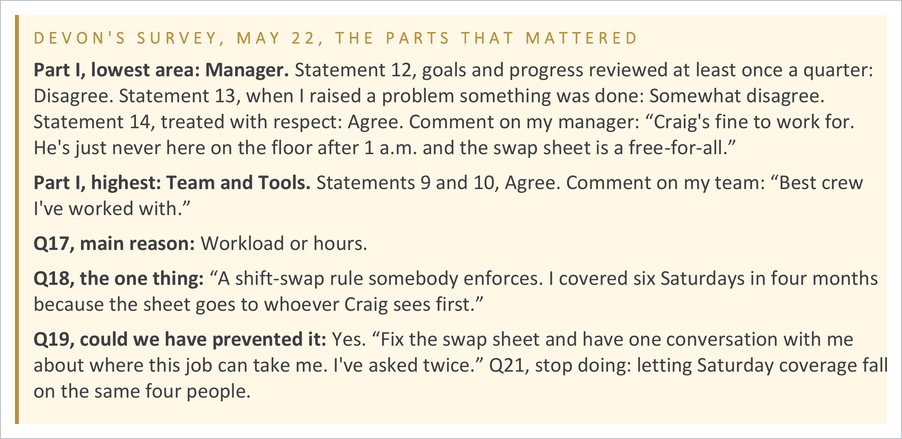
Devon's lowest area matched Tasha's, and so did the one thing that would have kept them. That's two rows supporting the same pattern, and once a pattern is identified, that's when the administrator acts.
THREE DEPARTURES, ONE PATTERN
| Thu, Feb 12 | Tasha Reed, two years and four months on the shift, gives notice. Maria sends the survey the week before her final day, and it's back on Feb 19. Lowest area: Manager. Reason: Schedule or flexibility. One row. Maria waits. |
| Mon, May 18 | Devon Price, 11 months on the shift, gives notice. Survey back May 22. Lowest area: Manager. Reason: Workload or hours. Two rows agree on the lowest area and on question 18. |
| Mon, Jun 1 | Maria emails Ron Alvarez, Craig's supervisor, with the pattern. The email is below. |
| Thu, Jun 4 | Maria and Ron, Craig's supervisor, meet with Craig. One action agreed, pictured in the Taking Action section above. |
| Fri, Sep 11 | Luis Ortega, four years and one month, gives notice for a day-shift job at another company. Survey back Sep 17. Lowest area: Pay. Reason: Better pay elsewhere. Manager marked high. Row three reads differently, which is what you want to see. |
EMAIL: MARIA TO RON, JUNE 1
Subject: Night shift, two exits, one pattern
Ron,
Two of the three people who've left nights since January marked Manager lowest, and both named the shift-swap sheet as the one thing that would have kept them. Both said nobody had talked with them about a next step, and both rated the crew and the equipment high.
Can I get 30 minutes with you and Craig this week? I'd like to propose that you lead it, I'll be there to represent the survey feedback, and we agree on follow-up commitments from Craig to include: the swap rule written down, and a growth conversation on the calendar for everyone working nights.
I'm sending you an invite to discuss this in detail before we meet with Craig. Talk to you soon.
Maria
The full example, with Devon's survey, Maria's email to Ron, the Trends Sheet, and the conversation with Craig, is in the Leader's Guide.
Frequently Asked Questions
The questions below address what leaders most commonly ask about the employee exit survey.
Click on the (+) sign below to expand each question. Click the (-) sign to collapse it again.
What is an employee exit survey?
What is the difference between an exit survey and an exit interview?
An exit survey is a written form with the same questions for everyone, so answers can be counted across several departures. An exit interview is a conversation. The survey stands on its own. The only conversations that follow it are a short clarifying call from the administrator, or the owner's conversation when a small business has no HR and the survey is the agenda.
What questions should an exit survey ask?
Sixteen rated statements across seven areas (role, tools, training, pay and benefits, team, manager, and the company) and five questions in the employee's own words: the main reason for leaving, the one thing that would have kept them, whether it could have been prevented, what to keep doing, and what to stop doing. The free employee exit survey form on this page carries all 21.
Who should conduct the exit survey?
Ideally, someone who isn't the employee's manager. With an HR team, HR collects it. Without one, a neutral person the owner already works with, such as an outsourced HR service, bookkeeper, accountant, or attorney. The manager should never see the completed form.
When should you send an exit survey?
The week prior to their last day of employment, but not before any counteroffer conversation is settled. Never on the last day. If it doesn't come back, send one reminder two days before the last day and then let it go.
Are exit surveys confidential?
Yes, that is the promise. The manager never sees the form, a theme reaches the manager only once two or more people from the team have raised it, comments are paraphrased rather than quoted, and the one exception (safety, harassment, discrimination, or ethics) is stated on the form and acted on immediately. Confidential means the administrator knows who wrote it but nobody else will.
Should an exit survey be anonymous or confidential?
Confidential is best. Anonymous means nobody knows who wrote it, including you, so you can't follow up or have any background knowledge. Confidential means the administrator knows who wrote it but nobody else will, and it's the promise that allows feedback to be taken in context with known HR issues.
How do you run an exit survey in a small business with no HR?
There are two routes. Borrow a neutral party you already pay, such as your bookkeeper, accountant, attorney, or outsourced HR service, and have them collect the survey and send you a summary. Or sit down with the person in their last week, use the survey as your agenda, and say up front that you'd appreciate honest feedback. Assure the employee that you value their input and will use it to try to improve on any gaps that need attention.
What do you do with exit survey results?
Log one row per person on the Exit Trends Sheet: enter last day, team and manager, tenure, main reason, lowest area, the one thing that would have kept them, and notes. When two rows from the same team agree, the manager's leader takes the pattern to the manager, strengths first, and they agree on one action with an owner and a date. The next person who leaves that team is the test on whether the actions taken were successful.
Is the employee exit survey template free?
Yes. The Employee Exit Survey and the Leader's Guide are free to download in PDF, Word, and Google Docs, with no signup and no password required.
Download Employee Exit Survey Tool

Employee Exit Survey:
Employee Exit Survey Leader's Guide:
Want the entire leadership tools library? Subscribe to our free newsletter and we'll send you a link to every tool on this site, all on one page, sorted by leadership phase. Every tool is free to download on its own page. The library just puts them in one place. Plus, you'll never miss out on updated or new tool announcements.
Your privacy is important to us. We never share or sell email addresses.
Leadership Tools Newsletter
Subscribe Free - See All Tools on One Page - Get New Tool Alerts
More Leadership Tools for Managing Your Team




Richard Gorham has led teams in financial services for more than 30 years, from retail branches and operations to investments and insurance, and he still leads a team today.
He founded Leadership-Tools.com in 2002 to give managers free, practical tools like the ones he used in his various leadership roles. Every tool here has been used in a real workplace and comes with a filled-in example you can follow.

Contact Information:
phone
(503) 970-9777
Email Customer Service
helpsupport@leadership-tools.com
Email Richard
richard@leadership-tools.com

By Richard Gorham
Leadership-Tools.com
2879 Riverwalk Loop, Eugene, Oregon, 97401
Copyright (c) 2002 - 2026 All Rights Reserved