- Home
- Leading Self
- Leadership Assessment
Leadership Assessment Tool (Free): 25 Questions + Scoring + Action Plan (Online/PDF/Word/Sheets)
If you’re new to leadership (or you’re ready to strengthen your fundamentals), this free Leadership Assessment Tool will help you quickly identify your leadership strengths and the specific skills that deserve your attention next.
This is a practical self-assessment built around 25 statements covering eight skill categories. Pick a response for each statement and your total score, category breakdown, and reading land in seconds. The goal is to identify a clear starting point for your next focused step.
Choose the format that fits how you work. The Excel version handles the math for you and shows your category breakdown automatically. The PDF and Word versions are scoreable on paper. The online AI version walks you through the assessment and helps you draft a 30-day action plan.
This free tool is particularly helpful to people who are in the initial phases of their management careers, new to leadership, or if they are currently struggling in their current leadership position.
Students and athletes, or anyone who has the responsibility of leading others, can benefit from completing this leadership assessment.
And once you have reviewed the results of this leadership assessment you want to pursue a deeper analysis of your leadership skill-set. You can use our 360 Degree Feedback Leadership Survey for this purpose.
Leadership assessments are often the starting point for personal growth within a structured leadership development framework.
The assessment covers a broad range of leadership competencies, so you'll see strengths and gaps clearly enough to act on. The output provides information you can use to pick one focused improvement and build a habit around it.
If you're in a rut leading on autopilot, this is the kind of self-check that breaks it. Even small, consistent changes in how you show up will be felt by the people you lead.
Jump To: Start the Assessment | What You Get |What This Assessment Measures | How to Use Your Results |360-Degree Feedback Option | FAQ |Download Assessment
Start the Leadership Assessment
Here's how the assessment works, regardless of which format you choose. Plan for about 15 minutes — 10 to answer, 5 to read your results.
STEP ONE: Open the Tool
Download the Excel, PDF, or Word version, or open the online AI version. Enter your name and the date. The tool includes 25 statements covering eight skill categories.
STEP TWO: Pick Your Response for Each Statement
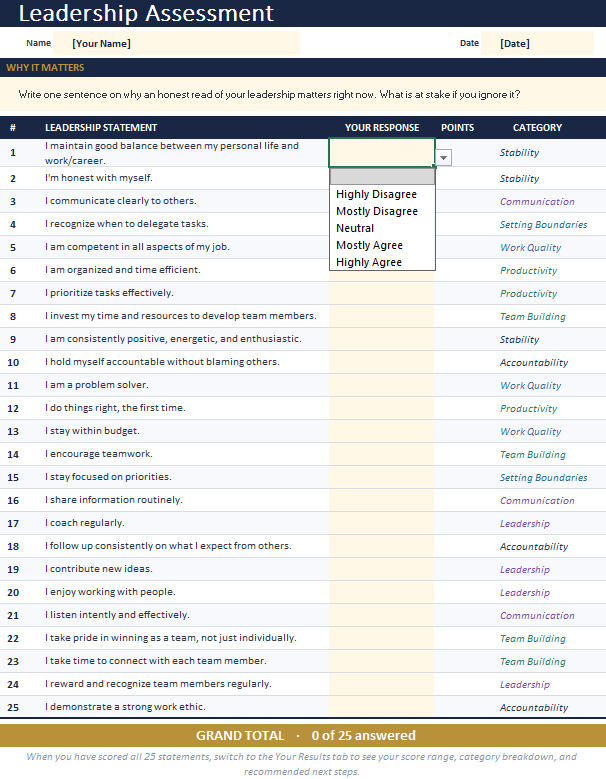
For each statement, pick from five options: Highly Agree, Mostly Agree, Neutral, Mostly Disagree, Highly Disagree.
In Excel, use the dropdown in the Your Response column. Points calculate automatically. In PDF or Word, place a checkmark in the matching column and multiply checkmarks by the column's point value at the end. Either way, the scoring math is identical.
The point values are:
- Highly Agree = 12
- Mostly Agree = 9
- Neutral = 6
- Mostly Disagree = 3
- Highly Disagree = 0
Maximum possible score: 300
Trust your first instinct. Stay in the spirit of the question. If a statement doesn't quite fit your circumstance, make minor adjustments, but don't skip questions, or your category breakdown won't tell you anything useful.
STEP THREE: Read Your Score and Category Breakdown
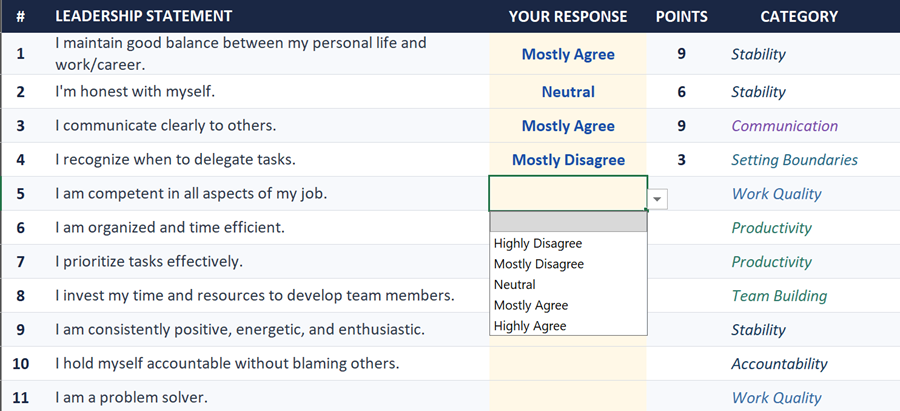
Your total score lands in one of four ranges. Use the range to set your expectations, then use the category breakdown to choose where to focus.
What Does My Score Mean?
See the following score definitions to determine your current level of leadership development:
270 – 300
Very Strong Leadership Skillset: Real depth and consistency. Focus on coaching others and sharing what you've built. The opportunity here is multiplying your impact through the people you lead.
225 – 269
Strong Leadership Skillset: Your expertise has grown noticeably. The opportunity is in fine-tuning the specific areas pulling your average down. Small improvements at this level make a big difference.
150 – 224
Developing Leadership Skill Set: An average leadership skill set with clear room to grow. The fundamentals are present, but consistency is uneven. Pick one focused area and build a habit around it for 30 days.
Below 150
Early-Stage Leadership Skill Set: You're early in your leadership journey, and that's useful information, not a problem at all. Pick one area, practice one small behavior consistently for 30 days, then reassess. Progress, not perfection, is the goal.
Once you identify your current level of leadership development, you'll want to determine what you can do next to proactively address areas for improvement.
You have four ways to take this assessment. The Excel version handles the math automatically and gives you an instant category breakdown — easiest for most people. The PDF and Word versions are scoreable on paper. The AI version walks you through the assessment and helps you draft a 30-day action plan on the spot.
Ready for the full 25-question assessment with complete scoring and an action plan?
Here's What You’ll Get
A 25-statement leadership assessment covering eight skill categories that define leadership effectiveness:
- A clear scoring system so your results are consistent and easy to interpret
- A category breakdown that tells you where to focus, not just what you scored
- Four score ranges with practical guidance for what to do next
- A built-in example (Excel version) that shows what a completed assessment and results page look like
- A 30-day action plan to immediately improve your results (Excel and AI versions)
How the Scoring Works (simple overview)
Each response carries a point value: Highly Agree = 12, Mostly Agree = 9, Neutral = 6, Mostly Disagree = 3, Highly Disagree = 0. Your total score is the sum of all 25 responses, with a maximum of 300.
In the Excel version, this happens automatically. You pick a response from the dropdown and the points, category averages, and total all calculate in real time. In the PDF and Word versions, you place checkmarks in columns and tally at the end.
Tip for Best Results:
Answer honestly. The goal here is to spot the few areas worth your attention next. Your first instinct is usually the most accurate read. If you find yourself debating between two responses, pick the lower one. The point is to get a useful signal, not a flattering one.
"Most of what we call 'management' consists of making it difficult for people to get their work done."
- Peter F. Drucker
What This Assessment Measures
Our leadership assessment identifies 25 key skills that define leadership effectiveness and potential. It helps you identify areas of strength and skills that may require additional development.
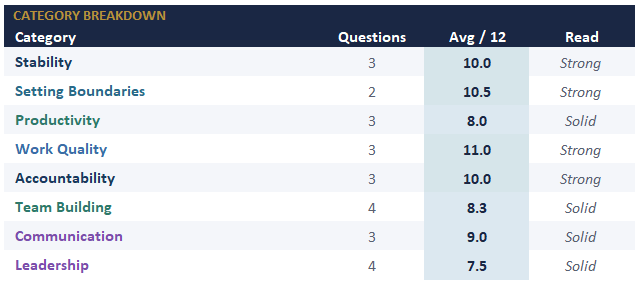
The Eight Leadership Categories
Stability
Self-awareness, emotional control, and steady presence — especially when things get hectic. Leaders who score well here become the calm in the room.
Setting Boundaries
Clear expectations and guard rails for personal and professional behavior. Knowing what to say yes to, what to say no to, and what to delegate.
Productivity
The difference between working hard (or appearing busy) and producing real results. Prioritization, organization, and time efficiency.
Work Quality
Holding yourself and others accountable for finishing strong — doing it once, doing it right, minimizing rework.
Accountability
Owning decisions and results without blaming others. Setting the standard your team will follow.
Team Building
Investing in people. Recognizing that no one person is as strong as the team working together.
Communication
Sharing information routinely, listening effectively, and keeping people aligned to priorities.
Leadership
Coaching, contributing new ideas, recognizing the team, and bringing the kind of energy others want to follow.
Who this leadership assessment is especially helpful for:
- People early in their management careers
- New or aspiring leaders
- Frontline managers who want a practical reset
- Anyone currently struggling in a leadership role
- Students, athletes, and anyone responsible for leading others
- Solopreneurs and small business owners leading contractors or small teams
How to Use Your Results (Action Plan)
Your score is the starting point. Your action plan is what creates change.
The goal isn't to fix everything. The goal is to pick one or two specific leadership behaviors and practice them consistently for the next 30 days. Small, repeatable changes are what your team actually notices — and what your category breakdown is pointing you toward.
Below is the eight-step process I recommend after you score your assessment.
Step 1: Review your results the right way (5 minutes)
Before you choose what to work on, pause and do a quick scan for patterns. This step helps you avoid a common trap: reacting emotionally to one low score and trying to overhaul everything at once. Instead, you’ll read your results like a leader - calmly, objectively, and with an eye toward what will make the biggest practical difference.
Think of your score as information, not a judgment. Your job is to spot what your results are consistently telling you, then choose one clear starting point you can act on immediately.
Do a quick scan for patterns:
Strength Patterns:
Look at the categories where you scored highest (Avg / 12 = 10 or above). These are your leadership assets. Keep using them on purpose.
Development Patterns:
Look at the categories where you scored lowest (Avg / 12 = 5 or below). These are your highest-leverage improvement opportunities.
Consistency Check:
- Did you score low across a whole theme (ex: productivity + prioritization + organization)? If yes, that’s often a sign of overload or unclear priorities, not lack of ability.
Context Check: Answer honestly
- “Where am I leading right now (work, volunteer, family, school, athletics)?”
- “Which results are being influenced by stress, workload, or lack of support?”
Important: Don’t turn one low area into a negative story about yourself. Leadership skills are learnable.
Step 2: Pick Your “Top 3” Opportunities (Don’t Pick 10)
Identify the 3 categories where you scored lowest. In the Excel version, these are easy to spot. The Avg / 12 column is color-coded, and the lowest categories show up in the cooler/lighter tones.
Then ask yourself:
- Which of these causes the most friction in my week right now?
- Which one, if improved, would make everything else easier?
If you’re unsure, start with one of these high-leverage foundations:
- Communication clarity
- Prioritization and focus
- Delegation
- Accountability/follow-through
- Listening and connection
Step 3: Choose ONE Priority for the Next 30 Days (Focus Creates Momentum)
This is the point where real growth starts, because focus turns insight into action. When you choose one priority, you’re not saying the other areas don’t matter. You’re simply giving yourself a realistic target you can practice consistently, even on busy weeks.
A 30-day window is long enough to build a noticeable habit, but short enough to stay motivating. It also gives you a clean way to measure progress: “Did I practice this often enough to see a difference?”
Small, repeated leadership behaviors are what your team will notice the most, and those same behaviors will fuel your results.
Use This Filter to Select Your First Focus Area
- Impact: Will improving this noticeably help my team/customer results?
- Frequency: Do I face this situation weekly (or more)?
- Control: Can I personally practice this without needing a major system change?
Examples of Strong 30-day Focus Choices
- “I want to become more consistent at setting clear priorities.”
- “I want to improve how I delegate so I’m not the bottleneck.”
- “I want to handle accountability conversations sooner and more respectfully.”
- “I want to strengthen recognition and morale on my team.”
Step 4: Turn Your Priority into a Single Measurable Behavior
This is where most leaders get stuck: they pick a theme (“communication”) but not a behavior.
Themes are useful, but they’re too broad to practice - and if you can’t practice it, you can’t improve it. That’s why this step matters so much.
A measurable behavior is something you can do on purpose, on a specific cadence (daily/weekly), in situations you already face. It also gives you a clear way to answer, “Did I actually work on this?” instead of relying on a vague feeling.
A good test is this: if an outside observer watched you for a week, could they clearly tell whether you did the behavior or not? If the answer is yes, you’ve chosen a behavior you can build into a real leadership habit.
Pick One Behavior That Is:
- Specific (easy to understand)
- Observable (someone else could see it)
- Repeatable (weekly, not once a year)
- Small enough to do even when busy
Examples (choose one that matches your priority)
If your focus is Communication:
- “I will end every meeting with a 60-second recap: decisions, owners, deadlines.”
- “I will send a short ‘what matters this week’ message every Monday.”
- “Before giving direction, I will confirm understanding by asking, ‘What are you taking away from this?’”
If your focus is Delegation:
- “Each week, I will delegate one task I’m holding that someone else can learn.”
- “When I delegate, I will define what ‘done’ means and when I want an update.”
- “I will delegate outcomes, not just tasks (what success looks like, not how to do every step).”
If your focus is Accountability / Follow-through:
- “For any task that takes longer than two days, I will confirm expectations in writing.”
- “I will address missed commitments within 24–48 hours (calmly and clearly).”
- “I will set one clear deadline and one checkpoint, instead of vague timelines.”
If your focus is Productivity / Prioritization:
- “I will choose my top 3 priorities daily and protect time for the most important one.”
- “I will stop starting new work before finishing the current priority.”
- “I will reduce rework by defining quality standards before work begins.”
If your focus is Team Building / Recognition:
- “Each week, I will recognize one specific behavior and its impact.”
- “In 1:1s, I will ask one growth question before giving advice.”
- “I will schedule one meaningful check-in conversation with each team member monthly.”
Step 5: Apply Your Commitment in a Real Situation This Week
Pick a predictable moment where you can practice immediately:
- Your weekly team meeting
- A project handoff
- A 1:1 check-in
- A deadline conversation
- A conflict or performance issue you’ve been avoiding
This matters because leadership improves in real moments, not in theory.
Step 6: Get Feedback (small, safe, and specific)
You don’t need a formal review process to get useful feedback.
Choose one person (peer, supervisor, team member, client) and ask one question:
- “What’s one thing I did this week that made your work easier?”
- “Where would you like more clarity or consistency from me?”
- “What’s one thing I could do differently next time to support you better?”
Tip: Ask for “one thing,” not a full evaluation. It keeps the conversation easy and honest.
Step 7: Track one simple metric (so you can see progress)
Pick one sign that improvement is working. Keep it lightweight:
Examples:
- Fewer follow-up questions from the team (communication clarity)
- Fewer missed deadlines or surprise escalations (accountability)
- More tasks completed without your involvement (delegation)
- Less rework or fewer errors (work quality)
- Better meeting outcomes (clear decisions and owners)
- Improved morale signals (more engagement, more initiative)
Write it down weekly in one sentence: “What did I do? What happened as a result?”
Step 8: Reassess and Adjust (30–90 days)
Retake the assessment in 30–90 days and compare your category breakdown side-by-side.
The total score matters less than what shifted underneath it — that's where you'll see whether your one focused habit actually moved the needle.
“Leadership development is self-development.”
— John G. Agno
When you reassess, ask:
- What improved?
- What still feels stuck?
- Do I need a better system (process/tools) or a better skill (conversation/behavior)?
Then either continue the same focus area for another month or choose the next priority from your Top 3.
One last thing: If your results reveal gaps, you're not behind, you're informed. The strongest leaders aren't the ones who never struggle. They're the ones who notice what needs to change and act on it. Pick one improvement and practice it consistently. That's the key to long-term success.
360-Degree Feedback Option (Deeper Analysis)
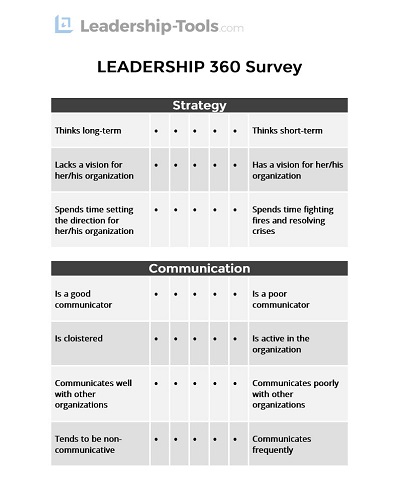
After you review your assessment results, you may want a deeper read on your leadership, especially how other people perceive your effectiveness, not just how you see yourself.
For that, use our 360 Degree Feedback Leadership Survey. It's a natural next step once you've identified your focus area from this assessment.
How to Use Both Tools Together
Step 1: Take the Leadership Assessment (self-view)
Step 2: Take the 360 Survey (to see how others view you as a leader)
Step 3: Compare results and select your top 1–2 development priorities for the next 60–90 days
Frequently Asked Questions (FAQ)
Is this leadership assessment really free?
Yes. The Excel, PDF, Word, and online AI versions of this Leadership Assessment Tool are all free.
How long does it take?
Most people complete the full assessment in 10–15 minutes. The Excel version scores automatically; the PDF and Word versions take an extra 5 minutes to tally.
Who should use a leadership assessment?
New managers, aspiring leaders, team leads, small business owners, students/athletes - anyone responsible for leading others.
How often should I retake the assessment?
Every 30–90 days is a helpful rhythm, especially if you’re actively building one leadership habit.
What should I do after I get my score?
Look at your category breakdown, not just your total. Pick the one or two categories scoring lowest, choose a single weekly behavior to practice, ask for feedback, and reassess in 30 days. The Action Plan section above walks you through the full process.
Can I use this assessment for hiring or promotions?
This tool is designed for self-development and coaching, not high-stakes employment decisions.
What if I score low?
A low score isn’t a verdict; it’s a starting point. Choose one area, practice one small behavior consistently for 30 days, and reassess. Progress is the goal.
What's the difference between the Excel, PDF, Word, and online versions?
All four use the same 25 statements and the same scoring math, so your result is consistent across formats. The differences are in the experience:
- Excel — pick a response from a dropdown, points calculate automatically, your category breakdown and reading update in real time. Includes a completed example tab so you can see what good results look like before you start.
- PDF and Word — print-ready, scoreable on paper. Best if you want to fill it out by hand or share it with a coaching client.
- Online AI version — walks you through the assessment conversationally and helps you draft a 30-day action plan on the spot.
Most people start with the Excel version because it does the math for you and shows the category breakdown automatically.
Download Leadership Assessment Tool

To access all of our leadership tools simply subscribe to our free newsletter. You will immediately receive a password that grants access to our entire leadership tools library.
Your privacy is important to us. We never share or sell email addresses.
More Self-Leadership Tools




Contact Information:
phone
(503) 970-9777
Email Customer Service
helpsupport@leadership-tools.com
Email Richard
richard@leadership-tools.com

By Richard Gorham
Leadership-Tools.com
2879 Riverwalk Loop, Eugene, Oregon, 97401
Copyright (c) 2003 - 2026 All Rights Reserved