
Twice a year is a good rhythm for most teams, or quarterly during fast growth or after a reorganization. Rerun it and compare your Develop Now counts over time rather than chasing individual scores. The pattern tells you more than any single number.
- Home
- Leading People
- Management Development Assessment
Management Development Needs Assessment (Free and Simple)
If you are trying to grow as a manager (or help other managers grow), you do not need a complicated “program” to get started. You need clarity. That is what this management development needs assessment is for.
This is a practical, easy-to-use way to identify skill gaps, pick a few high-impact development goals, and turn “we should train our managers” into an actual plan you can run in the real world.
Download Management Development Needs Assessment:
It works for new and experienced leaders, small-business owners with a small or remote team, and HR/L&D pros or coaches who want something they can plug into training right away.
You can use it as a self-assessment, a manager-and-coach conversation starter, or a lightweight management training needs assessment for your whole team. It is part of our larger library of free and low-cost leadership tools and resources built for busy people like you.
You are busy. Your team needs you. And somewhere in the background, you know you should be developing your management skills (or building stronger managers around you).
This page gives you a straightforward management development needs assessment tool you can use to spot the biggest skill gaps, choose a realistic development focus, and follow through without turning it into a long, stressful project.
Jump To: Overview | Who This Tool Is For | Why It Matters | What You Get, What You Don't Get |How the Tool Works | Step-by-Step Instructions | Interpreting Results & Examples | How to Avoid Pitfalls | FAQ | Get Updates Free |Download Template
Overview
Most management development fails for one simple reason. People jump straight to training without pinning down what needs to change.
A needs assessment fixes that. It helps you slow down for just long enough to answer, “What should we develop next, and why?” Then you can invest your limited time, money, and energy in the areas that will make the biggest difference.
This tool is designed to be practical, not perfect. You can run it in a single sitting for yourself, or roll it out across a team with minimal admin.
At the end of the assessment, you will have what you need to create a short list of priority skills and a simple action plan that you can start this week.
Who Is This Management Development Needs Assessment For
If you are wondering “Is this for me?” the answer is probably yes.
This management development needs assessment tool is built for:
New managers

- You want a clear baseline. You also want to stop guessing what “good management” means day to day.
Experienced managers
- You are ready to level up, but you do not want another generic workshop. You want targeted growth that shows up in your team’s results.
Small-business owners and solopreneurs with a team
- You might not have HR. You still need consistent communication, fewer misunderstandings, and less drama. This helps you put a simple development system in place.
HR/L&D professionals and leadership coaches
- You want a plug-and-play management training needs assessment that supports coaching, training plans, and better conversations with managers.
This tool also works well for remote teams because it makes expectations and feedback more explicit.
Why Doing a Management Analysis Is Important
Management development is not just “nice to have.” It is how you reduce friction and increase trust in the places that matter most: priorities, deadlines, and hard conversations.
A good manager creates clarity. A struggling manager creates noise. A needs assessment helps you target the few changes that reduce the noise fastest. Leaders should always be seeking to leverage tools and resources that support ongoing improvement. Complete this short exercise and discover which areas are needing some extra attention.
What improves for the individual leader
- You stop trying to improve everything at once.
- You get language for what you are working on (and what you are not working on right now).
- You get a plan that fits your real calendar.
What improves for the team
- More consistent expectations.
- Fewer surprises and fewer emotional “blow ups” because feedback becomes normal and specific.
- Better one-on-ones, clearer delegation, and fewer dropped balls.
What improves for the organization
- Less rework, fewer preventable people issues, and more predictable delivery.
- Stronger bench strength when you need someone to step up.
- Better retention, because people often quit managers, not companies.
Best, of all, our management development needs assessment also protects you from wasting money. Training is expensive. Time is expensive. This tool allows you to recognize your strengths and weak spots, without the heavy expense.
What You Get (And What You Do Not)
Before you dive in, let’s keep expectations clear and honest.
What you get:
- A clear snapshot of management strengths and gaps.
- A prioritized list of development targets.
- A simple way to align a manager, their supervisor, and/or a coach on what “better” looks like.
- A lightweight structure you can repeat quarterly or twice a year.
What you do not get:
- A clinical evaluation.
- A guarantee of performance change without follow-through.
- A one-size-fits-all “score” that tells you whether someone is a good or bad manager.
This is a practical (and powerful) tool, not a label-maker.
How The Management Development Needs Assessment Tool Works
This management development needs assessment tool is meant to feel simple in your hands, not “HR-heavy.”
"Not knowing where to begin is a common form of paralysis. Managers can begin to develop by assessing their existing skill-set starting right here."
You’ll work through a short set of core manager skill areas, rate what’s happening right now (based on real behavior you can point to), and then use the results to choose a small number of development priorities.
From there, you turn those priorities into a practical plan, what to practice, how to get feedback, and when to check in so it sticks.
This management development assessment template is built around a simple pattern:
Step One: Rate every task on two scales
The tool lists 47 tasks a working manager handles, grouped into seven categories under three phases (Leading Self, Leading People, Leading Teams). Rate each on Importance, how much it matters to the job you hold right now, and Difficulty, how hard it is for you to do well today. Go fast. Your first instinct is usually the honest one.
Step Two: Multiply the rows that matter
For each task you rated 4 or 5 on importance, multiply Importance by Difficulty. That's your score, from 1 to 25. Skip the rest: a task you rated 3 or below for importance tops out at 15, so the math has already answered it. Most people do about a dozen multiplications, not 47.
Step Three: Sort each score into a band
Every score falls into one of three bands. 20 to 25 is Develop Now. 12 to 19 is Plan It Next. 1 to 11 is Not This Quarter. The band tells you what kind of response fits, and it keeps you from booking a workshop for something a short conversation would fix.
Step Four: Find your focus phase
Copy your five highest scores, then read the Phase and Category columns. Whichever phase repeats is where your attention belongs, and it points to the part of the library to open next. If three or more share a category, that's your theme; if they're scattered, take the top two by score.
Step Five: Build a two-priority plan
Pick two priorities from your top five, not four. Give each one a weekly practice on live work and one person who will tell you the truth about how it's going. Set a check-in date thirty days out. Two priorities means two of everything.
You can run this as:
- A self-assessment (fastest)
- A manager + supervisor alignment tool (most useful for promotion readiness and performance)
- A coaching intake tool (great for coaches and L&D)
- A team-wide assessment (best for planning a training calendar)
At the end of the process, you’re not left with a vague “we should develop our managers” takeaway. You’ll have a clear picture of the few skills that will make the biggest difference right now, plus a simple next-step plan you can run, even in a busy week.
If you want to create extra traction, share the results with a supervisor, coach, or HR partner so your priorities get reinforced with real feedback and a scheduled check-in.
Step-By-Step: How To Run This Needs Assessment
You do not need a big rollout or a complicated HR process to get value from a management development needs assessment. You just need a repeatable way to collect honest input, pick a few priorities, and a path for consistent follow through.
In the steps below, you’ll see a few simple ways to run this management development needs assessment tool, depending on your situation, whether you’re assessing yourself, aligning with a supervisor or coach, or rolling it out across a small team.
Pick the option that fits your reality right now and keep things simple enough that you'll do it.
Option 1: Self-Assessment (30–45 minutes)
Start here if you are a solo leader, a founder, or a manager who wants a clear starting point.
Choose your assessment window
- Pick the last 60–90 days. Recency reduces “storytelling” and keeps you honest.
Rate yourself quickly
- Your first pass should be instinctive. Do not overthink it.
Pick your top two focus areas
- Two is enough. Three can work. More than that usually becomes “none of them.”
Write one behavior you will start doing
- Make it concrete. For example, “I will end every meeting with owners and deadlines,” not “I will communicate better.”
Schedule a feedback check-in
- Put it on the calendar now. If it is not scheduled, it is a wish.
Option 2: Manager + Supervisor (45–60 minutes)
This is the simplest way to improve development conversations and reduce awkward annual-review surprises.
Both people complete the assessment separately
- Do not negotiate ratings as you go. Rate first, compare second.
Compare answers and discuss gaps
- You are looking for differences in perception. Those differences are the conversation.
Agree on two development priorities
- Tie them to outcomes. For example, “improve delegation so projects stop bottlenecking.”
Set a 30-day practice plan
- Practice, not theory. Small actions repeated weekly beat big intentions.
Agree on how you will measure progress
- Use a visible signal. Examples include fewer escalations, faster turnaround, clearer handoffs, improved one-on-one cadence, or fewer missed deadlines.
Option 3: Team-Wide (lightweight rollout)
If you support multiple managers, keep it simple.
Decide your goal
- Are you planning training? Coaching? A new manager program? Be clear.
Choose 8–12 skill areas
- Too many makes the results useless. Keep it focused.
Collect results and look for patterns
- You are not hunting for “bad managers.” You are identifying common training needs.
Build a short learning path
- One core topic per month is usually plenty. Use your results to choose the order.
If you want more support materials, connect this page back to the free leadership tools and resources library, especially the Leading People tools for managing your team.
Once you’ve picked the option that fits your situation, keep the goal simple: create clarity and momentum, not a perfect score.
Choose two priorities, turn each one into a small weekly practice, and schedule a check-in date before you move on. That follow-up is what converts a management training needs assessment into real management development. I
f you want to go one step further, share your priorities with a coach, HR partner, or a trusted peer for accountability, and then pull in additional support from the Leading People tools for managing your team and more leadership assessment tools as you’re ready.
"It is through a genuine effort for personal development that the full potential of the individual and the entire human race can be realized.
- United Nations
Interpreting Results: Turning Ratings into a Plan
Getting ratings is the easy part. The real value comes from what you do next, turning a handful of numbers and notes into a focused plan you can follow in a busy week.
In this section, you’ll learn how to spot the few gaps that matter most right now, translate them into clear development priorities, and choose simple actions that create visible progress.
The goal is not to “fix everything.” It’s to pick the highest-impact skills, practice them on the job, and build a feedback loop so the improvement sticks.
Use this quick filter to prioritize:
Pain
- Which gaps are causing daily frustration, rework, conflict, or delays?
Risk
- Which gaps could create serious issues if they continue? For example, unclear expectations, inconsistent feedback, or poor hiring decisions.
Leverage
- Which gaps, if improved, would make other things easier? Communication and delegation are classic leverage skills.
Readiness
- Which gap is the manager most willing to work on right now? Motivation matters.
Then build a simple plan that includes:
- One skill goal (not five)
- Two weekly practices
- One feedback source
- One check-in date
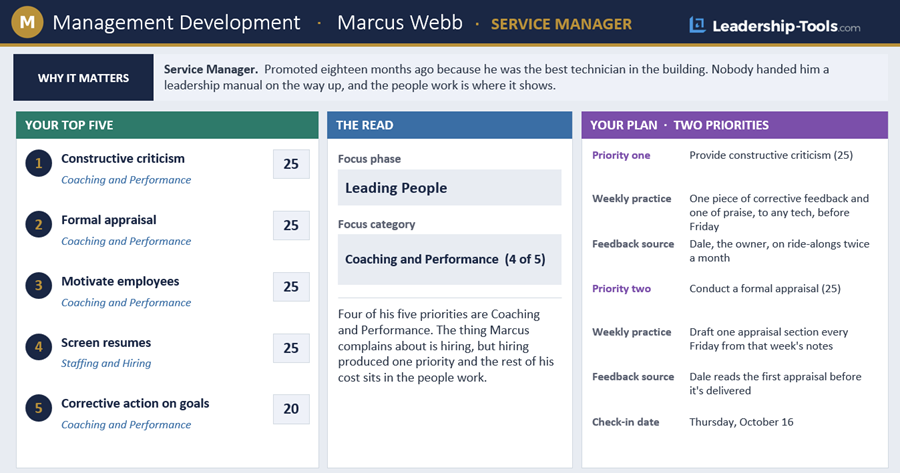
Example: Marcus, a Service Manager
Marcus runs service for a 22-person heating and cooling company, with nine technicians reporting to him. He got the job because he was the best tech in the building, not because he possessed proven leadership skills. So when he ran the management development needs assessment, the result was telling: four of his five top priorities landed in the same category, Coaching and Performance.
What makes his case interesting is the gap between what he complains about and what the assessment turned up. Marcus will tell you his problem is hiring, and sure enough, hiring produced one high score. But the real gap was sitting somewhere he'd never thought to look, in the people work nobody trained him for: giving honest feedback, running an appraisal, keeping a crew motivated on a rough day.
So he kept it simple and picked two things to work on, constructive criticism and the formal appraisal. Each one got a weekly practice and a person to answer to, his owner Dale, who agreed to check his work along the way. Then he set a date thirty days out to see what had changed.
Example: Dana, a Newly Promoted Operations Lead
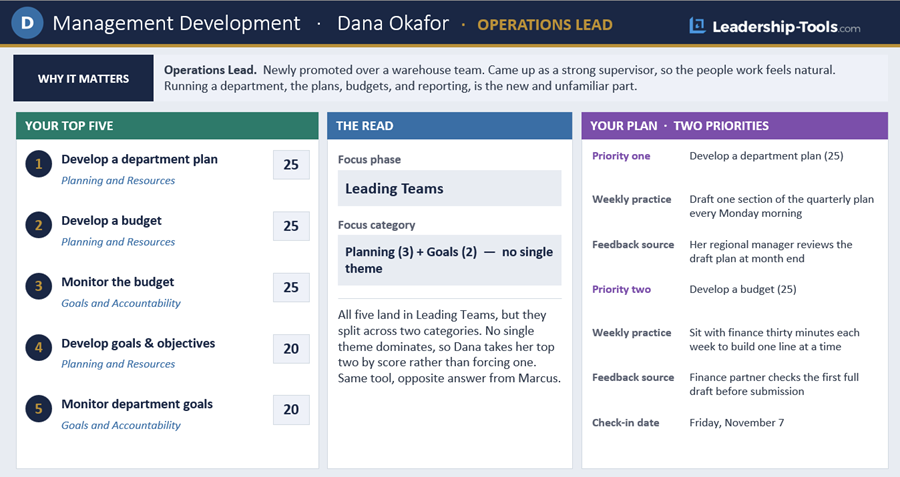
Dana had just taken over a warehouse team. She'd come up as a strong supervisor, so the people side of the job felt like second nature to her. What was new was everything that came with running a whole department: the plans, the budgets, the reporting she'd never had to own before.
Her assessment told a completely different story from Marcus's. All five of her priorities landed in Leading Teams, but they split across two categories, Planning and Resources on one side and Goals and Accountability on the other. Since no single theme rose to the top, she did what the tool suggests in that situation and took her highest two scores: build a department plan, and build a budget.
Same assessment, opposite answer. What one manager most needs to work on is rarely what the next one needs, and this assessment provides you with the numbers that help you decide.
Common Pitfalls (And How To Avoid Them)
Even a simple assessment can go sideways if people treat it like a scorecard, rush through it, or skip the follow-up. I’ve seen well-meaning leaders download a tool like this, fill it out once, nod at the results, and then go right back to firefighting because nothing changed on the calendar.
The good news is these pitfalls are predictable, and they’re easy to prevent with a few small choices.
In this section, you’ll see the most common ways a management development needs assessment tool gets misused, plus practical fixes that keep the process fair, useful, and focused on real improvement.
Here's a few watch-outs will keep you on track.
Pitfall: Treating the tool like a test
Fix: Treat it like a map. The goal is better conversations and better focus, not a perfect score.
Pitfall: Rating personality instead of behavior
Fix: Anchor ratings to examples. “In the last month, how often did this happen?”
Pitfall: Choosing too many priorities
Fix: Choose two. If everything is a priority, nothing gets practiced.
Pitfall: Using it to “prove” someone is failing
Fix: Use it to define support and expectations. If performance management is needed, be direct and fair, but do not hide it inside a development tool.
Pitfall: No follow-up
Fix: Schedule the next check-in before you close the conversation. Development without follow-up is just good intentions.
Pitfall: Copying a big-company program into a small team
Fix: Scale down. Small teams win with simple rhythms: clear expectations, weekly check-ins, and a few repeatable feedback habits.
If you remember one thing, make it this: the assessment is only as useful as the next two weeks. Keep the tool focused on real behaviors, choose just a couple priorities, and lock in a follow-up date before everyone gets busy again.
When you treat the results as a starting point for practice and feedback (not a verdict), you’ll get what you want from management development: clearer expectations, calmer communication, and steady improvement that your team can feel.
Frequently Asked Questions (FAQ)
A management development needs assessment should reduce confusion, so here are the questions people usually ask before they use a tool like this.
Click on the (+) sign below to expand each question. Click the (-) sign to collapse it again.
How often should we run a management development needs assessment?
Should this be a self-assessment, or should others rate the manager too?
Either works. A self-assessment is fastest, and it's honest as long as you rate for the job you hold today. For promotion readiness or a coaching relationship, have the manager and a supervisor rate separately, then compare. The gaps between the two ratings are usually the most useful part of the exercise.
Can I use this tool for new managers?
Yes, and new managers often get the most from it. Someone recently promoted will flag more tasks as Develop Now, which is normal. The instruction is the same: pick two priorities, not ten, and build a plan around those. The rest will still be there in ninety days, and several will have shrunk once the first two improve.
What if the manager's self-ratings and the supervisor's ratings are very different?
Treat the gap as the finding, not a problem to smooth over. A task the manager rates easy and the supervisor rates hard is worth a direct conversation. Rate separately first so neither anchors the other, then talk through the tasks where you disagree most.
Is this only for corporate environments?
No. The 47 tasks are the everyday work of running a team, so the tool fits a small-business owner with a few employees, a shift supervisor, a nonprofit lead, or a department head in a large company. Rename or skip any task that doesn't fit your world; the method still holds.
How does the scoring work?
Each task gets two ratings from 1 to 5: Importance and Difficulty. Multiply them for a score out of 25. Importance governs, so a task you rate low on importance can't reach the top band no matter how hard it is. Scores of 20 to 25 are Develop Now, 12 to 19 are Plan It Next, and 1 to 11 are Not This Quarter.
What are the three phases and seven categories?
The 47 tasks sit under three phases of leadership. Leading Self covers self-management and feedback. Leading People covers staffing and hiring, coaching and performance, and difficult situations. Leading Teams covers planning and resources, goals and accountability, and team communication. Your top five point you to a phase, and the phase points you to the tools worth opening next.
Download Free Management Needs Analysis Tool
Want the entire leadership tools library? Subscribe to our free newsletter and we'll send you a link to every tool on this site, all on one page, sorted by leadership phase. Every tool is free to download on its own page. The library just puts them in one place. Plus, you'll never miss out on updated or new tool announcements.
Your privacy is important to us. We never share or sell email addresses.
Leadership Tools Newsletter
Subscribe Free - See All Tools on One Page - Get New Tool Alerts
More Leadership Tools for Managing Your Team




Contact Information:
phone
(503) 970-9777
Email Customer Service
helpsupport@leadership-tools.com
Email Richard
richard@leadership-tools.com

By Richard Gorham
Leadership-Tools.com
2879 Riverwalk Loop, Eugene, Oregon, 97401
Copyright (c) 2002 - 2026 All Rights Reserved