A skip-level review is a 30-minute, one-on-one conversation between a leader and each person who reports to one of their managers. You ask about the person's work, how they're led, and where they want to go. Then you look across all the conversations for patterns and take those patterns back to the manager as coaching.
- Home
- Leading Teams
- Skip-Level Review
Skip-Level Review for Managers of Managers
A skip-level review is a 30-minute conversation between you and each person who reports to one of your managers. Our free skip-level review form gives you the question bank, an Interview Notes page for each person, a Theme List, and a Feedback Discussion guide for the manager. The skip-level review is a structured format for running skip-level meetings. This is designed for managers who lead other managers of people.
The Leader's Guide walks you through the entire process and also provides a completed example from start to finish.
If you lead managers who lead other team members, most of what you know about the front line reaches you through your direct reports. Good managers tell you the unvarnished truth, but you're still hearing what's happening through the lens of the managers, not directly from their team members.
A skip-level review is how you hear from the entire team directly, and it does two important jobs. It keeps you connected to every person in your organization, so that when something goes wrong, they come to you without hesitating, because they know you well enough to know you'll help. It also gives you facts about how the manager is experienced by their people, and that's the most useful coaching material a leader of leaders ever gets.
Skip-Level Review Form:
Skip-Level Review Leader's Guide:
Performance Coaching Review Log:
Skip-level review at a glance
| Formats | PDF, Word, Google Docs (log in Excel and Google Sheets) |
| Ideal for | Leaders who manage managers |
| Includes | Skip-Level Review form (5 pages) + Leader's Guide (12 pages) |
| Best for | Teams of 3 to 10 people under each manager |
| Pairs with | Performance Appraisal, Succession Planning |
Which file do you need?
| Print the Skip-Level Review form for each round: the question bank, one Interview Notes page per person, the Theme List, and the Feedback Discussion. | |
| Read the Leader's Guide once before your first round. It has the scripts, the two-person rule, and Dana's example from start to finish. | |
| Log the agreed actions in the Performance Coaching Log, the same spreadsheet you use for coaching and appraisals. |
Jump To: What a Skip-Level Review Does | How Often | Setting It Up | The Meeting Format | Questions to Ask | Three Situations | Finding the Themes | Coaching the Manager | Example | FAQ | Download
What a Skip-Level Review Does

A skip-level review is a listening tool. You ask each person about their work, about how they're led, and about where they want to go in their career. Then you look across all the conversations for patterns, good or bad, and you take the patterns back to the manager as coaching.
The manager's performance review is a separate conversation held at a different time, and what you learn in a skip-level will help to inform that review through the patterns you identify, the same way anything else you observe during the year does.
If the team senses the skip-level is an inspection of their boss, they may stop telling you anything useful, so go into those conversations with the honest intent of building rapport, learning, and supporting.
| Use a skip-level review to | Don't use it to |
| Stay connected to the people two levels down | Check up on a manager you've already made your mind up about |
| Hear how the team experiences their manager, and identify useful patterns for coaching and recognition | Collect ammunition for a performance conversation |
| Find out what the team needs that it isn't getting | Fix problems yourself over the manager's head |
| Spot who's growing and who needs more support | Decide who gets promoted |
Trust builds over time. The first time you do a skip-level review, people don't know what to expect. They'll be polite and a little guarded, and a few will wonder what you're really looking for. That's normal. Somewhere around the third or fourth round they stop wondering, because nothing they said has come back on them and the issues they raised have improved. Go into the first round knowing it takes time to establish trust. Trust the process.
How Often to Run Skip-Level Reviews
Quarterly is ideal, but depending on the size of the team, you should plan for scheduling skip-level reviews at least twice a year for every team you're responsible for. Your managers should also know that you reserve the right to talk with anyone in your organization whenever you like, and they should understand that as normal, not something to fear or be concerned about.
Make clear your intent and that you will be sharing helpful information learned from your conversations.
| Team size | A round takes | Cadence |
| 3 to 5 people | Half a day of interviews | Quarterly works well, and the whole round fits in a morning. |
| 6 to 10 people | Two to three a day across a week | Twice a year. Book the week early. |
| 11 or more | Two weeks, three a day at most | Twice a year. Protect the dates, because this is the round that gets pushed. |
| A new manager | One round about 90 days in | Then join the normal schedule. The team will tell you things the new manager can't see yet. |
Setting Up a Skip-Level Review
Tell the manager first
A manager should never hear about you conducting a skip-level from their team. If they do, they will assume the worst, and so will the team.
Be upfront with everyone, say what it is you are doing, when it's happening, and what you'll do with what you hear, and then ask your managers what they'd like you to listen for. That one question turns what can be perceived as an inspection into an exercise meant to identify what's working well and any gaps, and most managers will appreciate your efforts.
If the manager pushes back. Some will not be comfortable with you going directly to their team, and the usual concern is "it undermines me." This concern should be answered directly. The purpose of skip-level discussions is to create rapport with the team and to hear firsthand what's going well and if there are any gaps that you can address for them.
By meeting with team members directly, you'll hear patterns over time, which you will share with the manager, and nothing happens without them in the loop. Then schedule the dates. If you have a manager who can't tolerate you talking with their people that may signal a bigger issue, but don't rush to judgment. The skip-level discussions will tell you what you need to know.
Announce it to the team

Send one email to the whole team with the question bank attached. People who've seen the questions arrive with examples ready, and people who haven't arrive wondering whether they're in trouble and spend the first ten minutes finding out they're not. The Leader's Guide has the email written out for you. Edit as you see fit.
Next, book the meetings on the calendar. Thirty minutes each, with a 15-minute buffer after each one for completing your notes while the information is still fresh in your mind. Conduct no more than three or four skip-level conversations in a day. Use a private room with the door closed. If distance is an issue, a video call with your camera on and your own door closed will work, but face-to-face is the preferred approach. Never conduct skip-levels out in the open.
The Skip-Level Meeting Format: 30 Minutes in Three Parts
The agenda is the same every time, and the team knows it in advance, which is part of what makes the skip-level review feel safe for everyone. Ten minutes on the employee, ten on the manager, and ten on where the employee wants to grow, with two minutes at each end for the opening script and their questions for you.
| Minutes | What happens |
| 0 to 2 | Open with the script. It carries the confidentiality promise and its one exception, and people need to hear both before you ask the first question. |
| 2 to 12 | The Employee (E). Their work, their goals, what they enjoy, and what gets in their way. Start here because it's the easiest part to talk about. |
| 12 to 22 | The Manager (M). Style, with an example. What the manager does well, and what they could do more of or differently. One-on-ones, and whether they feel supported. |
| 22 to 28 | Opportunities for Growth (O). Where they want to be, what they're doing about it, and what they'd like a shot at. End here so the conversation finishes looking forward. |
| 28 to 30 | “Do you have any questions for me?” Answer as openly as you asked them to. Thank them, and tell them when they'll hear from you if follow-up is needed. |
The first two minutes matter more than any question you'll ask, because they set up the confidentiality promise and its one exception. Say the script below the same way every time, and the team will come to expect it.
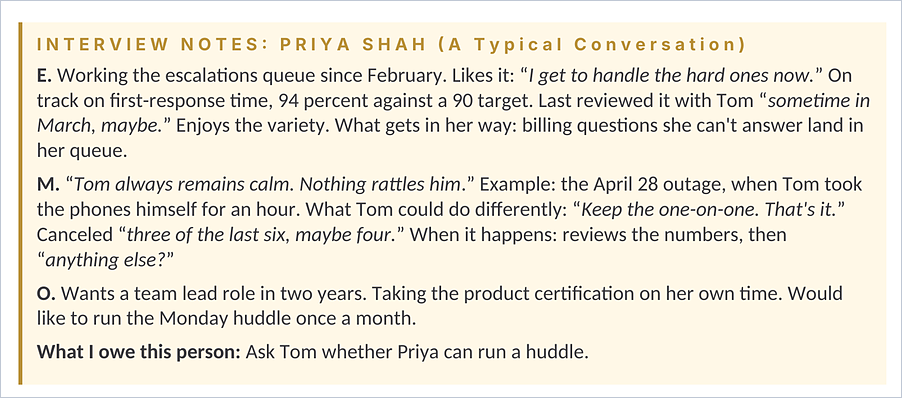
Take notes in their words, and mark direct quotes with quotation marks. "Hasn't had a one-on-one since March" is a note, and "Tom neglects his people" is a conclusion. Conclusions go on the Theme List, and only if more than one person supports them. Use paper if you can manage it, because a laptop between you looks like a report being written, and type your notes up in the buffer between meetings.
Ask for the example, every time. When someone says "my manager is good at telling me when I'm doing well," the next question is "That's good to hear. When did that last happen, and what was it about?" Praise and complaints are both worth very little until you have a specific example attached.
Skip-Level Questions to Ask
The form carries 17 questions, each with a follow-up that gets you a specific example instead of a general impression. Pick six to nine per interview, two or three per segment, and ask the same core set of every person so the themes line up afterward. A sample from each segment:
The Employee (E)
- What have you been working on lately, and how's it going? Which part are you proudest of?
- Are you clear on your goals and how they're measured? Are you on track? When did you and your manager last review your progress?
- What gets in the way of you doing your job most often? What would fix it, in your view?
The Manager (M)
- How would you describe your manager's style? Can you give me a recent example?
- What could your manager do more of, or differently? What would that look like in a typical week?
- How often do you meet one-on-one, and what does a typical one look like? When was the last one?
Opportunities for Growth (O)
- Where do you see yourself in two or three years? What's drawing you there?
- What skill would you most like to build this year? Who could help you build it?
- What's one thing you'd want me to know about you that I might not be aware of?
Close every interview the same way: "Is there anything you'd like to ask me?" Answer as openly as you asked them to, and tell them when they'll hear from you again.
Leave these out. Anything that asks the employee to rate or grade their manager. Pay, raises, or promotions. Questions about a named coworker. Anything you wouldn't act on.
"Don't lower your expectations to meet your performance. Raise your level of performance to meet your expectations. Expect the best of yourself, and then do what is necessary to make it a reality."
- Ralph Marston
Three Situations You'll Meet
The employee with a complaint. Listen all the way through and get the example. Then ask the question that matters most: "Have you raised this with your manager?" Most haven't, and your job is to help them have that conversation. Talk through what they'd say, when they'd say it, and how the manager is likely to take it. Offer to make sure the door is open, without saying what's coming through it, and don't promise to fix it yourself.
The employee working an angle. Some people see a skip-level as a chance to settle a score, or to get ahead of a problem of their own. The signs are familiar: a story without dates, a great deal about the manager and little about their own work, and curiosity about what other people have said.
Take the notes exactly as you would for anyone else and then hold what you heard aside to see if you hear similar comments from other team members. If the comment is not validated by others, more information is needed.
The employee who says everything's fine. This is common in round one, so ask the smaller questions. What did your last one-on-one cover? Which part of your week would you hand off if you could? If the employee is not fully engaged, accept it as being a quiet interview, note it as "no issues raised," and move on. Round three with this person will sound different, because by then they'll have watched two rounds go by with nothing coming back on anyone.
From Notes to Themes: The Two-Person Rule
Within a day of the last interview, read all your Interview Notes once. List each thing you heard more than once as a theme, count how many people raised it, pick the strongest example, and strip anything that would identify the person.
Mark each theme a strength or an opportunity and apply these rules. The Theme List will provide the source for your skip-level discussion that you will have with the manager.
| What you do with it | |
| Share | Two or more people raised it. It goes to the manager as a pattern, with the count and one example, and never attributed to an individual. |
| Hold | One person raised it, so it stays with you. Let the issue register as something you will be on the lookout for, but don't act on it until you have supporting information to back it up. If the issue raised holds up over time, it becomes your observation and you coach on it as an observation you've made. |
| Escalate | Anything involving safety, harassment, discrimination, or ethics. Share it with HR regardless of the number, and tell the employee first, as you promised in the opening script. |
Why two, and not three? While hearing three similar remarks from staff provides a stronger case for stating a pattern on paper, on a team of five requiring three would silence most of what you heard. Two instances work because the manager can't pin "two or more" on an individual, and because you'll present the pattern with one stripped-down example. On a team of three or fewer, say up front that patterns are harder to identify. Share only details that are about the work.
Strengths get the same theme list. Most skip-level reviews surface more things the team values about its manager than things it wants changed, and those positives should be emphasized. Stating "Six of seven shared" makes the recognition more meaningful than any compliment you could pay on your own.
Skip-Level Feedback: Coaching the Manager
Within a week of finishing the Theme List, schedule 45 minutes with the manager. Run it in this order, because the order is what keeps it a coaching conversation.
- Strengths, with the count. "Six of seven said you're the calmest person in the room when a customer escalates." Then let the manager respond.
- Opportunities, as themes. "Five of seven said one-on-ones have been canceled more than they've been held since March." Give the count and the example, and leave it there.
- Get the manager's read first. "What do you make of that?" Most managers have a reason, often a fair one, and their answer may provide important details not shared, and perhaps not known, by the team. This teaches you not to make assumptions. Differing views can both be true.
- Agreed actions. No more than three, each with an owner and a date. Some actions will be yours, because part of what the team needs sits above the manager.
- The follow-up date. Write it on the form in front of them, then log it.
Most people have good intentions. When they're being perceived differently from how they intend, they want to know, and the only way they'll hear it is from someone who heard it from their people. Deliver your observations the way you'd want to receive it, with the specifics that will resonate as being helpful and supportive. Focus on their strengths first and make every effort to ensure discovered gaps are addressed in a positive way.
Log it, then close the loop
Log the agreed actions in the same Performance Coaching Log you use for coaching and performance appraisals, one row per action under the manager's name, with Type set to Skip-Level. When appraisal time comes, the Coaching Report shows the skip-level themes next to everything else you've coached this manager on during the year.
Then close three loops.
- With each employee, deliver whatever you wrote under "What I owe this person" within two weeks, whether that's an answer, an introduction, or a follow-up on something they asked. This is what tells a team the conversation was real and that you honor the commitments you make.
- With the team, send a short note or take two minutes at the start of their team meeting: what you heard in general terms, what's changing because of it, and a general thank you to everyone for their engagement and valuable feedback. No details are shared here, only general findings where appropriate.
- With yourself, write down what you learned about the team. Who's growing, who needs more support, and who surprised you is your succession planning material, and the Succession Planning tool is built to receive it.
Skip-Level Review Example: Dana and Tom
Dana Whitfield is an Operations Director. Tom Keller reports to her and manages a seven-person customer support team. On Monday, May 4, Dana informs Tom she'll be running skip-level reviews with his team over the next two weeks, and he asks her to listen for whether the team understands the new ticket priority system that went live in April.
The meeting invitation emails go out to the team members on Tuesday, and the seven interviews run May 11 to 15, two or three a day, in the small conference room.
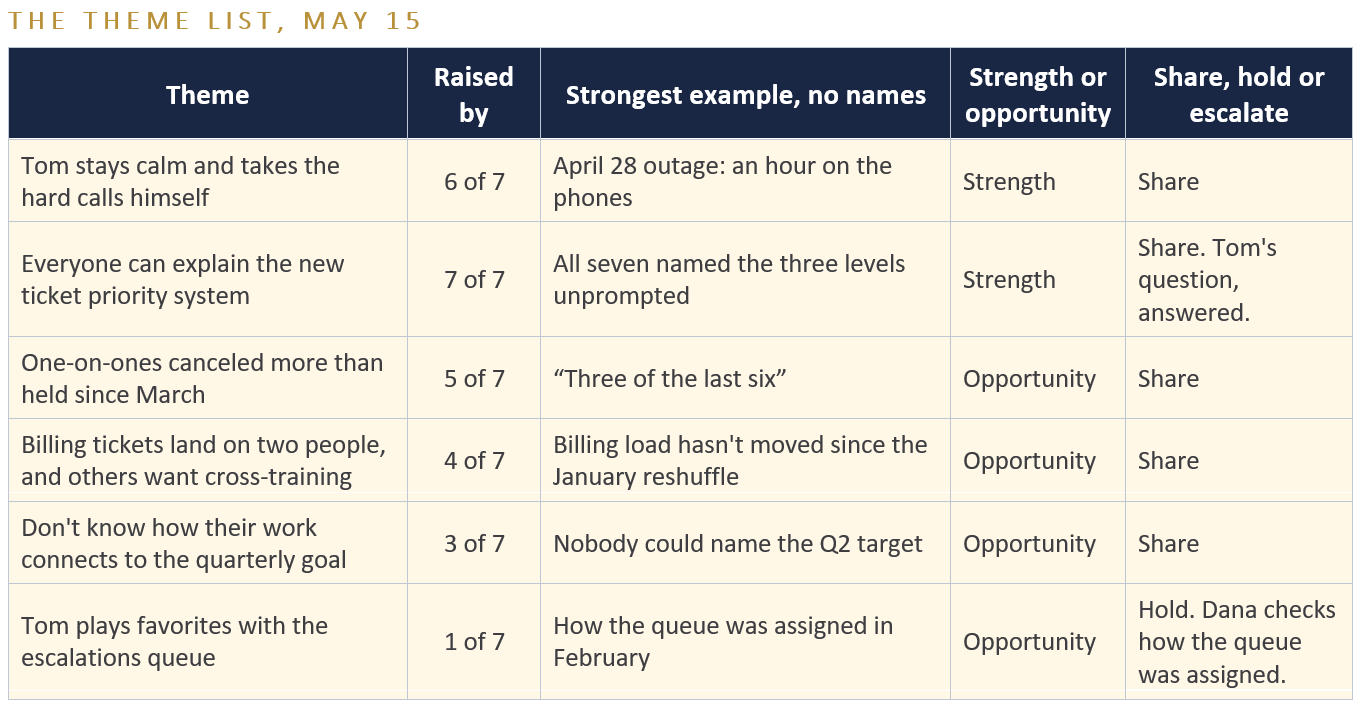
DANA'S THEME LIST, MAY 15
Seven interviews on Tom Keller's customer support team, 30 minutes each, May 11 to 15.
| Theme | Raised by | Strength or opportunity | Share or hold |
| Tom stays calm and takes the hard calls himself | 6 of 7 | Strength | Share |
| Everyone can explain the new ticket priority system | 7 of 7 | Strength | Share |
| One-on-ones canceled more than held since March | 5 of 7 | Opportunity | Share |
| Billing tickets land on two people; others want cross-training | 4 of 7 | Opportunity | Share |
| Nobody could connect their work to the quarterly goal | 3 of 7 | Opportunity | Share |
| Tom plays favorites with the escalations queue | 1 of 7 | Opportunity | Hold |
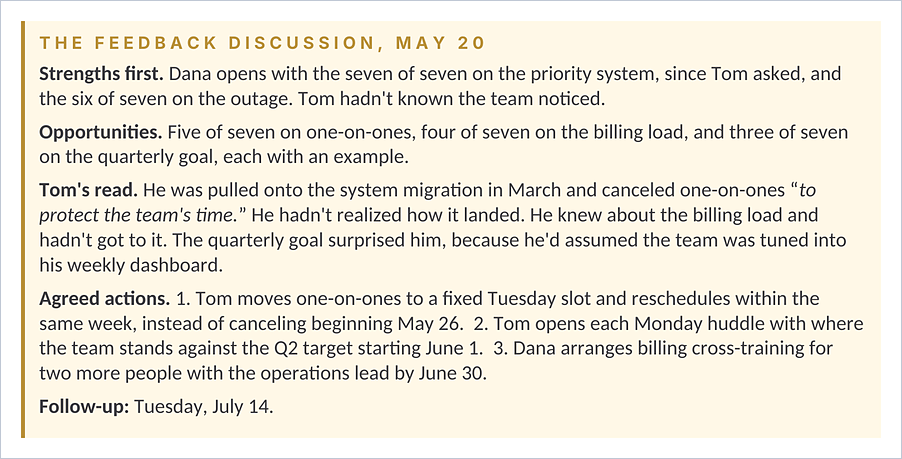
THE FEEDBACK DISCUSSION, MAY 20
Dana leads with the seven of seven on the priority system, since Tom had asked her to listen for it, and the six of seven on staying calm when a call goes sideways. Then the three opportunities, each with an example. Tom's read: he'd been pulled onto a system migration in March and canceled one-on-ones to protect the team's time, and he hadn't realized how it landed. The quarterly goal surprised him, because he'd assumed the team was tuned into his weekly dashboard.
Agreed actions. Tom moves one-on-ones to a fixed Tuesday slot from May 26 and reschedules in the same week instead of canceling. Tom opens each Monday huddle with where the team stands against the quarterly target, from June 1. Dana arranges billing cross-training for two more people by June 30. Follow-up on July 14.
The favorites comment stayed on hold. Dana checked the queue assignment the next morning: Priya was the only person certified on the product at the time, so it was a cross-training gap, and action three already covers it. Jordan's name never came up, and the billing load he raised is getting fixed because three other people raised it too.
On May 22 Dana sends the team a short note: one-on-ones will move to a fixed weekly slot starting next week, billing cross-training is coming for two more people before the end of June, and nearly all of them said how much they value having Tom in the room when a call goes sideways.
Dana asked Tom about Priya leading a huddle, and Priya ran the June 8 one. Dana also asked Tom whether he knew Jordan wanted the product team, and Tom set up the coffee meeting with the product team lead himself. Both employees heard back from their own manager, which allows Tom to be in charge of aligning with his team directly.
The full example, including both sets of interview notes and the coaching log entry, is in the Leader's Guide.
Frequently Asked Questions
The questions below address what leaders most commonly ask about the skip-level review process.
Click on the (+) sign below to expand each question. Click the (-) sign to collapse it again.
What is a skip-level review?
What is a skip-level manager?
Your skip-level manager is your manager's manager. In a skip-level meeting, that leader talks with you directly, skipping the level between you. The point is for them to hear how things are going from the team itself, and to stay connected to people who don't report to them directly.
How often should you hold skip-level meetings?
Quarterly is ideal, and twice a year is the minimum for every team you're responsible for. Scale it to the team: a team of five fits in a morning, a team of ten takes two or three interviews a day across a week. A new manager's team gets a first round about 90 days in.
What is the skip-level meeting format?
Thirty minutes in three parts of ten minutes each: the employee's own work and goals, their experience of their manager, and their opportunities for growth. Open with a short script that covers confidentiality, and close by asking whether they have any questions for you. The form on this page prints the agenda and the questions on one page.
What questions should I ask in a skip-level meeting?
Pick six to nine from the question bank, two or three per segment, and ask the same core set of every person so the themes line up. Examples: What have you been working on lately, and how's it going? What could your manager do more of, or differently? Where do you see yourself in two or three years? Every question has a follow-up that gets you a specific example.
Are skip-level meetings confidential?
Yes, with one exception, and you say both out loud before the first question. Nothing is repeated with a name attached, and the manager only hears patterns that two or more people raised. The exception is anything involving safety, harassment, discrimination, or ethics, which you're required to act on, and you tell the employee first.
What do I do with what I hear in a skip-level review?
Within a day of the last interview, list everything you heard more than once as a theme and count how many people raised it. Share a theme with the manager when two or more people raised it, hold anything only one person said until you've seen it for yourself, and escalate safety or conduct issues through HR. Then meet the manager, strengths first, and agree on no more than three actions with a follow-up date.
How is a skip-level review different from a performance review?
A performance review assesses the manager against goals and competencies, and the manager's own leader writes it. A skip-level review is a listening tool. It gives you facts about how the manager is experienced by their team, and those facts feed the performance review in patterns, the same way anything else you observe during the year does.
What if the manager objects to skip-level meetings?
Some will, and the usual form is "it undermines me." Answer it directly: you'll hear patterns, they'll get the patterns, and nothing happens without them in the loop. Then schedule the dates. A manager who can't tolerate you talking with their people may be signaling a bigger issue, but don't rush to judgment. The skip-level conversations will tell you what you need to know.
Is the skip-level review template free?
Yes. The Skip-Level Review form, the Leader's Guide, and the Performance Coaching Review Log are free to download in PDF, Word, Excel, Google Docs, and Google Sheets, with no signup and no password.
Download Skip-Level Review Tool
Skip-Level Review Form:
Skip-Level Review Leader's Guide:
Performance Coaching Review Log:
Want the entire leadership tools library? Subscribe to our free newsletter and we'll send you a link to every tool on this site, all on one page, sorted by leadership phase. Every tool is free to download on its own page. The library just puts them in one place. Plus, you'll never miss out on updated or new tool announcements.
Your privacy is important to us. We never share or sell email addresses.
Leadership Tools Newsletter
Subscribe Free - See All Tools on One Page - Get New Tool Alerts
More Leadership Tools for Managing Your Team




Richard Gorham has led teams in financial services for more than 30 years, from retail branches and operations to investments and insurance, and he still leads a team today.
He founded Leadership-Tools.com in 2002 to give managers free, practical tools like the ones he used in his various leadership roles. Every tool here has been used in a real workplace and comes with a filled-in example you can follow.

Contact Information:
phone
(503) 970-9777
Email Customer Service
helpsupport@leadership-tools.com
Email Richard
richard@leadership-tools.com

By Richard Gorham
Leadership-Tools.com
2879 Riverwalk Loop, Eugene, Oregon, 97401
Copyright (c) 2002 - 2026 All Rights Reserved