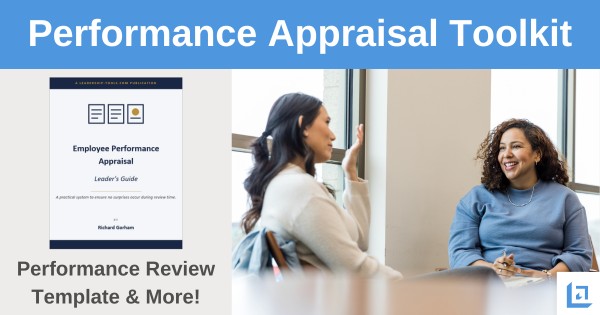
Yes! You can immediately download all three tools, the performance appraisal template, the leader's guide, and the performance coaching log. All three tools are free for you to use and customize as you see fit. Enjoy.
- Home
- Leading People
- Performance Appraisal Template
Free Performance Appraisal Template, Form, and Leader's Guide
Most performance appraisal templates hand you a blank form and wish you luck. The form is the easy part. What trips up a first-time manager is everything around it: when to start, which competencies to select, what to tell your team and when, how to write comments that are fair, and what to do when someone disagrees with a rating.
This free performance appraisal template covers the whole process. Download the appraisal form, the leader's guide, and the coaching log below. Use them together and the review you write will be well documented, thoughtful and fair to your employees.
A lot of the templates we reviewed were either too generic to be useful, or so detailed they felt like an HR system rather than a practical leadership tool. These three tools work together to provide a complete toolkit that's easy to implement. The toolkit provides enough structure to be fair and defensible, requiring minimal effort so a first-time manager has the support needed to have successful conversations.
Everything here works for annual reviews, quarterly check-ins, 90-day reviews, and self-assessments.
Performance Appraisal Leader's Guide:
Performance Appraisal Form:
Performance Coaching Review Log:
Jump To: Choose Review Type | What You Get | Who This Is For | Why Performance Appraisals Matter | The Annual Calendar | The No-Surprises Rule | What's Inside the Appraisal Form | The Rating Scale | Choosing Competencies by Role | How to Use Tools in Five Steps | Check Your Bias | What Not To Include | Appraisal Comments by Rating Level | A Completed Example | Common Mistakes to Avoid |Pre-Review Checklist | FAQ | Get Updates Free | Download Tools
Choose Your Review Type
The appraisal form carries a review type checkbox at the top: 90-Day, Quarterly, Semi-Annual, or Annual. Same form each time. What changes is how much of it you use and how far back you look.
90-Day
Best for: Onboarding feedback, confirming fit, setting early expectations for performance.
How to use: Set key competencies, role expectations, strengths, areas for improvement, and initial goals.
Quarterly
Best for: Ongoing progress tracking, catching issues early, adjusting goals. No surprises later.
How to use: Focus on the current quarter results in relation to overall annual expectations.
Semi-Annual
Best for: Mid-year checkpoint for progress on annual goals and overall review of performance.
How to use: Use same competencies you will use during the annual review. Give employee time to close any gaps.
Annual
Best for: Based on coaching log detail. The full-year assessment, and the merit conversation that goes with it.
How to use: Overall assessment, ratings, merit increase, focus on development and goals.
A self-assessment is not a separate review type. It is built into the employee appraisal form. The employee writes their comments under each competency before you write yours.
Download this performance appraisal template once, then adapt as needed.
What You Get
The performance appraisal template comes with three tools that work together. Leaders can track coaching conversations by competency. Use the leader's guide that walks you through the entire performance evaluation process. Tools include:
The Appraisal Form

You decide on competencies by role. Each section holds the standard for that competency, the employee's comments, your comments, and ratings. Then overall comments, the final rating, focus for future development, and signatures. Customize the performance appraisal template to fit your team.
The Leader's Guide

A four-part guide, with 25 sections. The annual calendar, seven role-based competency sets, sixteen competency definitions, every message written out and ready to send, the bias tests, the scripts for when someone disagrees, and one full review worked start to finish for a clear example to reference.
The Coaching Log

A spreadsheet for logging what happened as it happens, tagged to an employee by competency. The Coaching Report tab shows you, for any one person, how many entries you have against each competency and where the evidence is thin. Log coaching conversations all year long and the review writes itself.
Who Are These Performance Appraisal Tools For
This performance appraisal template is for busy leaders who want a simple, repeatable way to run employee performance reviews without overcomplicating the process.
It’s a strong fit for new and aspiring managers who want a clear structure for what to cover (results, behaviors, examples, and next-step goals) so the conversation stays fair, specific, and useful.
It’s also ideal for solopreneurs and small business owners managing small teams, when time is tight. This performance review template and related tools helps you stay consistent from one employee to the next and document key points across the year.
Best fit:
- First-time managers and frontline supervisors
- Small teams needing a lightweight annual performance review template
- Leaders who want a practical performance appraisal form for coaching + goal setting
This performance appraisal template is especially useful if:
- You want a simple annual performance review template you can repeat each year
- You need a straightforward performance appraisal form that doesn’t overcomplicate things
- You want to give feedback that is honest, specific, and respectful
If you already have a specific HR protocol: you can still use this template as your “prep worksheet” to organize ratings, examples, and goals before entering anything into your official platform.
What a Performance Appraisal Is (And Why It Matters)
A performance appraisal is a structured conversation that reviews past performance, aligns expectations, and sets goals for the next period.

For a new manager, a clear “structure” is a valuable asset. It turns a vague, nerve-wracking discussion into a clear leadership routine: look back at what actually happened (results and behaviors), name what should continue, and identify what needs to change. Done well, an employee performance appraisal reduces confusion because both people leave with the same understanding of what “good performance” looks like, and what specific actions will improve performance going forward.
A performance review also protects the relationship. When feedback only shows up in a once-a-year meeting, employees often feel blindsided or undervalued. But when you use a consistent performance appraisal form and ground your comments in examples, the conversation feels fair and professional.
It becomes less about “judging” and more about coaching: reinforcing strengths, removing obstacles, and setting a small number of measurable goals for the next period.
Finally, appraisals matter because they create clarity about what's working and what needs attention. A great review isn’t complete when the meeting ends, it just paves the way for coaching discussions to continue for incremental improvement. That’s why a strong performance appraisal template includes space for goals, standards, performance development opportunities, support needed, and recurring follow-up. It helps you turn good intentions into a simple plan your team can execute.
The Real Purpose of Employee Performance Reviews
A strong performance review should:
- Recognize what’s working (so you reinforce it)
- Address what’s not working (so problems don’t repeat)
- Clarify expectations (so “good performance” is understood)
- Agree on goals (so the next period is focused and measurable)
The Annual Calendar
Two requirements drive the performance review calendar, and they pull in opposite directions.
- Before you can accurately rate a year of performance results, the year should be finished with results available. This is why annual reviews are ideally completely in February, allowing time for results to publish and reviews to be completed.
- Setting next year's goals needs to happen before the new year begins. Rolling out goals and standards for meeting expectations should occur in November, allowing teams adequate time to gear up and hit the ground running on January 1st.
No single meeting date satisfies both initiatives, which is why this runs as two separate conversations.
Setting Up Next Year
- Early November: announcement to the team, with next year's competency standards attached.
- Mid November: goal-setting conversations with each employee.
- End of November: final goals for the coming year, confirmed in writing. Time left to prepare for the new year.
Why November and not December? The holidays, PTO and year-end planning take up all of December. Start in November and the goals are set, allowing everyone to focus on time with family and friends before ringing in the new year.

Closing Out Last Year
Mid-January: year-end results should be available. The self-assessment goes out with a two-week due date.
- Two weeks: the employee completes their self-assessment comments.
- Two weeks: the leader writes the reviews and makes the merit decisions.
- Two weeks: reviews sent to employee the day prior to when meeting is held, during meeting the review is presented, merit increases are communicated, signoff completed, and the conversation turns to the future.
End of February: all reviews are completed and signed.
First payroll in March: the new wage or salary increase takes effect.
The Rest of the Year
March through October carries no scheduled review milestones. Coaching conversations carry on throughout the entire year and coaching conversations and events get logged.
The “No Surprises” Rule
Performance issues should not show up for the first time in the annual review. There should never be a surprise in an annual review. If you are about to write a rating below a 3, answer three questions in writing before you do.
- Has this person heard this feedback before?
- When, and how did that conversation go?
- What support did I provide afterward?
If you can answer all three of these questions with specifics, the rating is fair and defensible, and the employee will not be blindsided. If you cannot, the problem is not the rating, it is that a performance issue was not addressed with a conversation.
In that case, rate against the standard the employee is aware of only. Later, after the review is completed, go back and set the expectation with the employee for future performance and write it into this year's goals.
Doing it in this manner costs you nothing. Rating someone down for an expectation they were never given costs you their trust.
One exception: If you have something positive to share for the first time, that is a good surprise and will be well received during the conversation, such as news of a promotion!
What’s Inside This Performance Appraisal Template
The form is built around competency blocks. Each block holds four things, in this order.
- The competency and its standard for performance: you write both in before you send the form. Both were already provided when goals were set the year prior, you are just providing on the form for easy reference. The employee needs to know what Fully Meets Expectations looks like in their role before they write a word about themselves.
- The employee's comments: what went well, what got in the way, anything you should know. No ratings are required of the employee. Rating is the leader's responsibility.
- Your comments: written after you have read their self-assessment, and reviewed your coaching log for details discussed throughout the year.
- The rating: Individual rating by competency and an overall rating for the year.

What is not on the form: Details of the annual merit increase. Deliver that news in the meeting, then confirm it the way your organization requires, usually a merit letter or an email. Keeping compensation information off the appraisal form keeps the signed document about performance only, not compensation.
The Rating Scale
Five levels, no half steps. A 3+ is what a leader writes when they cannot defend a 4, and there is no 3+ on this form.
| Rating | Level | What it means | Written example |
|---|---|---|---|
| 5 | Exceptional | Well beyond what the role requires, consistently, in ways others notice and benefit from. | Required |
| 4 | Exceeds Expectations | Regularly goes past the standard and lifts the quality of the work around them. | Required |
| 3 | Fully Meets Expectations | Good performance. The job gets done to standard, reliably, without anyone chasing it. | Encouraged |
| 2 | Partially Meets Expectations | Meets the standard in some areas and falls short in others, in ways both people can name. | Required |
| 1 | Not Meeting Expectations | Falls short in ways that affect the work, the team, or the customer. | Required |
Not Observed is the sixth option, and it is not a score. Use it when there was no real opportunity to see that competency during the entire review period. It carries no weight in the final rating. If the same competency comes back Not Observed two periods running, it is the wrong competency for that role. Replace it with a more meaningful competency.
The written example rule is what keeps the scale honest. Any rating of 5, 4, 2 or 1 needs a specific example in the comments. A 3 does not require one, though it is worth writing when you have it. Ratings that cannot be supported with an example tend to be the ratings that get disputed.
Choosing Competencies by Role
Decide on the competencies before the year starts so they have clearly defined expectations. Choosing the measures once you already know how someone performed is not fair to them. They should know what the measures are so they have the full year to meet them.
The leader's guide includes seven role-based sets. Find the one closest to the role, then swap what does not fit.
- Set 1, Frontline Individual Contributor: the default pick when nothing more specific fits.
- Set 2, Customer-Facing: member service, front desk, retail, support, reception.
- Set 3, Skilled Trades and Operations: production, maintenance, warehouse, field service.
- Set 4, Administrative and Support: office administration, scheduling, records.
- Set 5, Project and Professional: analysts, specialists, coordinators.
- Set 6, Metrics-Driven Roles: sales, call center, lending, claims, processing.
- Set 7, Supervisor and Team Lead: eight competencies covering their own work and their team's.

How many competencies you choose to use depends on the review type. We recommend using four competencies for a 90-day review, five for a quarterly, six for an annual, and eight for a supervisor.
Productivity and Results appears in every set, because every role has specific results it is accountable for. Goals and results should be addressed in the Productivity and Results section of the review.
Use the same set of competencies for everyone doing the same job. That is what makes ratings comparable across a team, and it helps to ensure reviews are handled consistently, particularly when it comes to making merit increase decisions.
"Giving such reviews is the single most important form of task-relevant feedback we as supervisors can provide."
- Andrew S. Grove, High Output Management
How to Use These Performance Evaluation Tools in Five Steps
- Set goals and standards for performance in November. Send the competency standards to the whole team, then hold a goal-setting conversation with each person. Establish two or three key performance goals for the team, and assign individual goals that support the team goals. Confirm the goals in writing before the year ends.
- Log coaching and performance events across the entire year. Include specifics such as numbers, incidents with a date, and details of conversations and what came of them. Log the wins as well as the challenges, because a log containing only problems or gaps in performance will yield a one-sided review.
- Read the self-assessment in full. Assign self-assessment in mid-January, once year-end numbers publish. Give employees two full weeks to complete their self-assessment. Read all comments by the employee before writing a word, then read it again competency by competency, while drafting your comments. Details from the log will help to inform your comments
- Complete comments and assign ratings. Every comment answers three things: what happened, the specific example, and the impact. Complete the no-surprises test before landing onany rating below a 3. Decide ratings for the whole team before allocating merit, so the budgeted merit pool is not gone by the time you reach the last review.
- Present the review, sign, and schedule. Send the completed review 24 hours ahead so both of you have read the same document. Conversations begin with the employee's questions first, then make any necessary changes, then inform the employee of their merit increase if applicable, then end by discussion goals and activities for next year. Make sure recurring coaching sessions have been scheduled for the entire year.
Check Your Bias Before You Rate
Everyone has personal biases. A key point for leaders is to be aware of them so you can avoid them when completing employee performance reviews.
There are five primary types of bias:
Recency: when recent events still fresh in your memory are used to reflect performance for the whole year.
Test: are your comments representative of the entire review period? If not, broaden them.
Halo: one strength is focused on rather than looking at multiple areas of performance, resulting in inflated ratings.
Test: is anyone rated 4 or above on most competencies? Question it if you see no variety in ratings.
Horn: opposite of halo bias; one problem drags every other performance rating down.
Test: rarely is someone below standard at everything. Find what they do well and say so.
Leniency: everyone gets a 4 because those conversations are easier for the leader.
Test: if nobody on your team is at a 3, your 4 rating is diminished in the eyes of your strongest performers.
Similar-to-me: people who work the way you do rate higher.
Test: for your highest-rated person, name a result rather than a working style. If you cannot do that, revisit the rating.
What Not to Include in a Performance Appraisal
There are certain subjects that should be kept out of a performance appraisal. Even if the employee raises the subject on their own, do not include in your written comments.
Topics to not include:
- Medical conditions, diagnoses, or treatment.
- Family circumstances, pregnancy, childcare, or eldercare.
- Age, race, religion, national origin, disability, sexual orientation, or gender identity.
- Speculation about motive. "Missed three deadlines" is a fact. "Does not seem to care" is a guess.
- Comparisons to named coworkers. Rate against the standard for the role.
- Union activity, protected complaints, or time off they were entitled to take.
- Personality descriptions untied to work. "Abrasive" is a judgment. "Interrupted three team members in the June planning meeting" is an observation.
Here is an example of the same note, written two different ways.
- Wrong: "Attendance slipped while he dealt with his mother's illness"
- Right: "Attendance was inconsistent between March and May, with eight unscheduled absences against a team average of two."
Appraisal Comments by Rating Level
Every comment should answer three things:
- What happened?
- Does it include a specific example?
- What was the impact?
If you miss any one of the three, the comment is diminished and not as useful. Below are examples at three rating levels for five common competencies. Adapt the specifics to your own people.
Communication
- Exceeds (4): "Runs the Monday huddle in under ten minutes and everyone leaves knowing what changed. Wrote the member FAQ in November after noticing the same three questions kept coming up. Two other branches asked for a copy."
- Fully Meets (3): "Clear with members and with the team. Asks when something is ambiguous rather than guessing, and I have not had to repeat an instruction."
- Partially Meets (2): "In June, four members hit the same online banking error and each one was solved individually without flagging the pattern to operations. Operations identified the root cause two months later than they could have."
Quality of Work
- Exceeds (4): "Account setup errors ran at 0.4 percent against a 1.5 percent standard, the lowest on the team. In February she noticed the new account checklist was missing the beneficiary field and rewrote it. All three representatives use her version now."
- Fully Meets (3): "Errors ran at 1.2 percent against a 1.5 percent standard, steady across all four quarters. Work comes back clean and I have not had to check behind her."
- Partially Meets (2): "Errors ran at 3.1 percent against a 1.5 percent standard. We discussed this on March 12 and again on July 8. The rate came down from 4.2 percent, so the progress is real. It has not reached standard yet."
Initiative and Ownership
- Exceeds (4): "Took the onboarding redesign from an idea in a meeting to a running program in six weeks, and assigned owners in the room rather than waiting to be asked."
- Fully Meets (3): "Worked the Delgado escrow problem for three days and two calls to the title company rather than handing it off. Closing went ahead on schedule."
- Partially Meets (2): "Raises problems in good detail, then waits for direction on all of them. In the March and August examples we discussed, a decision he was authorized to make sat for a week."
Dependability
- Exceeds (4): "Covered four shifts at short notice, including the week two representatives were out in January. Said yes before I finished asking."
- Fully Meets (3): "Reliable on schedule and on commitments. When something is going to slip, I hear about it before the deadline rather than after."
- Partially Meets (2): "Four internal deadlines slipped this year, each surfacing only after the date had passed. Raised on February 8 and again on June 3, with a shared deadline tracker put in place in February."
Customer Focus
- Exceeds (4): "Members ask for him by name. In August he stayed forty minutes past close with a member whose direct deposit had failed and worked it until the money landed. Three written compliments this year, the most on the team."
- Fully Meets (3): "Handles members professionally and patiently, including the difficult ones. No complaints this year and several unprompted thank-yous."
- Partially Meets (2): "Accurate with members but transactional. Two members this year asked to work with someone else, both citing tone rather than any error."
The test for any comment: Could the employee name the occasion you are describing? If the answer is no, the comment may be too vague to act on and too vague to defend.
A Completed Example: Marcus Webb
Marcus is a customer service representative at a credit union, two years in the role, rated on Competency Set 2 with one swap.
Here is his full annual review, competency by competency. Notice that this review is written directly to Marcus rather than about him. Addressing the employee as "you" makes the feedback read like a conversation.
Marcus Webb · Customer Service Representative · Annual Review
3Customer Focus
Marcus, members ask for you by name and I understand why. In August I watched you stay about forty minutes past close with a member whose direct deposit had failed to post. You worked it through until it was resolved. Three members wrote in about you this year, which is more than anyone else on the team. Where I see you at your best is with the ones who arrive frustrated. You do not rush them or get defensive. You stay calm and you make sure they feel heard.
Marcus, members ask for you by name and I understand why. In August I watched you stay about forty minutes past close with a member whose direct deposit had failed to post. You worked it through until it was resolved. Three members wrote in about you this year, which is more than anyone else on the team. Where I see you at your best is with the ones who arrive frustrated. You do not rush them or get defensive. You stay calm and you make sure they feel heard.
4Productivity and Results
You handled 2,180 member interactions against a target of 2,100, and no month fell below 90 percent. The consistency is what I want to call out here. Volume is easy to hit in a busy month and easy to miss in a slow one, and you did neither. You also picked up the overflow queue during the online banking rollout in June, when call volume ran well above anything I had forecast. That kept our wait times from climbing while the rest of us were still catching up.
You handled 2,180 member interactions against a target of 2,100, and no month fell below 90 percent. The consistency is what I want to call out here. Volume is easy to hit in a busy month and easy to miss in a slow one, and you did neither. You also picked up the overflow queue during the online banking rollout in June, when call volume ran well above anything I had forecast. That kept our wait times from climbing while the rest of us were still catching up.
3Communication
With members you explain things plainly, and you check that people have understood before you move on. In October I watched you walk a member through an overdraft fee without making her feel foolish for asking. That is a real skill and not everyone has it. Where I see your communication run thinner is upstream. In June, four separate members hit the same online banking error, and you solved each one individually but did not share the pattern with operations. They found it on their own about two months later. Passing that kind of detail along early saves the whole branch time, and it is where I would like your focus this year.
With members you explain things plainly, and you check that people have understood before you move on. In October I watched you walk a member through an overdraft fee without making her feel foolish for asking. That is a real skill and not everyone has it. Where I see your communication run thinner is upstream. In June, four separate members hit the same online banking error, and you solved each one individually but did not share the pattern with operations. They found it on their own about two months later. Passing that kind of detail along early saves the whole branch time, and it is where I would like your focus this year.
2Quality of Work
Your account setup errors ran at 3.1 percent this year against a standard of 1.5 percent. We first talked about this on March 12, when I walked five recent files with you and showed you where the misses were happening, and again on July 8. You took both conversations well and then you did the work. You built yourself a pre-submission checklist after the first one, and moving your account setups to the morning was your idea rather than mine. The rate came down from 4.2 percent to 3.1 percent over that span, and I want that progress on the record because it was real. It has not reached standard yet. Most of what is left is missing signatures, which is the narrowest version of this problem we have had all year and the one I expect you to close.
Your account setup errors ran at 3.1 percent this year against a standard of 1.5 percent. We first talked about this on March 12, when I walked five recent files with you and showed you where the misses were happening, and again on July 8. You took both conversations well and then you did the work. You built yourself a pre-submission checklist after the first one, and moving your account setups to the morning was your idea rather than mine. The rate came down from 4.2 percent to 3.1 percent over that span, and I want that progress on the record because it was real. It has not reached standard yet. Most of what is left is missing signatures, which is the narrowest version of this problem we have had all year and the one I expect you to close.
4Dependability
There is nobody on this team I count on more when the schedule falls apart. You covered four shifts at short notice this year, including the week in January when two representatives were out and I had us running thin every single day. All four times you said yes before I finished asking. No negotiation. I also value the quieter kind of dependability that tends to go unnoticed. You are on time, you are prepared, and when something is going to slip I hear it from you before the deadline rather than after.
There is nobody on this team I count on more when the schedule falls apart. You covered four shifts at short notice this year, including the week in January when two representatives were out and I had us running thin every single day. All four times you said yes before I finished asking. No negotiation. I also value the quieter kind of dependability that tends to go unnoticed. You are on time, you are prepared, and when something is going to slip I hear it from you before the deadline rather than after.
3Problem Solving
The Delgado escrow problem in May is the example I keep coming back to. It took three days and two calls to the title company to untangle, and you stayed with it the whole way instead of handing it back to me once it turned tedious. The closing went ahead on schedule. The member never knew there had been a problem. You are good at working a problem that is sitting in front of you. What I want to see next is you catching the ones that have not surfaced yet.
The Delgado escrow problem in May is the example I keep coming back to. It took three days and two calls to the title company to untangle, and you stayed with it the whole way instead of handing it back to me once it turned tedious. The closing went ahead on schedule. The member never knew there had been a problem. You are good at working a problem that is sitting in front of you. What I want to see next is you catching the ones that have not surfaced yet.
Overall rating: 3. "Marcus, you had a good year. Five of six areas are at standard or above, and the member-facing side of this job, which is the part members feel directly, is where I see you at your best. The 2 on Quality of Work is what holds my overall rating at a 3 rather than a 4. Account accuracy carries more weight in this role than in most, because a setup error can follow a member around for weeks or months afterward. The improvement across this year was real and it came from your own effort. If that trend holds, I expect this rating to move next year."
The overall rating comes from a fair accounting of the individual ratings. You can use a simple average or a weighted average where you have assigned a percentage weighting based on the importance of each competency.
If you depart from using simple math you need to be ready to explain it in a way that will be received as credible. The paragraph above does that. It tells Marcus the overall is not a verdict on his whole year, and it names why one competency carries more weight in this job and goes on to explain what would change the number.
Focus for Future Development
The form closes with two fields: where to focus next, and what support is needed. Keep your comments focused on one or two priorities. Stay away from using vague wording. Provide specific examples whenever possible.
Vague: "Improve communication with the wider team."
Specific: "Marcus, when the same issue shows up three times in a 30-day period, send a short note to the operations team naming the pattern. Measured by operations confirming receipt, reviewed at each monthly one-to-one, starting this month with a full review at 90 days. To support you with this goal, I will introduce you to the operations supervisor so you have a direct contact instead of needing to route the communication through me."
A goal with no support attached is a request with zero guidance. Naming what you will do as the leader makes it a shared commitment, and it is the part employees notice and appreciate the most.
Common Mistakes to Avoid
Even with a solid performance appraisal template, reviews can drift off track when the conversation becomes vague, reactive, or overly focused on a single moment in time.
The good news: most problems come from a few predictable mistakes. Use the checks below to keep your employee performance review fair, specific, and genuinely helpful. This is particularly important if you’re new to giving formal feedback.

Vague feedback without examples (“You need to be more proactive”)
Better: “Bring one improvement idea to our weekly meeting and propose first steps.”
Recency bias (only evaluating the last month)
Better: use the Performance Coaching Log to keep notes across the whole review period.
Overloading the review with too many improvement areas
Better: pick 1–2 priorities that matter most and support them well in your comments.
Turning the review into a debate over the rating
Better: discuss results, examples and expectations, then move toward goals and support.
If you avoid these common pitfalls, your performance appraisal form becomes more than documentation, it becomes a practical coaching tool.
Keep your feedback grounded in examples, focus on the few changes that will matter most, and end with clear goals and a follow-up date. That’s what makes the review feel fair to the employee and useful to you as a leader.
Pre-Review Checklist
A great performance review starts before the meeting. This pre-review checklist is a fast way to get your thoughts organized so you can lead a calm, evidence-based conversation. This is especially important when you’re busy or doing reviews for multiple people.
Use it 15–30 minutes before the appraisal to reduce surprises, focus on what matters most, and make sure your feedback is fair and specific.
Before the meeting:
- Review the employee’s role expectations and current goals
- Gather 3–5 concrete examples (wins + challenges)
- Check any available metrics (quality, output, customer feedback, timelines)
- Identify one development priority that matters most
- Plan your opening: appreciation, purpose of the review, shared goals
- Does every rating of 5, 4, 2 or 1 carry a written example that supports the rating?
- For every rating below a 3, has this person heard it before, and can you name when?
- Have you read the entire performance review once out loud as a practice-run?
- Is the merit decision made, and is it in line with the overall rating?
Once you’ve worked through the checklist, you’re ready to use the performance appraisal template with confidence: you’ll have real examples, a clear theme for the conversation, and a few concrete next steps to discuss.
If anything on the list feels hard to answer (missing metrics, unclear role expectations, not enough examples), treat that as a signal to gather more data or schedule a quick check-in before finalizing ratings.
Frequently Asked Questions (FAQ)
Click on the (+) sign below to expand each question. Click the (-) sign to collapse it again.
Is the performance appraisal template, guide and log all free?
What should a performance appraisal include?
At minimum: the competencies being rated and the standard for each one, the employee's own comments, your comments with specific examples, a rating for each competency, an overall rating, a development focus with the support attached, and signatures from both people.
What is the difference between a performance appraisal and a performance evaluation?
Nothing meaningful. The two terms describe the same process and are used interchangeably across industries. Some organizations prefer evaluation because appraisal sounds like property valuation, and others prefer appraisal because evaluation sounds like a test. Use whichever term your organization already uses.
What is the best rating scale for a performance appraisal?
A five-point scale with defined levels and no half steps. Five points give you enough range to distinguish real differences without creating false precision. Half steps like 3+ tend to be what a leader writes when they cannot defend a 4, which is why this form does not offer them.
When should I set goals and standards for the review year?
Mid to late November, before the year being measured begins. Send the competency standards to the team first, then hold a goal-setting conversation with each person. Choosing the measures after you already know how someone performed is not fair to them.
How many competencies should I rate?
Four for a 90-day review, five for a quarterly, six for an annual review, and eight for a supervisor. Use the same set for everyone doing the same job, which is what makes ratings comparable across a team.
How often should you do performance reviews?
One formal annual review, plus regular coaching conversations across the year. The coaching sessions are what change performance. The annual review is a snapshot of what those conversations produced.
Should employees complete a self-assessment?
Yes. The employee writes their comments under each competency before you write yours. It improves accuracy, surfaces obstacles you did not know about, and means the meeting starts from a shared document rather than a verdict.
What are examples of good performance appraisal comments?
Good comments answer three things: what happened, the specific example, and the impact. "Errors ran at 3.1 percent against a 1.5 percent standard, discussed on March 12 and again on July 8" works. "Needs to be more careful" does not, because the employee cannot act on it and you cannot defend it.
What should I never put in a performance appraisal?
Medical conditions, family circumstances, protected characteristics, speculation about motive, comparisons to named coworkers, union activity, or entitled time off. Keep the document on work performance during the review period, even when the employee raised the subject themselves.
What if the employee disagrees with a rating?
Ask what you have wrong and listen properly. New information changes ratings. Disappointment does not. If they raise something valid that you did not have, change the rating. If they say an expectation was never set, rate against the standard they knew and write the new expectation into this year's goals.
Should the merit increase go on the appraisal form?
No. Deliver the number in the review meeting, then confirm it the way your organization does, usually a merit letter or an email. Keeping compensation off the form keeps the signed document about performance.
Can I use this as an annual performance review template?
Yes. The form carries a review type checkbox for 90-Day, Quarterly, Semi-Annual and Annual. The same form covers all four. What changes is how many competencies you use and how far back you look.
Download Performance Appraisal Tools

Performance Appraisal Leader's Guide:
Performance Appraisal Form:
Performance Coaching Review Log:
Want the entire leadership tools library? Subscribe to our free newsletter and we'll send you a link to every tool on this site, all on one page, sorted by leadership phase. Every tool is free to download on its own page. The library just puts them in one place. Plus, you'll never miss out on updated or new tool announcements.
Your privacy is important to us. We never share or sell email addresses.
Leadership Tools Newsletter
Subscribe Free - See All Tools on One Page - Get New Tool Alerts
More Leadership Tools for Managing Your Team





Contact Information:
phone
(503) 970-9777
Email Customer Service
helpsupport@leadership-tools.com
Email Richard
richard@leadership-tools.com

By Richard Gorham
Leadership-Tools.com
2879 Riverwalk Loop, Eugene, Oregon, 97401
Copyright (c) 2002 - 2026 All Rights Reserved