- Excel: best for formulas, auto-totals, and customization
- PDF: best if you want to print and write by hand
- Google Sheets: To use this template: open the sheet, then choose File, then Make a copy
- Home
- Leading Self
- Debt Payoff Planner Templates
- Household Budget Template
Household Budget Template for Monthly Debt Reduction
Our household budget template helps you account for every dollar you earn and spend each month, from housing and utilities to food, insurance, and the cash you free up to pay down debt.
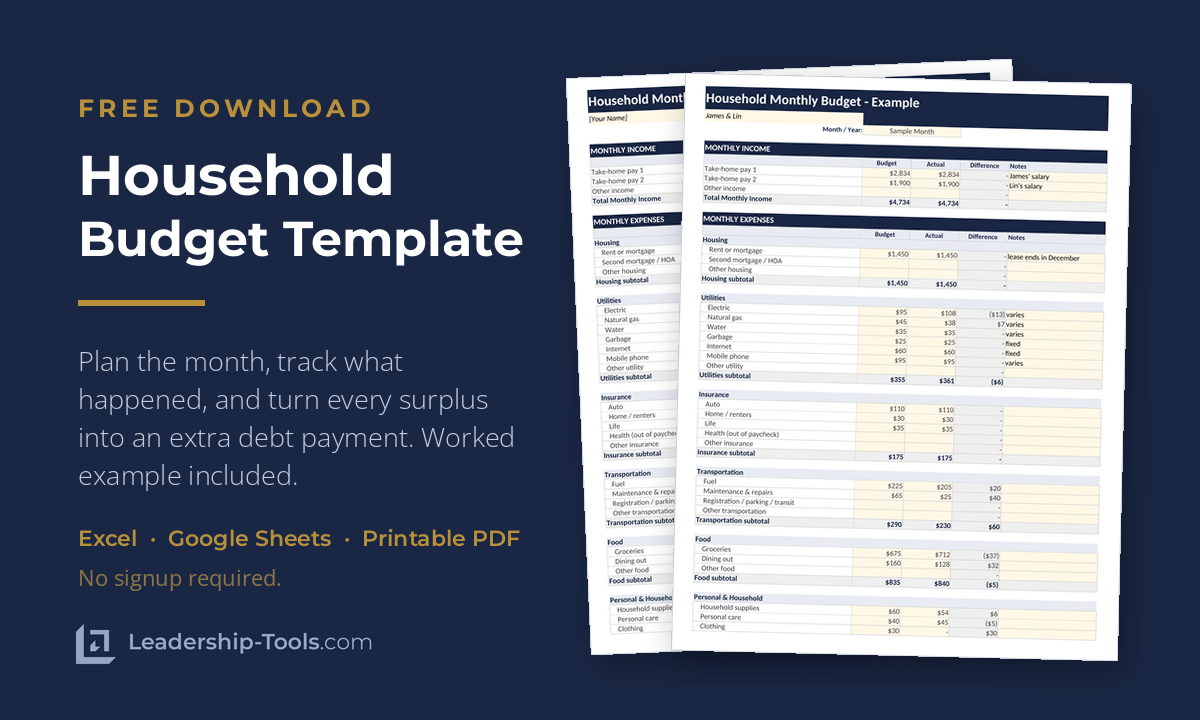
Download Household Budget Template:
Real leaders don't wait for their finances to fix themselves. They take ownership, get clear on the numbers, and build a simple system they can follow.
That's what this free budgeting template is built to help you do. It's one step in our free ebook, "10 Steps to Conquer Debt," part of our self-leadership resource library. The file you're about to download isn't only a spreadsheet. It's one of the practical leadership tools you'll use to take control of your money, reduce debt, and build more freedom into your life.
"The cold harsh reality is that we have to balance the budget."
- Michael Bloomberg
Your household budget, or personal budget planner as some people call it, is the cornerstone tool in your financial turnaround.
This step asks you to budget every line, one account at a time. The good news is that much of the groundwork is already done. If you completed your personal financial statement back in Step Three, you already have most of the numbers at your fingertips.
Jump To: Download Template |What It Helps You Do |What You'll Need | Categories Checklist | How to Use | Powering Your Payoff | Why This Matters | Build the Habit | Common Mistakes |FAQ | Get Updates Free | Download eBook
Download Household Budget Template
With this template you can plan an entire month of money in advance, then watch how the plan holds up as real life unfolds. Once you've subscribed to the Leadership-Tools free newsletter, you have access to our entire leadership library.
The file has three tabs. A How to Use tab walks you through the method. A blank template is where you build your own budget. And a completed example, built around a household we follow through the ebook, shows you exactly what a finished month looks like, including a real mix of over-budget and under-budget categories.
Don't underestimate this tool. When you track every dollar of income and every dollar of spending against a monthly plan, you sharply increase your odds of paying off your debt and starting to build real wealth.
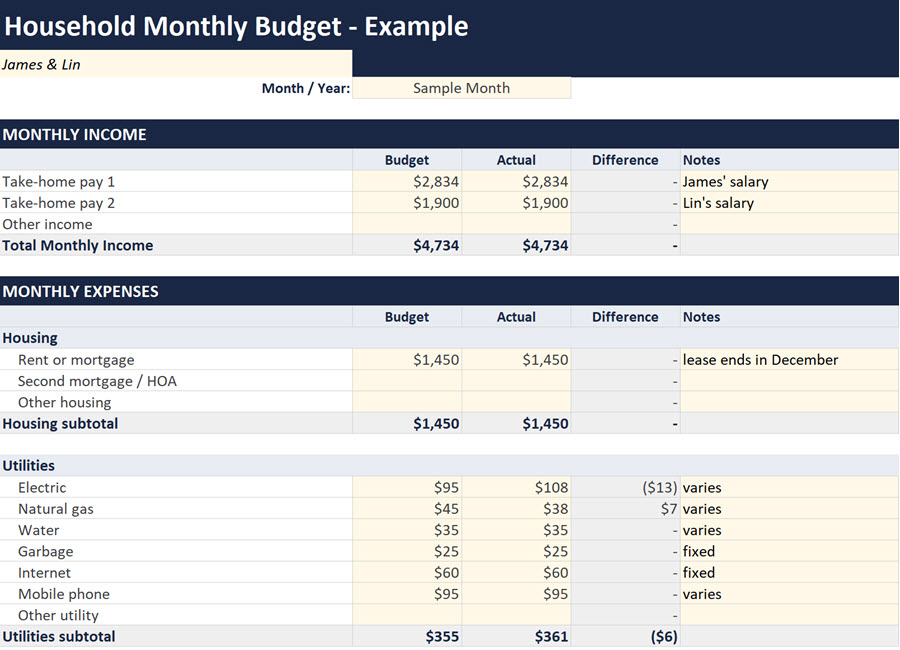
Once you've downloaded your template, give the first build the time it deserves. Your goal on day one is a complete and honest picture of your money, not a perfect one. From there, one or two smart changes a month will keep improving your bottom line.
What This Budget Template Helps You Do
A household budget isn't only a money tool. It's a leadership tool. Leaders don't guess. They measure, decide, and follow through. This template gives you a practical way to take control of your cash flow, lower your stress, and make steady progress on savings and debt.
The Main Outcomes You Can Expect
- Know exactly where your money goes, not where you hope it goes
- Separate the must-pay bills from the flexible spending
- Plan for irregular costs so they stop becoming emergencies
- Build a realistic monthly plan that funds both debt payoff and savings
Who This Budget Template is For
This free household budget template is built for:
- New and aspiring leaders building personal discipline and consistency
- Frontline managers and solopreneurs who want a simple monthly money system
- Households focused on cutting expenses, paying off debt, and building stability
What's Included, and What's Not
- Included: the template, plus a step-by-step process to fill it out and keep it current
- Not included: financial advice tailored to your exact situation, though the structure below makes it easy to apply your own goals
If your goal is more control and fewer money surprises, this budget template is a foundational tool. The next sections make sure you fill it out so it works in real life, not only on paper.
Account for Every Dollar: What You'll Need
This template works best when you come prepared. You just need honest numbers and the willingness to look at every account.
Most budgets fail for one reason: missing information. So before you open the file, set aside a little time to gather your materials, the way you'd lay out every piece before starting any job.
Pull these together first:
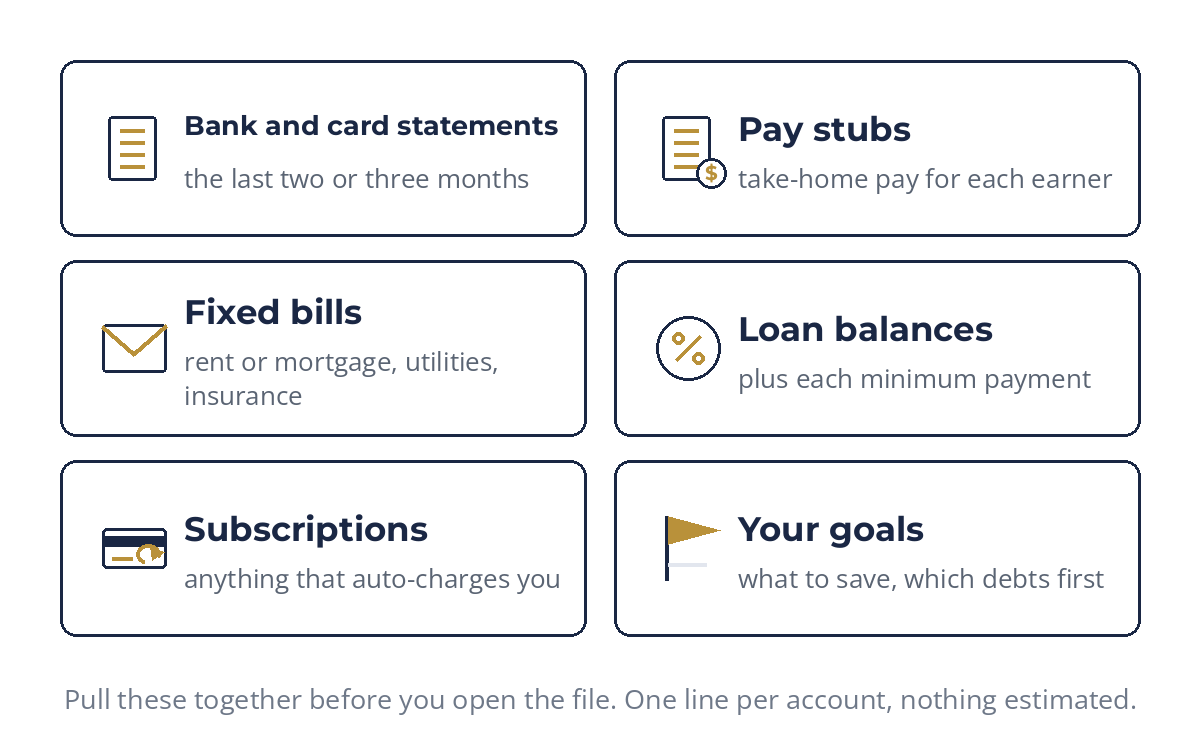
- Your last two or three bank and credit card statements, which is where your real spending lives
- A recent pay stub for each earner, showing take-home pay after tax
- Your most recent bills for each fixed account, such as rent or mortgage, utilities, and insurance
- A current balance and minimum payment for every loan and card
- A login or statement for any subscription or membership that auto-charges you
- A short note on your goals, what you want to save and which debts you want to clear first
The reason to gather it all now is simple. In the budget you'll list each account on its own line rather than estimate a category in one lump amount, because a single forgotten account is often where the easiest savings can hide. Having every statement in front of you is what makes that full accounting possible on the first pass.
The next section maps out every category the template covers, so you'll know exactly where each of these numbers goes.
Self-leadership means starting with real numbers and improving them as you go. With your financial information in front of you, you're ready to build a budget that reflects reality.
Household Budget Categories Checklist
A strong household budget template provides a complete category system. The template groups your spending into the blocks below, each one itemized so nothing slips through. Use this as your checklist.
Income
- Each take-home paycheck on its own line
- Other income
Housing
- Rent or mortgage
- Second mortgage or HOA
Utilities
- Electric, natural gas, water, garbage
- Internet and mobile phone
Insurance
- Auto, home or renters, life, health
Transportation
- Fuel
- Maintenance and repairs
- Registration, parking, or transit
Food
- Groceries
- Dining out
Personal and Household
- Household supplies, personal care, clothing
- Medical and prescriptions
- Childcare or school, pets
Subscriptions and Memberships
- Streaming and memberships you keep on purpose
Minimum Debt Payments
- Each card and loan minimum on its own line
Savings and Sinking Funds
A sinking fund is money you set aside a little each month for an irregular bill you know is coming, such as car registration or holiday gifts, so the full amount is ready before the bill arrives. It's different from an emergency fund, which is created to protect you from an unexpected expense.
- Emergency fund, for the unexpected
- A set-aside for each irregular cost, sometimes called a sinking fund, for repairs, medical, gifts and holidays, travel, and annual renewals
Extra Debt Payment
The amount you free up to attack your priority debt, above the required minimum payments
When your budget covers fixed, variable, and irregular costs, it becomes resilient, because it reflects how money really moves through a household.
Fixed costs cover what must be paid. Variable categories capture your day-to-day choices. And the irregular costs, car repairs, medical bills, holidays, annual renewals, stop being surprises and start being planned-for events.
That resilience is what prevents the most common budget failure: a plan that looks balanced until real life shows up and impacts your progress because you haven't fully planned for all future costs.
How to Use This Budget as a Self-Leadership Tool
This template is more than a place to record numbers. It's a tool that helps you make better decisions, stay accountable, and follow through on your "10 Steps to Conquer Debt" plan.
Work through the process once and you'll have a working household budget you can keep current in about ten minutes a week.
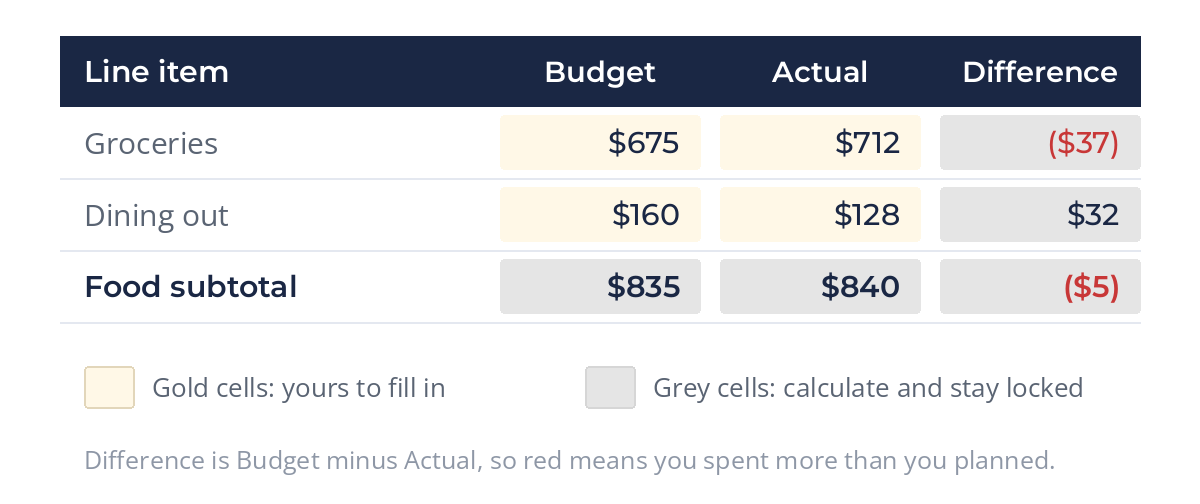
Every line has three columns. Budget is your plan for the month. Actual is what really happened. Difference shows the gap. You fill in the gold cells. The grey cells, including every subtotal and total, calculate on their own and stay locked so a formula can't be deleted by accident.
Start With the Completed Example
Open the completed example tab first. It shows a full month already filled in, so you can see how the pieces connect before you build your own. Then move to the blank template and make it yours.
Step 1: Enter Your Income
Start in the Income section and list each take-home paycheck on its own line. If your income varies, use a conservative monthly average from the last three to six months. The worksheet totals it for you, so you can see exactly how much you have to work with before a single bill is paid.
Step 2: Itemize Your Fixed Costs
Enter each fixed account separately: rent or mortgage, every utility, every insurance policy, every card and loan minimum, and the subscriptions you're keeping.
For annual or semiannual bills, divide by twelve and enter the monthly share. Now you can see how much of your income is already committed before you spend a cent on anything else.
Step 3: Itemize Your Variable Spending
Fill in groceries, fuel, dining out, household supplies, personal care, and the rest. If you're unsure, start from your recent bank statements, then refine as you track the real numbers.
Be honest here. Underestimating variable spending is the single biggest reason budgets fall apart.
Step 4: Fund Savings and Sinking Funds
Give your emergency fund a dedicated line in the budget, then add a small monthly set-aside for each irregular cost you know is coming, such as repairs, gifts, or annual renewals. Even a little in each one keeps a surprise bill from derailing your plan later on.
Step 5: Set Your Extra Debt Payment
Whatever is left after your living costs, your minimums, and a little savings becomes your Extra Debt Payment. This is the most important number in the tool.
Adjust your categories until the Difference at the bottom reaches zero, which means every dollar has a job. Then carry that steady extra payment into your Debt Stack Calculator to build your payoff plan and put the rollover to work.
Step 6: Read Your Month-End Result
No month lands exactly on plan, and that's fine. Some categories run high, others come in low.
At the bottom of the template, the Month-End Result takes whatever you came in under budget and adds it to your planned extra payment, so a good month turns into a bonus payment you can send straight to your target debt. Keep the steady amount in your Debt Stack Calculator, and treat any month-end surplus as extra firepower on top.
Step 7: Make It a Weekly Habit
A budget you build once and never reopen is just a document. A budget you review each week is a leadership habit.
Once a week, update the Actual column, compare it to your plan, and adjust the rest of the month if a category is running hot. That ten-minute check-in is where the real change happens.
How Your Budget Powers the Rest of Your Debt Payoff
This one tool ties the whole plan together. Your personal financial statement from Step Three told you what you owe. Your daily cash flow from Step Four showed you the timing of your money. This budget turns that knowledge into a monthly plan and frees up a specific dollar amount to attack your debt.
That freed-up amount is the fuel for everything that follows. Drop it into your Debt Stack Calculator and you'll see your debt-free date and the interest you'll save. Pair it with the Cash Envelope System in Step Seven and you'll protect the plan from overspending.
Each tool makes the next one stronger, and your budget is where the money to run all of them comes from.
Why This One Step Matters
Our "10 Steps to Conquer Debt" ebook walks you through a complete, practical process for getting out of debt and staying out. The household budget is one of the steps that ties so many others together.

It gives you clarity and control. Most people don't have a money problem so much as a clarity problem. This template shows you in black and white where your money goes and what needs to change.
It makes every other step work harder. Whether you're lowering an interest rate, building an emergency fund, or setting a payoff plan, your budget tells you what's possible and how fast you can move.
It turns goals into a monthly action plan. A goal like "pay off debt" only has power when it's tied to a specific dollar amount each month. This is where that connection happens.
It builds your self-leadership muscles. Used consistently, it reinforces three habits that carry into every part of life: telling yourself the truth about your situation, deciding based on facts, and following through even when it isn't easy.
And it flexes with your life. Single or married, families with kids, irregular income or several jobs, a growing business, the template adapts. As your life changes, your budget changes with it. The discipline of using it stays the same.
"We must consult our means rather than our wishes."
- George Washington
Build the Habit
A great budget template is only the start. The change comes from using it consistently. Here's a simple routine to keep your budgeting process alive without making it a chore.
- Daily, about five minutes. Record any new transactions and glance at the categories that tend to get away from you.
- Weekly, about ten minutes. Hold a short money meeting, on your own or with your partner. Review planned against actual, look ahead to any bills or irregular costs coming up, and pick one small improvement for the week ahead.
- Monthly, about thirty minutes. Close out the month, look at what surprised you, and set up next month's budget in the same file, improving one or two things at a time. Revisit your "10 Steps to Conquer Debt" goals and raise your extra payment as your situation improves.
If it helps, share your plan with someone you trust, a partner, friend, or mentor, and ask them to check in once a week. A little accountability turns good intentions into steady progress.
Common Budgeting Mistakes and Simple Fixes
Even a great template can fall short if the habits around it are weak. Here are the breakdowns we see most, with a fix for each.
Mistake 1: Forgetting Irregular Expenses
Fix: In your household budget template, create a line item to set up a small monthly set-aside, sometimes called a sinking fund, for the biggest non-monthly costs you know are coming. Start with your top three, such as car repairs, medical, and gifts. Even twenty-five to seventy-five dollars a month in each makes your budget calmer and tougher.
Mistake 2: Underestimating Variable Spending
Fix: Start from reality. Take last month's actual totals for groceries, fuel, dining out, and household items, and use those as your baseline. Then trim gradually, cutting dining out by twenty-five dollars next month rather than two hundred overnight. Remember, you're building a system you can follow, not a fantasy you'll abandon.
Mistake 3: Treating Leftover Money as a Plan
Fix: Leftover money disappears. Decide ahead of time what any surplus is for. Give it a job, an extra debt payment, your emergency fund, or a specific goal, so small wins turn into visible progress.
Mistake 4: Not Reviewing Weekly
Fix: A budget isn't set it and forget it. It's more like steering, small corrections that keep you on course. A ten-minute weekly check-in beats one stressful hour at the end of the month every time.
When you expect the surprise expense and plan for it, your budget becomes a shield. If you still have questions, the FAQ below covers the most common ones people have after downloading a household budget template.
Frequently Asked Questions (FAQ): Household Budget Templates
These are common questions people ask after downloading a household budget template:
What’s the best household budget template format: Excel, PDF or Sheets
How detailed should my household budget be?
List each account on its own line rather than a rough total for a whole category. Enter every utility, insurance policy, card, and subscription separately. The first pass takes longer, but seeing each account is how you decide whether a dollar is worth spending, and a single account is often where the easiest savings hide.
What is the difference between the Budget and Actual columns?
Budget is your plan for the month. Actual is what you really spent. The Difference column on our household budget template shows the gap, so you can see where you stayed on track and where you drifted. For an expense, a positive Difference means you spent less than you planned.
Can a good month help me pay off debt faster?
Yes. When your spending comes in under budget, the Month-End Result turns that surplus into a bonus payment you can send to your target debt, on top of your steady extra payment.
How do I budget if I get paid weekly or every two weeks?
Convert your income to a monthly number one of two ways: average the last three months, or use a conservative baseline and treat any extra checks as bonus debt payoff or savings.
What categories should a monthly household budget include?
At a minimum: income, housing, utilities, groceries, transportation, insurance, debt, savings, and irregular or sinking-fund costs.
How often should I update my household budget spreadsheet?
Weekly is the sweet spot for most households, about ten minutes. A monthly review is a solid backup.
Why does my budget work on paper but fail in real life?
Usually it's missing irregular expenses, underestimating variable spending, or skipping the weekly review. Use the full category checklist on this page so nothing gets left out.
Can I use this budget template for debt payoff?
Yes. Set your Extra Debt Payment line, choose the snowball or avalanche method in your Debt Stack Calculator, and use your weekly review to stay on track.
Continue Your Journey: The Full 10 Steps to Conquer Debt
"Money is a terrible master but an excellent servant."
- P.T. Barnum
Downloading this household budget template is a strong move. It's also one part of a complete path we've built to help you lead yourself to financial freedom. At Leadership-Tools.com you can access the full "10 Steps to Conquer Debt" ebook, a practical step-by-step plan that shows how all the pieces fit together, along with a growing library of self-leadership tools and worksheets designed to help you lead yourself first.
At first the budgeting process might feel simple, but you wouldn't be here if you didn't need to make some real financial changes. Use this template and the rest of our financial tools as you follow the steps, and you'll find a renewed confidence and peace of mind in how you manage your money.
In Step Seven we share another proven strategy for making sure you never overspend. Our Cash Envelope System is one more arrow in your financial quiver.
Download 10 Steps to Conquer Debt eBook & Budget Tool

Want the entire leadership tools library? Subscribe to our free newsletter and we'll send you a link to every tool on this site, all on one page, sorted by leadership phase. Every tool is free to download on its own page. The library just puts them in one place. Plus, you'll never miss out on updated or new tool announcements.
Your privacy is important to us. We never share or sell email addresses.
Leadership Tools Newsletter
Subscribe Free - See All Tools on One Page - Get New Tool Alerts
More 10 Steps to Conquer Debt Tools



Richard Gorham has led teams in financial services for more than 30 years, from retail branches and operations to investments and insurance, and he still leads a team today.
He founded Leadership-Tools.com in 2002 to give managers free, practical tools like the ones he used in his various leadership roles. Every tool here has been used in a real workplace and comes with a filled-in example you can follow.

Contact Information:
phone
(503) 970-9777
Email Customer Service
helpsupport@leadership-tools.com
Email Richard
richard@leadership-tools.com

By Richard Gorham
Leadership-Tools.com
2879 Riverwalk Loop, Eugene, Oregon, 97401
Copyright (c) 2002 - 2026 All Rights Reserved