Leadership Development Framework: How to Build One That Actually Works

Featuring The Leadership Standardâ„¢

A leadership development framework is a structured approach that helps leaders grow as their responsibilities expand. Instead of treating leadership as one skill to master all at once, a framework organizes growth into phases, so leaders know what to focus on as their influence increases.

Done well, a leadership development framework gives an organization a shared language for what leadership looks like at each level, a clear path for developing people into bigger roles, and a way to measure whether the development is actually working. Done poorly, it becomes a slide deck no one references.

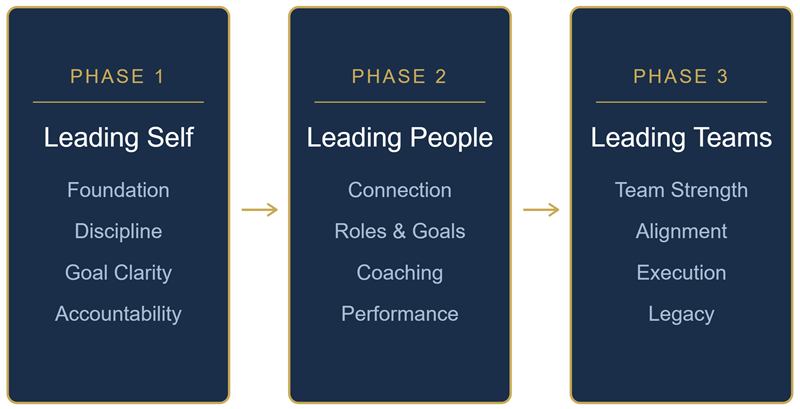
Leadership development framework diagram showing the three phases of leader growth: Leading Self, Leading People, and Leading Teams

This page covers what leadership development frameworks include, how organizations build them, and how to choose or design one that fits real-world leadership challenges. It also introduces The Leadership Standard, a practical framework built from two decades of working with managers in real situations.

If you're researching frameworks for your organization, building your own, or just trying to figure out where to focus your own development next, you'll find what you need here.

A Leadership Development Framework is a structured approach that helps leaders grow as their responsibilities expand.

Instead of treating leadership as a single skill to master, a framework organizes leadership development into phases, so leaders know where to focus their attention as their influence grows.

Each phase reflects the changing responsibilities leaders face as they move from managing their own performance to developing others and guiding teams toward meaningful results.

What a Leadership Development Framework Usually Includes

Frameworks vary in detail and language, but the strong ones share a common set of building blocks. Whether you're evaluating an existing framework or designing one from scratch, these are the elements that matter most.

  • Leadership levels or phases. A clear progression from individual contributor through team leader and beyond, so it's obvious what level of leadership the framework is talking about at any moment.
  • Core competencies for each level. The specific skills, behaviors, and mindsets expected at each phase of leadership. Without this, a framework becomes vague and hard to act on.
  • Development pathways. How leaders move from one phase to the next: stretch assignments, coaching, training, feedback, and time in role.
  • Assessments and self-checks. Tools that help leaders see where they actually are, not just where they think they are. Without honest assessment, development gets aimed at the wrong things.
  • Manager and coaching support. Frameworks fail when the leader's own manager isn't engaged. Strong frameworks build in support structures so growth isn't a solo activity.
  • Measurement and feedback loops. How the organization knows the framework is working: engagement, retention, promotion readiness, team performance, or feedback quality.
  • Practical tools. Templates, checklists, and worksheets that translate concepts into something leaders can use on Tuesday morning.

A leadership development framework that covers all seven of these well is rare. Most organizations either over-invest in competency models that never get used or under-invest in measurement and end up unable to prove the framework is making a difference. The Leadership Standard, introduced further down this page, was designed to keep each of these elements practical rather than theoretical.

How to Build a Leadership Development Framework

Organizations build leadership development frameworks for different reasons. Some are responding to a growth phase that's stretched their current leaders thin. Others are trying to reduce the chaos of inconsistent leadership development across the company. A few are preparing for a generational transition. Whatever the reason, the build process tends to follow five steps.

Step 1: Assess the Current State of Leadership in Your Organization

Before defining where you want leaders to go, get honest about where they are.

  • What's working in how leaders are developed today? 
  • What's missing? 
  • Where are leaders failing, and is the failure individual or systemic? 

Talk to managers, their direct reports, and the senior team. Look at retention data, engagement scores, and promotion patterns. The goal is to build a clear baseline, so the framework solves real problems, not imagined ones.

Step 2: Define What Leadership Looks Like at Each Level

Decide how many leadership phases or levels your framework will recognize and what's expected at each.

Most practical frameworks use three to five phases. Fewer than that feels too coarse; more than that becomes hard to remember and harder to use.

For each phase, name the core competencies, the behaviors that demonstrate them, and the typical challenges leaders face at that level.

Be specific enough that a manager could use the framework to coach a real person at their next one-on-one.

Step 3: Align Development Pathways to the Framework

A framework is only as useful as the development tools that supports it.

Map out how leaders actually grow from one phase to the next: stretch assignments, coaching, training programs, peer learning, manager development conversations, and time-in-role expectations.

If the only development path is "send people to a leadership workshop," the framework will stall. Practical frameworks build multiple pathways and let leaders mix them based on what they need.

Step 4: Build the Supporting Tools and Manager Capabilities

This is where most frameworks succeed or fail.

The framework needs tools leaders can actually use: assessments, coaching templates, planning worksheets, feedback structures, and progress trackers. Just as important, the managers responsible for developing leaders need their own development.

A framework built on the assumption that every manager already knows how to coach is a framework that won't survive its first year.

Step 5: Measure, Learn, and Refine

Decide upfront how you'll know the framework is working.

Common measures include engagement scores, retention of high-potential leaders, promotion readiness, manager feedback quality, and team performance against goals.

Review the data at least annually. Be willing to change the framework when the evidence says it isn't producing the leaders you need. Frameworks that never change are usually frameworks no one uses anymore.

Building a leadership development framework from scratch is meaningful work, and it isn't always the right choice.

Many organizations get further by adopting or adapting an existing framework that already has tools, language, and structure in place.

The Leadership Standard is one such framework, built specifically to be practical, adaptable, and supported by tools leaders can use immediately. The rest of this page walks through how it works.

The Leadership Standard: A Practical Leadership Development Framework

Leadership growth rarely happens all at once. Most leaders begin by learning to manage themselves well. Over time they take responsibility for developing other people. Eventually they may lead teams responsible for delivering important results.

Throughout that journey, the skills required change. The discipline that makes you a strong individual contributor doesn't make you a strong coach. The coaching skills that develop a single direct report don't automatically scale to align a team of fifteen.

Over the past two decades, Leadership-Tools.com has focused on providing practical resources that help managers improve their effectiveness in real situations. As the site grew, it became clear that many of those tools naturally supported three phases of leadership growth. That realization led to The Leadership Standard.

The Leadership Standard organizes leadership development into three phases that build on each other: Leading Self, Leading People, and Leading Teams.

Leading Self: The Foundation of Leadership

Every leadership journey begins with the ability to lead yourself well. Leaders who lack clarity, discipline, or personal accountability often struggle to guide others effectively.

The Leading Self phase focuses on personal leadership development, including:

  • Clarifying priorities and goals
  • Developing habits that support consistent performance
  • Taking ownership of results
  • Committing to continuous personal growth

The leadership assessments and personal development tools available on this site support this phase. They help leaders build the foundation that everything else in leadership depends on.

Leading People: Developing Others

Once leaders begin managing employees or supervising teams, leadership shifts from personal productivity to developing others.

The Leading People phase focuses on leadership skills such as:

  • Building trust and connection
  • Setting clear expectations
  • Coaching employees for improvement
  • Giving meaningful feedback
  • Strengthening accountability

Many managers are promoted because of strong individual performance, yet they are rarely given tools to help them develop people effectively. A structured leadership development framework helps managers grow into these responsibilities with greater confidence.

The coaching tools, feedback frameworks, and performance development templates on this site support leaders working in this phase.

Leading Teams: Aligning Effort and Results

As leadership responsibility expands further, leaders must coordinate the efforts of multiple people and ensure that teams move in the same direction.

The Leading Teams phase focuses on organizational leadership skills such as:

  • Aligning priorities and goals
  • Coordinating initiatives and projects
  • Strengthening team accountability
  • Creating systems that support consistent execution

At this phase leadership becomes less about managing individual tasks and more about creating clarity and alignment across a team.

Planning tools, leadership templates, and team development resources available on this site support leaders working in this phase.

Sample Competencies and Challenges by Phase

Each phase of leadership development has its own set of skills to build and predictable challenges to navigate.

The table below shows a few examples for each phase of The Leadership Standard. The full framework, including the underlying tools, assessments, and development paths, is being developed into a complete course and workshop.

Phase Sample Focus Areas Common Challenges
Leading Self Self-awareness, personal discipline, time management, role clarity, honest self-assessment Reactive habits, unclear priorities, difficulty saying no, blind spots about strengths and gaps
Leading People Coaching conversations, setting expectations, giving feedback, building trust, performance management Promoted on individual performance without coaching skills, avoiding hard conversations, inconsistent expectations
Leading Teams Strategic prioritization, role and ownership clarity, project tracking, succession planning, team alignment Too many priorities, unclear ownership, lack of visibility into progress, single points of failure

This is a simplified view. In practice, each phase has more depth than three focus areas suggest. The Leadership Standard book, course, and 90-day workshop, currently in development, go deeper into the competencies, tools, and progress measures that bring each phase to life. Subscribers to the free Leadership Tools newsletter will be the first to know when they're available.

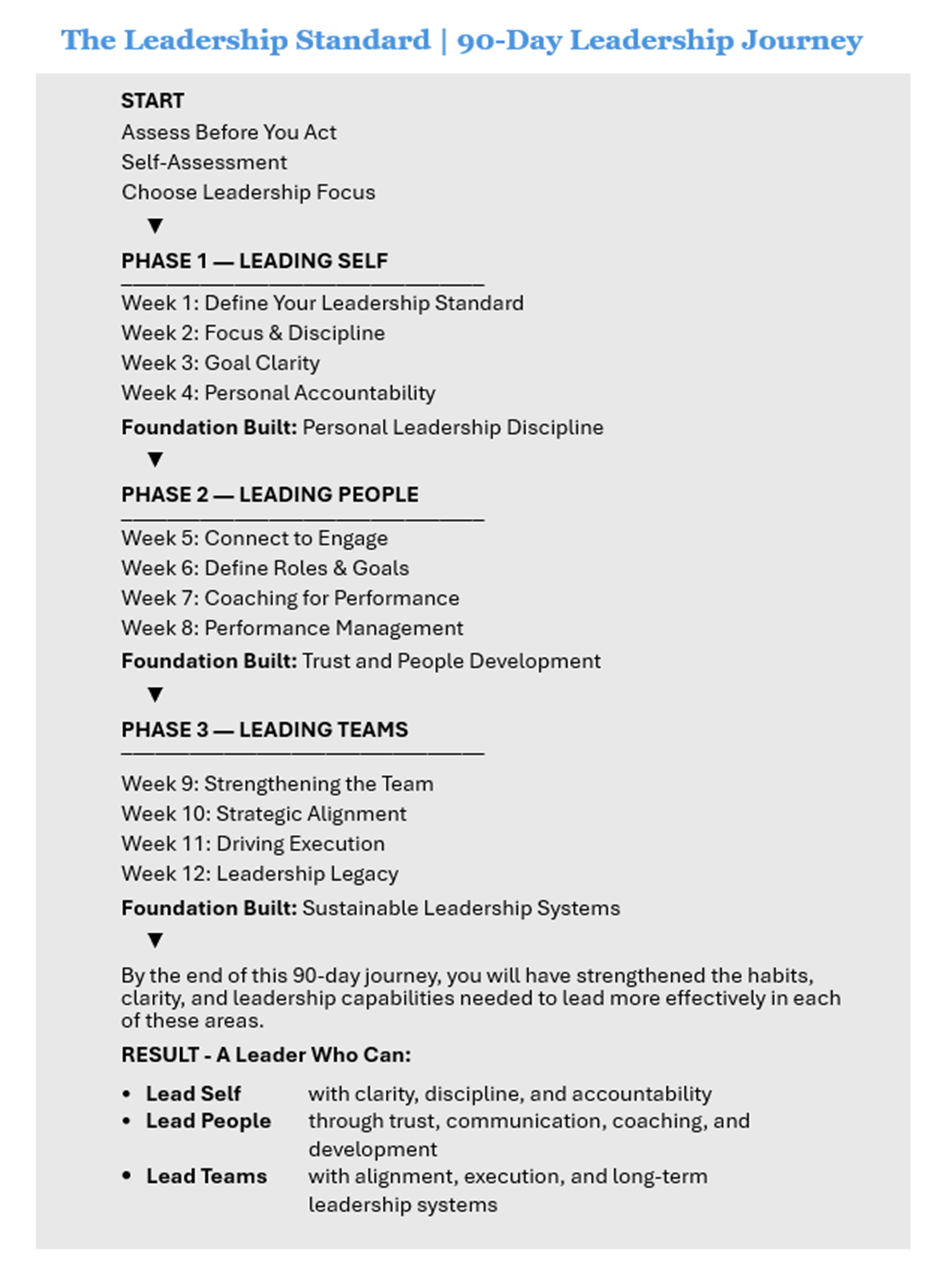
The Leadership Standard | 90-Day Leadership Journey

The Leadership Standard framework can also be applied as a structured leadership development journey.

Leaders move through three phases that build progressively on each other, strengthening personal discipline, people leadership, and team alignment over time.

The diagram below illustrates how the 90-day leadership journey progresses through the three phases of the Leadership Standard framework.

The Leadership Standard 90-day leadership journey diagram showing progression through Leading Self, Leading People, and Leading Teams

A complete guided version of this 90-day journey is currently being developed as part of The Leadership Standard course and workshop.

Leadership Tools That Support the Framework

Leadership-Tools.com has always focused on providing resources leaders can apply immediately. Many of those tools align naturally with this leadership development framework.

You can explore resources related to each phase:

Leading Self Tools
Leadership assessments and personal development resources.

Leading People Tools
Feedback tools, coaching frameworks, and performance development resources.

Leading Teams Tools
Planning templates, alignment tools, and leadership systems designed to help teams execute effectively.

All tools are free to download. No signup required.

Comparing Leadership Development Frameworks

Many organizations use leadership development frameworks to guide how leaders grow over time. The right framework depends on what the organization is trying to accomplish, how mature its current leadership development is, and what kind of practical support is available.

Here's how The Leadership Standard compares to other widely used frameworks.

The Leadership Standard

A practical leadership development framework built around three phases of leadership growth:

  • Leading Self
  • Leading People
  • Leading Teams

Designed to be supported by free, downloadable tools that leaders can apply immediately. Strongest for managers and team leaders who want a structured approach without a heavy theoretical lift.

Situational Leadership

Developed by Hersey and Blanchard, Situational Leadership focuses on adapting leadership style to the readiness and development level of the employee being led.

Strongest for leaders managing a wide variety of direct reports with different experience levels.

The Five Practices of Exemplary Leadership

Developed by James Kouzes and Barry Posner, this framework identifies five behaviors that distinguish strong leaders: model the way, inspire a shared vision, challenge the process, enable others to act, and encourage the heart.

Strongest for organizations focused on inspirational and values-based leadership development.

Servant Leadership

Originating with Robert Greenleaf, Servant Leadership emphasizes the leader's responsibility to serve their team and support the growth of others before pursuing their own success.

Strongest for organizations with strong values-driven cultures or mission-oriented work.

These frameworks aren't mutually exclusive. Many organizations draw on elements of several.

The Leadership Standard's contribution is its emphasis on practical, downloadable tools and a phased progression that any individual leader can follow at their own pace, even without organizational sponsorship.

Why a Leadership Development Framework Matters

Leadership isn't a single skill that can be mastered once and applied forever. It's a process of growth that expands as responsibilities increase.

A clear leadership development framework helps leaders understand that journey and focus on the skills that matter most at each phase of development. It gives organizations a shared language for what leadership looks like, a path for developing people into bigger roles, and a way to measure whether the development is actually working.

The Leadership Standard provides a practical way to guide that growth, supported by tools that leaders can put to work immediately. Whether you're evaluating frameworks for your organization or just trying to figure out where to focus your own development next, the resources on this site are built to help.

Frequently Asked Questions 

Common questions about leadership development frameworks, what they include, how to build them, and how The Leadership Standard fits in.

Click on the (+) sign below to expand each question. Click the (-) sign to collapse it again.

What is a leadership development framework?

A leadership development framework is a structured approach to growing leaders within an organization. It typically defines the leadership phases or levels that matter, the competencies expected at each level, the development pathways that help leaders move from one level to the next, and the tools and measures that support the process.

A practical framework gives leaders and managers a shared language for what leadership looks like and what's expected at each phase of responsibility.

Why is a leadership development framework important?

Leadership responsibilities change as a role grows. The skills that make someone a strong individual contributor are not the skills required to develop other people or align a team.

A framework helps leaders focus on the right things at the right time, so growth becomes intentional instead of reactive.

For organizations, a framework also creates consistency: every leader is developed against the same set of expectations, which makes promotion, coaching, and succession planning more reliable.

How do you build a leadership development framework for an organization?

Most practical frameworks follow five steps: assess the current state of leadership in the organization, define what leadership looks like at each level, align development pathways to support movement between levels, build the tools and manager capabilities that bring the framework to life, and measure results so the framework can be refined over time.

The most common failure point is step four. Frameworks that lack practical tools and manager development rarely survive their first year.

What competencies should a leadership development framework include?

The right competencies depend on the organization and the leadership level.

At foundational levels, frameworks typically emphasize self-awareness, personal discipline, accountability, and time management.

At people-leadership levels, the focus shifts to coaching, feedback, expectation-setting, and trust-building.

At team-leadership levels, competencies move toward strategic prioritization, alignment, project execution, and succession planning.

Strong frameworks define each competency with specific observable behaviors so coaches and managers can develop people against them.

How do you measure whether a leadership development framework is working?

Common measures include engagement scores, retention of high-potential leaders, internal promotion rates, manager feedback quality, and team performance against goals.

The right measures depend on what the framework was built to accomplish. A framework focused on developing first-time managers should be measured differently than one designed to build a succession pipeline for senior leaders.

The key is deciding the measures upfront, reviewing them at least annually, and being willing to refine the framework when the evidence says something isn't working.

What is The Leadership Standardâ„¢?

The Leadership Standard is a practical leadership development framework built around three phases of leadership growth:

  • Leading Self
  • Leading People
  • Leading Teams

It was developed from two decades of working with managers in real situations and focuses on habits, tools, and systems that leaders can apply immediately. Each phase is supported by free downloadable tools available on this site.

Who is the Leadership Standard designed for?

The framework is most useful for supervisors, managers, and team leaders who want a practical way to strengthen their leadership without working through dense theory.

It also works well for organizations looking for a framework they can adapt rather than build from scratch.

Many of the tools on this site were created specifically to support leaders working through these phases, whether as individuals or as part of a broader organizational rollout.

How is the Leadership Standard different from other leadership frameworks?

Most leadership frameworks focus primarily on style or theory. The Leadership Standard focuses on practical leadership development supported by free, downloadable tools.

It's structured around three phases that any leader can follow at their own pace, even without organizational sponsorship.

Frameworks like Situational Leadership, the Five Practices, and Servant Leadership cover different aspects of leadership and can complement The Leadership Standard rather than replace it.

Can a leadership development framework work for a small business or a team?

Yes. Some of the most effective applications of a framework happen at the team or small-business level, where one leader can apply the ideas without waiting for organizational rollout.

A small business owner can use The Leadership Standard to develop themselves first, then their managers, then their team.

The framework scales down as well as it scales up because the core phases of leadership growth are the same regardless of organization size.

Where should I start with The Leadership Standard?

Start with whichever phase matches your current leadership reality. If you're a new manager still finding your footing, start with the Leading Self tools to build your foundation. If you're managing people and looking to coach more effectively, start with the Leading People tools. If you're aligning a team or organization, start with the Leading Teams tools.

Each phase links to the full set of free resources for that area.

Get Updates Free

Subscribe to Free Newsletter - Receive Password - Access Leadership Tools Library

No Spam  |  Privacy Protected

Contact Information:


phone
(503) 970-9777

Email Customer Service

helpsupport@leadership-tools.com

Email Richard
richard@leadership-tools.com


By Richard Gorham
Leadership-Tools.com
2879 Riverwalk Loop, Eugene, Oregon, 97401

Copyright (c) 2003 - 2026 All Rights Reserved

Terms of Use    |    Privacy Policy