A coaching action plan template is a structured set of tools that helps leaders prepare for, document what was discussed in the coaching conversation, what the employee committed to, and when the follow-up will happen. The template on this page uses the FRONT framework (Focus, Reality, Ownership, Next Step, Time) to organize the conversation into five clear sections, plus a commitment update section to track progress from the previous meeting.
- Home
- Leading People
- Coaching Action Plan Template
Coaching Action Plan Template (With Conversation Guide & Examples)
A coaching action plan template is a structured tool used by managers to guide performance coaching conversations with employees. It helps define the focus, assess the current reality, clarify ownership, and establish next steps with clear timelines. This page and associated templates are designed for practical, real-world use in 1-on-1 coaching sessions and ongoing employee development.
On this page you'll find the employee coaching template, a conversation framework called FRONT, a decision guide for diagnosing the right response, two worked examples, and a coaching log template for tracking progress over time.
Most leaders are expected to coach their people but were never formally trained to do it. You're handed the responsibility with no structure, no script, and no clear picture of what a good coaching conversation should look like. The result is usually the same: conversations that feel productive in the moment, but don't actually drive change.
Everything works together, and everything is free to download below.
After using the coaching action plan template and supporting resources on this page, you'll avoid ever being in that kind of position. Instead, you'll have the knowledge and coaching templates necessary to help your team continually improve their results.
Follow the steps provided and download each of our coaching action plan templates below and use them to create a solid coaching conversation system.
Performance Coaching Leader Decision Guide:
Performance Coaching Conversation Worksheet:
Performance Coaching Log:
Coaching system at a glance
| Tools Formats | PDF, Word, Google Docs, Excel, Google Sheets |
| Ideal for | Managers leading regular coaching conversations with direct reports |
| What it covers | FRONT framework, Teach/Coach/Expect, decision guide, worked example |
| Best for | Building a repeatable coaching system across your team |
| Not ideal for | Formal performance improvement plans requiring HR documentation |
Companion tools included
Use the Leader Decision Guide before the conversation to diagnose whether the situation calls for teaching, coaching, or accountability.
Use the Conversation Worksheet during the meeting so the employee arrives prepared and the discussion stays focused on Focus, Reality, Ownership, Next Step, and Time.
Use the Coaching Log after the conversation to document commitments, schedule the follow-up, and track progress across weeks.
Use all three together to build a complete coaching system that covers every step from diagnosis to follow-through.
Jump To: Who This Template Is For | Why Coaching Conversations Fall Short | The Coaching Action Plan at a Glance | Before the Conversation: Teach, Coach, Expect | During the Conversation: Lead with FRONT | After the Conversation: Track with the Coaching Log | Completed Coaching Examples | Three Types of Coaching Conversations | Comparing Coaching Frameworks | Common Mistakes | When Coaching Becomes Accountability | Final Thought | FAQ | Get Updates Free | Download Template
Who This Tool Is For
If you're wondering how to coach an employee who needs to improve, this coaching action plan template gives you a repeatable way to have better coaching conversations with the people you lead.
It works well for:
- New or experienced managers looking for a practical manager coaching template they can put to use this week, especially if they weren't formally trained as coaches.
- Team leads who’ve been told to “coach more” but aren’t sure what that should actually look like in a real conversation.
- Senior leaders rebuilding coaching habits across their organization who need a common framework their managers can share.
If you’re already comfortable coaching but want a cleaner way to document conversations and track follow-through, the coaching log template and conversation worksheet will fit into your existing approach nicely.
If you’re new to coaching entirely, working through the full system in order gives you a practical starting point. You don’t need a certification or a formal training course to begin. You need a clear process, a few good questions, guidance on a cadence of activities, and the willingness to follow up on what was agreed.
Why Coaching Conversations Fall Short
Most coaching conversations fail for the same reason most planning sessions fail. The discussion feels productive in the moment, but nothing specific gets committed to, nothing gets written down, and nothing shifts afterward.
Ask a manager how their one-on-ones are going and the answer is usually something like “pretty good, we talk about what they’re working on.” Ask the employee what they agreed to work on last week and you often get a version of “we talked about a few things.” Both answers point to the same problem. The conversation happened, but the accountability didn’t.
There are three patterns that consistently undermine coaching conversations, even when the intent is good:
“Coaching is unlocking a person’s potential to maximize their own performance.”
— John Whitmore
The diagnosis gets skipped. The leader jumps into advice before understanding what kind of situation they’re dealing with. Is this someone who hasn’t been taught the skill yet? Someone who’s been taught but needs coaching to build consistency? Or someone who’s fully capable and simply isn’t meeting the expectation? Each situation calls for a different kind of response, and skipping the diagnosis usually leads to the wrong one.
The conversation wanders. Without a structure, discussions drift from topic to topic without landing anywhere. The employee leaves feeling heard but not clearer on what to do next. The leader feels like they offered support but isn’t quite sure what was agreed to.
Follow-up never happens. The conversation ends with a loose “let’s reconnect soon,” which usually translates to “never.” Two weeks later, the same issue comes up, and the cycle repeats. Without a scheduled check-in and a written record of commitments, coaching becomes a series of well-intentioned conversations that don’t drive real change.
The coaching action plan template on this page addresses each of these patterns directly. It works as a coaching plan for employees at any experience level, from new hires through senior performers, because the structure adapts to the situation rather than forcing the situation to fit the template.
The Coaching Action Plan at a Glance
The full coaching action plan template breaks into three phases. Each has a specific purpose and a specific tool that supports it.
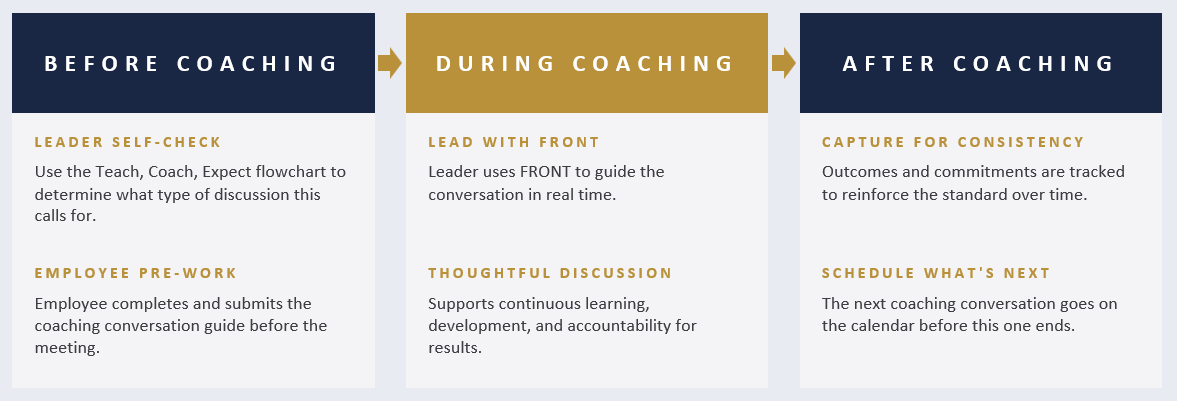
Before the conversation: Diagnose. Use the Teach, Coach, Expect framework and the decision guide to identify what the situation calls for. Not every performance issue is a coaching issue. Some are training gaps. Some are accountability conversations. Getting the diagnosis right before the conversation begins saves considerable time and prevents the wrong response.
During the conversation: Lead with FRONT. FRONT stands for Focus, Reality, Ownership, Next Step, and Time. It’s a coaching conversation framework that structures the discussion from start to finish without making it feel scripted. The coaching conversation template and worksheet walk through each letter with specific prompts.
After the conversation: Track. The coaching log captures what was discussed, what was committed to, and when the follow-up is scheduled. Used consistently, the log becomes a record of growth over time that makes your ongoing coaching considerably more effective.
Working through all three phases isn’t required for every conversation. A quick check-in might only need the FRONT structure. A formal performance discussion benefits from the full sequence. The point is that each phase is available when you need it.
Before the Conversation: Diagnose with Teach, Coach, Expect
The first thing any leader should do before a coaching conversation is figure out what kind of conversation this needs to be. Skipping that step is the most common reason coaching discussions go sideways.
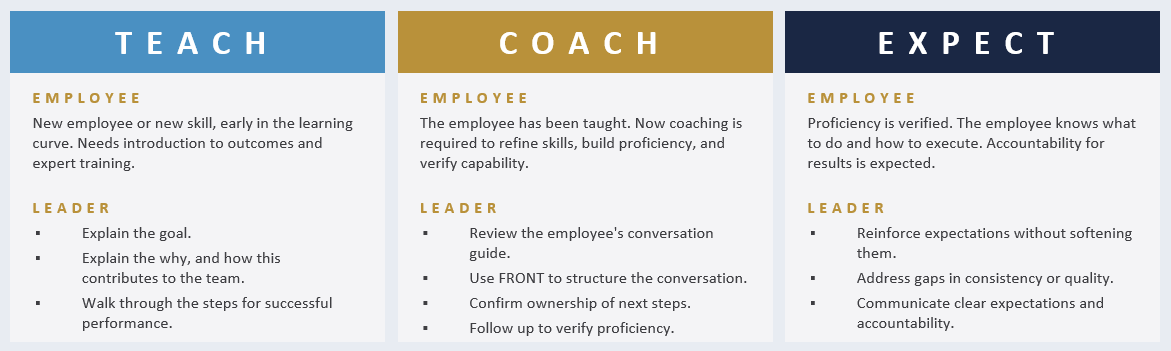
The Teach, Coach, Expect framework sorts most performance situations into one of three categories:
Teach applies when the employee is new to the role, new to a skill, or early enough in the learning curve that they haven’t been shown what good looks like yet. The response isn’t coaching. It’s instruction. Walk through the expectation, ensure they receive proper training, show the steps, explain the why, and make sure the person knows how to perform the task before you ask them to do it consistently.
Coach applies when the employee has been taught, understands the expectation, and is now building proficiency. They need support, feedback, and a structured conversation to refine their approach. This is where most coaching conversations live, and this is where the FRONT framework is most useful.
Expect applies when proficiency has been verified. The employee knows what to do and how to do it. Performance gaps at this phase aren’t skill gaps anymore. They’re accountability conversations, and the leader’s job is to reinforce the expectation clearly and fairly.
The most important rule in the framework is this: never move to Expect without first confirming the employee has been taught, coached, and observed performing the work successfully. Skipping that sequence turns accountability conversations into unfair ones, and the rest of the team will notice.
Leaders who hold themselves accountable to this discipline will earn the respect of their team, and the coaching action plan template makes that discipline easier to apply consistently.
The
Coaching Decision Guide
The coaching decision guide below walks you through five questions in order. Each question has a clear exit to an outcome: Celebrate, Teach, Coach, or Expect.
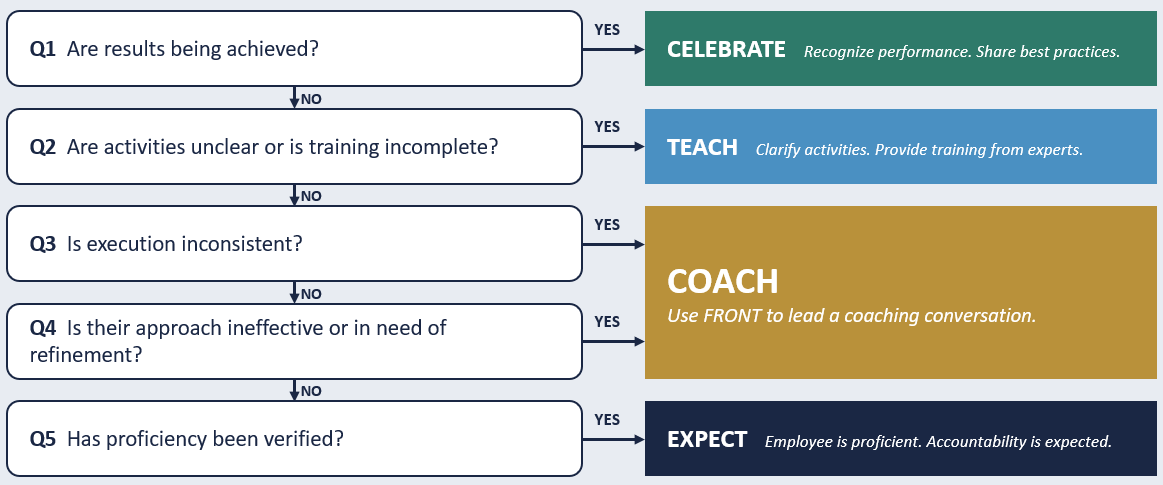
Every question follows the same rule: YES moves you to an outcome. NO moves you down to the next question.
Question 1: Are results being achieved? Start with the outcome, not the activity. If the numbers are where they need to be, the situation calls for recognition. YES → Celebrate. Share what's working, and don't assume good results are permanent. NO → continue.
Question 2: Are activities unclear or is training incomplete? Before labeling something a performance issue, confirm the employee has been given a fair shot. Coaching someone on a skill they've never been formally taught creates frustration on both sides. YES → Teach. Clarify expectations and show what good looks like. NO → continue.
Question 3: Is execution inconsistent? The employee can do the work well some of the time, but the quality varies. The issue isn't skill, it's application. YES → Coach. Use the FRONT framework to understand the inconsistency and agree on a specific next step. NO → continue.
Question 4: Is their approach ineffective or in need of refinement? The work is happening, but the method is limiting the result. YES → Coach. Same framework, slightly different focus: what's working, what isn't, and what a better approach might look like. NO → continue.
Question 5: Has proficiency been verified? This is the gate between coaching and accountability. YES → Expect. Reinforce the standard without softening it. NO → return to Coach. Proficiency must be verified through observation before moving to Expect. Skipping that step turns accountability conversations into unfair ones.
When the diagnosis isn't obvious, go back a step rather than forward one, and ask the employee directly: "Where do you think you are with this?" Their honest read usually clarifies whether it's a skill gap, a consistency gap, or something else entirely. The leader decision guide narrows the possibilities. The conversation confirms them.
During the Conversation: Lead with FRONT
FRONT is the coaching conversation framework at the heart of the coaching action plan template. It gives you a repeatable structure that works for a 15-minute check-in or a longer development discussion.
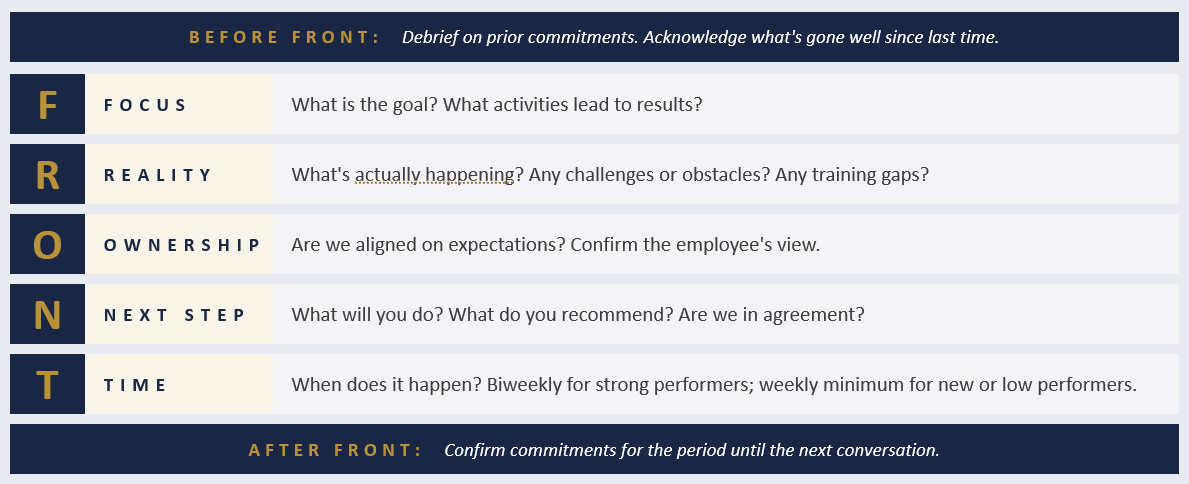
Each letter represents a question area that moves the conversation forward:
F — Focus. What is the goal, outcome, or area of performance we’re discussing today? Be specific. Vague focus produces vague commitments.
R — Reality. What’s actually happening right now? What examples, observations, or data support that picture? Reality grounds the conversation in facts rather than impressions.
O — Ownership. How does the employee see the situation? Where do you agree? Where do you see it differently? Clarity and alignment on the employee's ownership on the role and related responsibilities is the step most managers skip, and it’s the one that most affects whether the employee follows through.
N — Next Step. What will the employee do between now and the follow-up? A clear, specific, owned next step is the single most important outcome of any coaching conversation.
T — Time. When will it happen, and when will you check back? A next step without a date is a wish. Put it on the calendar before the conversation ends.
The Coaching Worksheet
The coaching worksheet walks through each of these with prompts the employee completes before the meeting, which turns the conversation into a working discussion rather than a debrief.
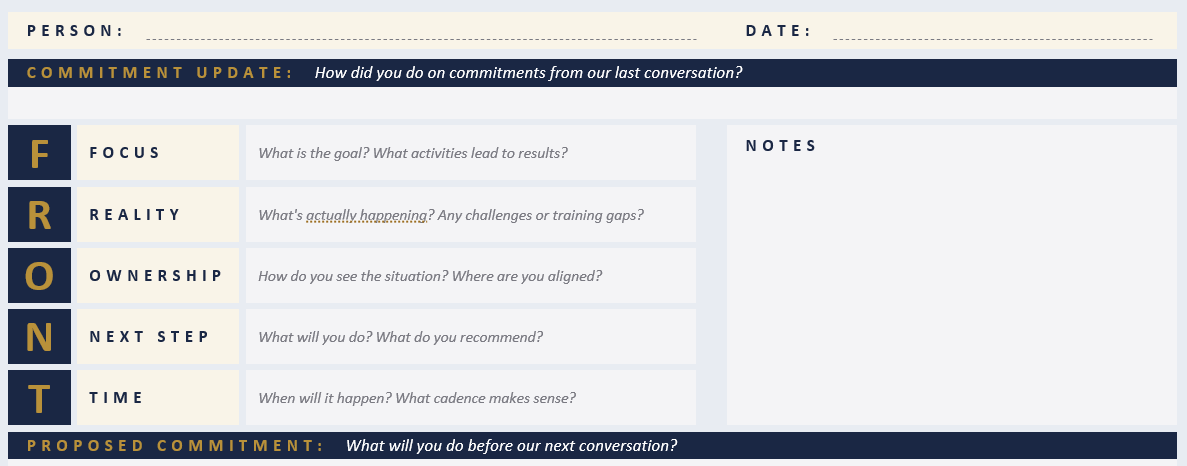
There’s a good reason to have the employee complete the worksheet beforehand. It shifts who’s driving the conversation.
When the employee submits their own read on Focus, Reality, and proposed Next Steps, they’re already engaged in the thinking. This also gives the leader time in advance of the conversation to think through the best approach. Your role becomes asking good questions, challenging assumptions where needed, and helping them land on commitments they’ll actually execute.
After the Conversation: Track with the Coaching Log
Most coaching conversations have no lasting record beyond a vague memory of what was discussed. The coaching log turns the coaching action plan template into a living document rather than a one-time exercise. That’s a missed opportunity.
Our coaching log template gives you a simple way to document each conversation in less than two minutes.
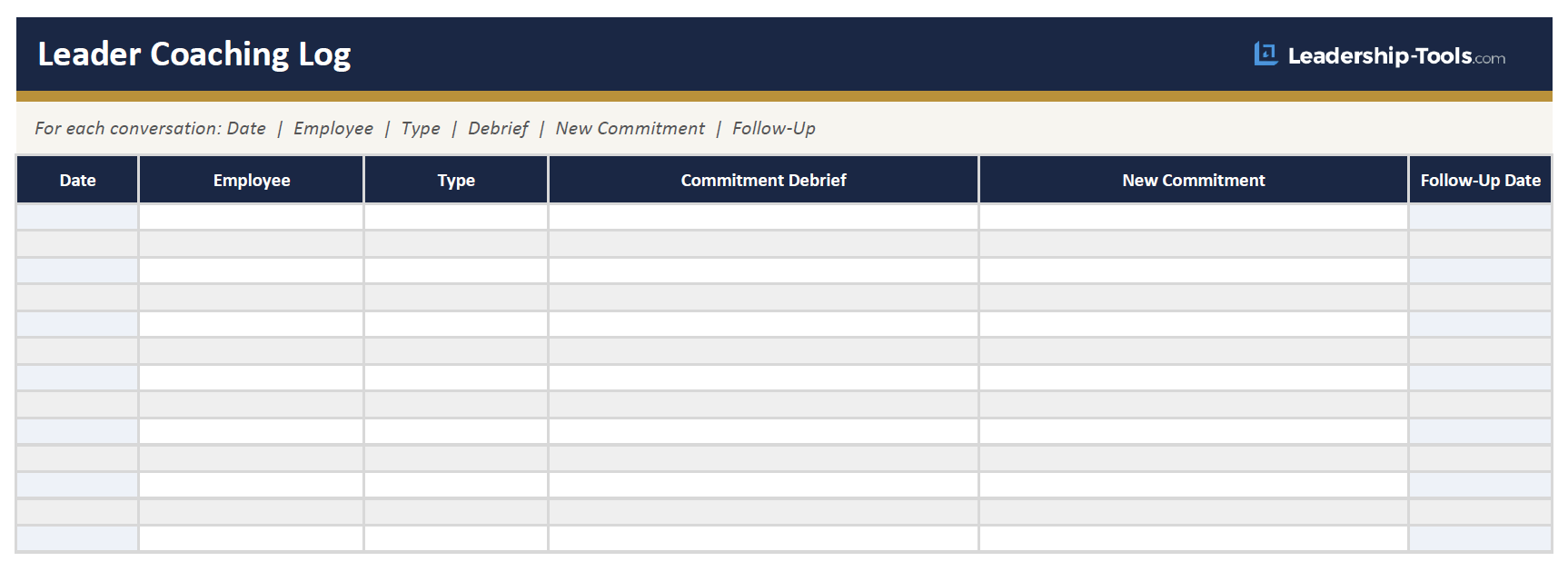
Here’s what the log captures:
- Date of conversation — when it happened.
- Employee name — who you met with.
- Type — one-on-one, observational, or in-the-moment.
- Commitment debrief — how did the employee do on commitments from the last conversation?
- New commitment — what are they taking on between now and the next conversation?
- Follow-up date — when will you meet again?
Notice what the log doesn’t capture. No full transcripts. No long write-ups. No surveillance-style notes on every word said. The log is intentionally light. Its purpose is to hold you accountable to consistent follow-through, not to create a paper trail that turns coaching into paperwork.
Used consistently, the coaching log produces several benefits that compound over time. You stop forgetting what was discussed two weeks ago. You spot patterns in an employee’s development that a single conversation would miss. And you build a factual record that makes quarterly reviews, development plans, and performance discussions considerably easier to ground in reality.
For managers of managers, the log also works as a simple way to verify that coaching is occurring consistently across the team. Review the log together in your one-on-ones, not as a surveillance tool, but as a way to support your leaders in building the habit.
Completed Coaching Action Plan Examples
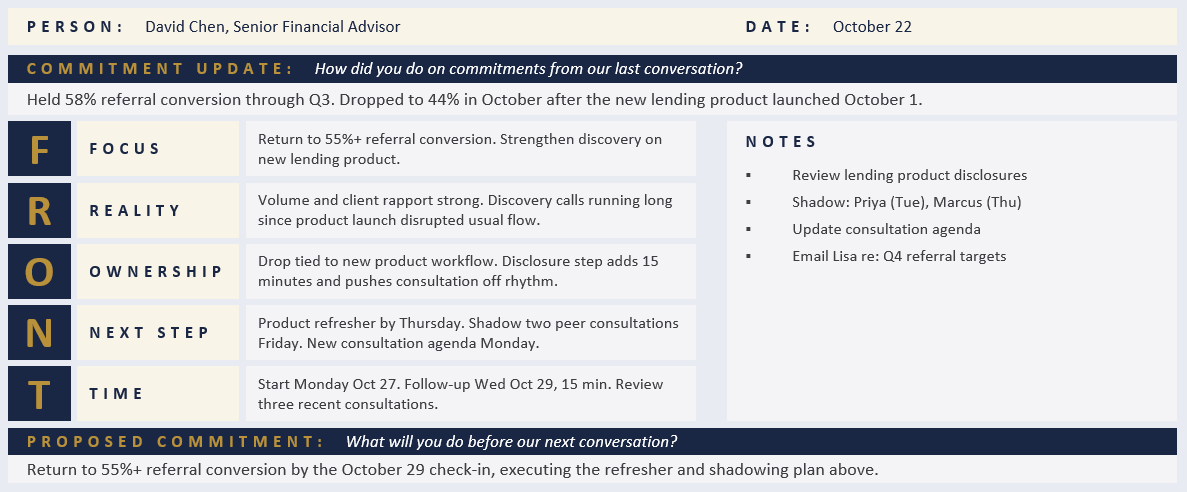
The coaching action plan template is easier to understand when you see it applied to a realistic situation. Here’s a completed coaching worksheet based on a common performance scenario in financial sales.
Coaching Action Plan Example (Employee Performance Coaching)
Person
David Chen, Senior Financial Advisor
Date
October 22
Commitment Update
Held 58% referral conversion through Q3. Dropped to 44% in October after the new lending product launched October 1.
Focus
Return to 55%+ referral conversion. Strengthen discovery on the new lending product.
Reality
Volume and client rapport remain strong. Discovery calls have been running long since the product launch disrupted the usual consultation flow.
Ownership
The drop is real and tied to the new product workflow. The added disclosure step adds about 15 minutes and pushes the consultation off its usual rhythm.
Next Step
Complete the product refresher by Thursday. Shadow two peer consultations Friday. Roll out a revised consultation agenda starting Monday.
Time
Start Monday, October 27. Follow-up Wednesday, October 29, for 15 minutes to review three recent consultations.
Proposed Commitment
Return to 55%+ referral conversion by the October 29 check-in, executing the refresher and shadowing plan above.
Why This Example Works
Notice a few things about how the worksheet is filled out:
The focus is specific and measurable. “Return to 55%+ referral conversion” is something both parties can verify. Compare that to “improve conversion,” which would have been vague enough to generate disagreement two weeks later about whether the goal was met.
The reality acknowledges what’s working. Volume and rapport are strong, so the conversation isn’t about starting from scratch. It’s about adjusting to a specific disruption. That framing keeps the employee engaged rather than defensive.
The ownership is honest. The employee isn’t making excuses, but they’re also not taking responsibility for something outside their control. The new product genuinely changed the workflow. The plan addresses the gap the change created.
The next step is actionable and has owners. Three specific actions. Two peer consultations, not “some.” A revised agenda, not “better preparation.” Each item can be verified.
The time commitment is concrete. A start date, a follow-up date, and an agenda for the follow-up. The conversation doesn’t end with “let’s reconnect soon.” It ends with “Wednesday at 3pm, here’s what we’ll review.”
That’s what a well-structured coaching conversation looks like when it’s written down. Twenty minutes of focused discussion turns into a clear, shared plan both parties can execute.
Coaching Action Plan Example (Professional Development & Succession Planning)
Coaching action plans are not just used to address performance gaps. They can also be used to guide employee development and prepare individuals for future roles.
The example below shows how the same structure can be applied to professional growth and succession planning.
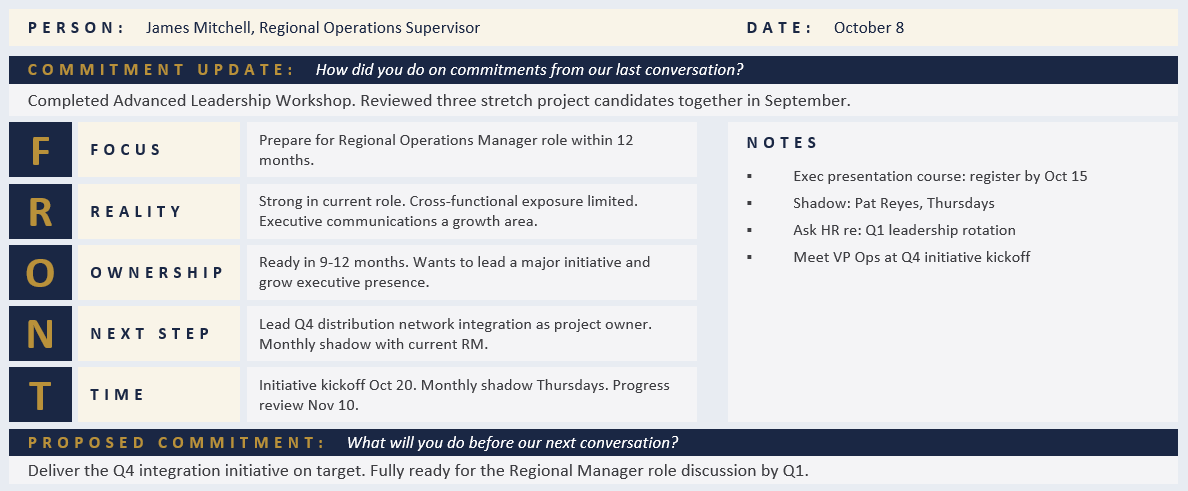
Person
James Mitchell, Regional Operations Supervisor
Date
October 8
Commitment Update
Completed Advanced Leadership Workshop. Reviewed three stretch project candidates together in September.
Focus
Prepare for Regional Operations Manager role within 12 months.
Reality
Strong in current role. Cross-functional exposure is limited. Executive communication is a development area.
Ownership
On track for readiness in 9–12 months. Needs to lead a major initiative and strengthen executive presence.
Next Step
Lead Q4 distribution network integration as project owner. Begin monthly shadowing with current Regional Manager.
Time
Initiative kickoff October 20. Monthly shadowing each Thursday. Progress review November 10.
Proposed Commitment
Successfully deliver the Q4 integration initiative and be fully prepared for Regional Manager role discussion by Q1.
When to Use Each Type of Coaching Action Plan
Not every coaching conversation has the same goal. Sometimes you’re working to correct a performance issue. Other times, you’re helping someone prepare for what’s next in their career.
Understanding which type of coaching action plan to use helps you focus the conversation, set the right expectations, and apply the framework in a way that fits the situation.
- Use performance coaching when addressing gaps
- Use development coaching when preparing for growth
- Use both as part of ongoing leadership development
Over time, the most effective leaders don’t treat these as separate conversations. They use both approaches consistently to improve performance while also building capability for what’s next.
“People may hear your words, but they feel your attitude.”
- John C. Maxwell
Three Types of Coaching Conversations
Not every coaching conversation is a formal one-on-one. In practice, most leaders end up having three different kinds of coaching discussions with their team, and each one uses a slightly different version of the same system.
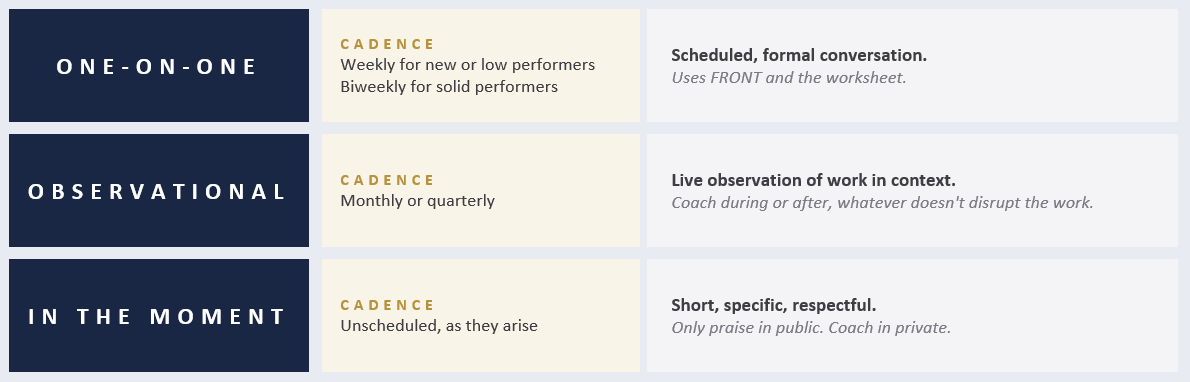
One-on-one. Scheduled, formal conversations that use the full FRONT framework and the coaching worksheet. The worksheet itself works as a simple one-on-one coaching template your team can use every week.
Observational. Live observation of work in context. You watch the employee handle a customer call, lead a meeting, or work through a task, and you coach either during the work or immediately after. Cadence is usually monthly or quarterly, depending on the role.
In-the-moment. Short, specific, respectful conversations as situations arise. A quick word after a team meeting. Feedback after a difficult customer interaction. These happen unscheduled, as the work generates them. The rule here is simple: praise in public, coach in private.
All three types show up in the coaching log the same way. The format doesn’t change based on the type. What changes is the depth and the cadence. A formal one-on-one might fill the worksheet completely. An in-the-moment conversation might only produce one line in the log. Both count. Both matter. And both contribute to the same ongoing development of the employee.
The coaching action plan template works for all three conversation types without any change in format.
Comparing Coaching Frameworks
FRONT isn’t the only coaching conversation framework in common use. If you’ve been coaching for a while, or you’ve taken a leadership development course in the past decade, you’ve probably encountered at least one of the frameworks below.
Each one was designed for a specific purpose and works well in the right context. The table compares how they handle the core elements of a coaching conversation.
Framework |
Core Structure |
Best Used For |
Primary Limitation |
|---|---|---|---|
| FRONT (this page) | Focus, Reality, Ownership, Next Step, Time | Ongoing performance coaching and development discussions with direct reports | Less structured for one-time coaching with clients outside the working relationship |
| GROW | Goal, Reality, Options, Will | Coaching conversations with clients or mentees where generating options is the focus | Doesn't explicitly prompt for ownership or scheduled follow-up, which are often the weak points in manager coaching |
| OSKAR | Outcome, Scaling, Know-how, Affirm/Action, Review | Solution-focused coaching in therapeutic and executive coaching contexts | More abstract than needed for most frontline manager conversations |
| CLEAR | Contract, Listen, Explore, Action, Review | Longer-term coaching engagements with a formal contracting phase | The contracting phase adds overhead that in-role manager conversations don't need |
The reason this page uses FRONT is that it’s built around the realities of leading a team. It assumes you already have a working relationship, that coaching will be ongoing, and that accountability for follow-through is part of the leader’s job. It also explicitly prompts for Ownership and Time, which are the two areas most frontline coaching conversations tend to be weakest on.
If you're already trained in GROW, OSKAR, or CLEAR, you can keep using those frameworks and still use the supporting coaching action plan templates on this page. The coaching log and decision guide work alongside any conversation framework without any conflict.
Common Mistakes (and Quick Fixes)
If you’ve tried to implement better coaching habits before and watched them fade after a few weeks, you’re not alone. The drop-off usually comes from a small number of common patterns that are easy to fix once you see them.
Mistake: Coaching becomes advice-giving.
Quick fix: Ask more than you tell. Early in the conversation, the employee should be doing most of the talking. Your job is to understand the situation before you suggest anything. If you’re halfway through the meeting and you haven’t asked a real question yet, slow down and reset.
Mistake: The next step is too big.
Quick fix: Break it down. “Improve your customer conversations” is a goal, not a next step. “Use the new disclosure template on your next five calls” is a next step. If you can’t imagine the employee completing the action before the next check-in, it’s too big.
Mistake: The follow-up keeps getting pushed.
Quick fix: Treat the follow-up date as a hard commitment. Put it on the calendar before the current conversation ends. If something genuinely has to move, reschedule it, don’t cancel it. Consistently rescheduled check-ins signal that the coaching itself isn’t a priority.
Mistake: The same conversation keeps repeating.
Quick fix: If you’ve had the same discussion with the same employee about the same issue more than twice, it’s time for a different conversation. Coaching assumes the person is still learning. Repeated conversations without change usually mean the situation has moved past coaching and into accountability.
Mistake: The coaching log is always out of date.
Quick fix: Update it during the conversation, not after. Two minutes at the end of the meeting beats fifteen minutes the next day trying to remember what was agreed. If you find you’re never updating it, the log itself might be too complicated. Simplify it until you will use it.
When Coaching Becomes Accountability
Most of this page is about coaching. But coaching isn’t the only kind of performance conversation a leader has to handle, and knowing when a situation has moved past coaching is one of the most important calls a leader makes.
The signal is straightforward: if you’ve had the same conversation with the same employee about the same issue more than twice, the situation has probably moved past coaching. Expectations have been explained. Training has been provided. Coaching has happened. The person understands what’s expected, and the performance or behavior still isn’t changing.
At that point, the conversation shifts from coaching to accountability.
"The single biggest problem in communication is the illusion that it has taken place."
— George Bernard Shaw
Coaching assumes the person is still learning. Accountability recognizes that expectations are understood and the person is capable of performing, but for whatever reason, isn’t. That’s not a failure of the coaching system. It’s a different kind of conversation.
Accountability conversations are uncomfortable, especially for leaders who care about their people. No one enjoys telling someone directly that their performance isn’t acceptable. But avoiding the conversation rarely helps the person involved, and it almost always creates frustration for the rest of the team who can see the gap.
The tools on this page still apply in these moments. The decision guide tells you when you’ve reached the Expect phase. The coaching log gives you the factual record that makes an accountability conversation fair rather than personal. The worksheet gives you a way to document the conversation clearly.
What changes is the tone and the stakes. You’re no longer asking “how can I help you grow?” You’re stating “this is the expectation, and here’s what needs to change.” Done well, these conversations strengthen a leader’s credibility with the rest of the team and often give the individual the clarity they need to either improve or recognize the role isn’t the right fit.
Providing clarity is a form of respect. When people understand where they are and what’s expected, they have a fair chance to either improve or decide the situation isn’t working for them. Avoiding the conversation denies them that chance.
A Final Thought
Coaching consistently is one of the clearest ways a leader builds trust with their people. It signals that you’re paying attention, that you’re invested in their growth, and that the time you spend together is meant to produce something real.
The coaching action plan templates on this page are here to support that. It turns a good conversation into a shared plan. The worksheet keeps the conversation focused. The guide helps you diagnose what the situation actually calls for. The coaching log keeps you honest about follow-through.
Used together, the worksheet, log, and decision guide function as a coaching plan for employees you can apply every week without starting from scratch each time.
None of these tools will do the work for you. A coaching conversation only becomes useful when the leader shows up prepared, listens honestly, and follows up when they said they would. What the system does is make that easier to do consistently, which is where the real value of coaching lives.
Start with one upcoming one-on-one. Work through the leader conversation guide before the meeting. Use the worksheet. Record what was agreed to in the log. Put the follow-up on the calendar before the conversation ends. That’s the whole system. Repeat it for a month, and both you and your team will notice the difference.
Frequently Asked Questions (FAQ)
These are some of the most common questions leaders have about the coaching action plan template.
Click on the (+) sign below to expand each question. Click the (-) sign to collapse it again.
What is a coaching action plan template?
How is this different from a standard performance improvement plan?
A performance improvement plan is typically a formal, HR-driven document used when an employee’s performance has fallen below acceptable standards and there’s a risk of termination. A coaching action plan is lighter, faster, and used for ongoing development. Most coaching action plans never become performance improvement plans because the coaching catches the issue early.
How long should a coaching conversation take?
Most one-on-one coaching conversations using this 1-on-1 coaching template fit into 20 to 30 minutes if the employee has completed the worksheet beforehand. If you’re consistently running over an hour, the focus is probably too broad. Narrow the scope. One well-coached issue beats five under-coached ones.
How often should I meet with each team member?
Cadence depends on the employee’s experience level and the current focus. Weekly works well for new employees or someone working through a specific performance gap. Biweekly is common for solid performers. Monthly is usually the minimum, because longer gaps make it hard to maintain momentum on any meaningful development work.
Can I use the employee coaching template for remote team members?
Yes. The FRONT framework and the worksheet work the same way over video that they do in person. The coaching log is arguably more important for remote teams because you lose the informal visibility that comes from sharing an office. A consistent written record compensates for that.
What if the employee pushes back on the coaching?
Some resistance is normal, especially if coaching hasn’t been part of the working relationship before. Stay grounded in facts. Describe what you’ve observed, why it matters, and what you’re hoping to see. If the pushback is about the coaching itself rather than the specific feedback, address that directly. Ask what would make the conversations more useful for them. Sometimes a simple adjustment in how the conversation is framed resolves the friction.
How is this different from the coaching conversations I already have?
Most informal coaching conversations skip one of three things: the diagnosis phase, the documented next step, or the scheduled follow-up. This system asks you to do all three every time. That’s usually the difference between coaching that produces change and coaching that doesn’t.
What’s the coaching log
actually for?
The coaching log serves three purposes. It holds you accountable to consistent follow-through. It gives you a factual record of what was discussed and committed to. And over time, it produces a picture of development patterns that would be invisible from any single conversation. It’s the simplest tool on this page and often the most valuable.
Do I have to use FRONT? I’ve been trained in GROW.
No. If you’re already comfortable with GROW, OSKAR, CLEAR, or another coaching framework, keep using it. The decision guide and the coaching log work alongside any conversation framework. The benefit of FRONT is that it’s optimized for frontline manager conversations rather than formal coaching engagements, but the other frameworks work well in their respective contexts.
Where do I start?
Pick one upcoming one-on-one meeting and open the various coaching action plan templates. Work through the decision guide beforehand to diagnose the situation. Use the worksheet to structure the conversation. Write the commitment in the coaching log before the meeting ends. Schedule the follow-up on the calendar. That’s the entire starting sequence, and it usually takes less than 30 minutes of actual prep the first time.
How do I coach an employee who is struggling?
Start with diagnosis, not advice. Before the conversation, work through the leader decision guide to confirm whether the employee has been fully taught, whether execution is the issue, or whether this has moved past coaching into accountability. Then use the FRONT worksheet to structure the discussion itself. Focus on what specifically needs to change, agree on a next step the employee owns, and schedule the follow-up before the meeting ends. That sequence turns "how to coach an employee" from a vague challenge into a concrete, repeatable process.
Free Coaching Action Plan Templates

Performance Coaching Leader Decision Guide:
Performance Coaching Conversation Worksheet:
Performance Coaching Log:
Want the entire leadership tools library? Subscribe to our free newsletter and we'll send you a link to every tool on this site, all on one page, sorted by leadership phase. Every tool is free to download on its own page. The library just puts them in one place. Plus, you'll never miss out on updated or new tool announcements.
Your privacy is important to us. We never share or sell email addresses.
Leadership Tools Newsletter
Subscribe Free - See All Tools on One Page - Get New Tool Alerts
More Leadership Tools for Leading People





Contact Information:
phone
(503) 970-9777
Email Customer Service
helpsupport@leadership-tools.com
Email Richard
richard@leadership-tools.com

By Richard Gorham
Leadership-Tools.com
2879 Riverwalk Loop, Eugene, Oregon, 97401
Copyright (c) 2002 - 2026 All Rights Reserved