A leadership action plan is a structured approach to identifying, organizing, and prioritizing improvements across a team or organization. Unlike a personal development plan focused on individual growth, a leadership action plan is designed for leaders who are accountable for the performance and results of a group of people. The Growth Roadmap on this page is built specifically for that purpose.
- Home
- Leading Teams
- Growth Roadmap Template
Leadership Action Plan: A Practical System for Leading Your Team Forward
A leadership action plan gives you a structured way to capture improvement opportunities across your organization, organize them into a strategic framework, and focus your effort where it will make the most difference. The result is a Growth Roadmap your team can actually use.
This page introduces a practical system built for leaders who are accountable for improving a team, department, or organization.
Download Leadership Action Plan Template:
This leadership action plan is built around two connected tools: the Growth Roadmap, a six-pillar framework that organizes your strategic priorities, and a Growth Inventory template that gives you a structured way to capture observation and ideas for future growth initiatives
It also provides guidance on creating a communication strategy due to the importance of keeping key stakeholders informed as your initiatives take shape. This will help to ensure alignment and avoids duplication of efforts.
Together, the Growth Roadmap and Growth Inventory give you a practical and strategic way to capture and prioritize multiple initiatives into focused action.
Jump To: Who This Tool Is For | Why Plans Fall Short | The Growth Roadmap | The Six Pillars of Growth | The Growth Inventory | Using Both Tools Together | New Leaders | Experienced Leaders |Keeping It Current | What This Does and Doesn't Do | A Final Thought | FAQ | Get Updates Free | Download Template
Who This Tool Is For
This system is designed for leaders who are responsible for improving results across a group of people, not just managing their own performance. That includes supervisors, managers, directors, and small business owners who are accountable for how a team or department functions and grows.
It's particularly useful if you're new to a leadership role and feeling pressure to act quickly but knowing you need to understand the landscape first before you act.
For leaders new to their role, the Growth Roadmap provides a clear path for success. The Growth Inventory exercise provides a practical way to capture your thoughts and ideas on a variety of initiatives that can support future growth, before making any important decisions.
Experienced leaders will also find this approach useful because both tools can be utilized at any time. Once completed, leaders can quickly see how each initiative fits within the bigger picture because each initiative is classified into one of six strategic pillars. This allows leaders to quickly see where their attention needs to be focused. And if you're concerned about receiving funding for your project(s), this tool will assist you in preparing to present growth priorities to senior leadership.
A completed roadmap communicates a strategic approach. This tool promotes organized thinking in a format that's easy to follow and discuss.
HR professionals and coaches supporting leaders through a development process will find these tools practical enough to assign specific tasks, and structured enough to support leadership accountability.
If you're looking for a personal leadership development framework focused on your own habits, goals, and performance, the Master Action Plan (M.A.P.) in the Leading Self section is the better fit.
Why Leadership Action Plans Fall Short
When someone searches for a leadership action plan, they often find templates built for individual development, including things like "improve my communication skills" or "set three SMART goals this quarter."While those serve a purpose, but they're not what a manager or leader needs when trying to improve an entire team, department or organization.
The scope and complexity is different, but the task is not difficult if you have a good system and tools to support you.
"The first responsibility of a leader is to define reality."
— Max De Pree
Leading a team means tracking people, processes, results, culture, development, and performance - all at the same time.
Without a framework, one of two patterns tends to emerge. Either leaders get pulled into whatever's most urgent and spend their time reacting to the issues of the day, or they make a long list of improvements that never gets prioritized or executed due to a lack of structure and accountability. .
The other failure point is treating planning as a one-time event. You build the plan, present it, maybe complete one or two items, but then the plan drifts. Eventually, it's filed away only to be replaced with a new focus.
A useful leadership action plan should be an ongoing working system. It's a process you actively manage and return to regularly, update as conditions change, and use as an active reference for where your attention should go. That's what the tools on this page support.
The Growth Roadmap
The Growth Roadmap is the centerpiece of this leadership action plan system.
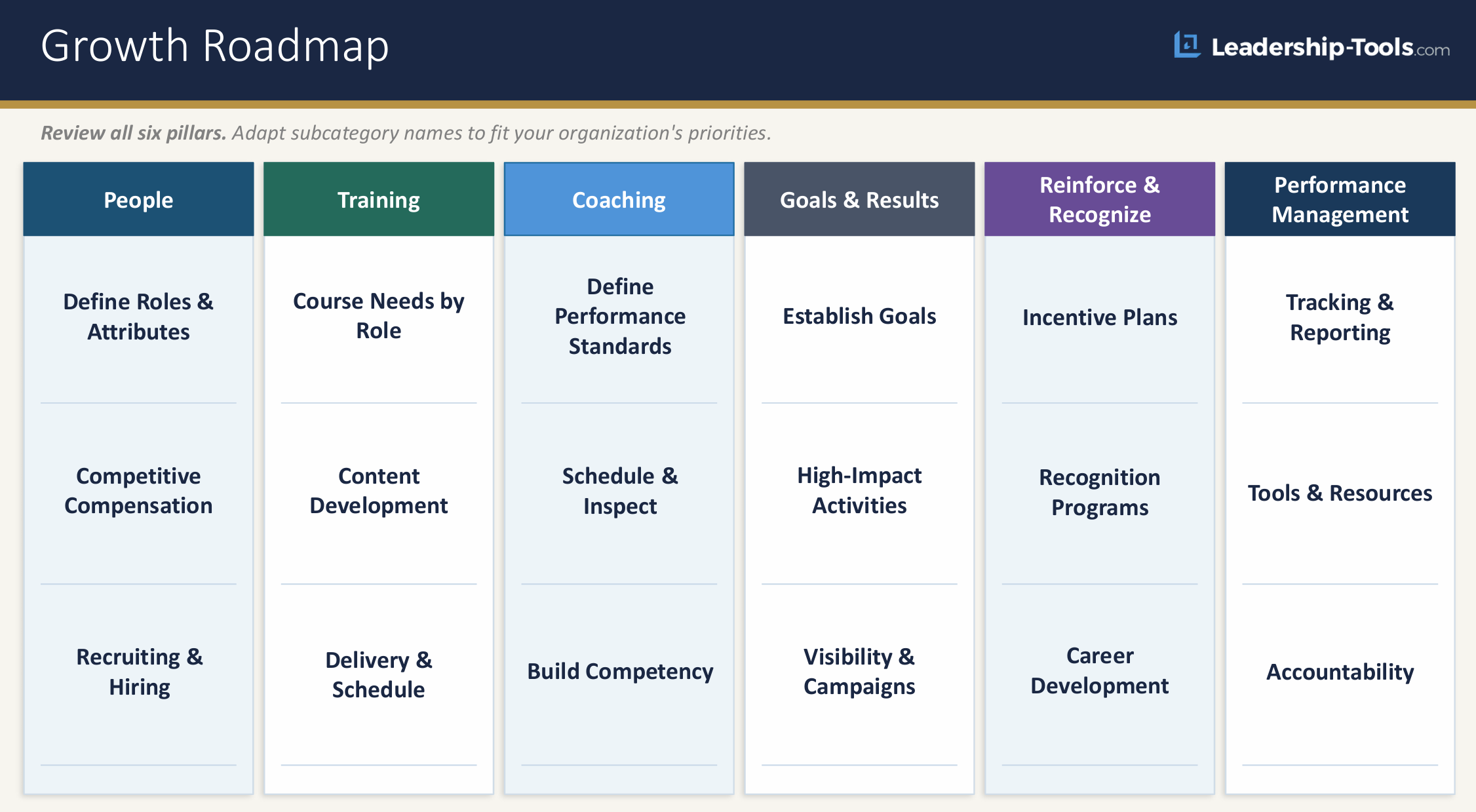
The problem the roadmap solves is one most leaders recognize immediately. There are always more improvement opportunities than time or resources will support. Without a practical framework, it's easy for important initiatives to remain on the sideline.
The Growth Roadmap helps leaders to organize their ideas for improvement opportunities into six pillars, each representing a core area of organizational leadership.
Within each pillar, you will define three subcategories. Pillars and subcategories can be customized to fit your specific team or department. The result is a visual, strategic map of where you're focused and why. This visual representation is useful both internally for guiding your own work and externally for communicating your priorities to others.
The Growth Roadmap is a practical leadership action plan template, and it's available as a free download in PDF, PowerPoint, and Google Slides formats. The PDF works well for personal reference, Google Slides allows you to copy and save to your own account, while the PowerPoint version makes it easy to build a customized roadmap
The Six Pillars of Growth
Each pillar in the Growth Roadmap covers a distinct area of organizational leadership. What follows is a brief look at what each one addresses.
People
The People pillar covers who's on your team, what they're capable of, and whether the right people are in the right roles. Improvement opportunities here might include role clarity gaps, succession considerations, hiring needs, or team structure. It's the foundational pillar because everything else depends on having the right people in place.
Note: The template provides examples to get you started. Each of the six pillars is fully customizable to reflect your organization's specific priorities and language.
Training
Training covers the knowledge and skills your team needs to perform well, and whether they have access to the development tools and resources that will support their growth.
This includes onboarding quality, technical skill gaps, cross-training opportunities, and whether your team has what they need to do their jobs well.
With Training as one of your six pillars, it stays visible as a strategic priority rather than getting pushed aside when performance demands feel more urgent. The Growth Roadmap keeps it in front of you.
Coaching
Coaching is different from training in a very important way.
Training builds knowledge. Coaching builds competency, meaning it's the action of a leader to verify that each team member is proficient in the critical skills needed to support successful performance and results.
This pillar also supports the quality and consistency of your one-on-ones, how well you're developing individual team members, and whether your coaching conversations are producing real improvement in behavior and expected activities.
For many leaders, this is where the most improvement opportunity exists. It requires consistent attention and a deliberate approach, which is exactly why having it as a named pillar in your roadmap keeps it from getting lost in the day-to-day.
Goals & Results
This pillar helps create clarity and accountability around achieving specific outcomes.
It's worth asking whether your team members understand what they're supposed to achieve, whether goals are specific enough to be actionable, and whether results are tracked in a way that's visible and useful. If role clarity is part of the gap, the Role Clarity Template in the Leading People section is a practical place to start.
When goals aren't being achieved, it can often be traced back to specific activities that aren't happening consistently or with enough quality. That's useful information and it tells you where the coaching conversation needs to go.
Most people genuinely want to do a good job. When they fall short, the missing piece is often consistent, practical coaching rather than effort or intention. This pillar keeps that responsibility visible so it doesn't get pushed aside by more urgent demands.
Reinforce & Recognize
Recognition is one of the most consistently underused tools in a leader's toolkit.
Most leaders genuinely value their people, but recognition gets crowded out by the pace of daily work and rarely gets scheduled the way other priorities do.
This pillar covers how consistently you acknowledge good work and whether your recognition practices are meaningful to the individuals receiving them. Used well, it helps build a culture where the right behaviors get noticed, reinforced, and repeated, which is exactly what drives sustained team performance.
Performance Management
This pillar covers the systems and processes that keep performance visible and moving in the right direction.
Tracking and reporting are the foundation for accountability. If something matters, it needs to be measured so leaders can see real numbers that support productive conversations with their team members. The easier it is to see what's happening, the easier it is to act on it.
Tools and resources matter here too. Leadership-Tools.com provides an entire library of practical tools and resources designed specifically to support leaders in this area. Browse the library and put what's useful to work.
Accountability becomes much more constructive when it's grounded in data. When leaders can see actual numbers and have provided the necessary training, tools, and resources for their people to succeed, performance conversations become more direct, more fair, and more productive.
Making sure this pillar is well developed gives you a solid foundation for managing performance consistently across your team.
The six pillars aren't independent of each other. A gap in Training can surface as a performance problem in Performance Management, and a weakness in Coaching can quietly undermine Goals & Results.
When you map improvement opportunities across all six areas, the connections become visible.
Each pillar influences the others, which is why addressing one area in isolation often produces less impact than leaders expect.
The Growth Roadmap gives you a complete view of the organization so your decisions are informed by the full picture rather than just the part that's most visible at the moment.
The Growth Inventory
With the Growth Roadmap framework in mind, the Growth Inventory gives you a structured way to start capturing the observations and ideas that will eventually become your most important initiatives.
As a leader, you're constantly noticing things. A process that's creating friction. A team member who's ready for more responsibility or quietly struggling. A gap in how expectations are being communicated. These observations happen in meetings, during one-on-ones, while reviewing results, or on the drive to work.
Most disappear before anything is done because they were never written down.
The Growth Inventory solves that. It gives each observation a home, organized against the six pillars and 18 subcategories you already know from the Growth Roadmap, so nothing gets lost and nothing has to be reconstructed from memory later.
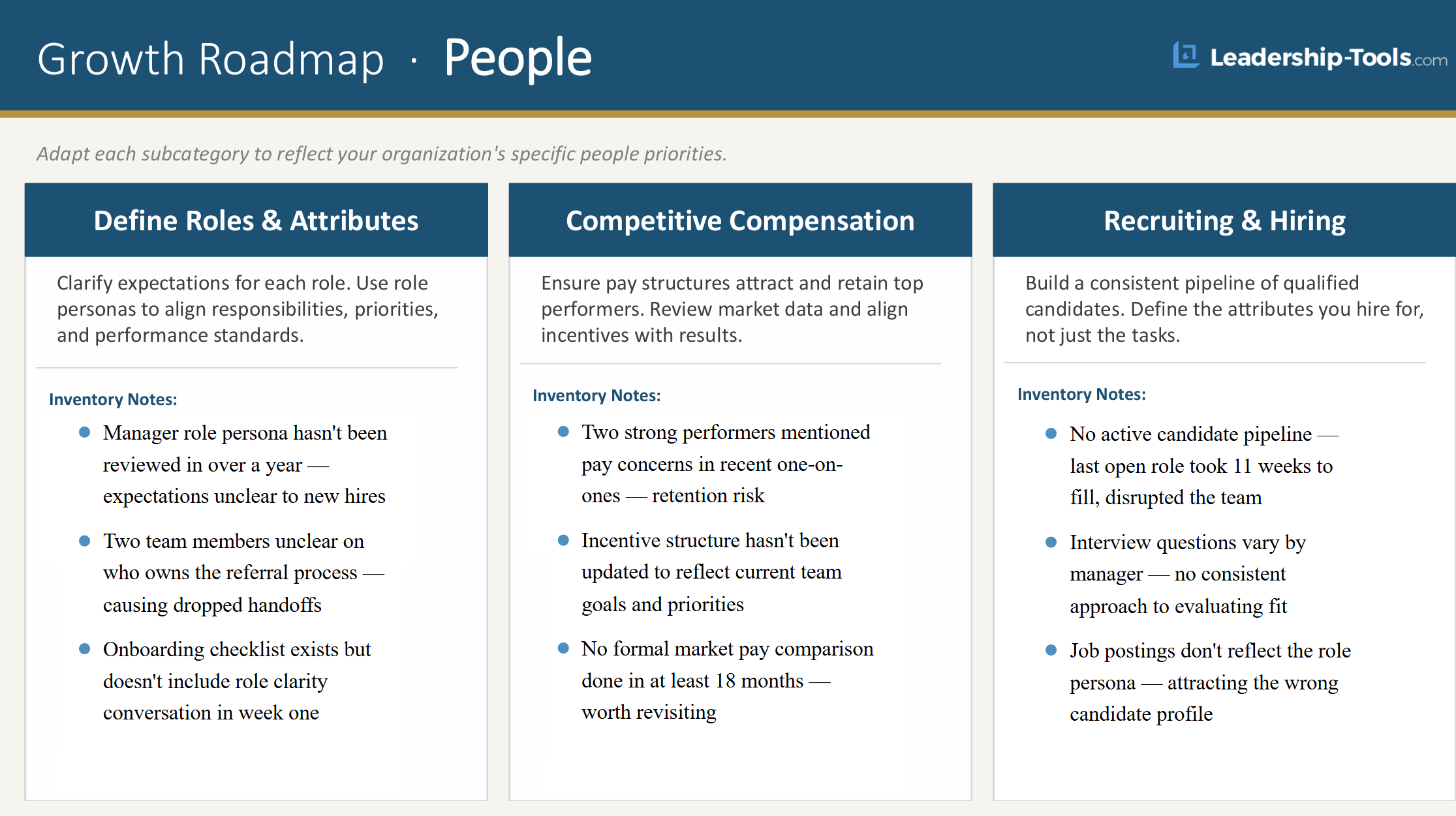
The image above shows the People pillar as a completed example. Each subcategory has a few observations captured in plain language, specific enough to act on later and brief enough to write in the moment.
The Growth Inventory doesn't require long narratives. Just add a short note to the pillar and subcategory it belongs to, along with any context that might be useful when you return to it. The habit of capturing observations and ideas matters more than how much you write.
Some items will be obvious quick wins you can address this week. Others will need budget, approval, or coordination before anything can happen. Knowing the difference early makes that process much faster.
As your inventory grows across all six pillars, patterns begin to emerge. Some pillars will fill up quickly while others may have only a handful of entries. A full pillar tells you where the real challenges are concentrated. A sparse one may signal things are running smoothly there, or that you haven't focused much attention in that area yet.
Completing a full inventory gives you an honest picture of how well the organization is structured for growth. Those observations become the raw material for the specific initiatives you'll organize and prioritize in the Growth Roadmap.
Using the Growth Roadmap and Growth Inventory Together
The sequence is intentional. You familiarize yourself with the Growth Roadmap first so you understand the six pillars and what each one covers. Then you conduct your Growth Inventory with that structure already in mind, capturing observations against specific categories rather than into a general list.
When it's time to organize and prioritize, most of the sorting is already done.
Once observations are sorted, the next step is prioritization within each pillar. Ask yourself how much impact would addressing this item have on team performance, and how much effort would it take?
- High-impact, lower-effort items are your starting point. These are your 'quick wins'!
- High-impact, higher-effort items go into medium-term planning.
- Low-impact items can wait or get delegated at a later time.
How you rank each item initially is a judgement call informed by your knowledge of the organization. Using these tools together are key to creating a leadership action plan that is thoughtful and based on personal observations.
As your roadmap takes shape, stakeholder communication becomes the natural next step. Make sure to inform the right people, including peers, senior leaders, and support departments leaders. They all should be aware of what your team is working on, and the reverse is also true.
Keeping everyone informed promotes alignment, prevents duplication of efforts, surfaces unexpected resource opportunities, and builds the kind of cross-functional trust that makes initiatives easier to complete.
"Action without a plan is the cause of every failure."
- Sun Tzu
For New Leaders: A 90-Day Application
Stepping into a new leadership role puts you in an interesting position. There's real pressure to demonstrate value quickly, and at the same time, real risk in moving too fast before you understand what you're actually walking into.
The Growth Roadmap and Growth Inventory give you a practical structure for navigating that tension. This approach provides you a way to be active and deliberate in your planning, while taking some time to learn about the organization and form connections with your team.
Here's how the first 90 days can be structured around both tools.
Days 1 to 30: Listen, Learn, and Connect
The first priority isn't strategy. It's relationships and understanding.
Introduce yourself to your team and be clear about what they can expect from you over the next three months. Visit locations, attend meetings, and sit in on as many conversations as you can. Talk to team members, peers, and business partners. Reach out to key stakeholders early, not because you have answers yet, but because you want to understand their perspective before forming your own.
While you're doing all of that, keep your Growth Inventory open. Capture what you're seeing across each of the six pillars.
Note the gaps, the strengths, the processes that seem to be working and the ones creating friction. Don't edit. Don't prioritize. Just capture. Your observations during this phase are some of the most valuable because you're still seeing the organization with fresh eyes.
Days 30 to 60: Collaborate, Build Trust, and Begin Organizing
With a meaningful inventory in hand, begin sorting your observations into the Growth Roadmap. Look for patterns across the six pillars. Which areas are dense with opportunity? Which ones seem solid? Where are the issues that keep surfacing in multiple conversations?
This is also when your early relationships start paying off. Share what you're seeing with trusted members of your team and key business partners. Not to present conclusions, but to pressure-test your thinking and build the collaborative trust that makes execution easier later. People are quick to support what they have helped to create.
Begin identifying potential quick wins. These are easily identified as initiatives that provide high-impact with relatively low-effort. Acting on one or two quick wins early builds credibility and momentum for a new leader.
Days 60 to 90: Develop Your Strategic Plan
By this point, your Growth Inventory should reflect a clear picture of where you will be focused and why. Common challenges like unclear priorities, duplication of effort, and gaps in coaching or tools all have a home. With an organized list of strategic initiatives identified, conversations with senior leadership will be perceived more favorably.
New leaders often want to make a significant impact early on and move too quickly to make changes. They don't take time to observe and learn before acting. When the Growth Inventory and Growth Roadmap are in place, that changes. The observations are organized, the relationships built in the first 60 days have validated the thinking, and the priorities become more clear.
Walking into that senior leadership conversation with a leadership action plan that is built from real observation is fundamentally different from arriving with a plan formed before you took time to fully understood the organization.
For Experienced Leadership: Getting Back to Being Intentional
If you've been leading for a while and you're feeling reactive or unclear where your time and focus would be best spent, it helps to pause and take a step back to see the full picture again through fresh eyes.
Conducting a Growth Inventory is useful here because it works as a strategic audit. Engage your entire team in the effort as they will see issues or opportunities you might miss.
Many experienced leaders who do this are surprised at the results. For example, you might realize you're spending the majority of your time in Goals & Results and Performance Management, while People, Training, and Coaching have been largely unattended.
That pattern makes sense given the demands of the role. Performance pressure is constant and highly visible, while development and culture work is slower and easier to defer. The Growth Roadmap makes those deferred areas visible again.
The Growth Inventory serves a different purpose for experienced leaders. Rather than building something new, it functions more as a reset. Capturing observations without immediately trying to solve them slows the reactive cycle and creates room for more deliberate thinking. At least annually, you should take time to update your leadership action plan using these tools.
Keeping the Roadmap Current
The Growth Inventory and Roadmap is designed to be revisited regularly, ideally quarterly.
Each review doesn't need to be a major exercise. A focused hour to assess progress on active initiatives, close out completed ones, and add new observations is enough to ensure ongoing progress.
As the organization evolves and your team's situation changes, new priorities will emerge and your leadership action plan should reflect that. The pillar structure of the Growth Roadmap and Inventory stays consistent, but the content inside must continually be reviewed and updated.
What This Tool Does and Doesn't Do
The Growth Roadmap and Growth Inventory are planning tools that support a high-quality leadership action plan. Used together, they help you see the organization more clearly, bring structure to a long list of competing priorities, and give you a framework you can actually lead from. What they don't do is replace the judgment, conversations, and follow-through that leadership requires.
Where these tools are particularly strong is in making the work visible. When improvement opportunities are organized across the six pillars, it becomes easier to see what's getting consistent attention and what's been quietly neglected.
A completed Growth Roadmap also works well as a communication tool. It gives you something concrete to share with your team, your peers, or senior leadership. It provides a clear, organized picture of where you're focused and why.
What the roadmap won't do is make the decisions for you. Prioritization still requires judgment that is informed by your knowledge of the organization. Successful execution of initiatives still requires consistent leadership. While the tools provide structure, it's up to the leader to make use of the findings and determine the how best to move forward.
A Final Thought
The leaders who get the most from these tools are the ones who return to them regularly.

The Growth Inventory provides an opportunity to capture your observations and ideas. The Growth Roadmap provides a clear view of your leadership action plan. It's something that is well organized and should be highly visible. Used together, they turn good leadership instincts into a system that works consistently over time.
Whether you're new to a role and still getting to know people and learning about the organization, or an experienced leader looking to reset your team's focus, the tools on this page will assist you in creating a path for future growth.
The tools are straightforward. What makes the difference is the consistency with which you use them. Leaders who do that will spend less time reacting to the issues of the day, and more time leading with intention.
Frequently Asked Questions (FAQ)
These are some of the most common questions leaders have when working to create a leadership action plan for future growth.
Click on the (+) sign below to expand each question. Click the (-) sign to collapse it again.
What is a leadership action plan?
What's the difference between a leadership action plan and a personal development plan?
A personal development plan focuses on your own skills, habits, and growth as an individual. A leadership action plan focuses on the organization or team you're responsible for improving. Both have value, but they serve different purposes. If you're looking for a personal development framework, the Master Action Plan (M.A.P.) in the Leading Self section of this site is the better fit.
What is the Growth Roadmap?
The Growth Roadmap is a strategic planning template that organizes improvement opportunities into six pillars: People, Training, Coaching, Goals and Results, Reinforce and Recognize, and Performance Management. Within each pillar, you define three subcategories that reflect your specific context and priorities. It's available as a free download in PDF, PowerPoint, and Google Slides formats.
What is the Growth Inventory?
The Growth Inventory is a structured way to capture what you're noticing across your organization before you try to organize any of it. A gap in training. A process creating friction. Read through the Growth Roadmap first so the six pillars are familiar, then run your inventory with that structure in mind. Observations should land in one of the six pillars. Don't worry about prioritizing initiatives at this point, just try to capture as many ideas as you can at this point.
What size organization is this built for?
The Growth Roadmap works for any size business. A small business owner with a team of five can use it just as effectively as a director managing multiple departments. The six pillars and related subcategories provide a starting framework that can be customized to fit your situation. Smaller organizations may combine pillars. Larger ones may expand them.
How is this different from a strategic plan?
A formal strategic plan typically covers organizational direction, financial targets, and multi-year goals. The Growth Roadmap operates at the team or department level. It focuses on how your team functions, performs, and improves.
The Growth Roadmap feeds directly into a leadership action plan or broader strategic planning process.
How often should I update the Growth Roadmap?
A quarterly review works well for most leaders. Each review doesn't need to be extensive. An hour to assess progress on active initiatives, close out completed ones, and add new observations from your Growth Inventory is usually enough.
The goal is to keep the roadmap connected to what's actually happening in the organization.
Can I use this with my team?
Yes, and involving your team tends to produce a more complete and accurate picture. When team members contribute to identifying improvement opportunities, especially within their own areas of responsibility, the resulting roadmap reflects what's actually happening on the ground. It also builds ownership. People are more committed to initiatives they helped identify.
What comes after the Growth Roadmap?
Two things, in order. First, narrow the list, because most roadmaps surface more good ideas than a team can work through at once. The How to Prioritize Work Projects page covers that decision. Second, keep visibility on the work once it starts, which is what the Project Tracker and Project Calendar templates handle. Keep stakeholders informed throughout. Peers, support departments, and senior leaders connected to your work need to see what you're doing. That prevents duplication of effort and surfaces resources you may not have known were available.
Free Growth Roadmap System
Download Leadership Action Plan Template:
Want the entire leadership tools library? Subscribe to our free newsletter and we'll send you a link to every tool on this site, all on one page, sorted by leadership phase. Every tool is free to download on its own page. The library just puts them in one place. Plus, you'll never miss out on updated or new tool announcements.
Your privacy is important to us. We never share or sell email addresses.
Leadership Tools Newsletter
Subscribe Free - See All Tools on One Page - Get New Tool Alerts
More Leadership Tools for Managing Your Team



Contact Information:
phone
(503) 970-9777
Email Customer Service
helpsupport@leadership-tools.com
Email Richard
richard@leadership-tools.com

By Richard Gorham
Leadership-Tools.com
2879 Riverwalk Loop, Eugene, Oregon, 97401
Copyright (c) 2002 - 2026 All Rights Reserved