D.A.R.T. is a categorization method for evaluating work initiatives based on their business purpose. Each initiative is labeled as Deepen (strengthening existing relationships), Attain (attracting new business), Retain (keeping existing customers), or Table Stakes (operational necessities). The D.A.R.T. analysis is one component of the Project Prioritization Template available as a free download on this page. It forces clarity about why an initiative matters before evaluating whether it should move forward.
- Home
- Leading Teams
- Project Prioritization Template
How to Prioritize Work Projects: A Practical Framework for Leaders
Knowing how to prioritize work projects is one of the most practical skills a leader can develop. What separates intentional leadership from reactive management is having a clear, repeatable way to decide which projects get the green light first.
Once a leader has completed a full inventory of potential growth initiatives, it's often the case that there are significantly more projects than your limited resources can support.
This page introduces a practical framework for leaders who need to prioritize multiple projects and decide where to focus first.
Our free Project Prioritization Template is a set of three tools that work together. Including a D.A.R.T. analysis worksheet for understanding why each initiative matters, a Cost vs Impact matrix for comparing initiatives side by side and identifying the quick wins that build early momentum, and a communication plan for keeping the right stakeholders informed as work gets underway. Three tools, three formats each. Download all three, or just the one you need.
D.A.R.T. Analysis Worksheet:
Cost vs Impact Matrix:
Communication Plan Worksheet:
Jump To: Who This Tool Is For | Why Prioritization Fails | Five Steps to Prioritization | The D.A.R.T. Analysis | Cost vs Impact Matrix | Quick Wins | Assign Initiative Leaders | Communication Plan | Comparing Prioritization Frameworks | Keeping Priorities Current | How to Break Ties | What This Tool Does & Doesn't Do | Final Thought | FAQ | Get Updates Free | Download Template
Who This Tool Is For
This guide on how to prioritize work projects is designed for leaders who have already identified improvement opportunities across their organization and now need a structured way to decide what to focus on first.
It’s useful whether you’re working from a completed project list that has been fully vetted, or a more informal list of initiatives you’ve been carrying around in your head. The underlying process is the same.
It’s particularly relevant for leaders managing more good ideas than their team has capacity to execute, and for anyone who wants a clear process for how to prioritize work projects deliberately. If you’re preparing to present strategic initiatives to senior leadership, a prioritized plan organized around clear reasoning lands considerably better than a general list of things you simply hope to accomplish.
If you haven’t completed a Growth Inventory yet, the Leadership Action Plan page introduces that process and provides the free Growth Roadmap template. A complete inventory makes everything that follows on this page considerably faster.
The Real Problem with Prioritization
The standard advice on how to prioritize work projects tends to be overly simplified. "Focus on what’s urgent and important, delegate the rest."
That framing has its place, but it doesn’t give you much to work with when you’re looking at ten competing initiatives and each one has a legitimate case for being first.
"You can do anything, but not everything."
— David Allen
The deeper problem is that without a clear method for evaluating initiatives against each other, leaders tend to fall into one of two patterns.
- Pursue too many things at once, spreading the team thin and slowing progress across the board
- Focus only on whatever feels most urgent that week, which pushes important long-term improvements further down the list with each passing week.
Either way, the team stays busy while meaningful progress remains elusive.
How to Prioritize Work Projects: A Five Step Process
Most leaders who struggle with prioritization aren't lacking good ideas. They're lacking a clear prioritization process.
Without a specific approach, the process can easily turn into decisions being made based on whoever argues loudest, whatever feels most urgent, or whatever the senior leader already decided before the meeting started.
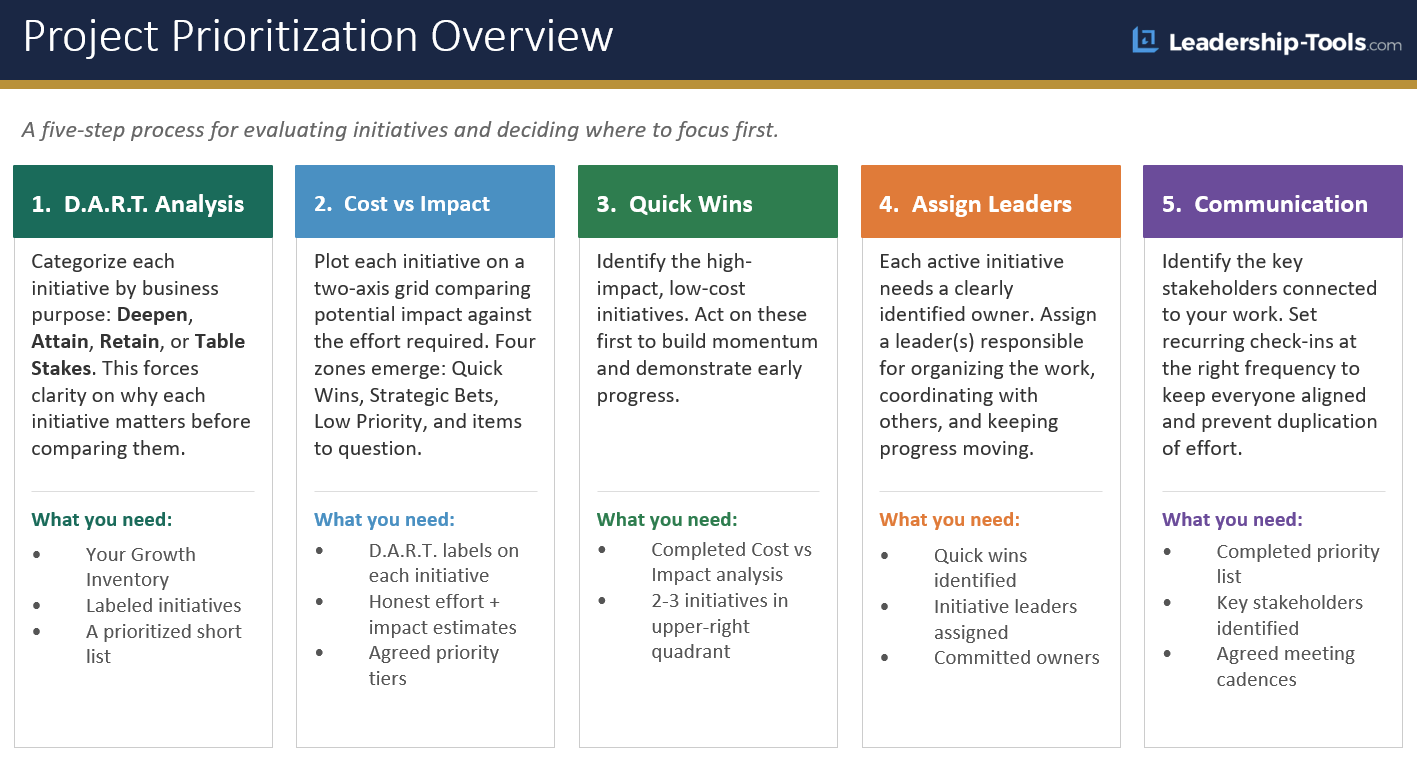
The five steps below are designed to prevent any confusion in the decision-making process.
Each step builds on the previous. You start by understanding the full landscape of what value each initiative brings to the organization using a D.A.R.T. analysis, then you evaluate the entire list visually against each other (Cost vs Impact), then you act on what the analysis reveals and plan for Quick Wins, assign Initiative Leaders, and build a communication plan to ensure alignment throughout the organization.
By the time you reach Step 5, your priorities are clearly defined, and the work is organized so your team can successfully execute each project.
Work through the steps in order the first time. Once the process feels natural, you'll find yourself moving through it faster and using the template as a standing reference rather than a one-time exercise.
Step 1: D.A.R.T. Analysis
With a complete list of initiatives in front of you, the first step in learning how to prioritize work projects is understanding why each one matters.
D.A.R.T. analysis assigns every initiative one of four categories based on how it connects to the overall health of the business. The purpose is to force clarity about why the initiative matters before you start comparing it to everything else on the list.
D = Deepen Relationships
Will this initiative strengthen relationships with existing customers, clients, or team members? Initiatives in this category tend to improve loyalty, trust, and the depth of existing connections.
A = Attain New Business
Will this initiative help the organization attract new customers, expand its reach, or open new opportunities? These are growth-oriented initiatives focused on building what doesn’t yet exist.
R = Retain Customers
Will this initiative improve the experience of existing customers and help ensure they continue doing business with you?
Retention is often where the most leverage exists, because the cost of losing a customer is almost always higher than the cost of keeping one.
T = Table Stakes
Is this something the organization must have in place to operate effectively and remain competitive? Table stakes initiatives don’t generate excitement, but neglecting them creates problems that eventually undermine everything else.

The worksheet does more than hold the list. Once you choose an Impact and a Cost for each initiative, it works out which quadrant that initiative belongs to and colors the cell to match the matrix in Step 2. By the time you finish this step, most of the plotting decision is already made.
Once each initiative has a D.A.R.T. label, the worksheet will assign it a reference number for easy tracking: D1, D2, D3, A1, A2, and so on. Those numbers make the Cost vs Impact step considerably faster.
Categorizing initiatives this way forces you to articulate why each one matters, which often reveals whether it’s as necessary as it first appeared.
This process also helps ensure your priorities are balanced across the four categories. An organization focused entirely on attaining new business while ignoring retention and table stakes is building on an unstable foundation.
Step 2: Cost vs Impact
With D.A.R.T. labels assigned, the next step is to compare initiatives side by side using a Cost vs Impact matrix.
Each initiative gets plotted on a simple two-axis grid, and once they’re all visible in one place, the right priorities tend to become clearer. The Cost vs Impact matrix is central to how to prioritize work projects effectively.

Impact runs on the vertical axis from Low at the bottom to Very High at the top. Cost runs horizontally from Very High on the left to Low on the right. Both axes use the same four levels as the worksheet, so an initiative marked High impact and Low cost has a specific cell it belongs in.
Defining Impact
Impact is about outcomes. What will actually change if this initiative succeeds?
Consider revenue generated, costs eliminated, improvements to customer experience, team performance gains, or operational efficiency. The more concrete you can make this estimate, the more useful the comparison becomes.
Defining Cost
Cost covers everything required to execute: time, money, people, and organizational energy.
What qualifies as high or low cost varies by organization. The goal is to determine a reasonable estimate that allows initiatives to be compared against each other.
Reading the Matrix
Once all initiatives are plotted, four zones become visible:
- Upper right — High Impact, Low Cost: Your quick wins. These deserve immediate attention and are the best place to start building momentum.
- Upper left — High Impact, High Cost: Your strategic bets. Valuable and worth pursuing, but they need proper planning and realistic timelines before anything moves.
- Lower right — Low Impact, Low Cost: Delegate or defer. Easy to do, but not high leverage. Good candidates to hand to someone developing.
- Lower left — Low Impact, High Cost: Pass for now. These deserve honest scrutiny before any resources are committed.
Leaders should use the completed matrix as a tool, a guide to help inform decisions. The matrix doesn’t make decisions for you, it does make the trade-offs more visible, which makes conversations around priority much more grounded and less personal.
Step 3: Quick Wins
The upper-right section of the Cost vs Impact matrix deserves its own focus because of what quick wins do for a team.
Quick wins are initiatives with meaningful impact and relatively low cost that can be completed in a short timeframe. The reason they deserve special attention early in the process is what they do for the team’s confidence.
When people see improvement happening early, a friction point removed or a process that’s been clarified, confidence in the broader strategy grows. The team starts to believe the work is actually moving forward, which creates the energy needed for the larger, more complex initiatives that come later.
Quick wins and serious strategic work aren’t in competition with each other. The early momentum from quick wins is often what gives a team the confidence and credibility to tackle the harder work that follows.
When identifying quick wins, look for initiatives where the improvement is noticeable and the execution is manageable.
Good examples of Quick Wins include:
- A process that currently slows down daily work
- A reference document that would help team members perform more consistently
- A communication gap that creates confusion every time it comes up
Aim to identify two or three quick wins and move on them early. The momentum they create carries into everything else on the roadmap.
Quick wins are one of the most important concepts when learning how to prioritize work projects.
Step 4: Assign Initiative Leaders
Once priorities are clear and quick wins are identified, the next step is deciding who will lead each initiative.
There’s a common pattern worth avoiding here. Leaders often assume that because an initiative is important, they need to personally drive every part of it. That assumption limits both progress and the development of the people around them.
A better approach is to assign ownership of each initiative to a capable member of the team. Each initiative should have a clearly identified leader responsible for organizing the work, coordinating with others when needed, and keeping progress moving forward.
This doesn’t mean the senior leader steps away entirely. The leader remains involved as a resource and guide, helping remove obstacles and ensuring the initiative stays aligned with broader priorities. But the day-to-day ownership belongs to the initiative leader.
When people lead real work, they develop real capability. They gain experience organizing projects, coordinating across teams, and solving problems that surface during execution. The team becomes stronger because more people have practiced leadership in meaningful ways.
Assigning clear ownership also makes communication easier. When you can tell a peer or senior leader exactly who owns each initiative and where it stands, confidence in your team’s execution grows considerably.
Step 5: Keeping Stakeholders Aligned
Learning how to prioritize work projects without planning the communication around them is how good decisions quietly lose support.
Once priorities are set and initiative leaders are assigned, the work of keeping the right people informed becomes just as important as the strategy itself.
Even well-designed initiatives lose momentum when key stakeholders don’t know what’s happening. The people connected to your work, including peers in other departments, support teams, business partners, and senior leaders, need visibility into what your team is doing.
Leaders especially dislike being the last to hear about something that affects their area.
Consistent stakeholder communication also tends to improve the quality of the work itself, not just prevent problems. When you share an initiative with another department, you sometimes discover they’re already working toward a similar goal, which can save a significant amount of duplicated effort.
Other times you find someone in the organization who has direct experience with what you’re trying to build and can offer resources or advice that accelerates the work considerably. Those kinds of insights only surface when communication happens early and consistently.

Who Belongs on the List
Not every stakeholder needs the same thing from you. A senior leader wants the headline in the first thirty seconds. A support team wants the detail. A peer in another department wants to know whether your work will impact theirs. A business partner wants to know what you need from them and when.
The worksheet asks you to label each person by type for that reason. It can sort by stakeholder type if you need it to, but more importantly it reminds you to change how you share updates depending on who is across the table.
One Conversation, Not One Initiative
A stakeholder connected to three of your initiatives who meets with you once is a single line on the worksheet, not three. The row represents the standing conversation, and the initiatives it covers get listed together. Two genuinely separate meetings on separate days get two rows.
This matters because leaders who track by initiative rather than by conversation end up with a calendar full of overlapping check-ins with the same handful of people.
As shown above, a simple approach works well here. Identify the key stakeholders connected to each initiative. Reach out and suggest a short recurring one-on-one so you can stay aligned as work progresses.
Together, agree on a frequency that makes sense. Some stakeholders may need a quick conversation every two weeks. Others may only need a monthly or quarterly check-in. The goal is a rhythm that keeps everyone informed without creating unnecessary meetings.
When there isn’t anything meaningful to report, offer to cancel ahead of time. People appreciate that, and it reinforces that these conversations are meant to be useful rather than just another calendar item.
Watch the Meeting Workload
Every recurring meeting you set up is a commitment against a finite calendar. The worksheet totals your commitments and converts them into meetings per month and hours per month, and that number tends to be higher than leaders expect. Fourteen stakeholders on a weekly cadence is fourteen hours a month.
Look at the total time committed before adding another row. A monthly conversation that actually happens beats a weekly one that gets cancelled half the time.
The Communication Plan Worksheet that helps you map your stakeholders and set appropriate meeting frequencies is included with the Project Prioritization Template on this page.
It’s a practical tool for keeping your priorities organized and your key relationships active as initiatives move forward.
"The essence of strategy is choosing what not to do."
- Michael Porter
Comparing Prioritization Frameworks
Most leaders have encountered at least one framework for how to prioritize work projects before arriving here. Some are genuinely useful in the right context. Others get applied too broadly and end up adding structure without actually improving decisions.
The table below offers a quick comparison of the most common methods. Each one was designed for a specific situation and works well there.
Method |
Best Used For |
Primary Limitation |
|---|---|---|
| D.A.R.T. + Cost vs Impact (this page) | Prioritizing multiple organizational initiatives with strategic context and clear business purpose | Works best after completing a Growth Inventory — not designed for quick daily task decisions |
| Eisenhower Matrix | Personal task management and daily to-do decisions | Too simple for complex multi-initiative planning — urgency bias tends to crowd out important long-term work |
| MoSCoW Method | Software development and project scoping decisions | Does not account for cost, capacity, or strategic alignment across an organization |
| Backlog Prioritization | Agile teams managing a running list of features or recurring tasks | Works well for repeating work cycles but not for strategic organizational initiatives |
| Urgency vs. Importance | Quick individual prioritization decisions in the moment | Urgency bias consistently crowds out important long-term improvement work |
The reason this page focuses on D.A.R.T. analysis and the Cost vs Impact matrix is that most leaders aren't trying to prioritize a personal to-do list. They're trying to decide which organizational initiatives get resources, attention, and people. That requires a method that accounts for strategic purpose, not just urgency or effort.
If you're managing your own daily tasks, the Eisenhower Matrix is a solid starting point. If you're deciding which improvement initiatives your team will pursue over the next quarter, the five-step process on this page is the better fit.
Keeping Priorities Current
Priorities shift as new information arrives, business conditions change, and initiatives get completed or stalled. You should revisit the entire list regularly to ensure progress is being made and priorities haven't shifted.
Knowing how to prioritize work projects once is useful. Doing it on a schedule is what keeps the list moving forward.
A monthly review works well for most upper-level leaders, with intermittent updates as requested. Talk through each of these during the regular review:
- Assess progress on active initiatives and close out any that are complete
- Reassign anything that has stalled or lost its owner
- Run new items from your Growth Inventory through D.A.R.T. and Cost vs Impact before adding them to the active list, including any strategic initiatives you're considering for the next planning cycle.
For every new initiative added to the active list, something else gets moved to the backlog or deferred. Teams have a fixed amount of capacity. Adding priorities without adjusting the list doesn’t produce more output. It produces more stress and confusion about what is most important to leadership.
When new requests come in, the question to ask before acting is simple: is this urgent, important, or both? Urgent things demand immediate attention. Important things drive meaningful outcomes. Many requests feel urgent but aren’t particularly important. Pausing to make that distinction before acting on a new request is one of the most practical ways to protect your team’s focus.
How to Break Ties Between Similar-Priority Projects
The Cost vs Impact matrix makes most decisions about how to prioritize work projects straightforward. But not always. On occasion it's too close to call.

When projects line up nicely on the matrix, high impact, low cost initiatives move first. Low impact, high cost items wait or get dropped.
But occasionally multiple initiatives land in roughly the same zone on the matrix. The strategic case for each is similar. The cost estimates are close, but you still need to pick one over the others.
When that happens, here are five practical tie-breakers to work through in order. Think through each question and give each project a check mark if it wins in that category. After completing all 5 questions, add up the check marks and the project with the most is a clear winner. If no winner is quickly identified, work with stakeholders to provide additional input for a well-informed decision.
1. Dependencies
Ask whether one initiative has to be completed before another can begin.
If Initiative A creates the foundation that Initiative B requires, the sequence is already decided. Dependencies remove the need for judgment and clarify the order before anything else needs to be considered.
2. Deadline pressure
Look at whether external factors are creating a hard deadline for any of the tied initiatives.
A regulatory requirement, a contract renewal, a seasonal window, or a commitment already made to a key stakeholder all create real urgency that the matrix alone won't capture. Initiatives with firm external deadlines move ahead of those with flexible timelines.
3. Available capacity
Consider which initiative your team can realistically begin right now given current workload.
The best initiative in theory is not useful if no one has the bandwidth to lead it well. A slightly lower-impact initiative that can be executed with full attention will almost always outperform a higher-impact one that gets launched half-resourced.
4. Stakeholder risk
Ask which initiative carries the greater cost of delay from the perspective of key stakeholders.
Customers, senior leadership, or business partners who are waiting on a specific improvement represent real relationship and credibility risk. When stakeholder expectations are clearly tied to a particular initiative, that weight belongs in the decision.
5. Sequencing for momentum
When all else is roughly equal, choose the initiative most likely to produce a visible, meaningful result quickly.
Early wins build team confidence and organizational credibility for the larger, more complex initiatives that follow. A slightly smaller win that lands in 30 days often creates more momentum than a larger win that takes six months.
Work through these five considerations in order. In most cases, one or two of them will break the tie cleanly without requiring a robust debate.
What This Tool Does and Doesn't Do
The D.A.R.T. analysis and Cost vs Impact matrix are evaluation tools. They help you compare initiatives against each other and surface the ones worth acting on first. They also make the reasoning behind your priorities visible, which matters when you need to communicate those choices to others.
They don’t eliminate judgment. You still need to know your organization, understand the context behind each initiative, and make calls that a framework alone can’t make for you. The tools provide structure for that judgment. They don’t replace it.
They also work best as living tools rather than one-time exercises. A matrix built in January and never revisited won’t reflect the organization in April, and priorities that felt right six months ago may need rethinking as conditions change. The value comes from returning to the process regularly.
Used consistently, this framework gives leaders a reliable method for how to prioritize work projects and keep focus where it matters. Over time that consistency produces more meaningful progress than any single initiative could on its own.
A Final Thought
The leaders who prioritize well tend to share one habit: they return to a clear framework when things get noisy, rather than defaulting to whatever demands the most attention in the moment.
A clear framework, applied consistently, is what makes prioritization work. Evaluating honestly, communicating the reasoning to your team, and revisiting the list as conditions change: that combination produces better decisions than any single tool can on its own.
Start with your inventory, run it through D.A.R.T., and plot the results on the matrix. Find your quick wins and move on them early. Assign ownership to the right people, keep your stakeholders informed, and build the habit of reviewing the list regularly.
That process, repeated consistently, is what turns a long list of improvement ideas into an organization that actually improves. Learning how to prioritize work projects well relies heavily on your willingness to say not yet.
Frequently Asked Questions (FAQ)
These are some of the most common questions leaders have when learning how to prioritize work projects.
Click on the (+) sign below to expand each question. Click the (-) sign to collapse it again.
What is the D.A.R.T.
framework?
How is the Cost vs Impact
matrix different from a standard priority matrix?
A standard priority matrix typically uses urgency and importance as its axes. The Cost vs Impact matrix focuses instead on the potential outcome of an initiative relative to the resources required to execute it. This makes it more useful when learning how to prioritize multiple projects at once, because it directly addresses the question of return on effort rather than just urgency.
What counts as a quick
win?
A quick win is an initiative that delivers noticeable, meaningful improvement and can be executed without major resources or long timelines. The criteria are impact and manageability, not just ease. An initiative that's easy to execute but doesn't produce a meaningful result isn't a quick win.
What is included in the free Project Prioritization Template?
Three tools that work together. The D.A.R.T. Analysis Worksheet is where you list every initiative, assign it a category, and estimate impact and cost. The Cost vs Impact Matrix is where you plot those initiatives and see the trade-offs side by side. The Communication Plan Worksheet is where you map the stakeholders connected to each initiative and set a meeting rhythm with each of them. Each one downloads separately, and each works on its own if you only need one piece.
How many initiatives should we be working on at once?
There's no universal answer, but most teams have more capacity for focused execution than they realize and far less capacity for fragmented execution than they think. A useful starting point is three to five active initiatives at a time, with the remainder organized into a visible backlog. A team focused on three high-impact initiatives will almost always outperform a team spread across ten.
Who should I include in my communication plan?
Anyone whose work touches yours or who will be affected by the outcome. That usually means peers in other departments, support teams like technology or risk, business partners outside the organization, senior leaders who fund or approve the work, and the team members leading each initiative. A useful test is whether the person would be annoyed to hear about your initiative from someone else first. If so, they belong on the list.
How do I handle pushback when I deprioritize something?
Be clear that deprioritizing is a decision about timing and capacity, not a judgment about the idea's value. Keeping a visible backlog of deferred initiatives with a commitment to revisit them helps manage that tension considerably. When people can see their idea hasn't been dismissed, just deferred, the conversation becomes much easier.
How often should I meet with each stakeholder?
Agree the frequency with them rather than deciding alone. Some stakeholders want a short conversation every two weeks. Others are fine with monthly or quarterly. The goal is a rhythm that keeps everyone informed without filling the calendar, so when there is nothing meaningful to report, offer to cancel ahead of time. People appreciate it, and it keeps these conversations useful rather than turning them into another standing meeting nobody values.
How does this connect to the Growth Roadmap?
The Growth Roadmap and Growth Inventory are where you capture and organize improvement opportunities across six strategic pillars. This prioritization framework is the natural next step. It's how you decide which of those opportunities to act on first. Start with the Growth Roadmap to see the full picture, then use D.A.R.T. and Cost vs Impact to determine where to focus.
Can I use these tools in Google Sheets and Google Slides?
Yes. Every tool is available as a PDF, in Microsoft Office format, and you can copy our Google file and save it to your own before you begin editing. We do not allow you to edit our master files in Google as that would change the templates for everyone else.
How does this help with
prioritizing strategic initiatives?
Strategic initiatives typically involve more stakeholders, longer timelines, and greater organizational impact than routine improvement projects. The D.A.R.T. analysis is particularly useful here because it forces alignment between each initiative and the organization's broader direction before any resources are committed. The Cost vs Impact matrix then helps determine which strategic initiatives move first and which ones need more preparation before they can be properly resourced.
How often should I revisit my priorities?
A monthly review works well for most leaders, with a more thorough review scheduled each quarter. The monthly review is shorter: assess progress, close out completed initiatives, and reassign anything that has stalled. The quarterly review is where you run new items through D.A.R.T. and Cost vs Impact before adding them to the active list.
What comes after
prioritization?
Once priorities are clear and initiative leaders are assigned, the next step is building actionable plans for the work that matters most. The Master Action Plan (M.A.P.) in the Leading Self section of this site is a practical framework for turning priorities into clear, executable plans with owners, timelines, and milestones.
Free Project Prioritization Template

D.A.R.T. Analysis Worksheet:
Cost vs Impact Matrix:
Communication Plan Worksheet:
Want the entire leadership tools library? Subscribe to our free newsletter and we'll send you a link to every tool on this site, all on one page, sorted by leadership phase. Every tool is free to download on its own page. The library just puts them in one place. Plus, you'll never miss out on updated or new tool announcements.
Your privacy is important to us. We never share or sell email addresses.
Leadership Tools Newsletter
Subscribe Free - See All Tools on One Page - Get New Tool Alerts
More Leadership Tools for Managing Your Team




Contact Information:
phone
(503) 970-9777
Email Customer Service
helpsupport@leadership-tools.com
Email Richard
richard@leadership-tools.com

By Richard Gorham
Leadership-Tools.com
2879 Riverwalk Loop, Eugene, Oregon, 97401
Copyright (c) 2002 - 2026 All Rights Reserved