Team spirit is the pride people take in their team and their willingness to pitch in for each other. You can see it when people cover for a coworker without being asked or share credit for a win.
- Home
- Leadership Articles
- Team Building Articles
- Building Team Spirit
How to Build Team Spirit at Work
Knowing how to build team spirit starts with knowing what it is: the pride people take in their team and their willingness to pitch in for each other. When people feel like key players on a team, they tend to contribute more, and that energy shows up in the results. The six strategies below show how to build team spirit at work on purpose.
The importance of team spirit shows up in everyday moments. A team with strong team spirit covers for a coworker who's out sick without being asked, shares credit in meetings and pushes through a busy month together.
Team spirit in the workplace also tends to fade when no one pays attention to it. Turnover, a heavy workload or a string of missed goals can wear it down, and by the time a leader notices, people may already be doing just enough to get by.
Learning how to build team spirit takes deliberate effort from the leader. Most of it comes down to the people you hire and whether each of them has a real part to play. Team spirit also grows when people trust each other and are working toward a goal everyone can see, like a sales target on the break room wall or a deadline the whole team owns.
If you're wondering how to build up team spirit on a team that's lost some energy, start with one or two of the strategies below and add more as they take hold. The same strategies work whether you're leading a new team or trying to develop team spirit on one that's been together for years.
Jump To: 6 Strategies | F.E.E. Approach | Example | FAQ
How to Build Team Spirit: 6 Strategies
These six strategies for building team spirit work for teams of any size, from a three-person office to a department of 50.
- Hire for energy and enthusiasm. Hiring the right people matters more to team spirit than almost anything else you do. When a position is open, it's tempting to hire the most experienced person as quickly as possible, so take the time to find out whether they bring the energy the team needs. A new hire who's self-motivated adds to team spirit from the first week.
- Identify each person's strengths. Many organizations put managers through personality assessments like Myers-Briggs or DISC, and the cost can add up. StrengthsFinder costs much less and works for everyone on your team. It shows each person's strengths and how a mix of different strengths makes the team stronger.
- Empower your people. If you've hired great people, trust them. Spell out the decisions they can make on their own, train them well and give them the chance to exceed your expectations. Most people take that kind of trust seriously and work hard to live up to it.
- Make time to connect. Give team members chances to get to know each other personally and professionally. The goal is enough of a connection that people understand what each person brings to the table, and their families don't need to vacation together. A few minutes of conversation at the start of a team meeting or a team lunch once a month goes a long way. For a remote or hybrid team, a 10-minute video check-in at the start of the week can do the same job.
- Give everyone a visible role. Make sure every person has a hands-on part in the team's big efforts. When you roll out a new sales campaign, one person might create a tracking poster and update it in the break room every day, another might lead the weekly sales meeting and someone else might bring the treats. When everyone has a job, everyone has a stake in the result.
- Make time for fun. You expect your team to work hard, so take time to celebrate when the hard work pays off. If you don't think of yourself as creative, put a couple of team members in charge of the fun and let them plan how to recognize the team's success.
"To build a strong team, you must see someone else’s strength as a complement to your weakness and not a threat to your position or authority."
- Christine Caine
Building Team Spirit With the F.E.E. Approach
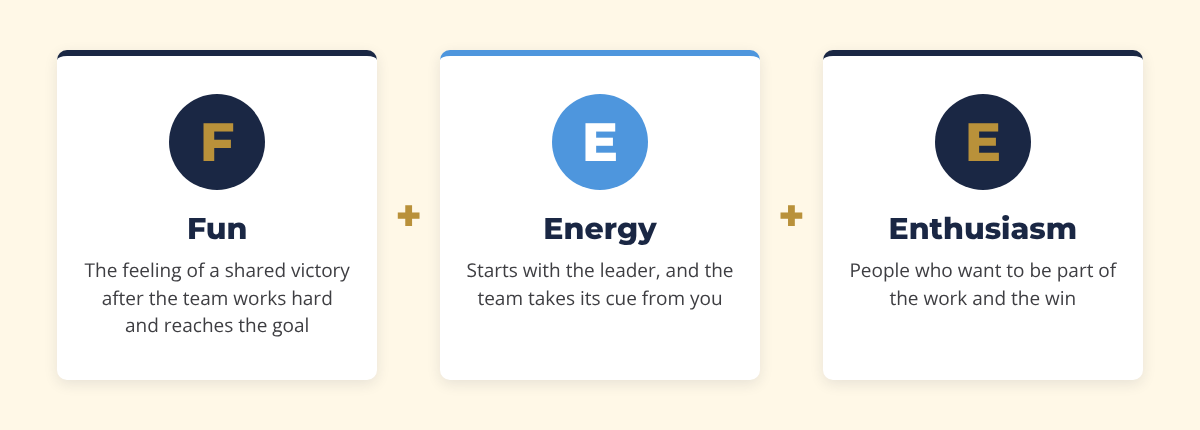
F.E.E. stands for Fun, Energy and Enthusiasm, and together they help you keep team spirit strong once you've built it.
Make it clear to your team that fun is what happens after the team has worked hard, worked well together and reached the goal. In other words, fun is the feeling of a shared victory.
Energy and enthusiasm start with the leader. When you're excited about the work, your team takes its cue from you and wants to be part of it.
To put F.E.E. to work, rate each person on your team from 1 to 5 for energy and enthusiasm, then do the same for experience. If two people are up for the same role, one highly experienced but low on energy and the other less experienced but driven, the person with more energy and enthusiasm is often the better choice, as long as they can learn the job fairly quickly.
It's the small, memorable moments of fun that keep people engaged over the long run, so keep encouraging them and keep the right people in the right roles.
Building Team Spirit in Practice
TONY'S MONTH-END CLOSE
Tony manages an eight-person accounts payable team. After two people left in the spring, month-end close was taking six working days, and the team had stopped going to lunch together.
For the next close, he gave everyone a visible role. Denise kept a tracking board by the coffee maker and updated it twice a day, Raj led a 10-minute huddle each morning and Aisha was in charge of the celebration. Tony told the team he'd buy lunch if they closed in five days.
They closed in four. Tony spent $120 on lunch, and Aisha asked everyone to name one thing a coworker did that helped.
Three months later, the team was still closing in four days, and the monthly lunch had become their idea.
Tony's changes cost one lunch and a little planning, and they gave each person a part to play and a reason to celebrate.
Team Spirit FAQ
The questions below address what leaders most commonly ask about how to build team spirit.
Click on the (+) sign below to expand each question. Click the (-) sign to collapse it again.
What is team spirit?
Why is team spirit important?
When people feel like key players on a team, they tend to contribute more and stay longer. Strong team spirit also helps a team get through busy stretches, because people are working for each other as well as for the goal.
How do you build team spirit at work?
Hire people with energy and enthusiasm, help each person understand their strengths and give them room to make decisions. Make time for the team to connect, give everyone a visible role in big efforts and celebrate when the hard work pays off.
What are some examples of good team spirit?
Covering a shift for a coworker, offering help before being asked, sharing credit in a meeting and celebrating a teammate's success are all examples. On a team with strong team spirit, people talk about what we did more than what I did.
How can you contribute to team spirit as a team member?
Offer help when a coworker is swamped, give credit to others and bring a positive attitude to busy days. Small habits like learning what your teammates are working on and celebrating their wins add up.
More Team Building Articles



Richard Gorham has led teams in financial services for more than 30 years, from retail branches and operations to investments and insurance, and he still leads a team today.
He founded Leadership-Tools.com in 2002 to give managers free, practical tools like the ones he used in his various leadership roles. Every tool here has been used in a real workplace and comes with a filled-in example you can follow.

Contact Information:
phone
(503) 970-9777
Email Customer Service
helpsupport@leadership-tools.com
Email Richard
richard@leadership-tools.com

By Richard Gorham
Leadership-Tools.com
2879 Riverwalk Loop, Eugene, Oregon, 97401
Copyright (c) 2002 - 2026 All Rights Reserved