A role clarity template is a simple tool used to define a role in practical terms. It outlines what the role is responsible for, what matters most, how decisions are made, and what success looks like. The goal is to remove ambiguity, so expectations are clear and performance becomes more consistent.
- Home
- Leading People
- Role Clarity Template
Role Clarity Template
A role clarity template gives you a practical way to define expectations, priorities, and what success looks like so people can perform more consistently. The result of this tool is a clearly defined Role Persona.
Download Role Clarity Template:
In most organizations, roles are described at a high level but rarely defined in a way that can be used day to day. Over time, the understanding of the role gets shaped informally rather than intentionally.
That makes it difficult to point to a single, shared definition of what the role is meant to be. Without that reference point, expectations tend to evolve in an undisciplined way, through conversations, assumptions, and individual interpretation.
A role clarity template gives you a simple way to bring that definition into one place so it can be seen, discussed, and used.
Below is a simple version you can use right away. It’s designed to be practical, not theoretical.
Jump To: Who This Tool Is For | Why Role Clarity Matters | Where Role Clarity Breaks Down |From Tasks to Contribution | The Role Persona & Examples | How to Use the Template | When to Use This Tool | Keep Content Specific | What Role Personas Do & Don't Do | A Final Thought | FAQ | Get Updates Free |Download Template
Who This Tool Is For
This tool is designed for leaders who are responsible for managing people and improving performance.
It is especially useful if you find yourself needing to clarify expectations more often than you would like, or if performance varies across people in similar roles.
It can also help if someone is new to a role, stepping into increased responsibility, or working in a position that has evolved over time without being clearly defined.
You do not need a formal process or a large team to use it. The template is meant to be simple and practical so it can be applied in everyday leadership situations.
Why Role Clarity Matters
Most performance problems on a team are not what they first appear to be.

What looks like a motivation issue, a skill gap, or even a personality conflict is often something simpler underneath. The person is not clear on what the role actually requires. Not the job title or general idea of the position, but the real working picture.
They lack the understanding of what matters most in the role, what success looks like, and where ownership begins and ends. That kind of clarity is rarer than most leaders realize, and the absence of it quietly drives a lot of the frustration that shows up in day-to-day leadership.
If you are managing a team and find yourself repeating expectations, correcting the same gaps, or wondering why performance of team members is uneven, especially for people doing similar work, unclear roles are worth looking at first.
The issue is usually not that people are not trying. It is that they are working from different assumptions about what the role actually means.
Using the Role Clarity template you can help team members clearly define their respective role by providing a Role Persona for each role.
Where Role Clarity Breaks Down
Unclear expectations affect performance in ways that are easy to miss because the impact tends to be gradual.
Work still gets done. People stay busy. But without a clear picture of what the role is meant to accomplish, effort becomes inconsistent. Some things receive too much focus, while other important tasks get neglected, and the leader ends up filling the gaps through constant follow-up and correction.
"Clarity is the answer to anxiety. Effective leaders are clear."
- Marcus Buckingham
Over time, that pattern becomes frustrating for everyone. The team member feels like they are working hard but still missing the mark, and the leader feels like they are needing manage things too closely just to keep everything on track.
Neither person is feeling successful in their role and that has a negative impact on the entire team.
Accountability also breaks down in this environment. It is difficult to hold someone responsible for results that were never clearly defined, and just as difficult for someone to take full ownership when expectations are unclear or constantly shifting.
At the team level, unclear roles create overlap, hesitation, and missed handoffs. Decisions slow down, responsibilities blur, and alignment suffers.
There is also a leadership cost that is easy to overlook. When roles are unclear, a manager spends a disproportionate amount of time clarifying, correcting, and redirecting instead of developing people or improving the business.
Here's the good news - you can fix this, because the problem is usually structural, not personal. Keep reading to learn how to do this well.
Moving from Tasks to Contribution
One of the most useful shifts in thinking about role clarity is moving from activity to contribution.
Most roles include a long list of recurring tasks, but a task list does not tell someone how to succeed. It tells them what to do, not why it matters or what good performance actually looks like.
A role that is clearly defined around contribution connects the work to outcomes, priorities, and ownership. For example, “complete weekly reports” is a task. “Provide accurate weekly reporting that helps the team identify issues early and make sound decisions” is a contribution.
The second version gives the person a reason to care about the quality of the work, not just the completion of it.
That shift changes how someone approaches the role, especially when time is limited and tradeoffs have to be made.
The Role Persona
The role clarity template is simple a tool. The outcome of using it well is something more valuable. The tool allows you to create a clear, working definition of the role.

That definition is often referred to as a Role Persona.
A role persona goes beyond a job description. It captures what kind of attributes a person will have to be successful in the role, how the role actually operates in practice, what it contributes, what it owns, how decisions are made, and what strong performance looks like.
When it is done well, the Role Persona becomes a reference point that can be used across multiple areas of leadership. It helps align expectations, guide performance, support hiring decisions, and create more consistent coaching conversations.
How the Role Persona is Structured
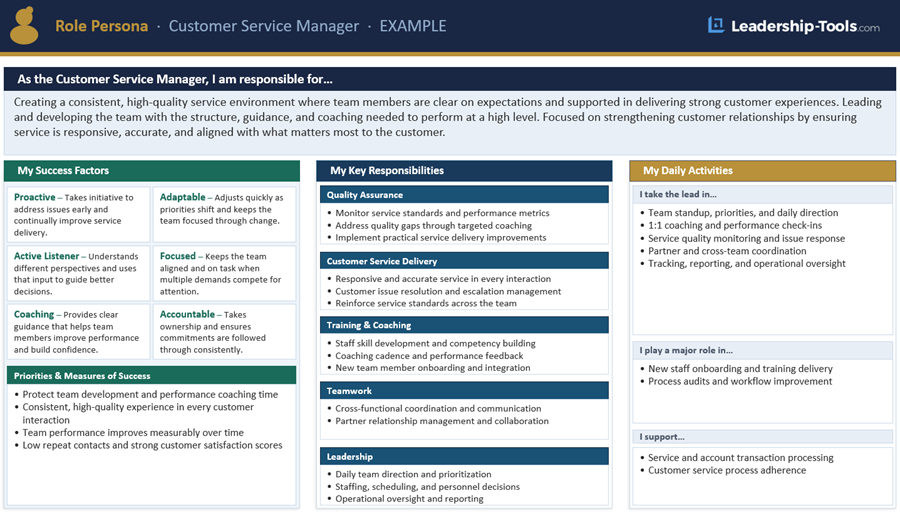
Each role persona is built around six areas. Together, they define the role in a way that is practical and usable day to day.
Role Purpose
- Clarifies why the role exists and what it contributes.
Top Responsibilities
- Identify the core areas the role owns.
Priorities
- Define what matters most when tradeoffs are required.
Decision Ownership
- Establishes what the role can decide independently and where input is needed.
Performance Standards
- Describe how the work should be carried out.
Measures of Success
- Define what strong performance actually looks like.
Shown below is an example of a completed Role Persona for a Customer Service Manager position. With this level of clarity, your employees will enjoy maximum confidence from knowing what is expected of them, and how they should prioritize their time for maximum job performance.
Role Persona Examples
Additional examples of well-defined content for various job roles are shown here. Leaders are encouraged to work with their team to create a Role Persona for each role within the team.
Branch Manager
Role Purpose
Lead branch performance by developing the team, growing relationships, and delivering consistent results across sales, service, and operations.
Top Responsibilities
- Drive branch sales performance
- Develop and coach team members
- Ensure consistent member experience
- Maintain operational and compliance standards
- Build relationships within the community
Priorities
- Protect team development and performance coaching
- Balance sales growth with service quality
- Address operational risks quickly
- Maintain consistent execution across the branch
Decision Ownership
- Makes day-to-day decisions related to staffing, coaching, and branch priorities
- Collaborates on major personnel or compensation decisions
- Escalates compliance issues or significant risk concerns
Performance Standards
- Maintains consistent presence and leadership within the branch
- Communicates expectations clearly
- Provides regular coaching and follow-up
- Balances focus between results and team development
Measures of Success
- Achievement of branch sales and service goals
- Improvement in team performance over time
- Strong member satisfaction and retention
- Low operational errors and compliance issues
Customer Service Representative
Role Purpose
Provide timely, accurate, and professional support to customers while resolving issues and reinforcing trust in the organization.
Top Responsibilities
- Respond to customer inquiries and requests
- Resolve issues accurately and efficiently
- Document interactions clearly
- Identify opportunities to improve the customer experience
Priorities
- Accuracy over speed when resolving issues
- Clear and professional communication
- Follow-through on unresolved items to ensure a quality customer experience
- Protect the customer experience in every interaction
Decision Ownership
- Resolves routine customer issues independently
- Seeks guidance on complex or sensitive situations
- Escalates complaints or high-risk interactions when needed
Performance Standards
- Maintains professionalism in all interactions
- Listens actively and communicates clearly
- Documents customer activity accurately
- Follows up in a timely manner when required
Measures of Success
- Customer satisfaction scores
- Resolution time and accuracy
- Reduction in repeat issues
- Positive feedback from customers and team members
Operations Analyst
Role Purpose
Support operational efficiency by analyzing processes, identifying gaps, and providing clear, actionable insights.
Top Responsibilities
- Analyze operational data and trends and make adjustments based on solid data
- Identify process improvements
- Support reporting and decision-making
- Maintain accuracy and integrity of data
Priorities
- Accuracy and reliability of analysis
- Clear communication of findings to all key stakeholders
- Focus on actionable insights over raw data
- Support key operational initiatives
Decision Ownership
- Recommends process improvements and reporting enhancements
- Collaborates with leadership on implementation decisions
- Escalates data integrity or system concerns
Performance Standards
- Delivers consistent accuracy in analysis and reporting
- Communicates insights clearly and concisely
- Identifies trends and issues proactively
- Follows through reliably on assigned work
Measures of Success
- Quality and usefulness of reporting
- Adoption of recommended improvements
- Reduction in operational inefficiencies
- Positive feedback from stakeholders
A role persona does not need to be perfect to be useful.
What matters is that it creates a shared, working definition of the role that can be used consistently. Once that clarity is in place, it becomes easier to align expectations, improve performance, and develop people in a more structured way.
The role clarity template gives you a place to start. The value comes from putting it into practice and define each role persona.
How To Use the Role Clarity Template (Team-Based Approach)
The template is very straightforward, but the value comes from how you use it with your team.

Filling it out on your own is a useful starting point, but the real impact comes from working through it with the people currently working in the role. By making your team part of the creative process, you'll gain greater insights and significantly increase the level of buy-in from team members.
Those conversations will likely surface assumptions, gaps, and conflicting expectations that would not have come to your attention any other way. Keeping the conversations practical and collaborative will ensure a quality outcome.
This approach turns role clarity into a working conversation rather than a static document.
Step 1: Prepare the Team
A few days before leading an in-person workshop with members currently in the role, ask participants to spend a small amount of time thinking about their duties.
Have them come prepared with a short list of what they believe are their most important responsibilities. Five to ten items is usually enough.
Then ask them to take it one step further by trying to identify:
- What should we continue doing?
- What should we stop doing?
- What should we start doing?
This preparation does two things. It gets people thinking about the role ahead of time, and it brings multiple perspectives into the room instead of starting from a blank page.
Step 2: Set the Context
At the start of the first working session, take a few minutes to explain why the exercise matters.
This is not just about documenting a role. It is about improving clarity, aligning expectations, and making it easier to lead, hire, and develop people over time.
When people understand the purpose, the conversation becomes more focused and more productive.
Step 3: Identify Core Responsibilities
Start by compiling a shared list of responsibilities.
Have the group combine their pre-work into one working list. This can be done on a whiteboard or any shared space where everyone can see it.
Once the list is built, have each participant identify what they believe are the most important items. This helps highlight where there is agreement and where perspectives differ. You might provide each person with some sticky dots to place next to the items they feel are top priorities. This will create a visual for where there is clear agreement and will also highlight outliers. Both provide insights for further discussion.
The goal here is not perfection. It is to surface how the role is currently understood.
Step 4: Refine Through Keep, Stop, Start
Once the initial list is in place, shift the conversation.
Looking at the responsibilities identified:
- What should we keep doing?
- What is missing that we should start doing?
- What can we stop doing or delegate?
This step is where the role begins to take shape.
It moves the conversation from “what exists today” to “what the role should be going forward.”
Step 5: Define What Strong Performance Looks Like
With the core responsibilities identified, focus on what it takes to perform the role well.
Ask the group to describe what an effective person in the role looks like. This can include:
- personal qualities
- mindset
- behaviors
- competencies
Capture these ideas in simple terms.
If your organization has defined values, this is also a good point to connect the role back to those values. It helps ensure the role is aligned with how the organization expects work to be done, not just what work gets done.
Step 6: Build the First Draft
After the session, take the input gathered and turn it into a working draft.
This includes:
- A short role summary that explains what the role is responsible for and why it exists
- A clear set of key responsibilities (usually five or so)
- Defined success factors based on how strong performance was described
The goal is to capture the intent of the conversation in a format that can be reviewed and refined.
Step 7: Review and Refine
Share the draft with the group ahead of a follow-up discussion.
Give people time to review it and come prepared with feedback, questions, and suggested changes.
During the follow-up session, walk through the draft together. Some parts may feel different from how the role has traditionally been viewed. That is normal.
Use the discussion to refine the definition until there is a shared understanding of the role.
Step 8: Define Supporting Activities
Once the role is clearly defined, identify the key activities that support success in the role.
These are the actions, routines, and responsibilities that ensure the role is carried out consistently.
Have the group identify and prioritize these activities so there is clarity not just in definition, but in execution.
Step 9: Finalize and Use the Persona
With the additional input, finalize the role persona.
At that point, it becomes a practical tool that can be used in multiple ways:
- to align expectations with current team members
- to guide coaching and performance discussions
- to update job descriptions
- to support hiring and candidate evaluation
The value of the persona comes from using it consistently, not just creating it once.
This process does not need to be overly complex to be effective.
What matters is that it creates a clear, shared understanding of the role, one that reflects how the work actually needs to be done.
Once that clarity is in place, many of the day-to-day challenges of managing performance become easier to address, because fewer things are left open to interpretation.
"People don't want to commit until they have clarity, but clarity comes with movement."
- Michael Hyatt
When to Use this Template to Create Role Personas

This tool is especially useful in a few common situations.
- When someone is new to a role, it provides a clear picture of expectations from the start instead of leaving them to figure it out over time.
- When performance is inconsistent, it helps determine whether the issue is skill, effort, or a lack of clarity about what the role requires.
- When two people in similar roles are performing differently, it can reveal differences in how the role is understood.
- It is also useful for experienced employees whose responsibilities have evolved over time without being clearly defined.
Beyond those situations, the output of this process (a clearly defined Role Persona) can be used in several practical ways.
- It can be used to update job descriptions so they better reflect what the role actually requires, which tends to attract more qualified candidates.
- It can help shape interview questions and provide a clearer way to evaluate candidates based on the real expectations of the role.
- Managers can also use it in coaching conversations as a shared reference point for discussing performance, identifying gaps, and reinforcing expectations.
Over time, this kind of clarity helps create more consistency across how roles are defined, how people are selected, and how performance is developed.
Keep Content Specific
The role clarity template works best when the language entered is concise and specific.
Vague statements like “support the team” or “maintain a positive attitude” do not provide a clear picture of what is expected. Challenge the teams to drill down and identify the heart of the message being conveyed.
The more concrete and observable the language, the more useful the template becomes. If something is too difficult to define clearly, that is usually a sign the expectation itself needs more thought.
What This Tool Does & Doesn't Do
A role clarity template will provide the means for creating high quality Role Personas but it's not a replacement for leadership.
The Role Persona does not eliminate the need for coaching, feedback, or regular communication. What it does is reduce the amount of confusion that would otherwise need to be managed day to day.
When roles are clearly defined, fewer things are left open to interpretation, and many performance issues become easier to address. If a team member is not achieving a particular goal, you can refer to the Role Persona and look back to confirm if the high impact activities are taking place. If not, then that should be the focus going forward.
Clear roles tend to create more freedom, not less. When people understand what they own and what success looks like, they spend less time guessing and more time executing.
A Final Thought
Defining roles clearly is one of the most practical steps a leader can take to improve performance.
Role clarity is one of the foundational pieces of a more structured approach to leadership, but it’s also one of the easiest places to start.
It creates alignment, strengthens accountability, and makes expectations easier to understand and apply. This role clarity template is part of a broader approach to leadership focused on creating clarity and consistency over time. But even on its own, it can make an immediate difference.
Start with one specific role. Use the team-based approached outlined above to provide clarity and improve buy-in.
Once Role Personas are in place for each role within your team, the rest becomes easier. Recruitment, onboarding and ongoing coaching are simpler once that foundation is in place.
Frequently Asked Questions (FAQ)
These are some of the most common questions leaders have when working to define roles more clearly and apply a role clarity template in practice.
Click on the (+) sign below to expand each question. Click the (-) sign to collapse it again.
What is a role clarity template?
What is a role persona?
A role persona is the outcome of using a role clarity template. It is a clear, working definition of a role that reflects how it actually operates in practice. Unlike a job description, it focuses on contribution, ownership, and performance rather than just listing tasks.
How is a role persona different from a job description?
A job description typically outlines duties and requirements at a high level. A role persona goes further by defining how the role is carried out day to day, what priorities matter most, and what strong performance looks like.
Many teams find that once a role persona is created, it becomes a better foundation for updating job descriptions.
When should I use a role clarity template?
This tool is especially useful when:
- someone is new to a role
- performance is inconsistent
- expectations need to be clarified
- responsibilities have evolved over time
- similar roles are being carried out differently
It is also useful when preparing for hiring, restructuring, or expanding a team.
Can I use this template on my own, or does it need to be a group exercise?
You can use it on your own as a starting point. However, the strongest results come from working through it with the person in the role or with a group of people who understand the role well.
That process helps surface assumptions and creates shared ownership of the final definition.
How detailed should the role persona be?
It should be specific enough to guide performance, but not so detailed that it becomes difficult to use.
In most cases, one page is enough if the content is clear and practical. The goal is usability, not completeness.
How often should a role persona be updated?
Roles tend to evolve over time, so it is helpful to revisit the persona periodically.
A good approach is to review it after a few weeks of use, then update it as needed based on changes in priorities, responsibilities, or expectations.
How can a role persona be used in hiring?
A role persona can be used to:
- refine job descriptions
- attract more qualified candidates
- create more targeted interview questions
- evaluate candidates based on real expectations of the role
It helps ensure that what you are hiring for matches how the role actually operates.
How does this help with coaching and performance management?
A role persona provides a shared reference point for expectations and performance.
Instead of relying on general feedback, you can point to clearly defined responsibilities, priorities, and success measures. This makes coaching more specific, more consistent, and easier for the team member to understand and apply.
Download Free Role Clarity | Role Persona Tool
Want the entire leadership tools library? Subscribe to our free newsletter and we'll send you a link to every tool on this site, all on one page, sorted by leadership phase. Every tool is free to download on its own page. The library just puts them in one place. Plus, you'll never miss out on updated or new tool announcements.
Your privacy is important to us. We never share or sell email addresses.
Leadership Tools Newsletter
Subscribe Free - See All Tools on One Page - Get New Tool Alerts
More Leadership Tools for Managing Your Team





Contact Information:
phone
(503) 970-9777
Email Customer Service
helpsupport@leadership-tools.com
Email Richard
richard@leadership-tools.com

By Richard Gorham
Leadership-Tools.com
2879 Riverwalk Loop, Eugene, Oregon, 97401
Copyright (c) 2002 - 2026 All Rights Reserved