It's a payoff plan where you pay the minimum on every debt and put all your spare money toward the smallest balance first. When that debt is gone, you roll its payment onto the next smallest, and so on. You build momentum with quick wins, which is what helps most people stick with it until the last balance is paid.
- Home
- Leading Self
- Debt Payoff Planner Templates
- Debt Snowball Calculator
Free Debt Snowball Calculator (Excel + Printable)
If you owe money on multiple cards or loans and you've got that pit in your stomach knowing you keep making payments without making progress, this free debt snowball calculator will show you something your monthly statements never do: the exact month you could be finished.

Download Debt Snowball Calculator:
You enter what you owe, add whatever extra you can spare, and it lays out the whole payoff plan for you, one month at a time.
Using the calculator is simple. You list your debts, put them in order of smallest to highest balance or highest to smallest percentage rate, then aim every spare dollar at one target while the rest tick along on their minimums.
The tool handles the math so you're making a decision instead of a guess. Open it in Excel, in Google Sheets, or in any free spreadsheet app, and print the worksheet if you'd rather plan it on paper first.
Jump To: Use the Calculator Now | What the Calculator Shows You |Who It's For | How to Use in Three Steps | Debt Snowball vs Debt Avalanche | How the Rollover Works | A Worked Example| Why It Matters | Track Your Progress | FAQ | Get Updates Free | Download Calculator
Use the Calculator Now
Take it for a spin. Enter your own debts below and see your debt-free date in about thirty seconds.
Quick Debt Snowball Calculator
Enter your debts and an extra monthly payment. The results update as you type. This is the quick version; download the free tool below for your full month-by-month schedule and progress tracker.
Debt nameBalanceAPRMin. pmt
$
Months to debt-free
--
Debt-free by
--
Total interest
--
Interest saved
--
| Approach | Months | Total interest |
|---|---|---|
| Debt Snowball (smallest balance first) | -- | -- |
| Debt Avalanche (highest APR first) | -- | -- |
| Paying only minimums | -- | -- |
Want the full picture? Get your month-by-month schedule, the what-if table, and a progress tracker.
Download the free calculatorGold cells are yours to fill in. Estimates use a fixed rate per debt and assume you start this month. For the exact schedule, use the downloadable tool.
What the Calculator Shows You
Most people know roughly what they owe. What they don't typically see until money gets tight is how long it will really take to pay off, and what it costs them. This tool answers four questions the moment you type in your debts.
- Months to debt-free. A true number you can count on if you follow your plan, not a vague estimate.
- Your debt-free date. The actual month your last balance hits zero.
- Total interest. What the debt costs you throughout the paydown process.
- Total you'll pay. Your balances plus that interest, so there are no surprises.
Once your debts are entered into the debt snowball calculator, you'll see a comparison panel that puts three paths side by side for your consideration: the debt snowball, the debt avalanche, and the do-nothing option of paying only minimums.
Seeing all three options side by side is usually the moment everything clicks, because the cost of doing nothing stops being abstract and turns into a number you can't unsee.
Who Is This For
This is for you if you're carrying more than one debt balance and you want a clear payoff plan instead of simply making minimum payments and continuing to carry the debt with no end in sight.
The debt snowball calculator fits a handful of common situations:
- You've got two or more debts (cards, a car loan, medical bills, a personal or student loan) and you're tired of guessing which to hit first.
- You can put even a little extra toward debt each month and you want to see what impact that little extra does for you over time.
- You like seeing the whole picture in one place rather than logging into five separate accounts.
- You want to know that you are making progress and feeling the momentum, not just blindly making payments.
It's less useful if you have a single debt and no room to pay extra, or if you're behind on basics like rent or utilities. In that case, getting current and building a small buffer comes first, and the Daily Cash Flow and Household Budget tools are the better starting point.
How to Use the Calculator in Three Steps
The debt snowball calculator is built to be intuitive and user-friendly. The only cells that you need to enter are the gold cells. After entering the gold cells, the grey cells provide your calculated results. The process is surprisingly easy, and if you've already completed your personal financial statement, you'll be done in a few minutes.
Step 1: Enter Your Debts
For each debt you have, type the name, the balance, the APR (annual percentage rate), and the minimum payment. You'll find the APR and minimum on your latest statement. Enter the rate as a percent, so 22.99%, not 0.2299.
Step 2: Add Extra Amount and Pick a Start Month
Put in any amount you can pay above the minimums, even $25 or $50 will be meaningful over time. Then, enter the month you'll begin. Every dollar you can commit to your paydown plan shortens your finish line, and the debt snowball calculator shows you exactly how much.
Step 3: Choose a Payoff Method
Pick from two different payoff plan options. Choose between the Snowball or Avalanche approach from the dropdown. The whole plan, the order you'll paydown your debts, the related payoff schedule, and your overall results will automatically reorder to match the plan you choose. That's it.
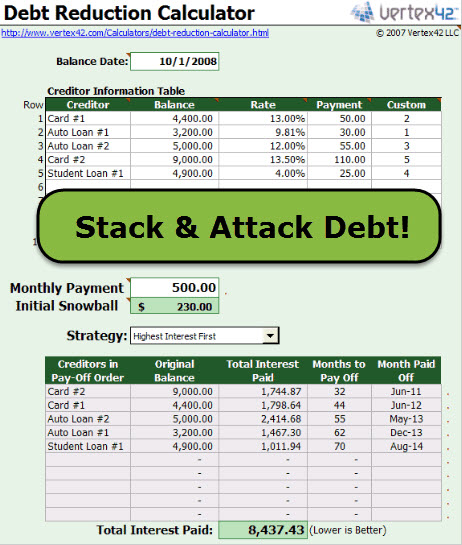 Fill in the gold cells. Everything grey calculates for you automatically
Debt Snowball vs Debt Avalanche
There are two solid ways to order your debts, and the calculator runs both so you can see the difference for yourself.
- The debt snowball pays off your smallest balance first, no matter the interest rate. This is our recommended approach because by tackling your smallest debt first, you'll experience success more quickly, and that momentum keeps you focused on the larger goal. Knock out a whole debt quickly, feel the win, then roll that freed-up payment onto the next smallest debt. It's about creating momentum.
- The debt avalanche pays off your highest interest rate first. Many people choose this option because on paper it saves you the most money, because you're starving the most expensive debt first.
So which should you use? Here's the honest answer most calculators won't give you. The avalanche usually saves a little more interest, but the snowball is the one people find most success with. Early wins provide you with fuel and focus.
When you erase a debt completely in the first few months, you'll have belief in the plan, and that belief is what carries you through the longer debt reduction journey. That's why I lean toward the snowball for most folks, and why the tool sets it as the default.
The compare panel shows you the exact dollar difference for your own numbers. You decide the approach that works best for you.

How the Rollover Works
Both the snowball and avalanche methods run on the same calculator and the "secret sauce" to each is when after paying off the first debt, you take that payment you no longer need to make and you add it to the next debt in line.
It's called rollover, and it's simpler than it sounds. Understanding the power of the rollover is critical because it's the whole reason both approaches work so well.
Each month you pay one steady amount: every minimum payment plus whatever extra you've decided you can add. The minimum payments keep all your debts current, and the extra payment goes straight at the one debt you're focused on.
Here's the part that does the heavy lifting. When that first debt is finally gone, the money spent on that payment doesn't drift back into everyday spending the way freed-up money usually does. Instead, it moves to the next debt in line, on top of that debt's own minimum and your extra, so the next one falls even faster than the first did. Then it happens again, and the amount aimed at each new target keeps growing as you go.
That's the snowball (or avalanche) picking up size as it rolls downhill, and it comes down to two moves. You stack your debts in a deliberate order, then you attack the one on top with everything you can spare while holding steady on the rest.
The calculator runs that cycle across all your debts, month after month. You'll see it happen and track your progress so you can see it happen in real time.
A Debt Snowball Calculator Example: Devin's Plan
Numbers make this real, so here's a sample scenario: Meet Devin, who owes $18,500 across three debts:
- Card A: $3,000 at 22.99% APR, $90 minimum
- Card B: $6,500 at 27.49% APR, $163 minimum
- Medical loan: $9,000 at 11.90% APR, $200 minimum
Those minimums add up to $453 a month. Devin has $200 extra that he has committed to his paydown plan, for $653 total, and chooses the snowball approach.
Watch what happens. The calculator points that extra payment at Card A, the smallest balance. Card A is gone in month 12. That whole payment now piles onto Card B, which clears around the two-year mark. Then the full $653 lands on the medical loan, and Devin is debt-free in month 38, with a debt-free date of March 2029. Total interest along the way is $5,805.
If Devin had paid only the minimums with no plan and no rollover, those same debts would take about nine years and cost nearly $16,000 in interest. The plan saves Devin more than $10,000 and years of life with this hanging over the kitchen table.
 The "Now Attacking" column shows the rollover in action, moving from Card A to Card B to the medical loan as each debt is paid off in full.
"The first debt you wipe out completely is the one that changes everything, because that's when you stop hoping the plan works and start knowing it does."
Why Debt Reduction Matters
It's easy to treat debt as a math problem, but anyone who has carried it knows it weighs on you heavily and can seriously diminish the quality of your life.
When you are feeling stuck in debt, it's always with you and it has a way of narrowing your options. So paying it down isn't only about the interest you save, real as that saving is. It's about getting your options back.
When your money stops going toward things you bought months ago, it starts going toward the life in front of you, whether that's an emergency fund, a bit of breathing room, or finally having the room to pursue new opportunities.
Leading your own life starts with leading your own money, and a clear plan is how you take the wheel. That's the calculator's real job. It turns something that feels endless into a finish line you can see, and then it keeps that line in front of you, month after month, until you cross it.
Track Your Progress
Once a month, after you've made your payments, you'll enter your real total balance into the tracker. From that one number the calculator works out how much you've paid down as a percentage and whether you're running ahead of or behind the plan you set.
There is a progress bar that is then filled in a little further than it was the month before. The whole check-in takes a minute, and it turns your goal into something you can track each and every month.
That bit of visible movement matters! When you can see the bar progress, the plan becomes something you can see and be proud of. That feeling of success is what carries you through the slow stretches when willpower alone might run out.
The on-track signal pulls its weight too. If a balance comes in higher than the plan expected, you find out immediately and can make the appropriate course correction to get back on track. Much better to catch it early than discovering the shortfall months later.
Some people are happy updating the progress tracker spreadsheet each month and watching the bar fill in on screen. Others do better printing it out, putting it on the fridge, and coloring it in by hand where they'll pass by it every day for a continual reminder.
Do whatever works for you best. The only real misstep is letting your debt plan drift out of sight, because the plan you stop looking at is the plan you stop following. Keep your eyes on it month after month, and the debt snowball calculator will walk you all the way to the end.
 Enter your balance each month and watch the bar fill. Progress you can see is progress you'll stick with.
Frequently Asked Questions
Click on the (+) sign below to expand each question. Click the (-) sign to collapse it again.
What is the debt snowball method?
Is the debt snowball or the debt avalanche better?
The avalanche, which targets your highest interest rate first, usually saves a bit more in interest. The snowball, which targets your smallest balance first, gets you faster wins that keep you motivated. The best plan is the one you'll actually finish, and for most people that's the snowball. The calculator runs both so you can compare the real difference for your own debts.
Do I need Excel to use it?
No. The file works in free Google Sheets, Excel for the web, and LibreOffice, as well as in Excel. There's also a printable PDF if you'd rather fill it in by hand.
Is it really free? Do I have to sign up?
Yes, the debt snowball calculator is 100% free, with no sign-up and no email required to download it. It's one of a set of free money tools we offer to help people get out of debt and build some stability.
How much extra should I put toward my debt?
Whatever you can do consistently, even a small amount. In the sample plan, adding $200 a month cut the payoff from about six years down to a little over three and saved thousands in interest. Use the What-If panel to try different amounts and see what each one does to your debt-free date before you commit.
Should I include my mortgage?
Usually not at first. Most people focus the snowball on consumer debts like cards, car loans, medical bills, and personal or student loans, then tackle the mortgage later. If you do include it, enter only the principal and interest portion, not taxes and insurance.
What if a minimum payment is too small to cover the interest?
The tool flags it in red and tells you, because when a minimum doesn't cover the monthly interest, that balance won't be reduced. You'll want to raise that payment so you're making real progress instead of running in place.
Is this financial advice?
No. It's an educational tool to help you plan and see your options clearly. Your results depend on the numbers you enter, and for decisions specific to your situation it's worth talking with a qualified financial professional.
Download 10 Steps to Conquer Debt eBook

Want the entire leadership tools library? Subscribe to our free newsletter and we'll send you a link to every tool on this site, all on one page, sorted by leadership phase. Every tool is free to download on its own page. The library just puts them in one place. Plus, you'll never miss out on updated or new tool announcements.
Your privacy is important to us. We never share or sell email addresses.
Leadership Tools Newsletter
Subscribe Free - See All Tools on One Page - Get New Tool Alerts
More 10 Steps to Conquer Debt Tools

Contact Information:
phone
(503) 970-9777
Email Customer Service
helpsupport@leadership-tools.com
Email Richard
richard@leadership-tools.com

By Richard Gorham
Leadership-Tools.com
2879 Riverwalk Loop, Eugene, Oregon, 97401
Copyright (c) 2002 - 2026 All Rights Reserved