- Home
- Leadership Book Reviews
- The Power Of A Positive No
The Power Of A Positive No
The Power Of A Positive No empowers you to understand how to say “No” in an understanding and effective way.
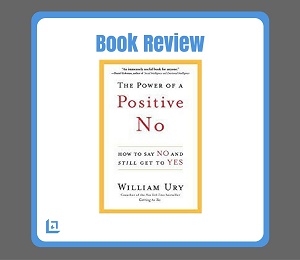
Whether you are at work, at home or speaking with a pushy relative, saying no doesn’t have to become an anxiety-filled event.
Every day we are confronted with situations where we feel compelled to agree to something, when in fact we are not 100% on board or perhaps just don't wish to support at all.
Many times we disagree completely, yet we cannot bring ourselves to
utter that tiny little word "No", because we fear what might happen if we
do.
"The way we communicate with people ultimately determines the quality of our lives."
 , author William Ury empowers his readers by providing concrete advice and practical examples for effectively saying "No" with confidence in virtually any situation.
Ury explains that your ability to say no most effectively is to deliver the message of "No" in between two "Yes's".
The first Yes is to yourself and a means of protecting what is important to you. You're not being selfish is saying yes to yourself. Rather you are setting clear boundaries and establishing a firm core set of values and principles.
After you are clear on the inner Yes, you then get to No. You say it clearly, without emotion, but in a respectful way. Obviously, it's not in anyone's best interest for either party to walk away offended or feeling that they've been marginalized. The way to ensure this is by quickly following up the No, with the second Yes.
The second Yes comes by discussing what you are willing to consider, on what terms, in what other situation - it's about discussing a potential Plan B. The second Yes allows the other person to hear a more positive no to their initial request.
By using the approach of "Yes, No, Yes" rather than just "No", you are demonstrating and you are thoughtful in your decision-making and respectful in your communications.
On his website the author provides this free tool illustrating the Three Steps to a Positive No.
Getting To Yes, Now What?
Prior to writing The Power Of A Positive No, Ury wrote the highly successful Getting To Yes.
In fact, in this video Ury explains how a discussion with Warren Buffet was instrumental in his decision to write this book.
In the following 4 minute video you can watch him tell the story.
How To Find The Yes For A Positive No?
 |
Ury explains how to create the proper balance of No and Yes.
He gives an example of a “No Smoking”
sign that he sees while on vacation at a Mountain Resort Lodge. The sign
presented it’s No message, but in a very positive and respectful way.
The sign read: “In order to accommodate the pleasure of all our guests, this is a No Smoking room. We ask that you smoke in our smoking room, The Great Outdoors! Thank you.”
The Power of a Positive No: How to Say No and Still Get to Yes is filled with similar examples of how one can effectively communicate a positive No. Once you understand the concept and give yourself a little practice, the skill can be developed fairly quickly.
Uncovering the hidden Yes, as we are saying No, is a key skill to develop. This accomplishes three useful tasks:
- It grounds you in something positive. You can now stand on your feet without stepping on their toes. Your No can be for your needs, not against the other person. Instead of only saying No and rejecting the other person, you can simply say Yes to what matters most to you.
- It gives you a sense of direction. You will now know where you are going with your No.
- It gives you energy. You'll have the fuel to deliver your No and to sustain it in the face of resistance.
The Power Of A Positive No is filled with multiple examples of how one can effectively communicate a positive No. Once you understand the concept and give yourself the benefit of a little practice, the skill can be developed fairly quickly.
As with most challenges, preparation and practice are necessary to develop the necessary skill. Indeed, once you have practiced the method, it takes less and less time to prepare, sometimes only a few seconds. However, initially it's important to take the time you need to prepare the best message possible.
"Any problem, big or small, within a family, a team, or between two countries, always seems to start with bad communication. Someone isn't listening."
- Emma Thompson
To further support the "Yes, No, Yes" approach, the author explains how one can “build a golden bridge”.
Twenty-five hundred years ago, the Chinese strategist Sun Tzu counseled leaders to “build a golden bridge for your opponent to retreat across.”
"The single biggest problem in communication is the illusion that it has taken place."
Although this advice still holds true today, Ury re-frames it more positively by advising us to build a golden bridge for the other person to advance across – toward a more positive and mutually beneficial solution.
We must step for a moment into the other person’s shoes to see how difficult it may be for them to say Yes to an alternate proposal. In their eyes, they may see a giant canyon that separates their proposed idea from your Plan B.
As the leader it is your job is to create a golden bridge that has merit; that they can accept, and possibly lead to advance for the benefit of the organization.
Through the countless stories and examples, Ury explains in clear detail how to Uncover Yes #1, Empower Your No, and Identify A Respectful Yes #2.book is a recommended read because
This is a book that can literally transform the quality of your communication skill, both personal and professional.
Author Bio
William Ury is a best-selling author. He directs
the Global Negotiation Project at Harvard University.
More Leadership Books



Assessments | Surveys | Games | Poems | Action Plans | Reward Ideas
phone
(503) 970-9777
Email Customer Service
helpsupport@leadership-tools.com
Email Richard
richard@leadership-tools.com

By Richard Gorham
Leadership-Tools.com
2879 Riverwalk Loop, Eugene, Oregon, 97401
Copyright © 2003 - 2026 All Rights Reserved