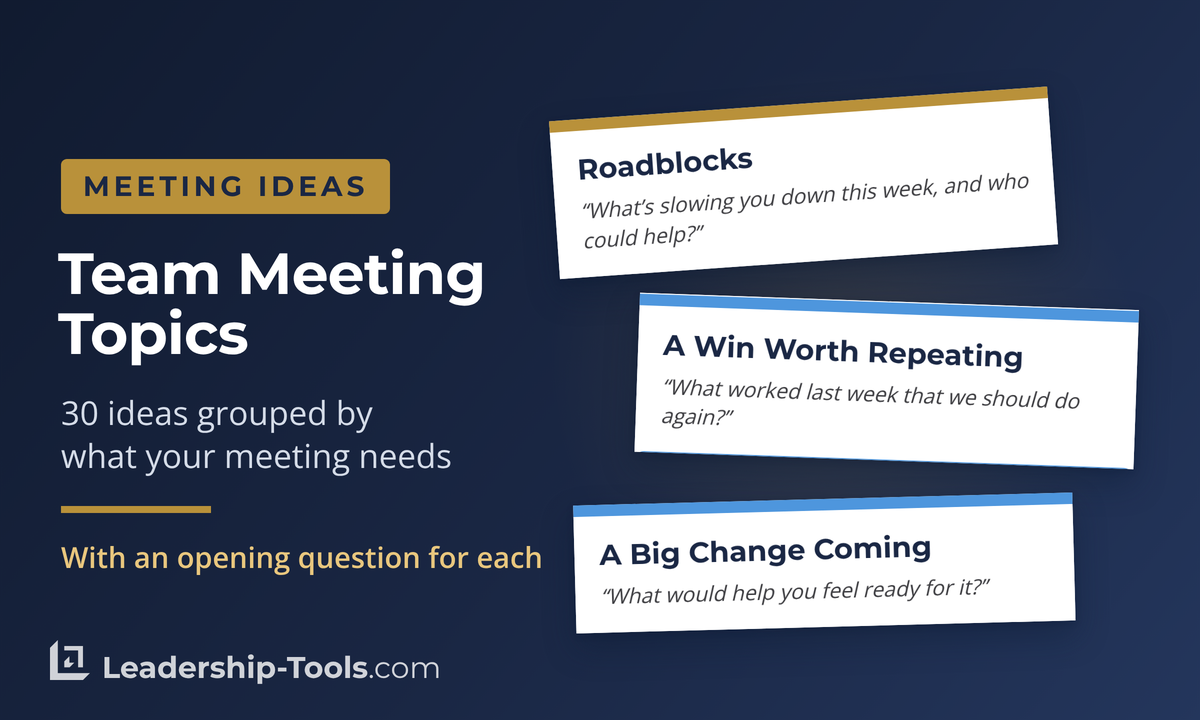
Good team meeting topics fit what your team needs that week, such as clearing a roadblock, recognizing good work, planning the next quarter or getting ready for a change. A topic works best with an opening question that gets the team talking about their own work.
- Home
- Leadership Lessons
- Leadership Lessons by Topic
- Team Meeting Topics
Team Meeting Topics
Team meeting topics are easier to choose when you start with what your team needs this week, whether that’s clearing a roadblock or getting ready for a big change. The 30 topics below are grouped by the goal of the meeting, and each comes with an opening question to get people talking and a lesson or tool to take the topic further.
I keep a few standing topics on every agenda, like production and compliance, but following the same agenda every week quickly gets stale for the entire team. Mixing in a new topic now and then, and letting a different team member lead it, keeps people engaged and looking forward to the meeting.
By including a variety of topics, exercises and activities during your meetings, attendees will view your meetings as time well spent rather than just a meeting they are required to attend.
These team meeting ideas work for a weekly huddle or a monthly staff meeting, in person or on a video call. To build the full agenda around a topic, see Business Meeting Agendas.
Jump To: Weekly Check-Ins | Recognition | Planning and Goals | Growth and Coaching | Customers and Sales | Team Building | Hard Moments | Leading a Topic | Video Calls | Example | FAQ
Weekly Check-Ins
Most weekly meetings cover updates, and these topics turn the updates into a conversation about what’s in the way and what comes first.
Roadblocks. Ask each person for something slowing their work this week and decide together who can help get things back on track.
Ask: “What’s slowing you down this week, and who on the team could help?”
Try it with: Project Tracker and Calendar
This Week’s Priorities. Have everyone name the work that matters most before the week fills up with other priorities.
Ask: “If you could finish only two things this week, what would they be?”
Try it with: How to Prioritize Work Projects
Initiative Updates. The team member leading each initiative gives the update, which keeps the work moving and gives them practice leading the group.
Ask: “What moved forward since last week, and what do you need from the team?”
Try it with: Master Action Plan (M.A.P.)
A Win Worth Repeating. Start with something that went well and what made it work.
Ask: “What worked last week that we should do again?”
Try it with: the lesson Make Each Day a Complete Day
Recognition
Recognition takes a few minutes of a meeting, and people tend to repeat the work that gets noticed in front of the team.
A Thank-You Round. Go around the room and have each person thank a teammate for something specific from the past week.
Ask: “Who helped you this week, and what did they do?”
Try it with: My Favorite Things Recognition Tool
Credit for the Try. Recognize an effort that didn’t work out, along with what the team learned from it.
Ask: “What did we try recently that fell short, and what did it teach us?”
Try it with: the lesson Give Credit to the People in the Arena
A Customer Compliment. Read a compliment from a customer out loud and ask the person it’s about to tell the story behind it.
Ask: “What did you do for this customer that made the difference?”
Try it with: My Favorite Things Recognition Tool
What People Do Well. Ask the team to name a strength they’ve seen in a teammate lately.
Ask: “What’s something a teammate does well that the rest of us could learn from?”
Try it with: the lesson Look for What People Do Well
Planning and Goals
Planning topics work best at the start of a month or a quarter, when the team still has time to change course.
The Quarter Ahead. Share the two or three goals for the quarter and ask the team what it will take to hit them.
Ask: “What will get in the way of these goals, and what can we do about it now?”
Try it with: Master Action Plan (M.A.P.)
What “Done” Looks Like. Pick a current project and agree on what finished looks like before anyone calls it done.
Ask: “How will we know this project is finished?”
Try it with: Role Clarity Template
Our Battle Cry. Work on a short team slogan together, or revisit the one you have, and put it at the top of the agenda.
Ask: “What do we want customers to say about us?”
Try it with: team battle cry examples
Lessons From the Last Project. Look back at a project that just ended and decide what to keep and what to change next time.
Ask: “If we started this project again tomorrow, what would we do differently?”
Try it with: Project Tracker and Calendar
Before We Fund It. When the team is asked to spend money on a new idea, ask for the plan and the numbers first.
Ask: “What would we need to see before we put money behind this?”
Try it with: the lesson Ask for the Plan Before You Put Money Behind It
Growth and Coaching
Growth topics show your people that their development matters to you, and the people who speak up are often the ones ready for more.
A Skill I’m Building. Each person names a skill they’re working on and how the team could help.
Ask: “What’s a skill you’d like to get better at this year?”
Try it with: Growth Roadmap Template
Stretch Assignments. Talk about the work people would like to take on next, and match a stretch assignment to someone ready for it.
Ask: “What’s a piece of work you’d like to try that’s outside your job today?”
Try it with: the lesson Test Your People Before You Need Them
Teach Something You Know. Give a team member ten minutes to teach the group a skill or shortcut from their own work.
Ask: “What do you know how to do that would save the rest of us time?”
Try it with: Leadership Lesson Plans
Feedback That Helped. Ask people to share a piece of feedback that changed how they work.
Ask: “What’s the most useful feedback you’ve ever received?”
Try it with: Performance Coaching Toolkit
Customers and Sales
Customer topics keep the team’s attention on the people you serve, and the best stories often come from the front line.
A Complaint Worth Learning From. Walk through a recent complaint, what the customer wanted and how the team responded.
Ask: “What was this customer trying to get done, and did we help?”
Try it with: the lesson Show You Care
What Customers Want Next. Share what customers have been asking for and decide what to do about it.
Ask: “What have customers asked for lately that we don’t offer?”
Try it with: the lesson Find Out What the Customer Wants
“Yes, I Can Help You With That”. Talk about owning a customer’s issue, whether you solve it yourself or hand it to the person who can.
Ask: “When a customer brings you something outside your job, what do you do next?”
Try it with: the lesson Leave Every Person Better Off
Results in the Same Market. When results are down, look at who is doing well in the same conditions and what they’re doing differently.
Ask: “Who is getting results right now, and what can we learn from them?”
Try it with: Team Accountability Activities
Team Building
A short activity once or twice a month builds trust and gets people talking, and it works best when a different team member leads it each time.
Who Knew?. Each person answers a question about themselves beyond their job title.
Ask: “What’s something about you most of the team doesn’t know?”
Try it with: Team Building Lesson Plan
Lost in Translation. Pairs try a two-round drawing exercise that shows how much changes when people can ask questions.
Ask: “Where do we give instructions without checking that they landed?”
Try it with: Team Building Lesson Plan
Pair Up on a Goal. Put people in pairs with a shared goal and a time to check in.
Ask: “Who would you pair with to hit this month’s goal, and why?”
Try it with: the lesson Build Your Own Master Mind
A Team Member Leads. Hand the activity to a team member, matched to their interests and skills, and let them run it.
Ask: “Which activity would you like to lead for the team?”
Try it with: Team Building Activities at Work
Hard Moments
Some meetings come after bad news or before a big change, and the topic matters more than usual at those times.
After a Setback. Talk about what happened and what the team can control, and hold big decisions until people have had a night to think.
Ask: “What part of this can we control, and what do we do first?”
Try it with: the lesson Don’t Decide When You’re Down
A Big Change Coming. Explain the change, the reason behind it and what stays the same, then take questions.
Ask: “What would help you feel ready for it?”
Try it with: the lesson People Buy Into You Before Your Plan
A Busy Season. Agree on what can wait and what can’t, so the team isn’t trying to do everything at once.
Ask: “What can we set aside for the next few weeks?”
Try it with: How to Prioritize Work Projects
When Someone Leaves. Thank the person leaving, then walk through who will pick up each part of their work.
Ask: “What do you need to know to take over this part of the work?”
Try it with: Succession Planning Template
Leave It at the Door. Share the idea of a hook on the door where you hang personal worries before work, so you can be present on the job and pick them back up afterward.
Ask: “What helps you switch from the rest of your day to work?”
Try it with: Choosing a Thoughtful Response
How to Lead a Team Meeting Topic in 15 Minutes
Most of these topics fit in about 15 minutes of a regular meeting. The steps below keep the time on the team’s own work.
- Ask the opening question, and give people a minute to think before anyone answers.
- Talk it through in pairs or small groups for five to eight minutes, so everyone gets a chance to speak.
- Have each group report back with their best idea, and write the ideas where everyone can see them.
- End with a commitment, such as who will follow up and by when.
When you want to go deeper, the lessons on Leadership Lessons by Topic add a story and a resource to a topic, and the free planner on Leadership Lesson Plans walks you through building your own.
Team Meeting Ideas for Video Calls

Every topic on this page works on a video call with a few small changes. Put the opening question on the screen and ask people to answer in the chat first, which gives the quieter people on the team a way in, then call on two or three people to talk through what they wrote. Breakout rooms take the place of small groups, and a topic usually needs a few minutes less than it would in person.
Ask people to keep their cameras on for the discussion if they can, and give the person leading the topic control of the screen, so the meeting doesn’t turn into you talking to a grid of faces.
Team Meeting Topics Example
Teresa leads a nine-person customer support team, and she adds a topic to the second half of her Tuesday huddle each week. The card below shows her plan for March and what came of it.
CUSTOMER SUPPORT TEAM · TUESDAY HUDDLES IN MARCH
Four weeks, four topics
| Week | Topic and opening question | Led by |
|---|---|---|
| 1 | Roadblocks. “What’s slowing you down this week, and who on the team could help?” | Teresa |
| 2 | Credit for the Try. “What did we try recently that fell short, and what did it teach us?” | Teresa |
| 3 | A Complaint Worth Learning From. “What was this customer trying to get done, and did we help?” | Malik |
| 4 | Who Knew? “What’s something about you most of the team doesn’t know?” | Rosa |
What came of it: In week 1, four of the nine agents named the same slow screen in the ticket system, and Teresa had a fix scheduled by Friday. In week 2, the team gave credit to Malik and Rosa for a callback program that only reached 12 of its 40 customers, and agreed to try it again with a shorter call list.
Each topic took about 15 minutes of a 30-minute huddle, and two of the four were led by agents.
Team Meeting Topics FAQ
The questions below address what leaders most commonly ask about team meeting topics.
Click on the (+) sign below to expand each question. Click the (-) sign to collapse it again.
What are good team meeting topics?
How often should you change your team meeting topics?
Keep your standing topics, like production numbers and compliance, on every agenda, and add a new topic each week or two. Following the same agenda every week tends to get stale, and a fresh topic keeps people engaged.
How do you get people to talk in team meetings?
Start with an open question, let a team member lead part of the meeting, and break into small groups that report back to the whole team. The less the manager talks, the more the team tends to say.
How long should a team meeting topic take?
Most topics on this page fit in about 15 minutes. A quick round like a thank-you round can take five, and a planning topic for a new quarter may need half an hour.
Can team members choose the meeting topic?
Yes, and it's a good way to develop someone who wants to grow as a leader. Ask them to pick a topic, plan the opening question, and lead that part of the meeting.
How do you run team meeting topics on a video call?
Share the opening question on screen, ask people to answer in the chat first, then call on a few people to talk it through. Use breakout rooms for small group work, and keep the topic shorter than you would in person.
More Leadership Resources




Richard Gorham has led teams in financial services for more than 30 years, from retail branches and operations to investments and insurance, and he still leads a team today.
He founded Leadership-Tools.com in 2002 to give managers free, practical tools like the ones he used in his various leadership roles. Every tool here has been used in a real workplace and comes with a filled-in example you can follow.

Contact Information:
phone
(503) 970-9777
Email Customer Service
helpsupport@leadership-tools.com
Email Richard
richard@leadership-tools.com

By Richard Gorham
Leadership-Tools.com
2879 Riverwalk Loop, Eugene, Oregon, 97401
Copyright (c) 2002 - 2026 All Rights Reserved