- Home
- Leadership Development Tools
- Succession Planning Template
Free Succession Planning Templates: Individual Review Guide and 4-Block Grid
Our free succession planning templates provide you with two complementary tools for assessing your team's bench strength and developing the next generation of leaders.
Whether you’re building a leadership pipeline for a small team or strengthening long-term organizational continuity, these tools give you a clear way to plan for structured development of your future leaders.
Strong teams are built by leaders who think ahead.
The people who make your team work well today will not always be there. By having a succession planning process in place before it becomes urgent, transitions become more easily managed. Without one, transitions can become longer than necessary and create major disruptions in workflow.
This page gives you a practical, structured approach you can begin using today for successful succession planning.
Our recommended framework includes two tools designed to work together.
- The Succession Planning Review gives you a structured way to assess each team member individually.
- The 4-Block Performance and Potential Grid gives you a visual overview of your entire team so you can see your bench strength at a glance.
Together, they form a complete, practical system for leadership succession planning that works at any team size.
Download these employee succession planning templates in multiple formats to start building your leadership pipeline immediately.
Template at a glance
| Formats | PDF, PowerPoint, Google Slides, Word, Excel |
| Ideal for | Leaders building team bench strength |
| Includes | Succession Planning Review + 4-Block Grid |
| Best for | Teams of 4–20 direct reports |
| Pairs with | Growth Roadmap, Project Prioritization, Initiative Tracker |
Not sure which template you need?
Use the Succession Planning Review to assess each team member individually — performance, potential, readiness, and development priorities.
Use the 4-Block Grid to map your entire team's bench strength and succession readiness on a single page.
Use both for a complete succession planning process — individual depth plus team-level perspective.
Jump To: Who This Is For | How to Use Tools | Why Succession Planning Gets Delayed | The Two-Tool Framework | The Succession Planning Review |Review Example | The 4-Block Grid & Example | How to Use Both Tools Together | Succession Planning Examples | Best Practices | FAQ | Download Templates
Who These Succession Planning Templates Are For
This framework is designed for team leaders, managers, and business owners who are responsible for a group of people and want a straightforward process for thinking about who is ready for greater responsibility and what it will take to get them there.
These templates are designed for team leaders, managers, and business owners who are responsible for a group of people and want a straightforward process for identifying who is ready for greater responsibility and what it will take to get them there.
You do not need an HR background or a formal talent management process to use them effectively. You need to know your people, be willing to assess them honestly, and commit to taking a few specific development actions based on what you find. If you manage anywhere from four to twenty direct reports and have not yet formalized how you think about leadership readiness, this is the right starting point.
These tools work well for frontline managers who want to be more intentional about developing the people around them, experienced managers responsible for multiple layers of leadership, and small business owners who recognize that their organization is more dependent on a handful of individuals than is healthy. What those leaders have in common is a need to see their bench clearly and develop it deliberately rather than waiting until a gap forces them to act.
The templates are also useful for leaders who are preparing for a talent conversation with their own manager or HR partner and want a documented, consistent framework to bring to that discussion. When succession planning is grounded in a structured assessment rather than general impressions, those conversations produce better outcomes for everyone involved.
These are not enterprise software tools or complex scoring systems. They are practical, low-overhead templates that a working leader can complete, maintain, and act on without significant time investment. If you are serious about developing the people around you and building a team that does not depend on any single individual to function well, these templates give you the structure to do that.
Why Succession Planning Gets Delayed and Why That's a Problem
Most leaders understand that succession planning is important. Most also keep pushing it to the next quarter. Understanding why that happens is the first step toward breaking the pattern.
The most common reason is that succession planning feels important but not urgent. There are performance issues to address, projects to manage, and deadlines pressing in from every direction. In that environment, a process that asks you to think three years ahead naturally gets deferred in favor of what is due this week.
The problem is structural: by the time leadership succession planning feels urgent, it is almost always too late to do it well.
""Believe in your people to do more; encourage them to learn and grow; help them to achieve new levels of competency, and you will secure the future of the business."
When a critical role opens unexpectedly and no one is ready to step into it, the organization faces a familiar set of costly choices. You can hire from outside and spend months helping someone learn the culture, the team, and the work. You can promote someone before they are truly ready and set them up for a difficult first year. Or you can distribute the work across people who are already stretched, accepting the toll that takes on both output and morale.
None of those outcomes are easy, and all of them are largely avoidable with advance preparation.
A related issue is that succession planning often gets treated as a documentation exercise rather than a development process. Leaders identify potential successors, fill out a form, and file it away until the next annual review. Nothing changes for the individuals identified, no development conversations happen, and no targeted action is taken. When a transition eventually occurs, the person whose name was written down two years ago is no better prepared than they were on the day it was written.
A succession planning process only works when it drives real action.
The framework on this page is designed with that in mind. It is simple enough to complete without significant prep time, structured enough to produce consistent results, and action-oriented enough to actually change how your people develop over time.
The Two-Tool Framework: What Each Template Does
This succession planning framework centers on two tools that work together to give you both depth and breadth: an individual assessment that captures the full picture of each team member, and a visual grid that shows your entire team on a single page.
This succession planning framework centers on two tools that work together to give you both depth and breadth: an individual assessment that captures the full picture of each team member, and a visual grid that shows your entire team on a single page.
The individual Succession Planning Review gives you the depth you need. It walks you through a structured assessment of each team member, covering their current performance, their potential, their readiness for greater responsibility, and the specific development actions that would prepare them for the next step. Completing this review for each person forces you to think carefully and document what you actually know, rather than relying on impressions that may shift with the most recent interaction.
The 4-Block Performance and Potential Grid gives you the breadth you need. Once you have completed the individual reviews, you place each team member on the grid based on your assessment of their performance and potential. The result is a clear, at-a-glance picture of where team members currently stand. You can immediately see where your strongest succession candidates are clustered, where development gaps exist, and whether you are overly dependent on a small number of individuals. Patterns that are invisible in a list of names become obvious when you can see the whole team on one page. That is what a well-designed succession planning template makes possible.
The critical sequence here matters. Complete the individual reviews first, then build the grid.Starting with the grid and placing people based on instinct gives you a picture shaped by general impressions. Starting with the reviews grounds every placement in specific, documented observations. That sequence is what separates a useful succession planning process from a conversation that sounds productive but changes nothing.
Template One: The Succession Planning Review Guide
The Succession Planning Review is a structured template for assessing each team member in a consistent, documented way.
It captures the specific information you need to make thoughtful decisions about readiness, development, and succession. That is the core purpose of this succession planning template.
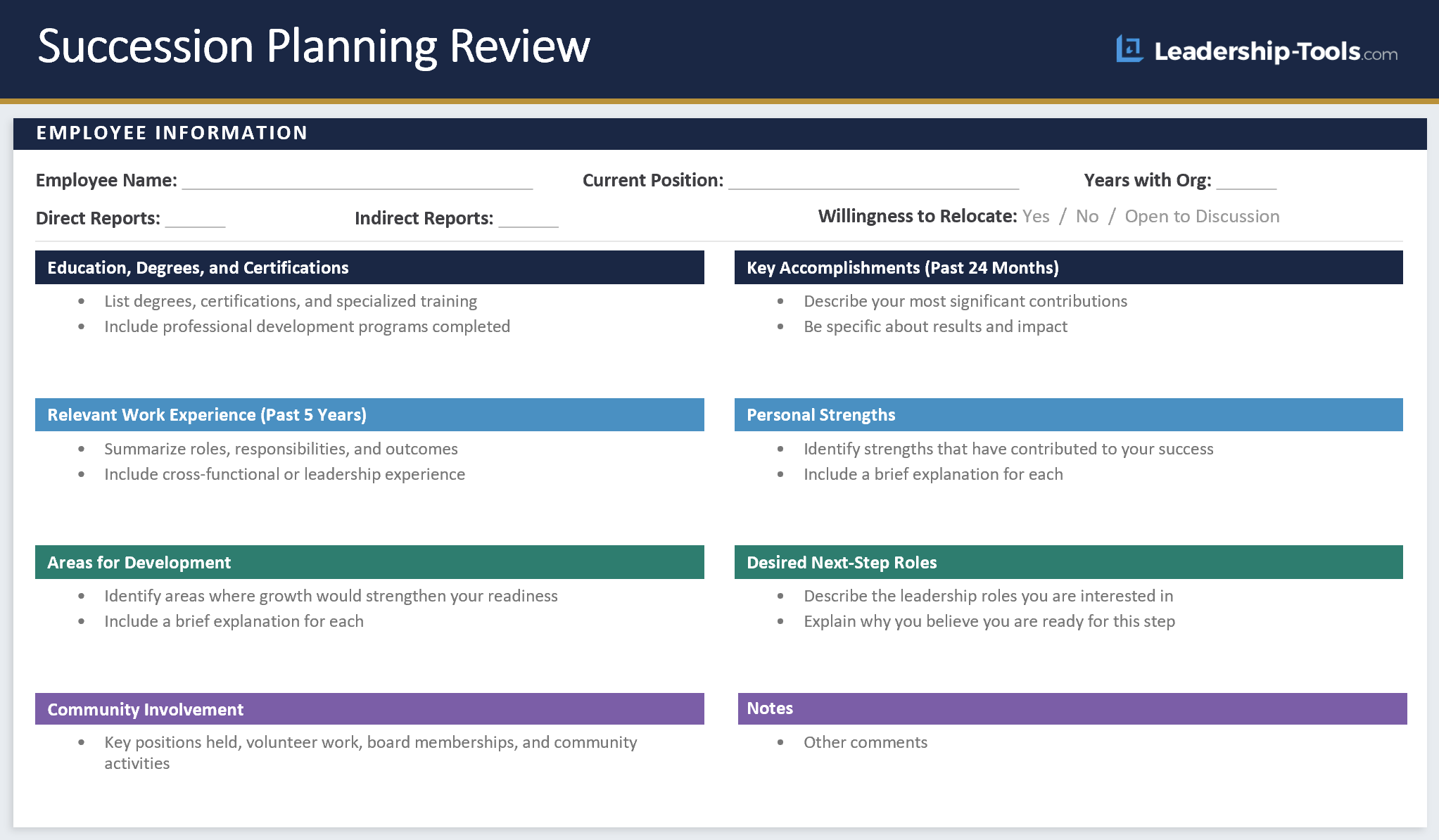
The review captures six substantive areas alongside basic role and background information.
Education, Degrees, and Certifications
A clear picture of the formal credentials and development programs the individual has completed. This gives context for how the person has invested in their own growth and what foundational knowledge they bring to their current role.
Key Accomplishments (Past 24 Months)
Recent, concrete results rather than general reputation. This section grounds the assessment in what the individual has actually delivered and keeps the conversation anchored to evidence-based results rather than personal impression.
Relevant Work Experience (Past 5 Years)
The roles, responsibilities, and outcomes that have shaped the person's current capability, including any cross-functional or leadership experience that may not be visible from their current position alone.
Personal Strengths
What the individual does well and why. This section often surfaces qualities that a leader observing from a distance may not fully see, and it gives the employee a voice in how their strengths are understood and applied.
Areas for Development
An honest, employee-owned picture of where growth would strengthen their readiness. When people identify their own development areas, the conversations that follow tend to be more candid and productive. It is one of the features that makes this succession planning template useful beyond the review session itself.
Desired Next-Step Roles
What the individual actually wants in the future. A succession plan built without knowing where someone wants to go is largely guesswork. This section captures their interest in specific roles and their own assessment of their readiness, which often reveals ambition or hesitation that a leader would not otherwise know about.
Once the review is complete, the leader has a documented, substantive foundation for the 4-Block discussion and assessment that follows.
Succession Planning Review Example
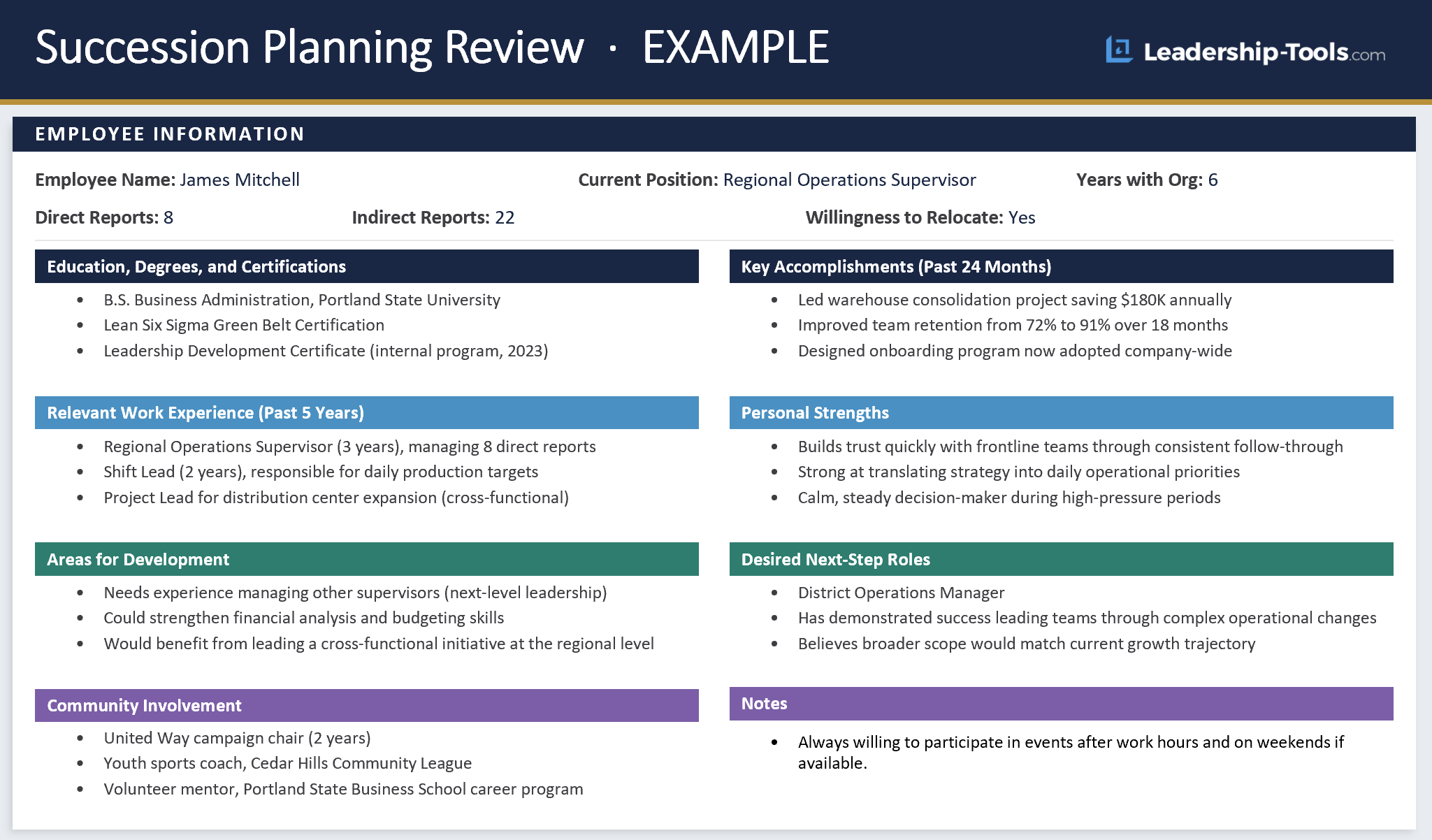
The example below shows what a completed Succession Planning Review looks like when a team member has worked through each section thoughtfully.
It gives you a clear sense of the depth of information the review is designed to capture and how that information sets up a more informed, evidence-based conversation about readiness and development.
"Average people do not want others to go beyond average."
- John Maxwell
Template Two: The 4-Block Performance and Potential Grid
The 4-Block Grid is where the leader takes the information gathered from the individual reviews and applies their own judgment to produce a team-level picture of bench strength. It is not a form to be filled out in isolation. It is the output of a thoughtful assessment process that begins with the Succession Planning Review.
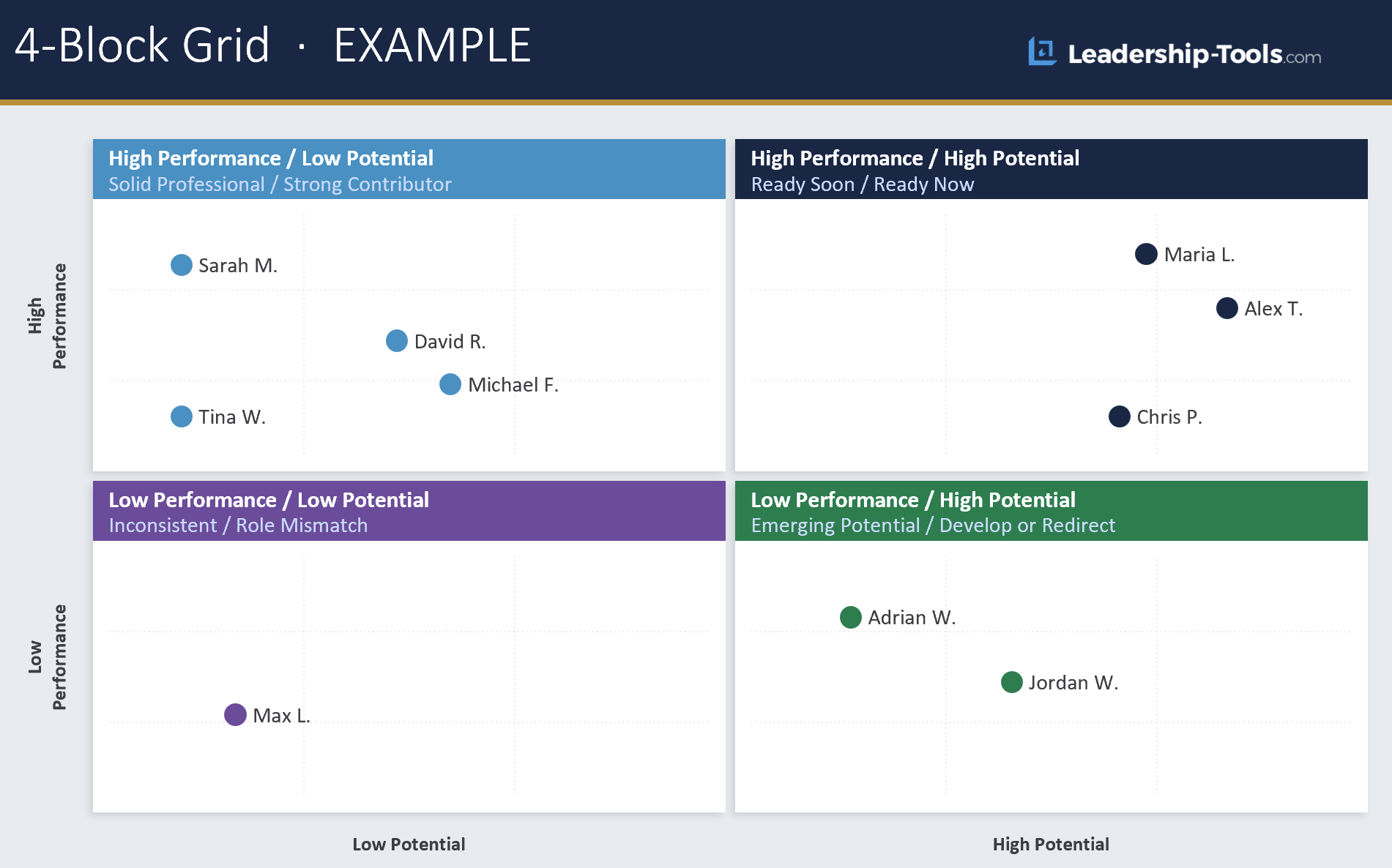
The grid places each team member in one of four quadrants based on two dimensions the leader evaluates: current performance and future potential.
- Performance reflects how well the individual is executing in their current role today.
- Potential reflects the leader's honest assessment of how much further that person can grow, how they handle increasing complexity, and whether they demonstrate the behaviors and judgment that larger responsibility requires.
The four quadrants each carry different implications for how you lead and develop the individuals within them.
High Performance / Lower Potential
Your reliable, deeply skilled contributors who are excellent in their current roles but may not be seeking or suited for significantly expanded leadership responsibility.
The right response here is recognition, retention, and opportunities to deepen expertise and expand influence within their current scope. These individuals may also be exactly where they want to be and don't aspire to move up, which is just fine.
Development focus: Recognition, retention, and opportunities to deepen expertise or expand lateral influence rather than vertical advancement.
High Performance / High Potential
Your strongest succession candidates. These individuals are delivering results today and show clear signs of readiness for greater responsibility.
They deserve stretch assignments, initiative leadership, cross-functional exposure, and direct conversations about their path forward. They are also your most likely retention risk, which makes intentional investment in their development urgent rather than optional.
Development focus: Stretch assignments, leading a project, cross-functional exposure, direct conversations about readiness for the next step.
Lower Performance / Lower Potential
This quadrant calls for the most honesty and care. Some individuals here may be in the wrong role or facing circumstances that a different assignment or clearer direction could address.
Others may require a more direct performance conversation. The response starts with clarity and fairness, not conclusions.
Development focus: Clear expectations, honest conversations, role clarity, and if needed, difficult decisions about fit and accountability.
Lower Performance / High Potential
Individuals who show real leadership capability but are not yet delivering at the level required.
They may be early in their role, working through a specific challenge, or not yet fully supported. With targeted coaching, clear expectations, and consistent feedback, many of these individuals become strong succession candidates over time.
Development focus: Clear expectations, targeted coaching, time-bound development plans, and support that reinforces accountability and growth.
When the full team is mapped, patterns become visible that no list of names can reveal.
Where your bench is strong, where development gaps exist, and where the organization is overly dependent on a small number of individuals all become clear at a glance. That visibility is often what prompts a leader to act. It is one of the most practical benefits a succession planning template delivers.
A word of caution on the grid: Placing people in quadrants is a simplification, and every simplification has limits. Potential is not fixed. It can change significantly as individuals grow, develop, and encounter new opportunities. The grid is a thinking tool, not a verdict. Use it to see patterns and prioritize your attention, not to create permanent labels or replace the deeper thinking that the individual Succession Planning Reviews require.
How to Use Both Tools Together: The Right Sequence
The individual review and the 4-block grid are most powerful when used together, in the right order, as part of a single integrated process.
The recommended sequence has three stages.
1. Complete the Individual Succession Planning Reviews
Work through each team member systematically before any group discussion takes place.
This step ensures that your grid placements are grounded in specific, documented observations rather than general impressions or the most recent interaction. It also gives you the detail you need to have meaningful development conversations with each individual once the process is complete.
2. Build the 4-Block Grid from Discussion and the Completed Reviews
Use the performance and potential assessments from each review to place team members on the grid.
When the reviews are done first, every placement has a rationale behind it. You can defend your thinking, compare individuals consistently, and identify patterns across the team with confidence.
3. Identify Development Priorities and Take Action
Once you have both tools completed, you are in a position to make decisions.
Which individuals are getting a stretch assignment this quarter? Who is ready for a formal development conversation about their next step? Where do you need to have a more honest performance discussion?
The tools create the clarity; the actions create the results.
Both templates work best as living documents rather than static snapshots. Review them once or twice a year on a formal basis, with informal check-ins in between to capture significant changes in performance, potential, or circumstances.
A review cycle that happens reliably, even if it is simple, is far more valuable than an elaborate one that happens occasionally.
Succession Planning Examples: What This Looks Like in Practice
Understanding how to use a succession planning template is more concrete when you can see what the process actually looks like across different team situations. Here are three common scenarios leaders encounter and how the two-tool framework addresses each one.
Example 1: The High-Performer You Can't Afford to Lose
One of the most common succession planning scenarios involves a team member who is doing exceptional work and has been quietly fielding calls from recruiters.

They are your strongest performer and the person most likely to step into a key leadership role when one opens. The risk is that if you are not proactive, their next opportunity will be somewhere else.
The succession review helps you document what you know about this person's potential, identify the specific development investments worth making, and put a name and timeline to the conversations that need to happen. The 4-block grid makes the retention risk visible by showing how your bench strength changes if this individual is removed from the equation.
That visibility is often what prompts a leader to move from intention to action on a development conversation or retention effort they have been postponing.
Example 2: A Critical Role with No Clear Backup
Another common succession planning challenge is the discovery, usually prompted by a near-miss, that a specific role is critically important and no one else in the organization knows enough to cover it if needed.
This concentration of knowledge and capability in a single individual is sometimes called key-person dependency, and it is one of the most common gaps that a structured succession planning process reveals.
When you complete the individual reviews for your full team and then build the grid, this pattern becomes immediately visible. You may find that the individual holding this critical knowledge sits in the high performance, lower potential quadrant. This means they are excellent at what they do but are not a candidate for advancement.
The development response shifts from preparing them for the next level to ensuring that their knowledge is shared, documented, and distributed across at least one other capable team member who could manage continuity if needed.
Example 3: A Team with Thin Bench Strength
Sometimes completing this 4-block succession planning template will reveal that the overall team is performing adequately but has very limited depth in the top-right quadrant.
There may be strong individual contributors, but few who are clearly developing toward greater leadership responsibility. This is a common situation for leaders who have been focused on execution and results and have not yet invested deliberately in building the next tier of leadership.
This scenario calls for a different kind of succession planning response.
Rather than focusing on individual development plans for one or two people, the focus shifts to creating more intentional leadership development opportunities across a broader segment of the team. Project leadership, stretch assignments, and visible projects with meaningful accountability can all serve as development experiences that surface potential that a purely assessment-based review might not yet capture.
Succession Planning Best Practices: What Separates Good Processes From Great Ones
Having a succession planning template is the starting point. Using it in a way that actually develops people and strengthens your organization requires a few additional commitments that are worth naming explicitly.
Be Honest, Not Optimistic
The most common way succession planning fails is through wishful thinking.
A name gets placed in the top-right quadrant because the person is likable or visible or has been with the team a long time, rather than because the evidence supports it. Honest assessment is not about being harsh, it's about being useful.
An inflated assessment helps no one, least of all the individual who is being set up to take on a role they are not truly ready for. Use the individual review section of your succession planning template to better inform your decision-making before you place anyone on the grid.
Separate Potential from Seniority
Leadership succession planning can easily default to tracking seniority rather than potential.
The person who has been in the role longest is not necessarily the person best positioned to step into greater responsibility. Look for evidence of learning agility, leadership behavior beyond formal authority, and the ability to handle increasing complexity.
Those indicators are more predictive of future performance than tenure or title.
Make the Development Plan Specific
A development plan that reads "expand leadership skills" is not a development plan.
A development plan that reads "lead the Q3 training rollout as the initiative owner, with a check-in at weeks four and eight to assess progress and provide coaching" is a development plan.
Specificity is what converts intention into experience, and experience is what actually builds capability.
When you complete the development section of the succession review, ask yourself whether someone reading it six months from now would know exactly what was supposed to happen. If not, make it more concrete.
Review Regularly, Even Briefly
Succession planning done once a year in a single intensive session produces diminishing returns compared to a lighter-weight process that happens consistently.
A brief quarterly check-in, even fifteen minutes reviewing the grid and noting any significant changes in performance, potential, or circumstances will keep the information current and the development conversations alive. It also builds the habit of succession thinking as a natural part of how you lead, rather than as a separate exercise that happens once a year and then gets filed away.
Have the Conversations
The succession planning process creates real value only when leaders actually talk to their people about what they see and what they are investing in.
Most team members are not passive in their own development. When they know a leader has thought carefully about their potential and is taking action to develop them, that awareness changes how engaged and committed they feel.
Have the conversations that the reviews make possible. Share what you see, invite them into their own development, and be honest about both the timeline and what it will take to get there.
Frequently Asked Questions
The questions below address what leaders most commonly ask when they are getting started with succession planning or working through these templates for the first time. If you don't see what you're looking for, feel free to reach out through our contact page.
What is a succession planning template and why do I need one?
A succession planning template is a structured tool for identifying which team members are ready for greater responsibility and what development is needed to get them there. Most leaders understand that people eventually move on, get promoted, or leave unexpectedly. The problem is that by the time a transition feels urgent, it's usually too late to handle it well. A template gives you a consistent process for thinking about readiness before that moment arrives, so when it does, you're making a deliberate decision rather than scrambling to fill a gap.
What is the difference between the Succession Planning Review and the 4-Block Grid?
The Succession Planning Review is completed by the individual. It captures their background, accomplishments, experience, strengths, development areas, and the roles they're interested in pursuing. The 4-Block Grid is completed by the leader. It uses that input, combined with the leader's own observations, to place each team member in one of four quadrants based on current performance and future potential. The two tools serve different purposes and are designed to be used together, with the individual reviews completed first.
Do I need to share the succession planning review with each team member?
Sharing your thinking generally produces better outcomes than keeping it private. When a leader takes the time to discuss what they see in terms of someone's performance, potential, and development needs, those conversations tend to strengthen engagement and clarify what it will take to move forward. The review is designed to support those conversations, not replace them. Being direct with someone about where you see them today and what you believe they're capable of is one of the more valuable things a leader can do.
How is leadership succession planning different from standard succession planning?
Standard succession planning typically focuses on who could fill a specific role if it became vacant. Leadership succession planning takes a broader view. It focuses on identifying individuals with leadership potential at multiple levels, actively developing them over time, and building an overall pipeline of capable people who can step up as the organization grows and changes. It's less about replacing individuals and more about building the kind of depth that makes a team resilient over time.
How often should I update the succession planning templates?
A formal review once or twice a year is the right cadence for most teams, with a lighter check-in each quarter to capture any significant changes in performance, potential, or circumstances. What matters more than the frequency is whether the development actions that come out of the review are actually happening. An annual review that produces no real change in how people are being developed isn't succession planning. It's documentation.
What do I do with team members in the lower performance, lower potential quadrant?
This is the quadrant that calls for the most honesty. Some individuals here may be in the wrong role, facing personal challenges, or simply unclear on what's expected of them. Others may not be the right long-term fit for the team. The right response starts with clarity: clear expectations, direct feedback, and a genuine effort to understand what's driving the situation before drawing any conclusions. If performance doesn't improve after a real effort to support it, more difficult conversations about fit and accountability become necessary. Avoiding that reality doesn't serve the individual or the team.
Can I use these templates for a small team or a small business?
Yes. Succession planning is just as important for small teams and small businesses as it is for large organizations. In some ways it's more important, because the impact of losing a key person is proportionally larger when the team is small. These templates are designed to be practical at any scale. If you're a small business owner with a leadership team of four or five people, the tools work for you. Adjust the scope to fit your context, but don't let team size be the reason to avoid thinking ahead.
These templates are free?
Yes. Both the Succession Planning Review and the 4-Block Performance and Potential Grid are available at no cost in PDF, PowerPoint, Google Slides, Word, and Excel formats. No sign-up is required to download either one.
Download Succession Planning Tools

To download all our free tools, simply subscribe to our free newsletter. You will immediately receive a password that grants access to our entire leadership tools library.
Your privacy is important to us. We never share or sell email addresses.
More Leadership Tools for Managing Your Team







Contact Information:
phone
(503) 970-9777
Email Customer Service
helpsupport@leadership-tools.com
Email Richard
richard@leadership-tools.com

By Richard Gorham
Leadership-Tools.com
2879 Riverwalk Loop, Eugene, Oregon, 97401
Copyright (c) 2003 - 2026 All Rights Reserved