- Home
- Leading Self
- Leadership Quiz: 10 Key Questions
Leadership Quiz: Are You Meeting Your Team’s Needs?
This leadership quiz takes about 5 minutes. You'll answer 10 questions about your team's experience, not your own performance. The goal here is to provide a clear read on whether your team's basic needs are being met, and to identify one focused conversation worth having this week.
Leaders don't fail because they lack good intentions. They fall short when they don't clearly understand what their people actually need from them day to day.
Answer these 10 questions honestly. There are no right or wrong answers, just a clear starting point. The questions are about your team's experience, not your performance review.
Managers who can answer Yes to most of these questions tend to experience a more engaged team, fewer surprises, and better retention. The ones they can't answer Yes to are exactly the conversations worth having next.
This leadership quiz is part of the Self-Leadership tools at Leadership-Tools.com, designed to help you lead with clarity, confidence, and consistency.
Jump to: The 10 Key Leadership Questions |How to Take the Quiz | How the Quiz Works |What Your Answers Tell You |Common Answer Patterns | Action Plan: Improve Your Leadership | FAQ |Download the Quiz
Leaders need to understand that without first meeting an employee's basic needs at work, you can't expect a team to produce at its best.
A thoughtful leader makes time for an honest self-check, and ensures the needs of the team are being met. Not to win a popularity contest, but because it's the right thing to do for the employee, the organization, and the people the organization serves.
"Most people don't quit companies. They quit their manager. Most departures could be avoided if the leader had asked a few key questions earlier."
A team member's basic needs at work are simple. They need to know what's expected of them. They need the tools, training, and support to do their job well. And they need to feel they matter, both to their leader and to the organization. As the leader, you have the most direct influence on whether those needs are met.
The 10 Key Questions leadership quiz helps you identify the specific areas where your team may need more from you. If you can answer Yes to most questions, you're on solid ground. The few you can't answer Yes to are the most useful information this quiz gives you.
A No tells you something specific is missing. A Not Sure tells you something more uncomfortable: that you genuinely don't know whether your team is getting what they need in that area. Both answers are useful. Both point to a conversation worth having.
The 10 Key Leadership Questions
The 10 Key Questions leadership quiz takes the lens of your team. Each question asks what they experience day to day, not what you intend. The gap between the two is where most leadership growth actually happens.
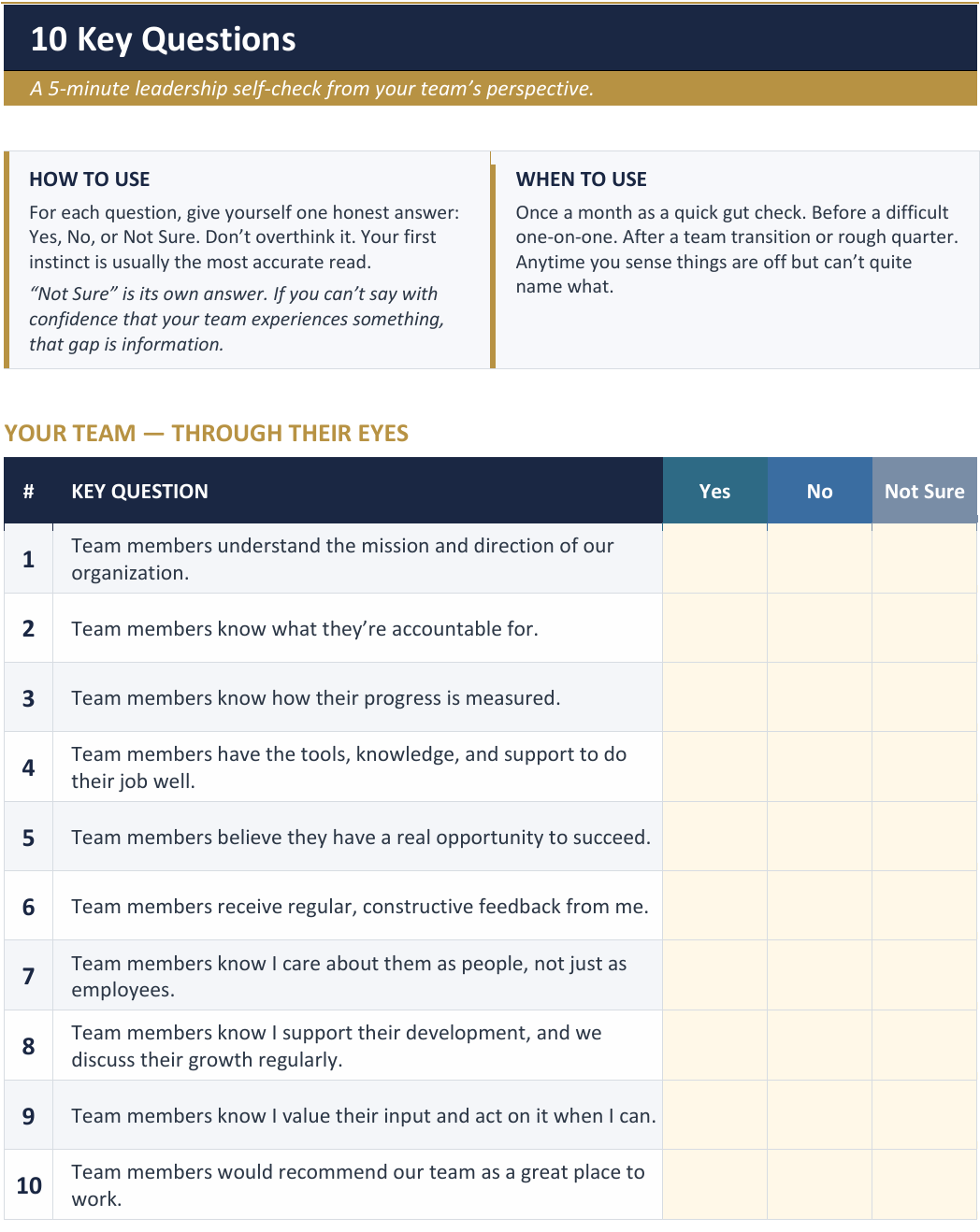
- Team members understand the mission and direction of our organization.
- Team members know what they're accountable for.
- Team members know how their progress is measured.
- Team members have the tools, knowledge, and support to do their job well.
- Team members believe they have a real opportunity to succeed.
- Team members receive regular, constructive feedback from me.
- Team members know I care about them as people, not just as employees.
- Team members know I support their development, and we discuss their growth regularly.
- Team members know I value their input and act on it when I can.
- Team members would recommend our team as a great place to work.
Answer Yes, No, or Not Sure for each question. When you're done, look at every answer that isn't a confident Yes. The first one that surprised you is usually where to start.
How to Take the Leadership Quiz
Set aside 5 quiet minutes. This leadership quiz works best when you answer honestly, based on how you've actually been leading over the past 60–90 days, not how you'd like to be leading.
1. Answer Yes, No, or Not Sure for Each Question
Three honest options. No sliding scale, no need for scoring or calculating results.
- Yes: I'm confident this is true for my team right now.
- No: This isn't where it needs to be.
- Not Sure: I genuinely don't know. Worth asking.
"Not Sure" is its own answer. If you can't say with confidence that your team experiences something, that gap is information.
2. Be Specific When Considering the Answer
Picture real people and recent situations rather than answering in general. For example, let's address a few of the key questions that are included in this exercise:
Question #1: Team members understand the mission and direction of our organization.
Depending on the size of your organization, you may or may not have a formal mission or vision statement. Either way, this question is about whether your team can articulate what we're here to do and where we're headed in their own words. Not whether they can recite a poster.
If your team would struggle to answer that, building a team mission statement together is a powerful exercise. We've provided mission statement tools and mission statement examples to help.
Question #6: Team members receive regular, constructive feedback from me.
Feedback doesn't have to be formal to be effective. Some of the best feedback happens in 30-second moments. For example, a quick "here's what I noticed" after a meeting, a specific thank-you for a behavior worth repeating, or an honest "this isn't working, here's what I'd change."
The leaders who answer Yes to this question consistently are the ones who treat feedback as a daily habit, not a quarterly event.
A tool that can help with this is our My Favorite Things tool.
Question #8: Team members know I support their development, and we discuss their growth regularly.
Regular one-on-one conversations are the single most reliable way to make this question a confident Yes. Schedule them weekly or monthly depending on team size. You can always cancel a meeting if it isn't needed. If you don't have it scheduled, the chance of it happening drops to nearly zero.
Not sure what to discuss? Walk through a few of these 10 questions together. Ask each person directly: where do you feel supported, and where could you use more from me?
You can also use our Performance Appraisal tool to guide a deeper conversation, or our Succession Planning tool for team members aspiring to grow into bigger roles.
3. Read Your Pattern, Not Your Score
There's no number to add up. Look at your full set of answers and notice the pattern. Where did you confidently mark Yes? Where did the No or Not Sure answers cluster? The next section walks you through what your pattern likely tells you.
Tip: Print these 10 questions and use them as a discussion guide with your team or a mentor. Honest feedback from someone who works with you daily is one of the most useful inputs to your leadership growth.
"Ask questions. Growth is fueled by desire and being actively engaged. Imagine yourself learning throughout your life at the rate of an infant."
- Bruce Mau
How This Leadership Quiz Works
This leadership quiz isn't about labeling you a "good" or "bad" leader.
It focuses on one practical idea: effective leaders consistently meet the basic needs of their team. When those needs are met, performance improves, trust grows, and people stay. When they're ignored, frustration builds, no matter how talented the leader is.
The 10 questions explore how well your team experiences:
- Clear expectations and direction
- The tools, training, and support to do their job
- Regular, useful feedback
- Recognition, development, and being valued as people
Notice the framing. These questions aren't about what you intend to do as a leader. They're about what your team actually experiences day to day. The gap between intention and experience is where the most useful leadership growth happens.
Use this leadership quiz as:
- A 5-minute monthly self-check
- A pre-1:1 prep tool when something feels off
- A discussion guide with a peer, mentor, or coach
- A reset after a difficult quarter or team transition
What Your Answers Tell You
The point of this leadership quiz isn't a number. It's a clear read on where your team's needs are being met, and where they aren't.
Use the prompts below to turn your answers into something useful.
Step 1: Look at the Pattern, Not the Count
Before you focus on individual questions, scan your answers as a whole. A page full of confident Yes answers tells one story. A handful of No or Not Sure answers tells another. A single No surrounded by confident Yes answers tells a third. The pattern matters more than the count.
Step 2: Notice Where Not Sure Showed Up
Not Sure is the most useful answer this quiz gives you. It points to questions where you don't have visibility into your team's experience. That's not a failure. It's a signal that a conversation is overdue.
Pick the Not Sure answer that surprised you most. That's the one to act on.
Step 3: Pick One Focus Area
Don't try to address every No or Not Sure at once. Pick the one question where a change in your behavior, or one honest conversation with your team, would matter most this week.
Then commit to working on it consistently for the next 30 days.
Common Patterns People See
This isn't a personality test. There are no fixed result categories you'll be sorted into. That said, certain answer patterns show up often enough to be worth naming. Read these as observations, not labels. If one sounds like you, it points to where the most useful work lives.
Mostly Yes, but slow to acknowledge people
Yes answers across expectations, accountability, tools, and feedback. No or Not Sure on questions about recognition, development, or valuing input (questions 7, 8, 9, 10).
This is common for leaders who are technically strong, get results, and rarely let performance issues linger. The team gets clarity and direction, but feels under-recognized. The work that lifts this pattern is small and consistent: specific recognition, regular development conversations, and acting visibly on team input.
Mostly Yes, with Not Sures clustered around development
Confident Yes on the structural questions. Not Sure on questions about whether team members feel supported in their growth or believe they have a real opportunity to succeed (questions 5, 8).
This pattern usually means development conversations aren't happening on a regular cadence. The fix isn't a formal program. It's a recurring one-on-one rhythm with one consistent question: *what's one skill you want to be stronger at six months from now, and how can I support that?*
A No or Not Sure on mission and direction
Yes on most operational questions, but a stumble on question 1: whether team members understand the mission and direction of the organization.
This shows up most often in teams that have grown quickly, gone through a strategy shift, or had a leadership change. The team is busy executing, but no one has paused to re-articulate where the work is heading. Worth a 30-minute team conversation, not a memo.
A scattered pattern of Not Sures
Not Sure answers spread across multiple categories with no obvious cluster.
This usually means visibility is the issue. You're not sure how your team experiences these things because you haven't recently asked them directly. The fix is the simplest one on this page: ask. Pick three of the Not Sure questions, walk through them with your team in your next one-on-ones, and listen to what comes back.
Action Plan: One Conversation Worth Having
Use your answers to surface one focus area, have one conversation about it, and commit to one specific behavior. That's the whole loop.
Step 1: Pick One
Look at your No and Not Sure answers. Choose the one question where a change in your behavior would matter most to your team right now. Resist the urge to pick three.
Examples to make this concrete:
- "Team members receive regular, constructive feedback from me." If this is a No or Not Sure, the focus is feedback frequency.
- "Team members know I support their development, and we discuss their growth regularly." If this is a No or Not Sure, the focus is development conversations.
Step 2: Have One Conversation
Talk with the people on your team who would actually know whether this question is a Yes for them. Not a survey. A real conversation. Listen more than you defend. Ask what would have to change for that question to become a confident Yes from their perspective.
Their answers will probably surprise you. That's the point.
Step 3: Commit to One Specific Behavior
Not a goal. A behavior. Something concrete and small enough that you'll actually do it, even on a busy week.
Examples:
- Feedback: "Within 48 hours of any major task or project, I will give each person at least one specific piece of feedback."
- Recognition: "Every Friday, I will send three specific thank-you messages to team members highlighting what they did and why it mattered."
- Development: "In every monthly one-on-one, I will ask: what's one skill you want to be stronger at six months from now, and how can I support that?"
Step 4: Review After 30 Days
At the end of 30 days, ask yourself three questions: Did I follow through on my behavior consistently? What changed in how my team responded? Could I now answer Yes to that quiz question with confidence?
If yes, pick the next question on your list and repeat. If no, look at why. The behavior may have been too big, or the question may need a different conversation behind it.
Step 5: Retake the Quiz Quarterly
The most useful way to use this leadership quiz isn't once. It's quarterly, alongside your team's natural rhythm. The questions are simple, but the answers shift over time as your team changes, your responsibilities grow, and your habits evolve.
Take the leadership quiz. Pick one focus area. Have one conversation about it. Commit to one behavior. That's how this becomes more than another self-evaluation.
This leadership quiz is one tool in the Self-Leadership section at Leadership-Tools.com. For a deeper look at your own leadership behaviors, pair it with the Leadership Assessment. For a 30-day plan to act on what you find, pair it with the Master Action Plan.
Frequently Asked Questions
Is this leadership quiz really free?
Yes. The PDF, Word, and Google Docs versions are all free to download with no sign-up required. If you want access to our full leadership tools library, a free newsletter signup gets you a password.
How long does the leadership quiz take?
About 5 minutes. The quiz is 10 questions with three honest options each (Yes, No, Not Sure). The scoring is intentionally simple. There's no math, no scale, no result tier. The point is the pattern your answers reveal, not a number.
What kind of leader does this quiz help me understand?
It helps you understand what kind of leader your team actually experiences day to day. Most leadership quizzes focus on your style or personality. This one focuses on whether your team's basic needs are being met. The gap between your intentions and your team's experience is where most leadership growth happens.
Is this the same as a leadership style quiz?
No, and that's intentional. Leadership style quizzes sort you into a personality category like Coach, Visionary, or Driver. This quiz takes a different angle: it asks 10 specific questions about your team's experience and helps you identify the one or two areas worth addressing next. If you want a deeper look at your own leadership behaviors and skill categories, our Leadership Assessment covers that ground in 25 questions across 8 skill areas.
What does "Not Sure" mean as an answer?
Not Sure is its own answer, and often the most useful one. It means you genuinely don't know whether your team experiences something, which is information. If you can't say with confidence that your team feels supported in their development, that gap is worth a conversation, not a guess.
How often should I take the leadership quiz?
Once a quarter is the most useful cadence. The questions are simple, but the answers shift over time as your team changes, your responsibilities grow, and your habits evolve. A quarterly retake lets you compare patterns and see which behaviors are sticking.
Can I use this leadership quiz with my team?
Yes, and many leaders find that's where the real value lives. Print the 10 questions and walk through them in a one-on-one or team meeting. Ask each person how they would answer the questions about their own experience, then compare to your own self-assessment. The places where your answers and theirs differ are the most valuable conversations on this page.
What should I do after I take the quiz?
Pick the one question where a No or Not Sure answer surprised you most. Have an honest conversation with the people on your team who would actually know whether the answer should be Yes. Then commit to one specific behavior for the next 30 days. The "Action Plan: One Conversation Worth Having" section above walks you through this in detail.
How is this different from your Leadership Assessment?
The Leadership Assessment is a deeper look at your own leadership behaviors. 25 statements, 8 skill categories, scoring tiers, and a 30-day development plan. This 10 Key Questions quiz is a faster, lighter tool that takes a different lens: your team's experience, not your own performance. Many leaders use both. The assessment for quarterly self-development, the quiz for monthly check-ins or before a difficult conversation.
Where can I get the printable version?
Three formats are available right above this section: PDF, Word (.docx), and Google Docs. All free. The Word and PDF versions include a brief How to Use / When to Use guide and a one-page action panel for the conversation step.
Download 10 Key Questions Tool
To access all of our tools simply subscribe to our free newsletter. You will immediately receive a password that grants access to our entire leadership tools library.
Your privacy is important to us. We never share or sell email addresses.
More Self-Leadership Tools





Contact Information:
phone
(503) 970-9777
Email Customer Service
helpsupport@leadership-tools.com
Email Richard
richard@leadership-tools.com

By Richard Gorham
Leadership-Tools.com
2879 Riverwalk Loop, Eugene, Oregon, 97401
Copyright (c) 2003 - 2026 All Rights Reserved