A mission statement is one or two sentences saying what your business does, who it does it for, and what those customers get from you that they couldn't get from a competitor. Most good ones run 25 words or fewer.
- Home
- Leading Teams
- Business Plan Template
- Mission Statement Template
Mission Statement Template: Free Worksheet with Examples (Word, PDF, Google Docs)
Our mission statement template walks you through four steps to write one or two sentences that tell your employees, your customers and a prospective lender what your business does, who it's for, and why they'd pick you over any competitor.
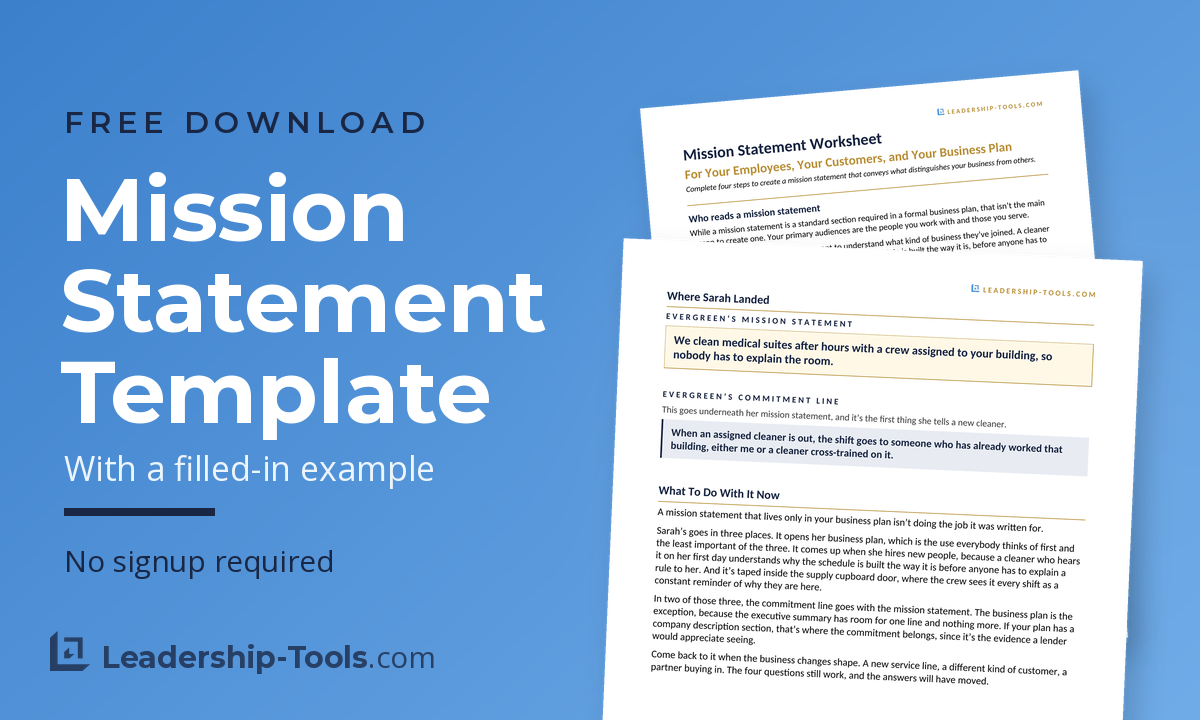
Download Free Mission Statement Template
The worksheet comes with a fully worked example, so you can see how a real owner has completed each section before you begin working through the exercise.
Free, with no signup and no password required. The Word and Google Docs versions let you type your answers straight into the document, and the PDF prints cleanly for a quick copy to review.
Jump To: What's Included | What Is a Mission Statement | Filled-In Example | The Four Steps | The Commitment Line | Sharpen It | Three Checks | Test It with AI | Mission Statement Examples | Mission vs. Vision | Where It Goes | Common Mistakes | The Full Toolkit | FAQ | Download Template
What's Included in This Mission Statement Template
The worksheet runs 21 pages, with space provided for your notes. Inside you'll find:
- Four steps, four questions each: the work you do, the customers you serve, the difference you make, and the commitment behind it. Each step opens with an example of the types of answers most new owners give and compares that to what a better answer looks like, and an explanation for why the answer is better.
- A fill-in-the-blank pattern that turns your answers into two clear sentences.
- A strike list of 18 over-used words that show up on too many corporate about us pages.
- Three checks that your draft has to pass before you call your mission statement done.
- A copy-and-paste prompt for any AI assistant, if you want a second opinion on your wording. (Recommended)
- The whole worksheet filled in by Sarah, the owner of Evergreen Office & Medical Cleaning, from her first rough answers to her finished mission statement.
There is a clear pattern for any good mission statement. The pattern is provided below. By filling in the blue fields with your own answers, you'll have a rough first draft in a few minutes. Our mission statement template, which has step by step instructions, is what turns that rough draft into something that will differentiate your business from your competitors.
What Is a Mission Statement?
A mission statement is one or two sentences saying what your business does, who it does it for, and what those customers get from you that they couldn't get from a competitor. Most good business mission statements run 25 words or fewer.
"Great businesses are created by effective leaders who articulate a clearly stated mission."
The mission statement is a standard section in a formal business plan, but a lender is not the most important person who'll read it. Your people read it to understand what kind of business they've joined. For Evergreen, a new cleaner who hears it on her first day understands why the schedule is built the way it is because the mission is based on it. Your customers read your mission statement and will judge whether you're living up to what you've promised.
That's why the mission statement template forces you to clarity that promise. Anyone can write "We provide quality cleaning services." It's true, and it can be said by every cleaning company in town, so it tells people nothing about why they should choose your business.
A Filled-In Mission Statement Example: Evergreen Office & Medical Cleaning
Sarah owns Evergreen Office & Medical Cleaning. She cleans offices and medical suites in the evenings with two part-time cleaners, and it's the same business example you'll find in the Business Plan Financials Workbook, so her numbers and her mission statement tell one story.
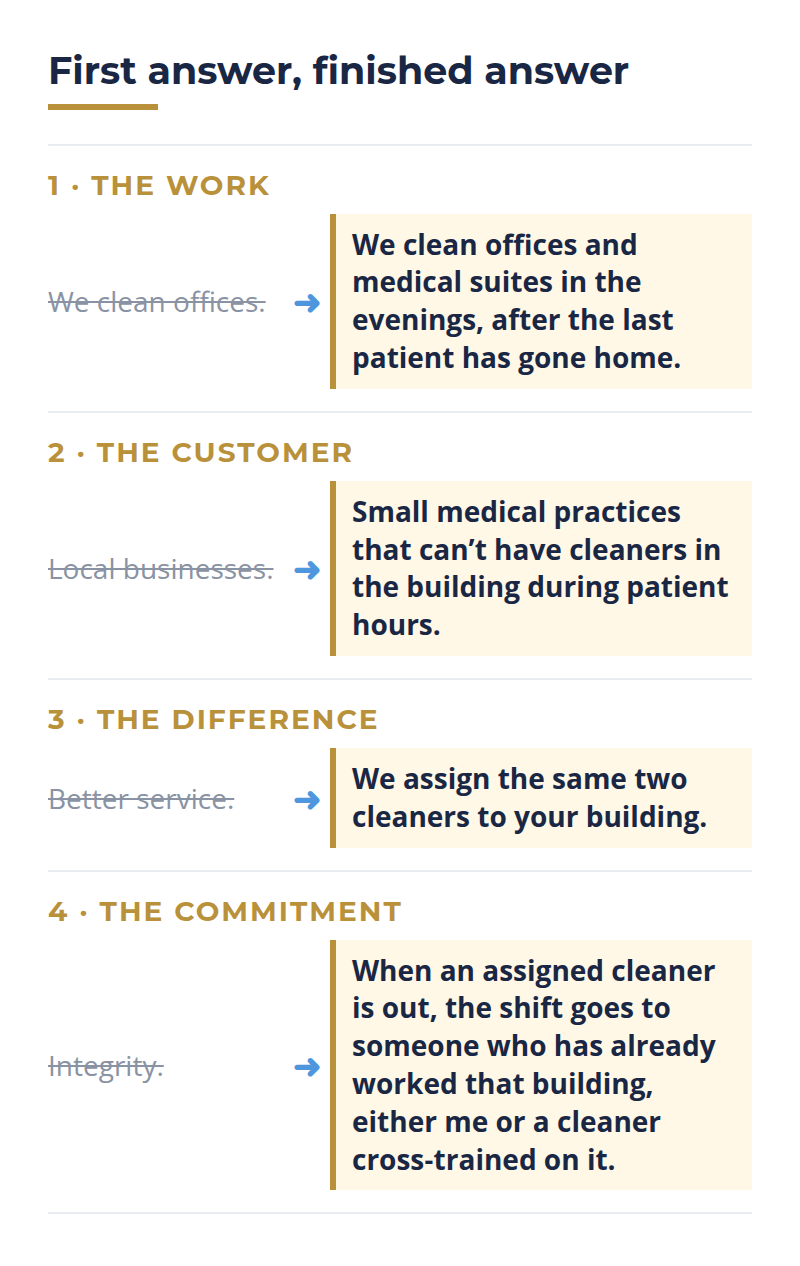
Her first answers were no better than anybody else's. Her commitment, at first, was one word: "Integrity." The image here shows where each of her four answers started and where it ended up.
The four questions under each step are what made the difference. One of them, "What do people assume you do that you don't?", turned up the fact that people hear "cleaning" and picture housekeeping. Another sent her to the phone, where her longest customer said: "I don't have to explain the room to anybody. It's the same two women every week and they know where everything goes."
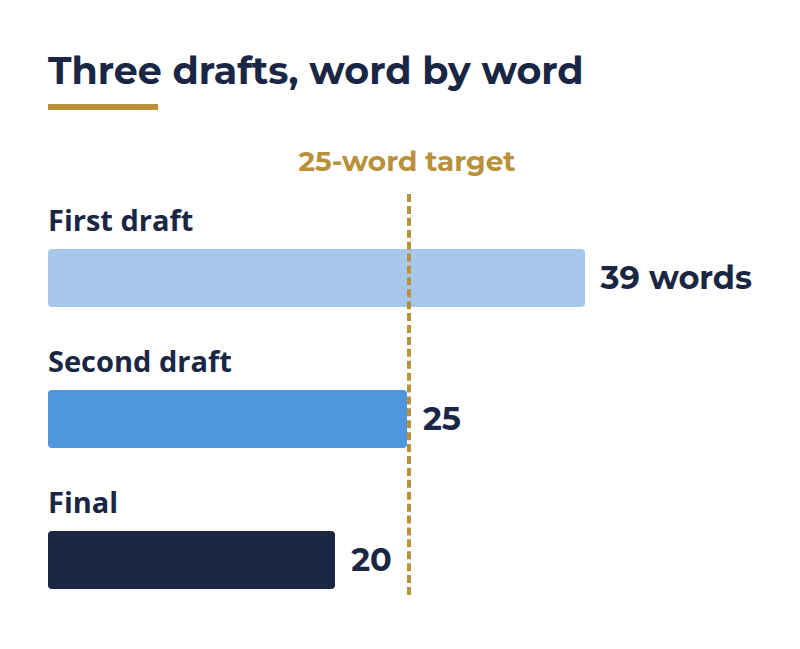
Her finished lines went into the pattern next. The work and the customer became the first sentence, and the difference became the second: "We clean offices and medical suites in the evenings for small medical practices that can't have cleaners in the building during patient hours. We assign the same two cleaners to your building, so nobody has to explain the room." That's 39 words. It's long, but it already says something no other cleaning company in her town was saying.
She made two changes to fine-tune her sentences. She cut "after the last patient has gone home," because her customer line already tells the reader the work happens once patients have left. And she added seven words to the end of the second sentence, which you'll see in her finished statement below.
She also had to choose between two unique differences that she had identified. The unannounced monthly inspection was every bit as real as the assigned crew, and one customer had named it as the reason they stayed. Sarah went with the crew because it's what her customers mention most often. The inspection didn't go to waste. It's the kind of detail that belongs on her about page and in what she tells a new cleaner on day one.
From there, Sarah reviewed her mission statement for over-used rules (see strike list below) and made sure a competitor couldn't make the exact same claims, which took her draft to 20 words. Then, she wrote her commitment line underneath it.
EVERGREEN'S MISSION STATEMENT
We clean medical suites after hours with a crew assigned to your building, so nobody has to explain the room.
EVERGREEN'S COMMITMENT LINE
When an assigned cleaner is out, the shift goes to someone who has already worked that building, either me or a cleaner cross-trained on it.
Twenty words in the statement. The commitment line goes underneath it, and it's the first thing Sarah tells a new cleaner.
Look at what the last seven words are doing. "So nobody has to explain the room" is her customer's phrase, almost word for word. The reason somebody should pick you is often in something a customer already said, in better words than you'd have chosen.
How to Write a Mission Statement in Four Steps
Set aside about an hour to complete this exercise. Understand you may also need to make one or two short phone calls to get some outside perspective from either an existing or prospective client, or other trusted source.
Each step in the mission statement template has four questions, and short phrases are fine for answering each question. You'll finish each step with one line, and three of those four lines will eventually become your mission statement.
Step 1: The Work You Do
Name what the business does plainly enough that somebody outside your trade can picture it. A customer who can't tell what you're offering within a few words stops reading and quickly moves on to the next service provider.
"We provide quality cleaning services" fails this test, since it fits every cleaning company in the industry. "We clean medical suites and offices in the evenings, after the last patient has gone home" passes the test. It names the work, says when it happens, and a reader who has never set foot in the building can see what it is that you offer.
Start rough when writing your answers, the point is to get those first thoughts on paper. Then add when the work happens and what kind of space or work it involves.
Don't worry about being unique yet. Your competitors could describe their work the same way, and that's fine at this point.
Step 2: The Customers You Serve
A statement that tries to include everybody ends up describing nobody. Naming your customer does two jobs. The right people read it and know you are seeking a relationship with them, and the wrong ones move on, saving everyone from wasting time.
"Local businesses" could describe the customers of any company in town. Sarah landed on "Small medical practices that can't have cleaners in the building during patient hours." That line leaves somebody out, and that's what passes the test. If you can't think of a business you'd turn away, the answer is still too broad.
The quickest route to dial in your focus is to look at your two best customers, or target customers, and write down what they have in common: their size, their industry, the situation they were in when they found you. Then name who you've turned down or wished you could.
Step 3: The Difference You Make
This is the step most new owners get wrong, and it's why so many mission statements fall flat. Anyone can say what they do and who they serve. The question your prospective customer is weighing is why they should pick you over the place that charges less.
"Better service," "We care about our customers" and "Quality work at a fair price" all cost nothing to say, so every competitor says them. A difference worth writing down costs you something. Sarah assigns the same two cleaners to each building, which means she gives up the scheduling flexibility of sending whoever is free that night. A competitor who won't give that up can't honestly make the same claim.
Don't guess at your difference. Ask. The thing you do differently may be something you just assume everybody does. Sarah ran Evergreen for a year before a customer told her the unannounced monthly inspections were the reason they'd stayed with her company; she thought that was just how you make sure the job gets done right.
If you already have customers, call the two or three who've been with you longest and ask two questions: what made you pick us in the first place, and what would you miss if we closed tomorrow? Write down their specific words, not your summary of them. The second question gets the better answer, because people forget why they chose a provider three years ago, but they always know what they'd miss if you were no longer able to serve them.
If you haven't opened your business yet, ask people who buy the service from somebody else what they wish they were getting. The gap in their answer is your opening to fill that need.
Promise What You Control
"The same two cleaners every week" sounds better than what Sarah wrote, but the first time somebody quits or calls in sick it becomes a lie. She can't guarantee who turns up. She can guarantee who she assigns and how they're trained. Write the policy you control rather than the result you hope for, because the policy survives and unexpected event, such as someone calling in sick at the last minute.
Step 4: The Commitment Behind It
Step three says what the customer can expect. Step four says what you do to keep that promise on a day when it would be easier not to.
"Integrity," "We never cut corners" and "Our customers come first" all fail here, because nobody can act on them. A cleaner reading "integrity" still has no idea what to do when her partner calls in sick at 5:30. Sarah's rule tells her: "When an assigned cleaner is out, the shift goes to someone who has already worked that building, either me or a cleaner cross-trained on it." That rule costs Sarah something. She cross-trains her staff so a qualified backup is always ready, and in February she covered two routes herself for a week while one of her cleaners had the flu.
This step also tests step three. Every question asks you to name something you've already done, like a job you turned down or a rule your people follow when you aren't available. Sarah passed on a four-office contract worth $2,600 a month because the client wanted daytime cleaning. If you come up empty on all four questions, your difference is a claim you haven't backed up yet, and you want to know that before you build a sentence around it.
The Commitment Line: What Goes Underneath
The mission statement template leaves you with two pieces, and they do different jobs.
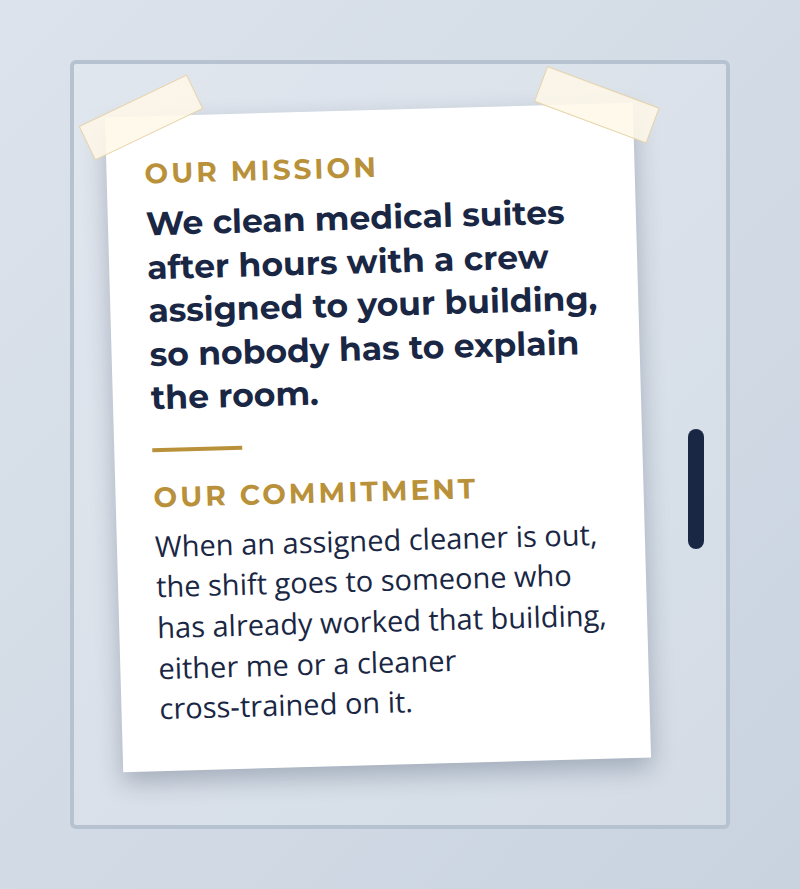
The mission statement makes the claim. The commitment line is the rule that keeps it true, and it goes underneath the statement rather than inside it.
Your people lean on the commitment line most. A cleaner standing in a dark office at nine at night, deciding whether the job is finished, needs a rule she can follow. Customers read it as well, and it's the part that shows you mean what you say.
Keeping the two apart also keeps your statement short. Sarah's commitment line is 25 words on its own. Folded into the mission statement, it would have pushed her past 40 words and buried the difference her customers care about.
A good commitment line passes one test: could the newest person on your crew act on it tonight without calling you first? "We value reliability" leaves the new recruit guessing. "When an assigned cleaner is out, the shift goes to someone who has already worked that building, either me or a cleaner cross-trained on it." tells her what happens and who makes the call. Write your commitment as something you do or refuse to do, and name the situation it covers, the same way step four of the worksheet asks you to.
Sharpen It: Strike the Over-Used Words
It's easy to use words that are common, and frankly over-used. Some of these words are used so often they 've become cliche'. Plus, you're aiming for 25 words or fewer so this review should help to get you there. Two passes are usually sufficient.
Pass one is mechanical. Cross out every one of these words and phrases you find in your draft. All 18 turn up on Fortune 500 about pages, and not one of them tells a reader what the company sells.
world-class · best-in-class · cutting-edge · industry-leading · innovative · solutions · synergy · leverage · empower · passionate · committed to excellence · exceed expectations · customer-centric · value-added · quality service · integrity · strive · dedicated to
The second pass takes more thought. Read your draft as though your closest competitor had written it and put their name at the top. Any phrase that would still be true for them comes out because that means it's not specific to your business.
Your customer often drops out in the second pass, and that's what you want. Sarah's finished statement never says "small medical practices," because "medical suites" already tells a reader who she works for.
Put Sarah's last two drafts side by side and you can see where the words went. Her second draft read: "We clean medical suites after hours for practices that can't have cleaners in during patient hours, with the same two cleaners assigned to your building." That's 25 words. Her final version dropped the clause about patient hours, since "after hours" already says it, and swapped "the same two cleaners" for "a crew assigned to your building."
The swap matters as much as the cut. You're getting very specific.
A crew assignment is a policy Sarah controls, which is the point of the Promise What You Control box back in step three, and it freed up room for her customer's seven words.
When you're cutting your own draft, cut the filler before you touch the difference. Words like "that," "very," "in order to" and "we strive to" can almost always go. The words that differentiate your business need to stay. If you're at 28 words and the only way to reach 25 is to lose the part that sets you apart, keep the 28. A short statement that sounds like every competitor's has still missed the point, so make sure you don't cut so much that you lose what makes you different.
Three Checks Before You Call It Done
All three checks have to pass. They're in the worksheet with space to write, and they're simple enough to complete in a short period of time.
First, does the opposite of your sentence sound like a real business? Write your sentence down, then write the opposite underneath it. Ask whether any real company would put that opposite on its own website.
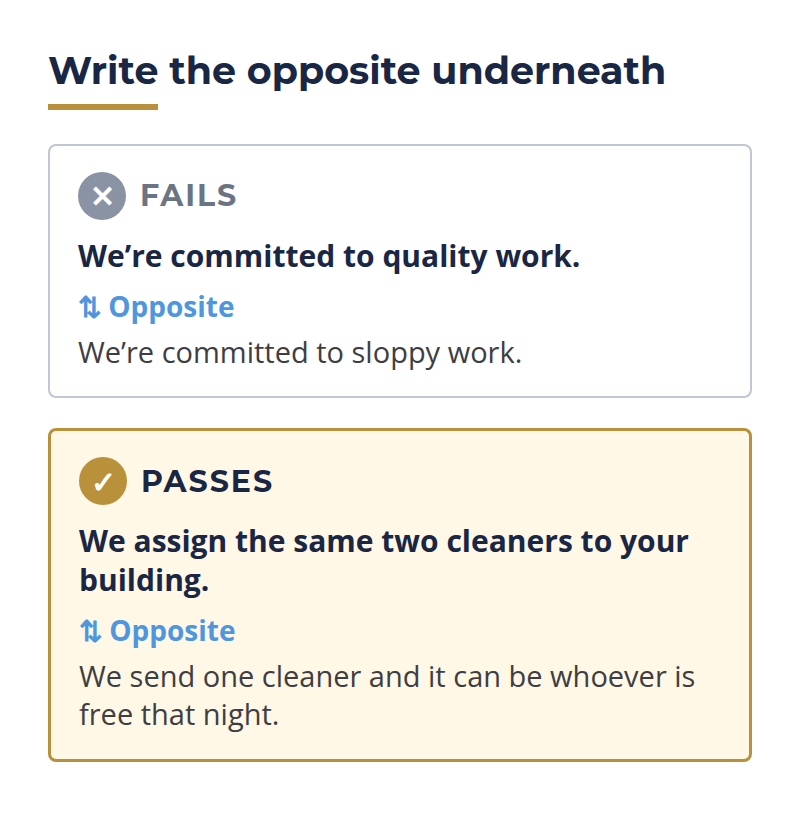
The first sentence fails because no company would ever promise sloppy work, so promising quality tells a customer nothing. Sarah's passes because its opposite describes how most of her competitors work, and they'd defend it: one floating cleaner costs less to schedule than a two-person crew.
Second, could a new hire tell it's your company and no other? You can't check this one on your own without some level of bias, so don't. Hand your draft to whoever you hired most recently and ask: does this describe us, or could any company in our line of work say the same thing? Your newest people are the right ones to ask, because a lot of them worked for a competitor a month ago.
Third, can you say it out loud without looking? Close the document and say it. If you stumble, count the words. Sarah's runs 20. The longer it is, the more difficult it will be to remember. If it's past 30 words, you'll trip on it every time.
When a check fails, the sentence nearly always describes the work and stops there. "We clean medical offices in the evenings" is work only. "We clean medical offices in the evenings with the same two cleaners assigned every visit" is work plus a unique selling point. Go back to what you invest in step four, because that investment is your difference.
"When you discover your true mission, you will feel its power. It will fill you with enthusiasm and a burning desire to get to work on it."
- W. Clement Stone
Test Your Mission Statement with AI
An AI assistant can't improve the thinking behind your mission statement, because it doesn't know you or your customers. What it can do is test your wording, point out where a competitor could say the same thing, and offer alternatives built only from the facts you give it. Ultimately, you still decide which version sounds like you.
To get started, copy the prompt box below, paste it into ChatGPT, Claude, Gemini or Copilot, and fill in the blue field first. The first thing the assistant will ask is whether you've finished the worksheet.
If you have already completed the mission statement template (highly recommended), it asks you to paste your eight answers from page 16 and goes straight to testing your finished statement. (The prompt on page 16 does the same job with your answers already filled in.)
If you haven't completed the mission statement exercise yet, don't worry, the AI assistant will interview you through the same four steps, one question at a time, before it drafts anything.
What comes back will vary from one assistant to the next. Watch for one thing: whether it can name something in your sentence that a competitor couldn't say. If it can't, go back to step three before you polish the wording.
Mission Statement Examples
Every example of a mission statement below is built on the same pattern as the mission statement template, with a commitment line underneath. The small business and non-profit examples were written for this page to show the pattern at work across different kinds of organizations; they aren't quotes from real companies. The famous ones at the end are quoted from each company's own website.
Small Business Mission Statement Examples
A plumbing company
We repair and replace plumbing in homes built before 1970, and the plumber who quotes your job is the one who does the work.
Commitment line: If the plumber who quoted the job can't make the date, a 5% discount to the rescheduled work.
A neighborhood bike shop
We sell and repair commuter bikes, and every bike we sell gets free adjustments for its first year.
Commitment line: A free adjustment on a bike we've sold goes ahead of a paid repair.
A bakery
We bake bread every morning with flour milled in-state, and nothing baked yesterday goes back on the shelf.
Commitment line: Whatever's left at two o'clock goes to the shelter on Fifth Street that afternoon.
A bookkeeping practice
We keep the books for restaurants with fewer than twenty staff, and your monthly reports are delivered by the fifth.
Commitment line: If a report is going to be late, the client hears it from us by the third, with the reason and revised due date.
Look at how each one is built. The plumber, the bike shop and the bookkeeper each name a customer narrow enough to turn people away. Each difference costs the owner something: a plumber who can't hand a job to whoever's free, a shop that loses a paid repair slot, a bakery that gives away bread it could have sold at half price the next morning.
Non-Profit Mission Statement Examples
The pattern works the same way for a non-profit organization, with two swaps. The customer becomes the people you serve, and the difference becomes the change you make for them.
A food pantry
We stock groceries for families on the north side, open two evenings a week so parents can come after their work shift.
Commitment line: Nobody is asked for paperwork on their first visit.
A youth reading program
We pair second and third graders who are behind in reading with one volunteer tutor for the whole school year.
Commitment line: A volunteer who can't commit to the full school year helps at events instead of tutoring.
A senior dog rescue
We foster senior dogs in volunteer homes until they're adopted, however long that takes.
Commitment line: We don't take in a dog until a foster home is ready for it.
The reading program's commitment is the one to study. Turning away a willing volunteer is hard for a non-profit that's always short of help, and that's why it proves the "one tutor for the whole year" claim means something.
Famous Mission Statements, Run Through the Three Checks
Large companies write mission statements for a different audience than yours, so don't copy their style. They're worth studying, however, to see how the three checks hold up for a much larger organization.
Walmart
Purpose statement: "A people-led, tech-powered omnichannel retailer dedicated to helping people save money and live better."
For years, Walmart's mission was nine words: "We save people money so they can live better." The short version passes every check. Its opposite, charging people more, describes plenty of real retailers, and anyone can say it without looking. The current version keeps that idea but adds "dedicated to," which is on the strike over-used words list, and runs to 14 words.
Microsoft
"Microsoft's mission is to empower every person and every organization on the planet to achieve more."
"Empower" is on the strike list, and the sentence fails the new hire check: nothing in it says the company makes software. It works for Microsoft because everybody already knows what Microsoft sells. A small business doesn't have that luxury.
Patagonia
"We're in business to save our home planet."
Eight words, easy to say out loud, and its opposite describes plenty of real companies that never mention the planet. It passes the new hire check only because Patagonia backs it with decisions people can see, which is the job your commitment line does.
TED
"Discover and spread ideas that spark conversation, deepen understanding, and drive meaningful change."
TED, a non-profit, used two words for years: "Spread ideas." The current version is longer and more specific about what the ideas are for. The two-word version is still the one most people remember.
Mission Statement vs. Vision Statement
A mission statement describes what your business does today, for whom, and why they pick you.
A vision statement describes where you're headed: what the business looks like in five or ten years if the mission works.
Sarah's mission is about tonight's route. A vision for Evergreen might read: "By 2030, four assigned crews, each with its own route of small medical practices, and Sarah running the business instead of a route." Her mission tells a new cleaner what to do this week. Her vision tells a lender, a future partner or a senior cleaner where their work is taking the business.
You don't need a vision statement to write a business plan, and the worksheet doesn't cover one. If you write one, do it after your mission statement. A vision built on a vague mission tends to be vague too.
Where Your Mission Statement Goes
A mission statement that lives only in your business plan isn't doing the job it was written for.
Sarah's mission statement serves a purpose in three places.
- It opens her business plan, inside the executive summary. That's the use everybody thinks of first, and it's the least important of the three. The executive summary has room for one line, so the commitment line goes in the company description section of the business plan instead, where it serves as evidence to a lender about your personal dedication.
- It comes up when she hires new staff, because a cleaner who hears it on her first day understands why the schedule is built the way it is.
- And it's taped inside the supply cupboard door with the commitment line underneath, where the crew sees both every shift.
Come back to your mission statement whenever the business goes through significant change: a new service line, a different kind of customer, a partner buying in. The four questions will still work to help you identify the need to make any changes.
Common Mistakes in a Mission Statement
Most weak mission statements come from a handful of mistakes, and every one of them is easy to catch once you know where to look.
- Writing the mission statement alone. The difference your customers value is often something you just assume everyone does. Two phone calls to existing or prospective customers can highlight competitive advantages you might otherwise miss.
- Over-used corporate words. "Innovative solutions" and "exceed expectations" fit every company, so they tell a reader nothing about how your business is different.
- Promising an outcome you can't control. "The same two cleaners every week" breaks the first time somebody quits or calls in sick. Promise the policy instead. "The same two cleaners are assigned every week"
- Trying to include every customer. If nobody is left out, the statement is weak because your target customer can't tell if you are uniquely qualified to serve their needs.
- Stuffing the commitment into the sentence. Your commitment rule belongs underneath the mission, where it can be specific without making the mission statement too long to remember.
- Confusing a mission statement with a slogan. A slogan is written to be catchy. A mission statement is written so your people know what to do and if you're a good match.
- Filing the mission statement and forgetting about it. If your crew has never heard what the mission of the business is, the was just exercise you completed, nothing more.
The Rest of the Business Planning Toolkit
The mission statement template is one of seven free tools built to work together on a complete business plan.
- Business Plan Template and Guide: The written plan for your business, with a step-by-step guide to every section that is required by a prospective lender. A business plan should be completed whether a loan is required or not to ensure all key factors going into the business are fully vetted.
- Business Plan Financials Workbook: Projects your first year from three input tabs and builds all three financial statements for you, including the Income Statement, Balance Sheet and Statement of Cashflow. Evergreen, the business in this worksheet, is the worked example.
- Balance Sheet Template: What the business owns and owes on a single date, with the ratios a lender calculates built in.
- Income Statement Template: Whether the business made money over a period, from sales down to net income.
- Cash Flow Statement Template: Where the year's profit went, and whether it turned into money you can spend.
- Business Plan Appendix: Where your supporting documents go, including full financial statements a lender may ask to see.
Frequently Asked Questions
Questions most often asked about the mission statement template.
Click on the (+) sign below to expand each question. Click the (-) sign to collapse it again.
What is a mission statement?
Is the mission statement template free?
Yes. The worksheet is free to download in PDF, Word and Google Docs, with no signup and no password.
What formats does the mission statement template come in?
It comes as a Word document you can type into, a Google Doc that works in any browser, and a PDF that prints cleanly if you'd rather work with a pen. All three have the same 21 pages, and the filled-in example is in every one.
How long should a mission statement be?
Aim for 25 words or fewer. That's short enough to say out loud without looking, and long enough to name your work, your customer and your difference. Past 30 words, most people stumble when they try to say it.
What are the four parts of a mission statement?
The worksheet builds it from four steps: the work you do, the customers you serve, the difference you make, and the commitment behind it. The first three become the mission statement. The fourth becomes a separate commitment line that sits underneath it.
What's the difference between a mission statement and a vision statement?
A mission statement describes what your business does today, for whom, and why they pick you. A vision statement describes where you're headed: what the business looks like in five or ten years if the mission works. Write the mission first.
What is a commitment line?
It's one line written as a rule your people follow to keep your mission statement true on a hard day. Sarah's reads: "When an assigned cleaner is out, the shift goes to someone who has already worked that building, either me or a cleaner cross-trained on it." It goes underneath your mission statement rather than inside it.
Where does the mission statement go in a business plan?
It opens the executive summary. The commitment line belongs in the company description section, where a lender reads it as evidence that you can keep the promise your mission statement makes.
Can I use this template for a non-profit?
Yes. The pattern works the same way for a non-profit organization. Read "customer" as the people you serve and "difference" as the change you make for them. There are non-profit mission statement examples on this page.
Can AI write my mission statement for me?
It can be of significant help in fine-tuning your final mission statement, but it can't read your mind and it doesn't have your experience. And AI doesn't know your customers. The worksheet includes a copy-and-paste prompt that has an AI assistant test your wording and offer two alternatives built only from facts you give it. You decide which version sounds like you.
What words should I avoid in a mission statement?
Avoid words that fit every company, such as world-class, innovative, solutions, customer-centric, committed to excellence and exceed expectations. The worksheet has a strike list of 18 over-used words. If a competitor could put their name on your sentence, it needs to be changed.
How often should I update my mission statement?
Come back to it when the business changes shape: a new service line, a different kind of customer, or a partner buying in. The four questions still work, and your answers will be updated according to the facts on the ground.
Download Mission Statement Template

Want the entire leadership tools library? Subscribe to our free newsletter and we'll send you a link to every tool on this site, all on one page, sorted by leadership phase. Every tool is free to download on its own page. The library just puts them in one place. Plus, you'll never miss out on updated or new tool announcements.
Your privacy is important to us. We never share or sell email addresses.
More Business Planning Tools & Information




Contact Information:
phone
(503) 970-9777
Email Customer Service
helpsupport@leadership-tools.com
Email Richard
richard@leadership-tools.com

By Richard Gorham
Leadership-Tools.com
2879 Riverwalk Loop, Eugene, Oregon, 97401
Copyright (c) 2002 - 2026 All Rights Reserved