- Home
- Leading People
- Business Letter Writing Templates
Business Letter Template Pack: Copy, Customize, and Send with Confidence
This page gives you a free business letter template pack, plus a few business letter sample examples and formatting guidance so you are not starting from scratch. You can copy the wording, adjust the details, and send it.
This collection of business letters was created to assist business owners and leaders with effective letter writing templates to ensure effective and professional business correspondence on a wide array of subjects.
If you are leading people, running a small business, or supporting managers in HR or L&D, you eventually need to craft a communication that is clear, professional, and easy to defend later. That might be a simple request, a follow-up after a tough conversation, a customer or vendor issue, or a formal notice that needs the right tone.
Download Free: Business Letter Templates, simply subscribe to our free Leadership Tools newsletter.
This page gives you a free business letter template pack, plus clear directions on how to complete the letter and the templates are already professionally formatted so you are not starting from scratch. The goal is simple: less second-guessing, fewer misunderstandings, and more consistent and timely communication across your team.
This is part of our free leadership tools and resources series for managing people, built to be practical, lightweight, and easy to use in real life.
Overview: What's Included
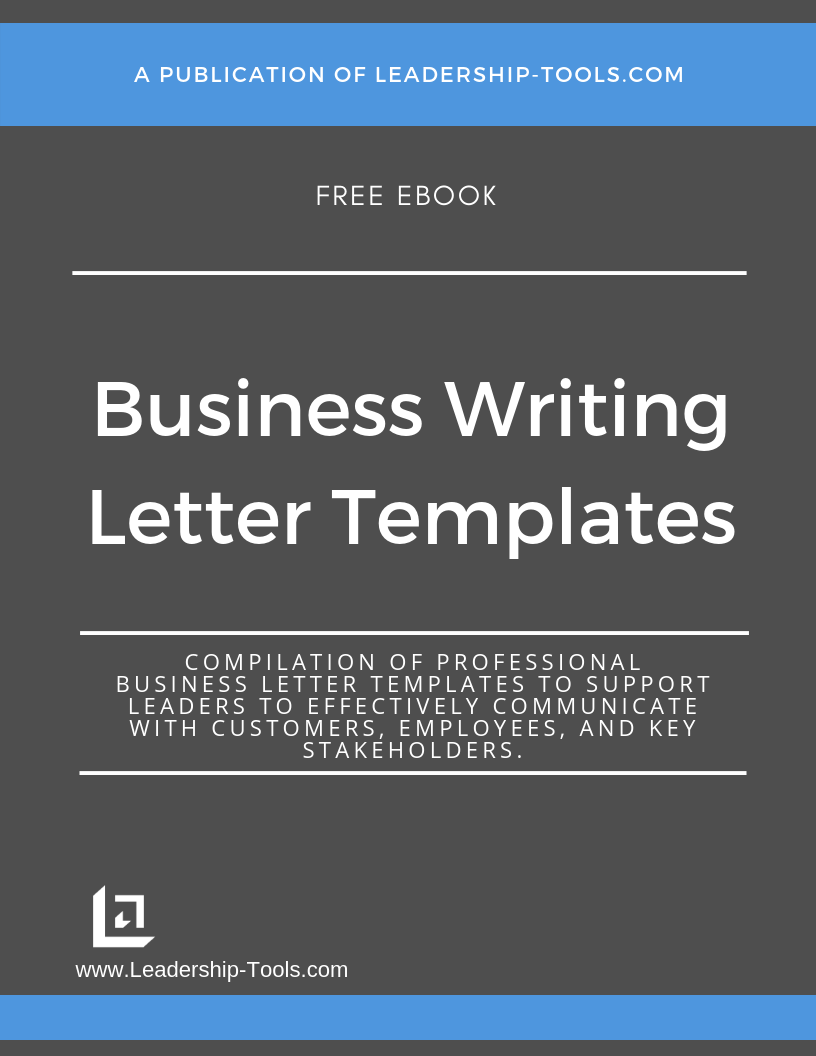
Here is what you will get from our business letter writing template pack:
- Ready-to-use business letter templates for common workplace situations
- A quick information guide (explaining when it's appropriate to use each template and suggestions on the intended tone)
- Instructions on how to complete each section of the template
- Practical tips for when to keep it formal, and when an email is enough
This page is not about writing essays. It is about sending common professional communications that are clear to the recipient of your letter.
Who This Is For (and when to use a formal letter)
You will get the most value from these templates if you are:
- A new manager who needs to set expectations clearly
- A small-business owner who wants more consistent communication
- A remote-team leader who needs decisions and requests documented
- An HR or L&D professional who supports managers with plug-and-play tools
- A coach who wants clean examples clients can reuse
Typical moments where a business letter template helps:
- You need to make a request and set a deadline for a common issue
- You need to confirm what was agreed to in a conversation
- You need to address a problem without escalating it
- You need to document next steps for accountability
- You need a formal message for a customer, vendor, or partner
Quick note: if your situation involves legal risk (termination, discrimination claims, medical issues, pay disputes), treat templates as a starting point and involve HR or legal counsel before sending via certified mail.
Collection of Business Letter Templates
"Whether written or face-to-face, you cannot overstate the importance of effective communication."
Ready to check out our free collection of Business Letter Templates? Okay, let's get started.
You can review our entire collection of templates by going through the individual page links below, or you can download a full compilation as a free ebook from our library of leadership tools. For your quick and easy reference, all business letter templates have been compiled into a single pdf ebook.
Here is a list of the various types of business letter samples that you can use as templates in your communication efforts:
» Apology Letter - Use our free apology letter the next time you or a member of your staff makes an error that impacts a customer.
» Appreciation Letter - This letter of appreciation tells the recipient how much their efforts mean to you and the organization.
» Complaint Letter - Use this complaint letter template to feel more at ease with how to effectively make your point to a vendor or business partner.
» Collection Letter - Our sample demand letter can help you manage accounts receivables and increase cash flow by collecting money more quickly from your clients.
» Condolence Letter - This condolence letter template provides the right balance of emotional support while maintaining a professional standard.
» Cover Letter - Our free cover letter goes great with your resume when applying for a new job. This tool provides a basic template that works for most cover letter needs.
» Donation Request Letter - Use this letter template to ask for support when raising money for a great charitable cause.
» Employment Offer Letter - Next time you need to write a formal offer of employment, use this template to make your offer clear to the candidate.
» Introduction Letter - Our sample introduction letter is perfect for making a great first impression when reaching out to new or prospective business clients.
» Resignation Letter - This letter of resignation template provides you with a simple yet effective template for resigning from a position.
» Recommendation/Reference Letter - Use this business letter sample when making a recommendation or referring someone to another business professional.
» Termination Letter - Letting an employee go is one of the most difficult (and risky) actions a leader takes. Use this sample termination letter to effectively end the employment of a non-performing employee.
» Thank You Letter - Our thank you letter template provides leaders with a great way to let employees and business partners know how much you appreciate them.
» Welcome Letter - Our customer welcome letter template provides a formal kickoff to a new customer relationship that will hopefully last for many years into the future.
To get started, you can read each of the above links, or you can download the complete collection of Business Letter Samples as a free eBook by following the instructions below.
"Communication - the human connection - is the key to personal and career success."
- Paul J. Meyer
How to Use This Business Letter Template Pack (step-by-step)
You do not need a writing process that takes an hour. You need a simple routine you can repeat anytime a message matters.
This step-by-step walkthrough shows you exactly how to use the business letter template pack so you can move from “blank page” to a clear, professional letter in minutes. You will pick the right scenario, drop in the key facts, and make the next step unmistakable, without overexplaining or sounding stiff.
Follow the steps in order the first time. After that, you’ll have a reliable system you can use for requests, follow-ups, customer or vendor issues, and documentation that needs to be clean and consistent.
Step 1: Choose the Scenario that Matches Your Goal

Ask yourself: what do I want the reader to do after they read this?
- Approve a request
- Deliver information
- Change behavior
- Confirm an agreement
- Resolve an issue
Step 2: Fill in the “Facts” Before You Polish the Tone
Draft first with concrete details:
- Names and dates
- What happened (only what you know)
- What needs to happen next
- Deadlines and owners
- How the person can respond or ask questions
Step 3: Use the “CALM” Check Before You Send
This is a quick leadership filter you can use on any letter.
- C: Clear. Can the reader summarize your point in one sentence?
- A: Accurate. Are you stating facts, not assumptions?
- L: Limited. Did you keep it to one main topic and a few key details?
- M: Measurable next step. Did you state what happens next, and by when?
If your letter passes CALM, it will usually land well.
Step 4: Read It Out Loud Once
If it sounds harsh, it will read harsh. If it sounds vague, it will create follow-up questions. Fix it now, not after you hit send.
Step 5: Save a Copy Where It Belongs
If the letter is about performance, commitments, or policy, store it in the appropriate system. That can be a client file, employee file (with proper access), or a project folder.
Business Letter Examples (adapt these quickly)
Sometimes the fastest way to write a strong letter is to start with a solid example and adjust it to fit your situation.
The business letter sample examples below are written in plain, professional language, with clear next steps and a calm tone you can use in most workplaces. These examples can be copied and inserted into a full template as you see fit. Pick the one that’s closest to what you need, swap in your names, dates, and details, and then tighten it so it says exactly what you mean in as few words as possible.
If you’re unsure, aim for three things: a clear purpose in the first lines, the key facts in the middle, and a specific next step at the end.
1) Request with a Deadline (simple and professional)
Subject: Request for updated project timeline
Hello [Name],
I’m writing to request an updated timeline for the [Project Name] work. Please send the revised schedule, including key milestones and any risks, by [Day, Date] so we can confirm commitments with the team.
If you need input from me to finalize the dates, reply with your questions and I’ll respond by [timeframe].
Sincerely,
[Your Name]
[Title]
[Phone] | [Email]
2) Confirming an Agreement After a Conversation
Subject: Confirming next steps from our meeting
Hello [Name],
Thank you for meeting with me on [Date]. This note confirms what we agreed to:
You will [Action 1] by [Date].
I will [Action 2] by [Date].
We will check in on [Date/Time].
If I missed anything, reply by [Date] and I’ll correct it. Otherwise, I’ll proceed based on the plan above.
Sincerely,
[Your Name]
3) Addressing an Issue Without Escalating
Subject: Follow-up on [Issue]
Hello [Name],
I’m following up about [Issue] observed on [Date]. The impact was [brief impact in plain language]. Going forward, please [specific expectation].
If something is blocking you from meeting this expectation, let me know by [Date] so we can solve it quickly.
Sincerely,
[Your Name]
4) Customer/Vendor Problem (firm, fair, and specific)
Subject: Request to resolve [Order/Invoice/Service Issue]
Hello [Name],
I’m writing about [problem] related to [order/invoice/project], dated [date]. We need this resolved by [date] to avoid disruption to our operations.
Please confirm by [date/time] whether you will:
Option A: [resolution], or
Option B: [alternative resolution].
Thank you,
[Your Name]
[Company]
If you want, you can turn any of these example templates into a longer letter by adding context in one or two short paragraphs. Just be sure not to "over-communicate" as you don't want to dilute your intended purpose of the message.
Business Letter Writing Tips
Next, let’s review a few common tips that leaders should abide by each time they put their pen to paper to write an effective business letter.
Consider the following tips for effective business writing when using our free business letter templates.
Get to the Point
A quality business letter is short and concise. All pertinent information is provided in a brief and clearly organized manner.
It’s very important to consistently include a date on all correspondence. Make a note of the day you receive correspondence as well. This can prove highly valuable if you ever need to prove the timing of an event.
While you always want to ensure a civil tone and a professional manner, you also don’t want to use any more space than necessary. Always be respectful of the recipient’s time. Maintain a balanced approach in terms of being cordial and staying on topic.
Upfront State the Purpose
In today’s high paced work environment, professionals more than ever are required to process a large volume of written material. Time management is a skill that leaders use regularly, and they are quick to "round file" a piece of correspondence if they cannot determine its purpose or benefit right away.
Don’t make the mistake of thinking that every word of your letter will be read, unless it’s short and to the point. For these reasons, it is necessary to state your purpose in the opening sentence of the letter.
Keep it Professional
Although in some cases your intention may be to personally connect with the recipient of your letter, you still must maintain a professional tone. For legal reasons, and just to ensure you aren’t blurring the lines of personal and professional, it’s best to keep it professional.
Pay close attention to possible run-on sentences as these become tiresome to the reader very quickly. Readers can easily become lost to the meaning of your words if too many words are used in one sentence.
You don't want to annoy or create a perception of being uneducated or unprofessional by not adhering to the proper use of English and proper grammar.
Always Proofread Before Sending
Too often a new manager will create an important letter, sign and mail it without ever taking the time to proofread it for errors. Whenever possible, let some time pass after writing your letter. Then come back to the letter with a fresh eye to proofread. Odds are that you will be surprised at the number of errors you will be able to find.
Be patient. It takes some time to write a good business letter. However, it won’t take you nearly as much time when you leverage our business letter samples.
Create a Master File
Leaders are often required to write letters for the same types of
situations throughout any given year. Smart leaders maintain a special file they can refer to or examples of good business
letters. Our free business letter templates should go in this
file as a quick and easy reference tool for future communications with customers and employees.
As a leader the greatest investment you can make is in the personal and professional growth of yourself and your people. If you value personal growth and self-development, then consider supporting other team members in their leadership development journey.
There are many reasons people fail in business. Some common fatal errors include but are not limited to:
- lack of education, knowledge or skill
- lack of effort or work ethic
- lack of passion or ambition
- lack of get-to-it-tive-ness and stick-to-it-tive-ness
- lack of grit, determination and persistence
- lack of tact or diplomacy
- lack of being able to say "No"
- lack of a willingness to give back to the community it serves.
Effectively address each of the above issues as you complete this business planning course and your chances for long-term business success will be greatly improved.
Understand the Benefits (for you, your team, and your organization)
Even simple communication issues can cost you hours. People misread tone, deadlines get missed, and you end up doing extra follow-ups that should not be necessary.
Our collections of business letter templates give you a repeatable way to say what you mean, in a professional format that holds up over time for common communication needs. It helps you communicate with confidence, protect working relationships, and create clear written records when it matters.
Below is how this tool pays off for you personally, for the people you lead, and for the bigger organization you are operating in.
For You as a Leader
- You stop spending mental energy rewriting the same messages
- You communicate with less emotion and more intention
- You create a repeatable system for common situations
- You reduce “I thought you meant…” misunderstandings
For Your Team
- People know what you expect, and what “good” looks like
- Requests feel fairer because they are specific and consistent
- Follow-ups feel less personal and more process-based
- It becomes easier to coordinate work, especially remotely
For the Organization
- More consistent communication across managers
- Cleaner documentation when decisions need to be reviewed later
- Fewer avoidable conflicts caused by unclear messages
- A more professional external voice with customers and vendors
Common Pitfalls (and How to Avoid Them)
Even with a solid business letter template, it’s easy to make small mistakes that create big headaches.
Most problems are not about grammar. They are about clarity, tone, and follow-through. The good news is these pitfalls are predictable, so you can avoid them with a quick check before you send.
Use the points below as a simple “pre-flight list” to keep your letter professional, fair, and easy for the reader to act on.
Pitfall: Being vague to avoid discomfort
Fix: Put the ask in the first 2–3 lines. Add a deadline. Name the next step.
Pitfall: Over-explaining
Fix: One topic per letter. If you have three issues, write three short messages, or schedule a conversation and document the outcome.
Pitfall: Sounding harsh or legalistic when it is not necessary
Fix: Use plain words. Be direct, but human. Save heavy language for true compliance situations, with HR support.
Pitfall: Mixing facts with assumptions
Fix: Separate what you observed from what you suspect. If you do not know, say what you need clarified.
Pitfall: Using templates as a substitute for leadership
Fix: A letter cannot replace a real conversation. Use the letter to support the conversation, confirm next steps, or reduce confusion.
If you take nothing else from this page, take this: the best business letter is the one that makes the next step obvious.
Keep it clear, keep it factual, and keep the tone calm. When you pair that with a repeatable template, you communicate more like a leader and less like someone trying to win an argument.
Then save your final version, so you have a clean record you can rely on later if questions come up.
Frequently Asked Questions (FAQ)
You probably don’t need a “perfect” letter. You need one that’s clear, professional, and easy to act on. These quick FAQs cover the most common questions leaders and small-business owners ask when they’re using a business letter template, including formatting, what to include, and when an email is enough.
If you don’t see your situation here, use the closest template and focus on the basics: state the purpose of your correspondence early, include the key facts, and end with a specific call to action or next step.
Should I use a business letter or an email?
If the message is routine and low-risk, an email is fine. If you need a formal record, a consistent format, or a more professional external message, a business letter template helps.
Do I need to include a subject line in a printed letter?
Not always, but it is helpful when the topic is serious, time-sensitive, or likely to be filed later.
What is the best format to use in the US?
Block format is the safest default. It is clean, common, and easy to scan. All of our business letter templates use block format.
Can I use these templates for performance documentation?
Yes, as a starting point for clarity. For higher-stakes situations, coordinate with HR and follow your organization’s policies.
How do I keep templates from sounding robotic?
Add one human sentence that matches the situation, then keep the rest structured and clear. For example: “I appreciate the effort you’ve put in here. I want to make sure we’re aligned on next steps.”
Download Free Business Letter Templates | Free eBook

To download our free collection of Business Letter Samples and Templates, simply subscribe to our free newsletter. You will immediately receive a password that grants access to our entire leadership tools library.
Your privacy is important to us. We never share or sell email addresses.
More Leadership Tools for Managing Your Team








Contact Information:
phone
(503) 970-9777
Email Customer Service
helpsupport@leadership-tools.com
Email Richard
richard@leadership-tools.com

By Richard Gorham
Leadership-Tools.com
2879 Riverwalk Loop, Eugene, Oregon, 97401
Copyright (c) 2003 - 2026 All Rights Reserved