A business plan template is a pre-formatted document that lays out the standard sections of a business plan and tells you what belongs in each one, so you're filling in fields rather than staring at a blank page. Our template covers ten sections, from the executive summary through to the appendix, with written instructions built into every section and a confidential cover page at the front.
- Home
- Leading Teams
- Business Plan Template
Free Business Plan Template and Step-by-Step Guide (Word, PDF, Google Docs)
The Business Plan Template gives you a complete fill-in-the-blank plan document with all ten sections laid out. The companion guide, How to Write a Business Plan, walks you through each section and tells you what belongs in it.
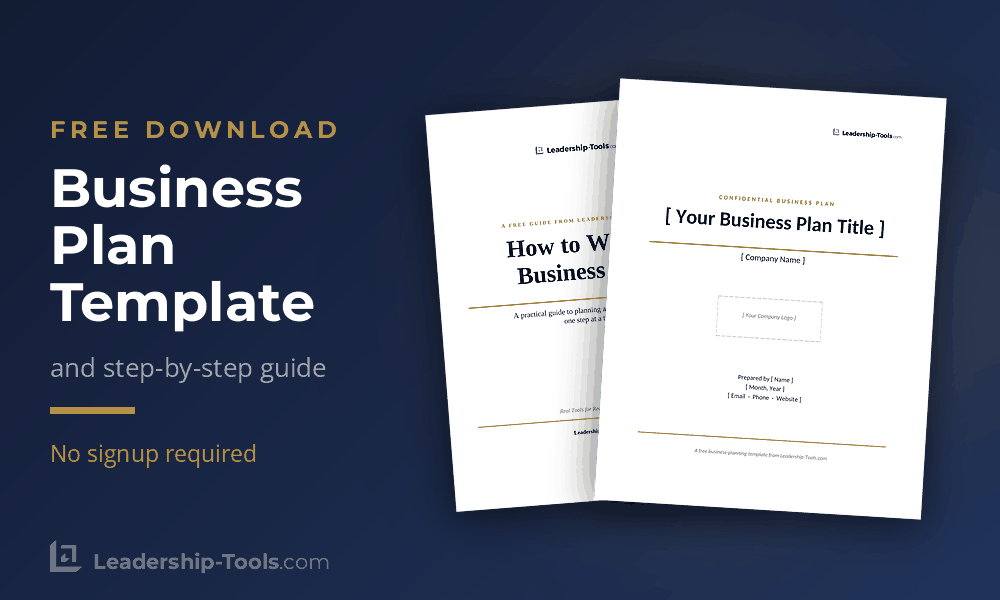
Too many new business owners skip writing a detailed business plan. Mostly because nobody ever showed them what all goes into it, and how it can greatly increase their chance of being successful. With our tools, that won't be a problem for you.
The business plan template hands you the structure, and the how-to guide tells you how to complete each section, including help in answering the key questions a loan officer asks. It's very common that when reviewing a business plan a lender will skip straight to your funding request section, so we'll make sure they are impressed with what they see.
Open the guide first, keep the template beside it, and work through the template one section at a time.
Download Free Guide: How to Write a Business Plan
Download Free Business Plan Template
Two free tools, no signup required. The tools work whether you're opening your first location or writing a plan for a business you've run for nine years.
A new owner leans on the guide's preparation questions. An established owner usually moves faster through the plan and spends most of their time in the financials. The template is the same document either way.
Jump To: Two Tools, One System | What's Inside | Which Tool You Need | What a Business Plan Is | Plan Sections Explained | How to Use the Template | Common Mistakes | The Full Toolkit | FAQ | Get Updates Free | Download Templates
Two Tools, One Business Plan Writing System
The guide teaches you how to complete the process. The template will capture all the important details. Use them together and you'll end up with a business plan you can be proud of.
How to Write a Business Plan runs about fifty pages across ten key sections. Each section of the plan covers: what it's for, what a lender or investor is looking for, the questions you should be ready to answer, and the traps that will sink a weak plan. The guide also carries short success lessons on persistence, borrowing, advertising, and protecting your time, drawn from successful leaders worth learning from.
The Business Plan Template mirrors that same structure. Every section in the guide has a matching section in the template, with a short instruction box telling you what belongs there and a blank field for your response. Take your time to fully research the details, fill in each of the required fields, and you have a finished business plan.
“Good fortune is what happens when opportunity meets with planning.”
― Thomas Edison, inventor
One piece of advice before you start, straight from the guide: write the executive summary last. It's the first section a reader sees and the hardest to write without first completing the other fields. Once the other nine sections are done, the summary is mostly a matter of pulling your best sentences forward.
Complete the other sections in whatever order suits you. Most new business owners start with the company description and market analysis, since that's the part of the business they may already have some level of certainty about.
Bottom line, take your time, be thoughtful, and make sure every detail you include is 100% accurate.
What's Inside the Business Plan Template
Our free business plan template includes ten sections, with subsections and written instructions built into every one.
The full content will include:
- Executive Summary: Highlights, Objectives, Mission Statement, Keys to Success
- Company Description: Company Ownership and Legal Entity, Market Analysis, Competitive Analysis
- Operations Structure: Location, Interior, Hours of Operation, Organizational Structure, Management Qualifications
- Service or Product Offer: Suppliers, Service, Manufacturing
- Marketing Strategy: Market Segmentation, Pricing, Advertising and Promotion
- Key Risks and Obstacles
- Goals and Strategy: Milestones, Sales Forecast, Break-Even Analysis, Strategy and Implementation
- Funding Request: Start-Up and Acquisition Summary, Start-Up Expenses, Determining Start-Up Capital
- Business Financials: Sales and Financial Management
- Appendix: Miscellaneous Documentation
When you open the template file, you'll see a confidential cover page. There you will fill in your business name, logo, contact details, and the date, plus a table of contents that matches the list above. The Word and Google Docs versions are editable. The PDF is there for printing or for reading through before you commit to a specific format.
Which Business Planning Tool Do You Need?
Seven free tools sit in this business planning collection, and two of them are the how-to guide and template available on this page.
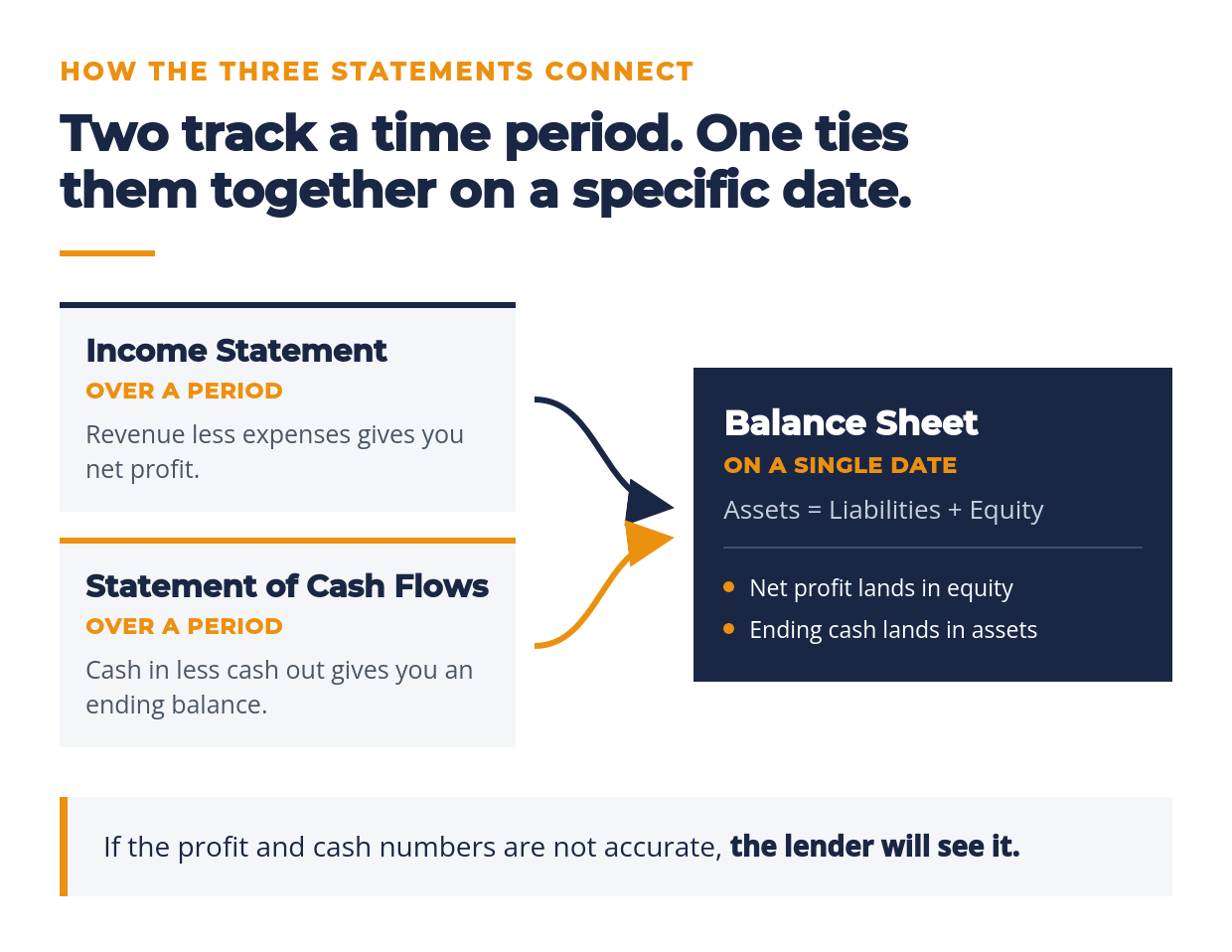
There are also four tools that focus squarely on the financial numbers and each one lives on its own page with instructions and examples to reference. The balance sheet, income statement, and statement of cash flows are three common statements that lenders like to view together.
There's also a supporting page on developing a mission statement. The final page focuses on the business plan appendix, which is the section in the very back of the business plan.
- If you're writing a plan from scratch: Start with the guide and the business plan template and leave the rest alone until you reach the financials, which is what the other tools support.
- If you are ready to focus on the financials: The Business Plan Financial Workbook builds your sales forecast, break-even analysis, and funding requirement from the figures you enter, and it comes with a tutorial that walks through each tab.
- If a lender asks you for a balance sheet: The Balance Sheet template lays out assets, liabilities, and owner's equity in the format a credit officer expects to see.
- If you need an income statement: The Income Statement template covers revenue, cost of goods sold, operating expenses, and what's left at the bottom is net profitability, which is the number most readers are most interested in.
- If you want to know when cash will be running low: The Statement of Cash Flows projects month by month, and that projection is how you work out how much start-up capital you need before you walk in and ask for it.
- If you're stuck on writing the mission statement: It's the shortest section in the plan and the one most owners rewrite five or six times before it sounds like them. The mission statement page has examples to work from and a process for getting your team involved.
- If you're assembling the supporting documents: Anything a reader might want to verify belongs in the business plan appendix, from lease agreements and licenses to resumes, supplier contracts, and the market research behind your numbers. The business plan appendix page covers what to include and what to leave out.
You'll have no problem finding sites offering a dozen template variants: startup plan, one-page plan, investor plan, lean plan, and so on down the list. We publish one business plan template, because a solid plan for a two-person landscaping company uses the same ten sections as a plan for a twelve-person software shop.
Remember, if you're going to be walking into a bank to ask for a loan, the funding request and the financials that support it must carry the weight, so that's where your time and efforts should go. If you're planning internally with no lender in the picture, you can hold the funding request to a brief sentence or two and spend the time you save on goals, risks, and operations.
What a Business Plan Is, and What It Isn't
A business plan is a written account of what your business does, who it serves, how it earns money, and where it's headed over the next three to five years. For most small businesses it runs somewhere between fifteen and forty pages, and the ten sections in our template cover the ground that a lender, an investor, or a prospective business partner will expect to find.
What trips up a lot of new business owners is the assumption that the plan is a document you need to do only once. It isn't. A business plan should be a living document that you review and update regularly, or as the market shifts. This means the assumptions you commit to paper in January may need rewriting by September if a competitor opens two blocks away or your main supplier raises prices by twelve percent.
Before we walk through the various sections of the business plan template, it's worth addressing three things that keep good owners from ever starting.
- "Business plans are only for bankers and investors": An outside lender will almost always require a written plan, but the person who gains the most from writing the plan is you. The research it forces you to do on your own market, your competitors, and your financial numbers is invaluable, and can greatly increase your chances of success.
- "Business planning is a one-time event": Write the first version as thoroughly as you can, then review and update it on an ongoing basis. Owners who manage well against their plan revisit it annually at a minimum, and most check their forecast against actual results every month.
- "I don't need a plan for a business this small": The majority of new small businesses close within their first three years, and running a small operation gives you less margin for error. For any size business, there is no good argument for not completing a business plan.
None of this asks you to become a financial analyst. It asks you to answer honest questions about your own business in writing, which is harder than it sounds and considerably more valuable than most owners expect going in. While it will require effort on your part, you will learn a great deal about the business you are about to embark on. Armed with increased knowledge, you'll be positioned to move forward with greater confidence.
"Our goals can only be reached through a vehicle of a plan, in which we must fervently believe, and upon which we must vigorously act. There is no other route to success."
- Pablo Picasso, painter
The Sections of a Business Plan, Explained
What follows is a section-by-section walk through the ten parts of the business plan template, with what each section is for, what belongs in it, and the mistake that shows up most often. The guide covers every one of these in far more depth, so treat this as your map and the guide as your instructions.
1. Executive Summary
The executive summary is a concise overview of your vision and how you intend to make it real, and it sits first in the plan because it's the first impression your reader will have of your business. Include a clear description of the business, your goals, what you've achieved to date, and the key objectives coming next. Make the reader feel your enthusiasm for the road ahead, because if they don't believe you're excited to lead this business, they're unlikely to be excited about financing it or partnering with you.
The most common mistake: Writing this section first. Draft it last, once the other nine sections exist, so the summary reflects what the plan says rather than what you hoped it would say.
Mission Statement
Your mission statement lives inside the executive summary, and it tells employees, customers, and business partners what your organization stands for, and it can run from a few words to a few sentences.
Four questions will get you most of the way there: the work you do, the customers you serve, the difference you make, and what is your commitment behind it?
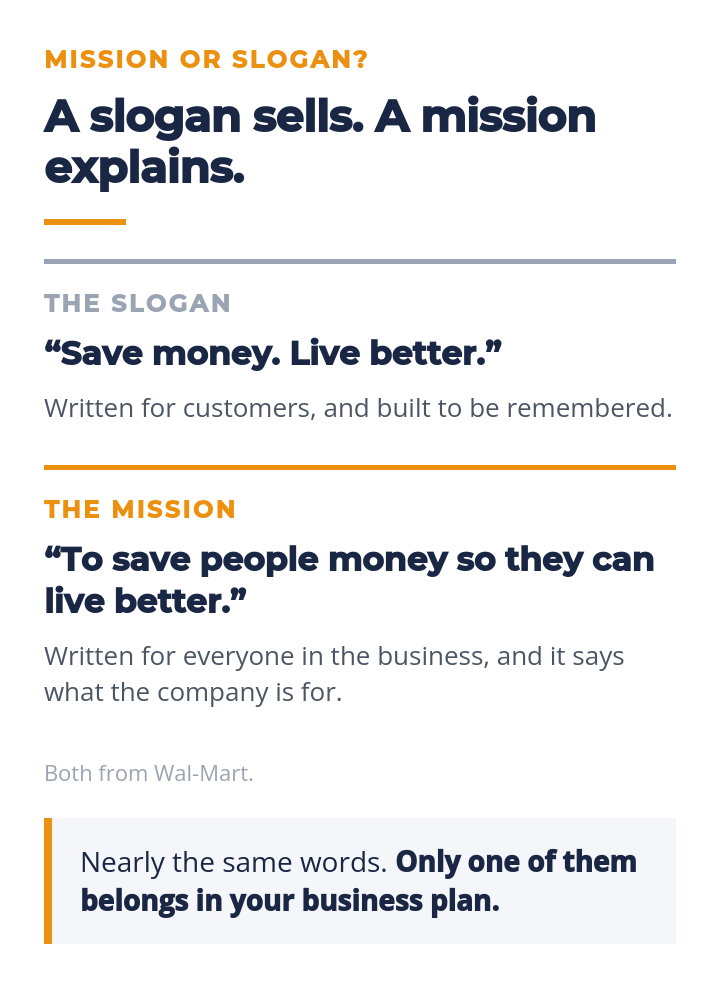
Too often new business owners will confuse a company slogan with a mission statement. They are quite different, each having its own distinct purpose. One is to connect with customer, while the other is to invite everyone in the organization to participate in a shared purpose.
Most owners bring their whole team into this conversation, and the statement is stronger for it.
The most common mistake: Writing a slogan instead of a mission. A slogan sells. A mission explains what the business is for, and it's allowed to take a little more room to do that. Our mission statement template walks through the process and includes examples worth studying.
2. Company Description
The company description gives the reader a solid overview of the business entity and sets up everything that follows. State the type of business you've formed, whether that's a sole proprietorship, partnership, or S or C corporation, along with who owns what percentage.
Define the industry, say whether the business is a franchise or an expansion of an existing operation, and confirm whether required licenses and permits have been acquired or explain where you are in the process. Banks and investors will expect every one of those details spelled out.
The most common mistake: Assuming the reader already understands your business. What seems obvious to you after ten years in the trade may be invisible to the reader. Make no assumptions when detailing your plan.
Market Analysis
The company description carries two substantial subsections, and this is the first of them.
The market analysis section presents the research you've done on the market you intend to compete in, and the reader should come away with a vivid picture of where that market stands today. Define the customer you'll attract, break them down demographically, and say how large your client base is now and how large it could become with the right strategy or investment. Describe whether the market is expanding, contracting, or holding steady, and if you believe you have a competitive advantage. Explain how you know a market exists for what you are offering.
The most common mistake: Presenting hope as research. A chart or graph illustrating market growth carries weight only when the numbers behind it came from somewhere that you can specifically name.
Competitive Analysis
The purpose of the competitive analysis is to know your competition better than they know themselves. Identify competitors by name, detail their product lines or services, break the picture out by market segment, and assess the strengths you'd like to emulate alongside the weaknesses you can work against.
Research market share for each one, and project the time and cost it will take your business to gain a foothold. Pay attention to how they market themselves and where their customers come from.
The most common mistake: Studying only the market leaders. One of the smaller operators may be about to introduce something that changes the business landscape. Understanding how a small player enters the market can often tell you more than how the biggest competitor defends their standing.
3. Operations Structure
Structure and process are the bookends of a well-run company, so this section explains how yours is put together. Cover the physical location and why you chose it, the interior and how much square footage you need, whether that space allows for expansion, and your hours of operation across each channel.
Include a formal organizational chart with departments and lines of leadership. Name your key personnel with their titles, and be transparent about ownership, including each owner's percentage and whether they're active or passive in daily operations. If you outsource work to a virtual assistant, a freelance designer, or a contract marketer, say so and explain why you rely on them.
The most common mistake: Minimizing your own qualifications. Readers want to know your background in this type of business, what your specific role will be, and whether you're self-aware enough to name your own weaknesses alongside your strengths.
4. Service or Product Offer
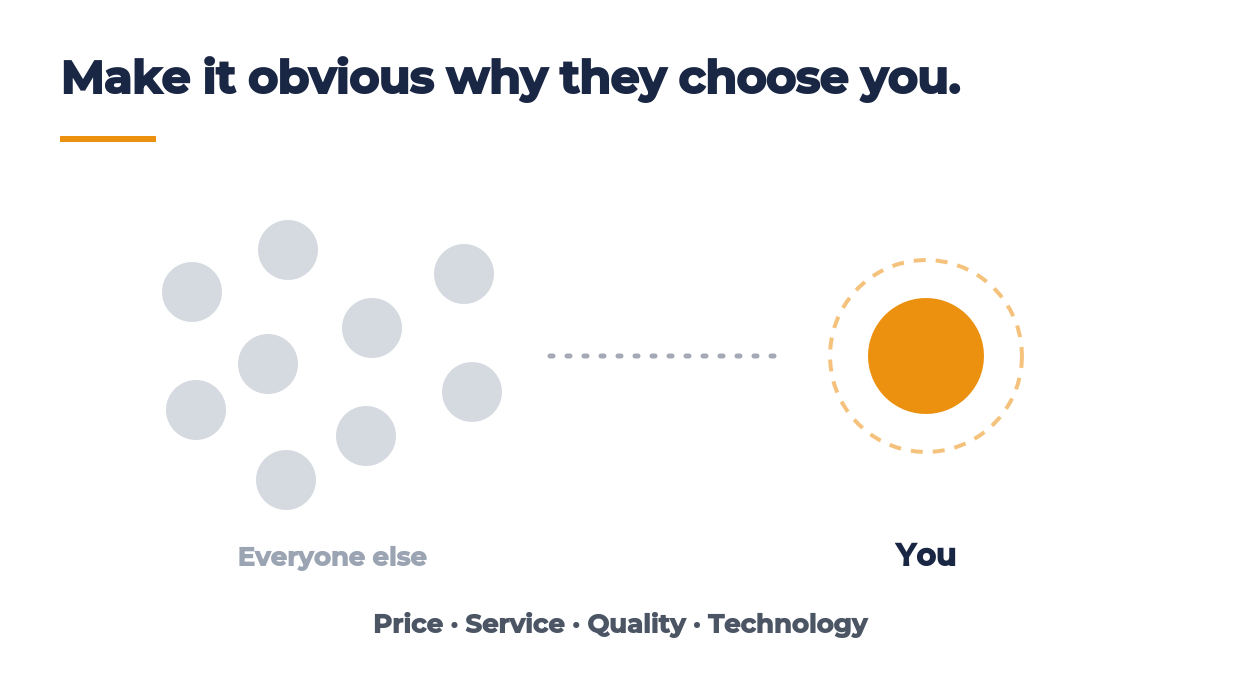
Describe in vivid detail what you're selling and why your target customer will choose it over what's available now. You can distinguish yourself on price, on service, on quality, or by bringing new technology to an industry that hasn't seen any. Your job in this section is to be specific about which of those you're betting on.
Cover what's included in the offer, how you arrived at it, and whether you can adjust it as the market changes. Address your suppliers and manufacturers too: how reliable they are, how quickly product is made once an order comes in, and how inventory is secured.
The most common mistake: Listing the catalog of products and services without specific details. Ten products on a page tells the reader nothing about why anyone would buy them from you.
5. Marketing Strategy
A marketing strategy shows the reader you know exactly how you'll attract and sell to your target market, and the emphasis belongs on who you're selling to rather than how many units you expect to sell. Build the section around three areas. Market segmentation covers how your market divides and which segment is your primary target. Pricing explains your approach and how you'll justify it to customers, whether you're positioning above or below the competition. Advertising and promotion covers how you'll reach people and what you expect that to cost.
The most common mistake: Writing a strategy that never changes. An approach that works in summer may fall flat in winter. A strategy that appeals to one group may fall flat with another, so build in room to have multiple approaches and be willing to make adjustments.
6. Key Risks and Obstacles
Many owners are uncomfortable naming risks in a document they're using to ask for money, and they minimize the risk section as a result. That's the wrong approach when writing a business plan. A lender already knows every venture carries risk, and what they're assessing is whether you see the same risks they do and have thought about how to handle them.
State each risk along with its potential impact. Explain why you believe it can be managed or avoided, and describe the contingency plan you'd put into motion.
The most common mistake: Sugar-coating a potential risk to the business. Naming a risk squarely gives your reader the chance to advise you on it. An experienced banker will have greater trust in a plan that admits its exposure over the one that pretends there isn't any.
7. Goals and Strategy
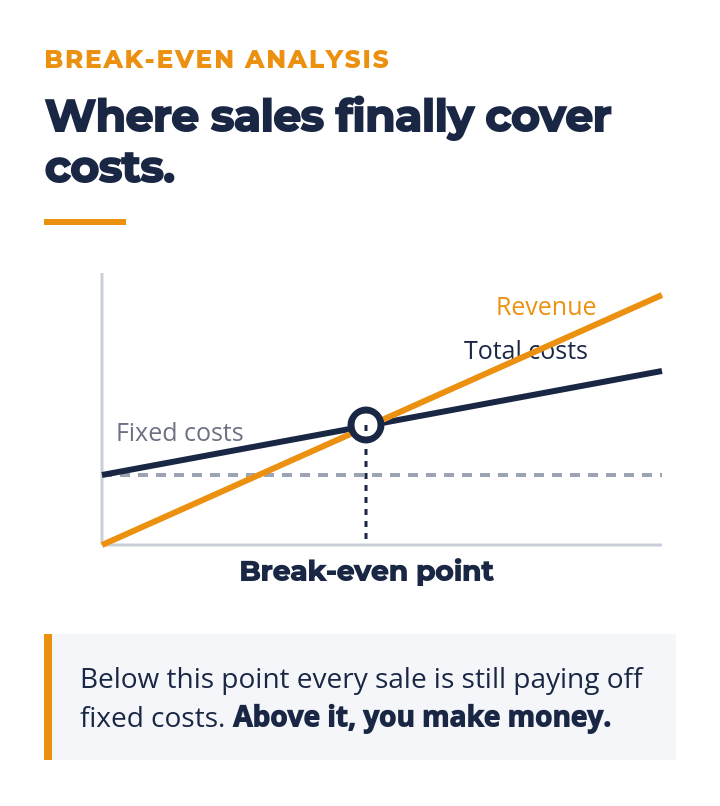
Break your goals into milestones, each with a start date, a completion date, and a budget, and lay them out in a table so a reader can take them in at a glance. Include sales and growth forecasts by month, quarter, and year, along with a break-even analysis showing the point at which sales cover expenses.
There are three ways to raise profit, and each has a cost worth thinking through: increase sales and you may need more staff, raise prices and you may lose your competitive position, cut fixed costs and quality may be impacted.
The most common mistake: Setting goals that only point upward. The ACES approach covers more ground. What do you want to achieve, what do you want to conserve, what do you want to eliminate, and what do you want to steer clear of? Our Business Plan Financial Workbook calculates the break-even analysis for you.
8. Funding Request
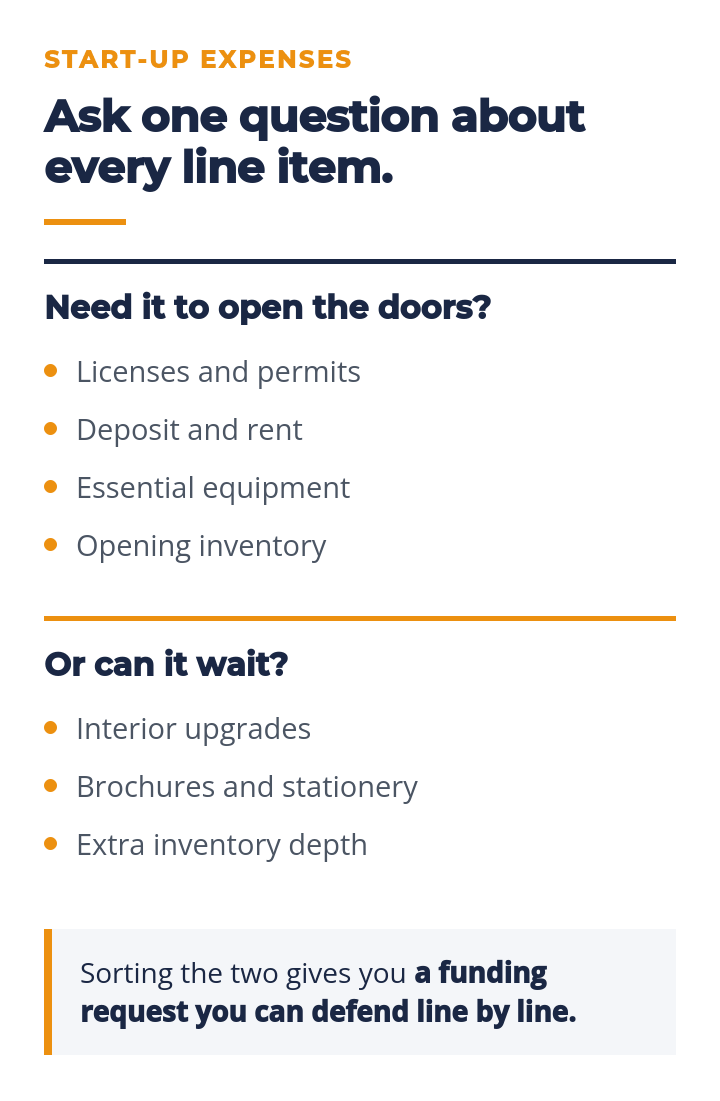
This is the section a prospective lender or investor may turn to first, before reading a word of anything else.
State the amount you need, explain in detail how the funds will be used, and set out exactly how you intend to repay them with all available terms stated plainly.
List your start-up expenses in full, and as you build that list, separate what you need on day one from what can wait until the business is established. A monthly cash flow projection for the first year is the most reliable way to work out how much start-up capital you require.
The most common mistake: Naming a figure without showing the source behind it. Banks lend to people with good credit, relevant experience, adequate security, and a reasonable prospect of repayment. Your funding request must speak to all four.
Our Business Plan Financial Workbook enables you to build the projections required, and will highlight the funding you'll need during the first year in business.
9. Business Financials
The business financials are where the numbers are analyzed to back up any funding request and to assist the owner in making important business decisions. Three statements do the work. The balance sheet gives a snapshot of assets, liabilities, and equity at a single point in time, and it balances because assets equal liabilities plus equity. The income statement covers revenue, cost of goods sold, expenses, and what's left over across a period of time. The statement of cash flows deals only in cash moving in and out, ignoring non-cash items like depreciation, and it's the statement that tells you when you'd run dry.
Banks typically want monthly projections for year one, quarterly for year two, and annual figures for years three through five.
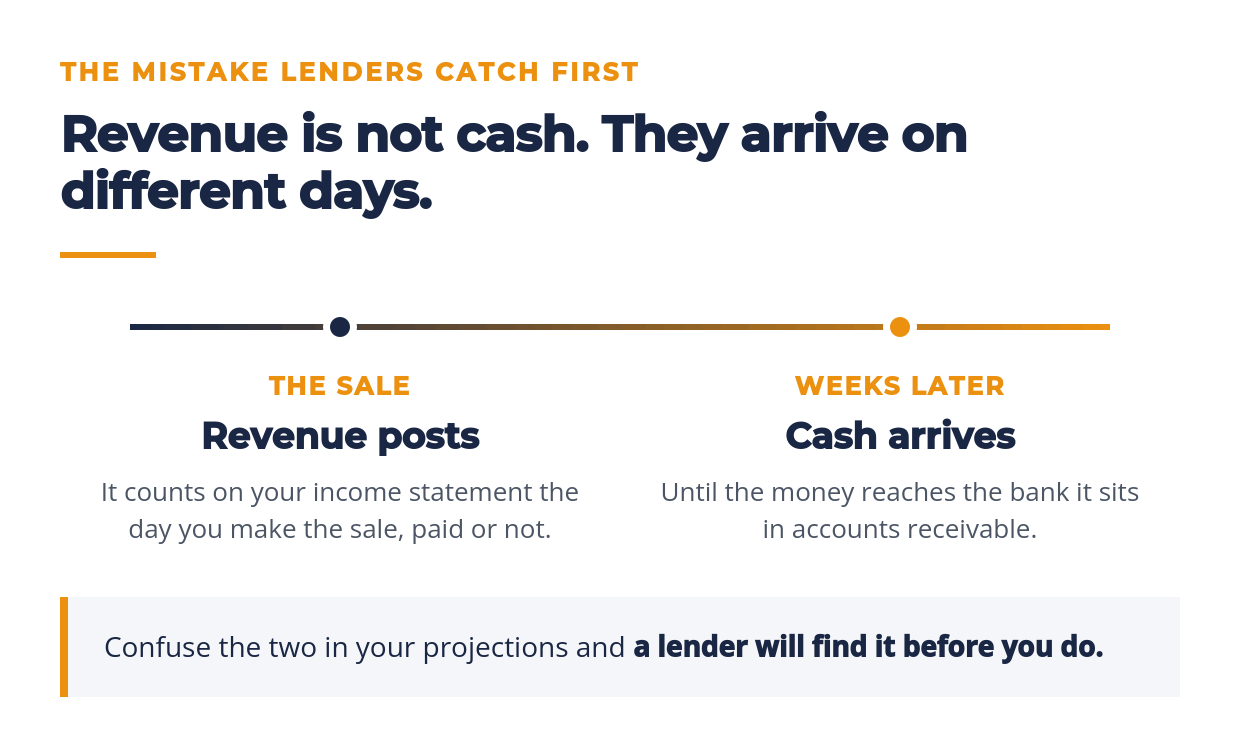
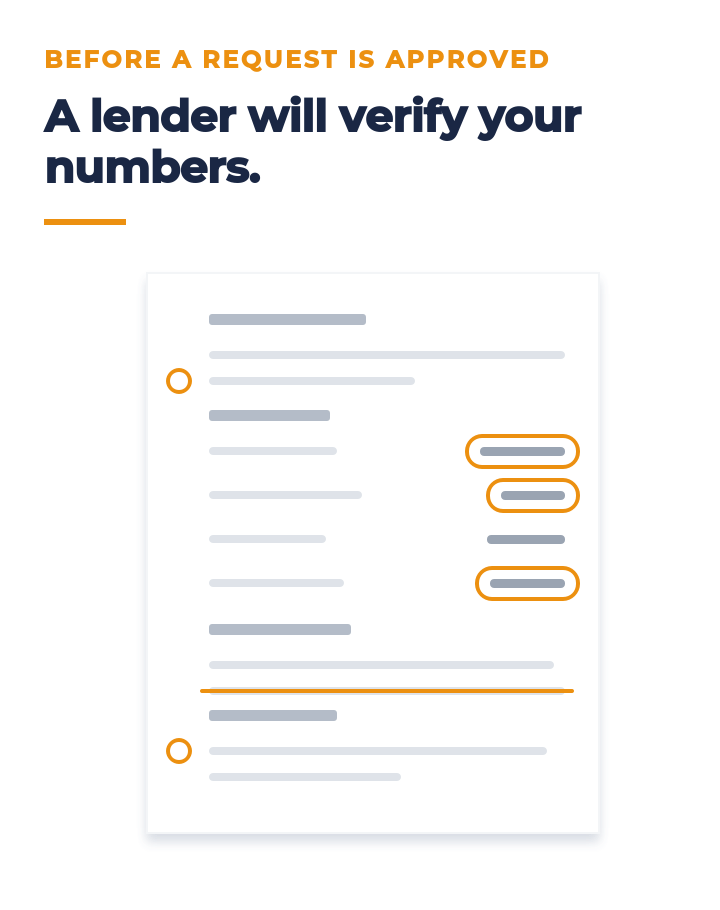
The most common mistake: Confusing revenue with cash received. Revenue posts to the income statement when the sale is made whether or not the money has arrived, while cash shows on the balance sheet only once it's in the bank. Lenders read your plan looking for inconsistencies, so it's far better to find your own errors before they do.
10. Appendix
The business plan appendix holds the supporting material that backs up claims you made earlier in the plan. An appendix that is thorough adds real credibility because it shows you've thought through all the important details before submitting the plan.
Documents worth including are personal resumes, personal financial statements, business and personal credit reports, copies of leases, letters of reference, relevant contracts and agreements, legal documents, and tax returns. Much of this is proprietary, so treat the appendix as confidential and keep a master distribution list of everyone who receives a copy of the plan.
The most common mistake: Assembling it the night before. Confirm every item is accurate and relevant before it goes in, because one out-of-date lease or a resume with the wrong dates undermines the care you took everywhere else. Our page on the business plan appendix covers what belongs there in more detail.
How to Use the Business Plan Template
The template and the guide are built to be worked side by side, and the sequence below is recommended to optimize your time.
- Download both files in the same format: If you're working in Word, take the Word versions of each so you can keep the guide open in one window and type into the template in the other. The Google Docs versions work the same way and save as you go.
- Read the How to Write a Business Plan guide in full: Each section explains what a reader is looking for in that section and lists the questions you should expect to be asked about it. Reading each section carefully before filling in the matching template fields will save you time overall since you won't be guessing what information to include.
- Start with the sections you already know well: Most owners find the company description and the product or service offer easiest to begin with, because that's the part of the business they live in daily. Knocking out the easier sections quickly will provide a feeling of momentum and will encourage you to tackle the remaining sections because you are now vested in the process.
- Build the numbers before you write about them: Open the Business Plan Financial Workbook, enter your figures, and let it produce your sales forecast, break-even point, and funding requirement. Then bring those results back into the goals, funding request, and financials sections so the narrative and the numbers are all in alignment.
- Write the executive summary last, then hand the plan off to someone trusted to review: Once the other nine sections are finished, the summary is mostly a matter of pulling your strongest sentences forward. After that, give the whole plan to someone who'll tell you the truth about it. Their feedback should be taken seriously and used to further improve the final document.
Set a date to revisit the plan once it's done. Review your business plan annually at a minimum. Compare your actual results against your projections every month. This is how the plan earns its keep as a management tool rather than just sitting in your desk drawer.
Common Mistakes That Sink a Business Plan
The problems below turn up again and again in business plans that get declined. None of these are difficult to avoid once you know where to look for them.
Writing the executive summary first: You end up summarizing a plan you haven't written yet, which produces a first page that promises things the following thirty pages don't always deliver. Draft it last.
- Projections that can't be traced back to anything: A sales forecast that climbs thirty percent a year because thirty percent "felt reasonable" will not survive a conversation with a lender. Every number needs a source, whether that's your own historical figures, a supplier quote, or published industry data you can point to.
- Burying the risks: Owners leave this section thin hoping the reader won't notice the exposure, but an experienced reader will notice so it's best to name each risk plainly. Say what the risk could cost you and explain how you plan to mitigate the risk if it comes to pass.
- Confusing your market with your hope: "Everyone needs this product" is not a market analysis. A defined customer, a demographic breakdown, and a defensible estimate of how many of them you can reach is the kind of clarity you need to articulate.
- Leaving the template's instruction text in the finished document: It happens more often than you'd think, particularly in the sections owners rush through at the end. Read the whole plan start to finish before anyone else sees it, and delete any instructions left remaining as you go.
- Finishing the plan and never opening it again: A well written business plan that isn't used to compare your projections against results is a lost opportunity. Owners who get the greatest value from their plan check the results against forecast monthly and update their plan at least annually.
There's one more important point worth mentioning, because it costs owners more money than any of the above. Many business owners never share the plan with the people who have to carry it out. Your team will work toward goals they understand far more reliably than goals they've never seen, so take the time to walk them through the plan. Make sure they understand the key milestones that need to be achieved. Provide some incentives and recognition for hitting them, and let them be part of celebrating the success of the business.
The Complete Business Planning Toolkit
Seven free tools make up this collection. The How to Write a Business Plan guide and the business plan template are both provided on this page. The other five each have their own page with instructions and examples. Plus, we've included an article about the business plan appendix for your reference.
- How to Write a Business Plan: A fifty-page guide covering all ten parts of the plan, with preparation questions for each section and short success lessons on persistence, borrowing, advertising, and protecting your time. Available above in PDF, Word, and Google Docs.
- Business Plan Template: The fill-in-the-blank companion to the guide, with instructions built into every section and a confidential cover page. Available above in PDF, Word, and Google Docs.
- Business Plan Financial Workbook: Enter your figures and the workbook produces your sales forecast, break-even analysis, and start-up funding requirement. A separate tutorial walks through each tab.
- Balance Sheet Template: Assets, liabilities, and owner's equity in the format a credit officer expects, with instructions for reading what it tells you.
- Income Statement Template: Revenue through to net earnings, laid out top down, with guidance on the revenue and cash distinction that catches people out.
- Statement of Cash Flows: A month-by-month projection of cash in and cash out, which is the statement that tells you how much capital you need before you go asking for it.
- Mission Statement Template: A process for writing a mission your team believes in, along with examples from companies worth learning from.
- (Article) Business Plan Appendix: Where your supporting documents go, including full financial statements a lender will expect to have easy access to. For every important claim within your business plan, you should include any supporting documentation in the appendix.
Work through them in whatever order your situation calls for. If you're preparing for a lender meeting, the financial tools workbook is a great place to start since it carries the most weight and deserves most of your time.
Frequently Asked Questions
Questions we get asked most often about the business plan template, the how-to guide, and business planning in general.
Click on the (+) sign below to expand each question. Click the (-) sign to collapse it again.
What is a business plan template?
Is the business plan template free to download?
Yes. The template and the companion guide are both free, with no signup, no password, and no email address required. Download whichever format suits you and get to work.
What formats does the business plan template come in?
The template is available in PDF, Microsoft Word, and Google Docs. The Word and Google Docs versions are editable so you can type directly into each section, while the PDF is useful for printing or for reading through before you commit to filling one in.
What sections should a business plan include?
A complete business plan includes ten sections: executive summary, company description, operations structure, service or product offer, marketing strategy, key risks and obstacles, goals and strategy, funding request, business financials, and an appendix. Your mission statement sits inside the executive summary, while market analysis and competitive analysis both sit inside the company description.
How long should a business plan be?
Most small business plans run between fifteen and forty pages, and the length depends far more on the complexity of the business than on any rule. A single-location service business can make its case in twenty pages, while a manufacturing operation with several product lines and a detailed funding request will need considerably more room.
Do I need a business plan for a small business?
Yes, and arguably more than a larger operation does. The majority of new small businesses close within their first three years, and a small business has less margin to absorb a wrong turn. Even if you never approach a lender, the research the plan forces you to do on your market, your competitors, and your own numbers is worth the time on its own.
What is the difference between the guide and the template?
The guide teaches and the template captures. How to Write a Business Plan runs about fifty pages and explains what each section is for, what a lender is looking for, and the questions you should expect to be asked. The template mirrors that same structure with a blank field for each section, so you read the relevant part of the guide and then write your answer into the matching part of the template.
When should I write the executive summary?
Write it last, even though it appears first in the finished plan. Once the other nine sections exist, the summary becomes a matter of pulling your strongest points forward rather than trying to summarize a plan you haven't written yet.
What financial statements does a business plan need?
A complete plan includes a balance sheet, an income statement, and a statement of cash flows, along with a sales forecast and a break-even analysis. Banks typically ask for monthly projections covering the first year, quarterly figures for the second year, and annual figures for years three through five.
What goes in a business plan appendix?
The appendix holds the supporting documents that back up claims made elsewhere in the plan, including personal resumes, personal financial statements, business and personal credit reports, copies of leases, letters of reference, contracts and agreements, legal documents, and tax returns. Treat it as confidential, since much of that material is proprietary, and keep a master list of everyone who receives a copy.
How often should I update my business plan?
Review and update the plan annually at a minimum, and compare your actual results against your projections every month. The business environment shifts, so assumptions you wrote down in January may need rewriting by September if a competitor opens nearby or a key supplier raises prices.
Can I use this template for a startup business?
Yes. The same ten sections apply whether you're opening your first location or writing a plan for a business you've run for years, and what changes is how much you write in each one. A startup will spend more time on the funding request, the start-up expense list, and the cash flow projection that determines how much capital you need before you open the doors.
Download Business Plan Template and How-To Guide

Guide: How to Write a Business Plan
Free Business Plan Template
Want the entire leadership tools library? Subscribe to our free newsletter and we'll send you a link to every tool on this site, all on one page, sorted by leadership phase. Every tool is free to download on its own page. The library just puts them in one place. Plus, you'll never miss out on updated or new tool announcements.
Your privacy is important to us. We never share or sell email addresses.
Leadership Tools Newsletter
Subscribe Free - See All Tools on One Page - Get New Tool Alerts
More Leadership Tools




Contact Information:
phone
(503) 970-9777
Email Customer Service
helpsupport@leadership-tools.com
Email Richard
richard@leadership-tools.com

By Richard Gorham
Leadership-Tools.com
2879 Riverwalk Loop, Eugene, Oregon, 97401
Copyright (c) 2002 - 2026 All Rights Reserved