A cash flow statement shows where your money came from and where it went over a period of time. It sorts every dollar into three groups: cash the business produced by doing the work, cash spent on or received from equipment and property, and cash moving between the business and its owners or lenders. Add the three together and you have the change in your bank balance.
- Home
- Leading Teams
- Business Plan Template
- Cash Flow Statement Template
Cash Flow Statement Template
A cash flow statement answers the question every profitable business owner eventually asks: how much money is available to spend right now and where is it? This free cash flow statement template answers it for you. Fill in the cream-colored cells and the section totals, the net change in cash and your ending balance will calculate automatically.
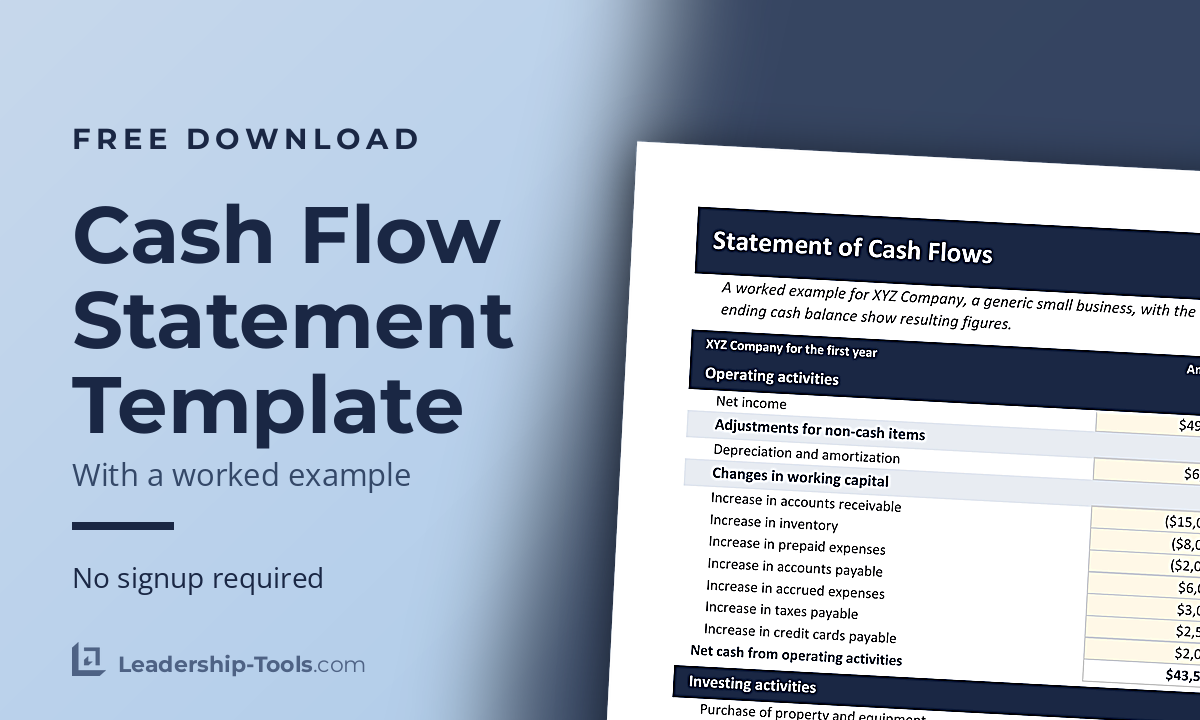
Download Free Cash Flow Statement Template
This template is built for a small business rather than a corporation, and it follows the typical three-section format a lender expects to see. Every line carries an explanatory note telling you whether the figure goes in as a positive or a negative, which is where people often make an error.
Free, with no signup and no password is required. The worksheet has three tabs: a short How to Use guide, the blank cash flow statement template, and a finished example for XYZ Company at the end of its first year.
Jump To: Which Format to Pick | A Worked Example | The Three Sections | Operating Activities | Investing and Financing | Not Your Bank Statement | What If the Numbers Aren't Working | How the Three Statements Connect | Common Mistakes | The Full Toolkit | FAQ | Download
Which Format to Pick
All three versions contain the same cash flow statement. The difference is what you can do with each one.
- Excel is the one most people choose. It calculates totals and percentages as you complete the cream-colored fields. Pick this one if you have Excel and plan to use the cash flow statement template more than once.
- Google Sheets works the same way and runs free in any browser, with nothing to install. Click the link, choose File then Make a Copy, and you have your own version. Pick this one if you don't have Excel.
- PDF doesn't calculate anything, so you'd have to total the sections yourself. It's still worth having, because it includes the finished example and reads well on paper or on a phone. Pick this one to read through before you start, or to print and fill in by hand.
Whichever you choose, open the Example tab first. This is the statement people find hardest to build from scratch, and seeing a finished one with real figures give you a better idea of what you will be building as you start filling in your own numbers.
A Worked Cash Flow Statement Example
This is XYZ Company's first year, and it's the clearest way to see where cash is coming in and out of the business, and what available to spend.
The business earned $49,000 of net income. It finished the year with $23,000 in the bank. The statement explains the gap.
Start at the top. Net income arrives from the income statement, then $6,000 of depreciation is added back, because that expense reduced profit without any cash leaving the account. Next come the working-capital changes, and this is where most of the money went. Customers still owed $15,000 at year end, inventory took $8,000, and prepaid expenses another $2,000. Against that, XYZ hadn't yet paid $6,000 of supplier bills, $3,000 of accrued wages, $2,500 of taxes and $2,000 on credit cards, all of which kept cash balance elevated a bit longer. The section totals $43,500 of cash generated by the business.
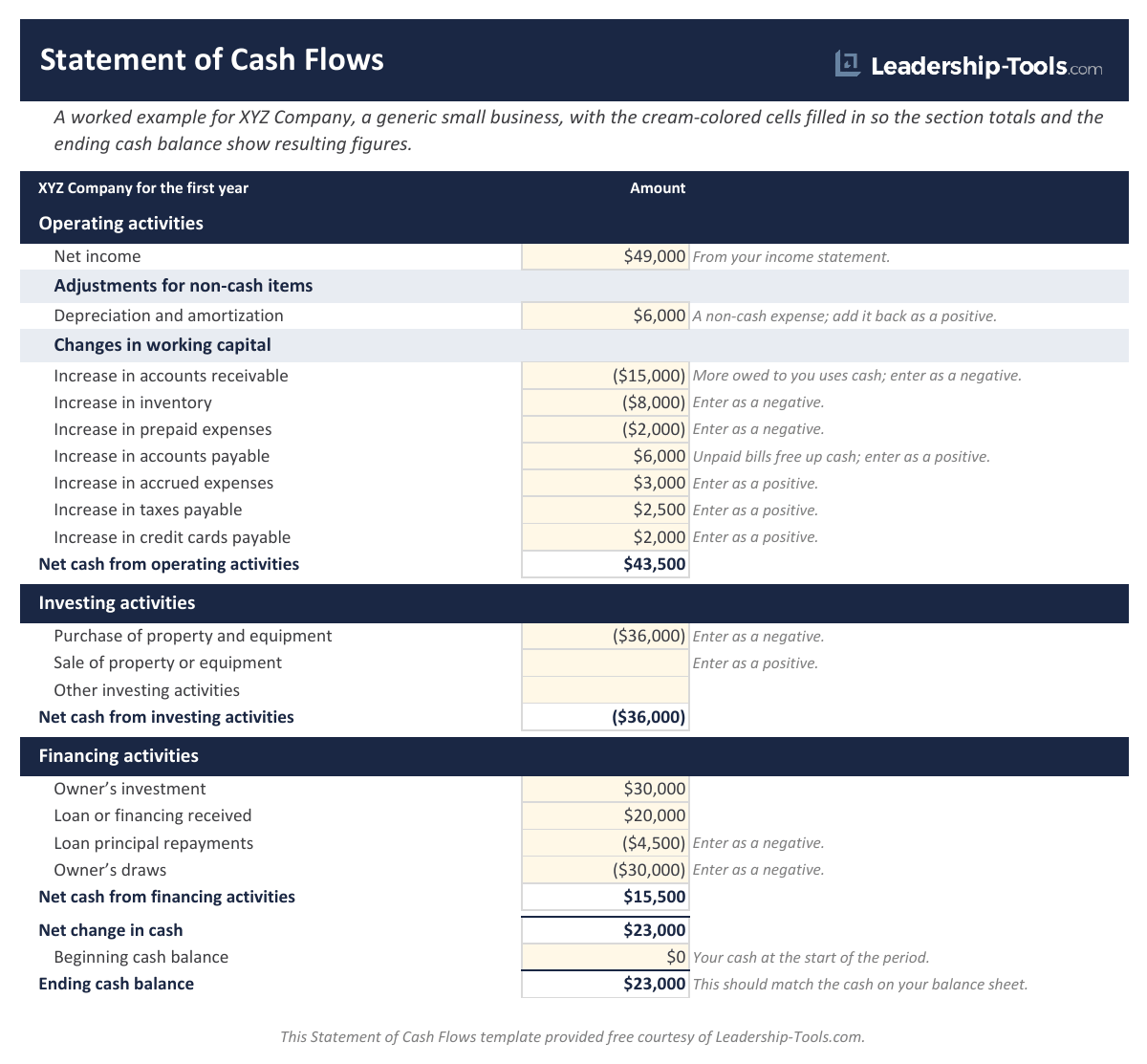
Investing is one line: $36,000 spent on equipment, vehicles and furniture. Real money out, and none of it appears as an expense on the income statement.
Financing nets to $15,500. The owner put in $30,000, a $20,000 loan came in, $4,500 of loan principal went back out, and the owner drew $30,000.
Add the three sections and the change in cash is $23,000. Starting from nothing, that's the closing balance, and it matches the cash line on the balance sheet exactly.
So the $26,000 difference between profit and bank balance isn't a mystery. It's sitting in unpaid invoices and inventory, it went into equipment, and a large part of it went home with the owner from draws.
The Three Sections of the Cash Flow Statement
Every cash flow statement, from a one-person business to a listed company, splits into the same three sections. They answer three different questions about where your money came from.
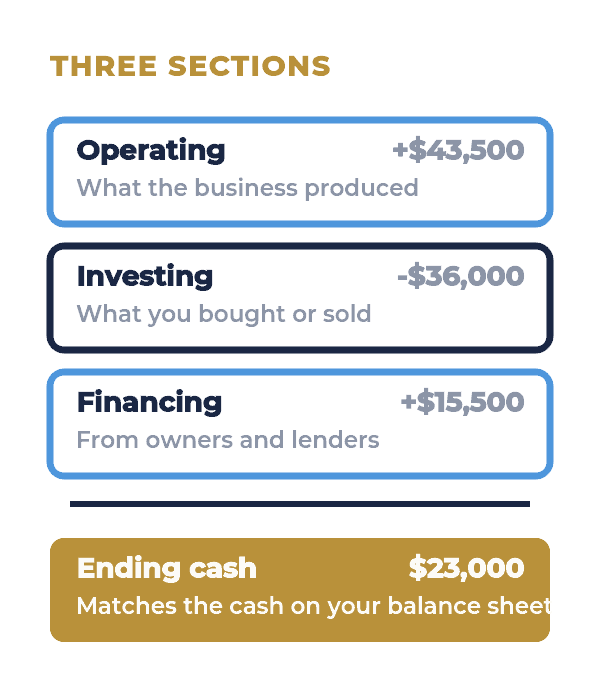
- Operating activities is the money your business itself produced by doing the work. It starts with net income, adds back anything that reduced profit without costing cash, and adjusts for the timing differences between earning money and receiving it. XYZ generated $43,500 here.
- Investing activities covers what you bought or sold that the business will use for years, such as equipment, vehicles, and property. XYZ spent $36,000 and note that none of that appears as an expense on the income statement, which is one reason profit and cash diverge.
- Financing activities is money moving between the business and the people who fund it. Owner contributions and draws, loans received, loan principal repaid. XYZ netted $15,500 after the owner put in $30,000, borrowed $20,000, repaid $4,500 of principal, and drew $30,000.
Add the three together and you have the change in cash for the period. Add that total to your opening balance and you have the closing balance, which should match the cash figure on your balance sheet to the dollar.
The order these three sections flow matters. A lender reads operating first, because a business that can't generate cash from its own operations is being kept alive by borrowing or by the owner's savings. Strong operating cash with heavy investing is a business that's growing. Weak operating cash propped up by financing is a business that's running on someone else's money.
Operating Activities, and Why Profit Isn't Cash
The operating activities section doesn't list your sales and expenses. Your income statement already did that. Instead it starts from net income and works backwards to the cash, adjusting for everything that made profit and cash differ during the period. Accountants call this the indirect method, and it's the format lenders want to see.
Two types of adjustments happen here.
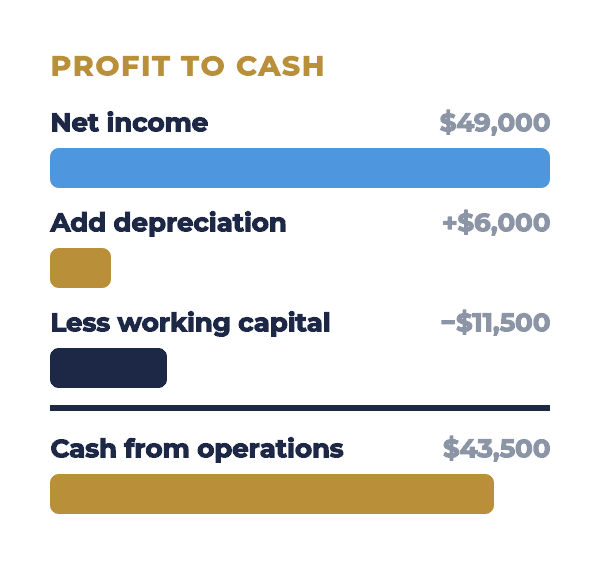
- Non-cash expenses get added back. Depreciation is the main one. XYZ recorded $6,000, which reduced profit by $6,000 without a dollar leaving the bank, so it gets added back. This is the line owners most often miss, and leaving it out understates your operating cash by exactly that amount.
- Working capital changes get adjusted. These are the timing gaps between earning money and holding it. The cash flow statement template provides instruction on every line, and the underlying rule to add or subtract the amount is simple once you see it.
When something you own grows your cash shrinks. Customers owed XYZ $15,000 more at the end of the year than they did at the start, which is revenue that XYZ has already counted but not yet collected, so it's subtracted. Inventory rose by $8,000, which is cash converted into goods sitting on a shelf. Prepaid expenses rose by $2,000, which is money handed over for something the business hasn't used yet.
When something you owe grows, your cash in maintained. XYZ owed suppliers $6,000 more than at the start of the year, and those bills were already counted as expenses even though the money hadn't gone out yet, so the cash was still in the account. The same goes for $3,000 of accrued wages, $2,500 of taxes payable and $2,000 on the credit card.
For XYZ, $25,000 went out into unpaid invoices, inventory and prepayments, while $13,500 stayed in the account because bills hadn't been paid yet. The difference is $11,500 of cash the business earned but didn't yet have. So start with $49,000 of profit, add back the $6,000 of depreciation, take off that $11,500, and you land on $43,500 of cash from operations.
That $5,500 gap between profit and operating cash is small because XYZ grew at a steady pace. Grow quickly and the gap widens fast, because every new customer means another invoice waiting to be paid and more inventory bought before any money comes in.
A business can be profitable and still maintain enough cash in the bank account, which is the most important lesson this section gives you.
Investing and Financing
These two sections are simpler, and between them they explain most of the remaining gap between profit and the available bank balance.
Investing covers what you bought or sold that the business will use for years rather than months. The cash flow statement template gives you three lines: purchases of property and equipment, sales of the same, and a catch-all for anything else. Money spent goes in as a negative, money received as a positive.
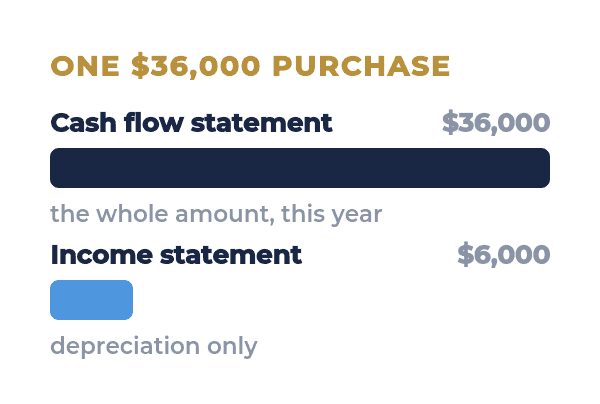
XYZ spent $36,000 on equipment, vehicles and furniture. The full $36,000 in cash came out of the bank account during the year. The income statement, meanwhile, recorded only $6,000 of that purchase as depreciation, because depreciation spreads the cost over the years you use the asset. So the same purchase reduced cash by $36,000 and reduced profit by $6,000. That single difference accounts for $30,000 of the gap between the two statements.
Financing is money moving between the business and the people who fund it. Owner contributions and loans received come in as positives. Loan principal repaid and owner draws go in as negatives.
XYZ had four lines here. The owner put in $30,000, the bank lent $20,000, $4,500 of loan principal was paid back, and the owner drew $30,000 for personal use. Add those up and the section nets to $15,500 coming in.
Two things to get right in this section. Record only the principal part of your loan payments here, because the interest is an expense and is already inside the net income figure at the top of the statement. And put owner draws here rather than on your income statement, since money you take home isn't a cost of running the business, even though it certainly reduces the cash.
Now the whole year fits together. XYZ made $49,000 of profit, turned $43,500 of it into cash, spent $36,000 on equipment, and took in $15,500 net from the owner and the bank. Add those last three figures and the bank balance rose by $23,000, which is exactly what the business had at year end.
Why This Isn't Just Your Bank Statement
A cash flow statement and a bank statement both track your money, so it would be natural to assume they are the same. The truth is they are quite different.
Your bank statement is a list tracking your deposits and withdrawals. It records every transaction in the order it happened and tells you the balance at the end. What it can't tell you is why the balance is what it is.
The cash flow statement provides greater insight. It takes the same money and sorts it by where it came from, so you can see whether your balance grew because the business is working or because you put your own money in.
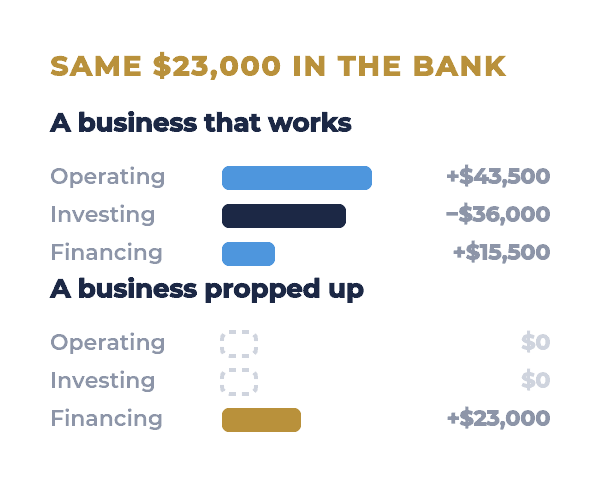
Picture two businesses that both finished the year with $23,000 in the bank. Their bank statements would look much alike. Their cash flow statements would not.
The first is XYZ Company. It produced $43,500 of cash from the work itself, spent $36,000 on equipment, and took in $15,500 net from the owner and a loan. This is a business paying for itself while investing in its own capacity.
The second business, ABC Company, produced nothing from operations, bought no equipment, and reached the same $23,000 because the owner put in $23,000 of personal savings. Identical bank balance, entirely different business.
A lender can tell those two apart in about ten seconds, and the first thing they look for is what's behind the cash balance. That's why they ask for this statement rather than just your bank statements.
"Entrepreneurs believe that profit is what matters most in a new enterprise. But profit is secondary. Cash flow matters most."
- Peter Drucker
What If the Numbers Aren't Working
The levers you can pull on a cash flow statement are different from the ones on an income statement. Here you're not changing what you earn, you're changing when the money moves.
- Collect faster. XYZ had $15,000 tied up in unpaid invoices at year end. Cutting that to $8,000, by invoicing the day work finishes rather than at month end, or by asking for a deposit up front, would put $7,000 into operating cash without selling anything extra. This is the biggest and fastest lever most small businesses have, and it costs nothing but the awkwardness of asking.
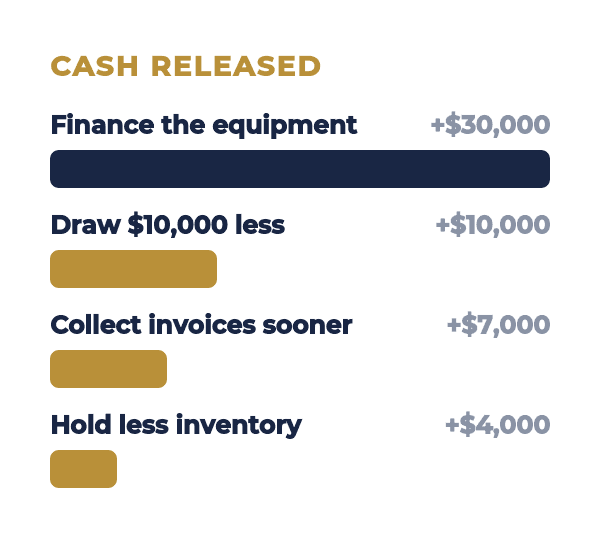
- Carry less inventory. Another $8,000 of XYZ's cash is sitting on a shelf or in a warehouse. Every dollar of stock you don't need is a dollar you can't spend. Reducing inventory releases cash immediately, though it can cost you sales if you run out of inventory to sell, so it's a lever that must be managed closely. Cutting by half the amount releases $4,000.
- Pay a little slower, within your terms. XYZ already holds $6,000 of supplier bills at year end. Using the terms your suppliers give you, rather than paying everything the day it arrives, keeps cash in your account longer. Stretching beyond agreed terms is a different thing, and it can cost you relationships and sometimes your credit rating can be impacted.
- Spread the big purchases. The $36,000 of equipment left the bank in one year. Financing it instead would move most of that out of investing and into small monthly repayments in financing, leaving up to $30,000 of that cash in the account during the year. You'd pay interest for the privilege, which is the trade.
- Draw less. The owner took $30,000 out. Every dollar left in the business is a dollar of cash that available for other things. Taking $20,000 instead of $30,000 leaves another $10,000 in the business.
Notice what isn't on this list. Nothing here changes your profit. Collect faster and you don't earn a cent more; you simply have the money sooner. That's why a business can fix a cash problem without fixing a profit problem, and why the two statements need to be read together rather than one instead of the other.
How the Three Statements Work Together
The cash flow statement sits in the middle of the income statement and the balance sheet. It takes a number from one and hands a number to the other.
The first line is net income, and it comes straight off your income statement. XYZ's $49,000 arrives here unchanged. If those two figures don't match, one of the statements is wrong.
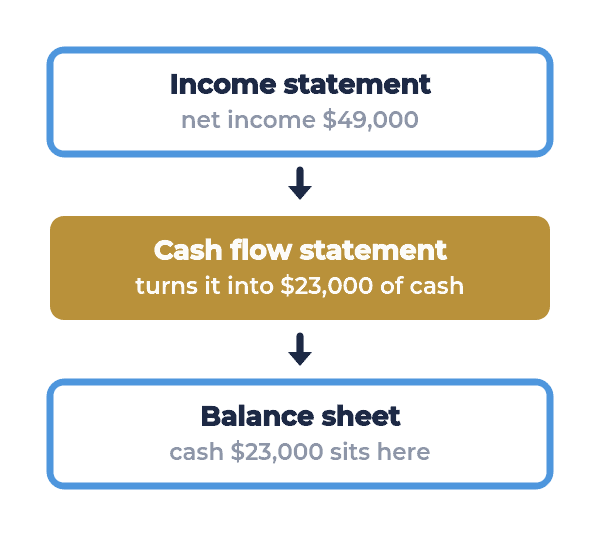
The last line is ending cash, and it belongs on your balance sheet. XYZ's $23,000 sits at the top of the assets section as cash and cash equivalents. Again, if they disagree, something upstream needs to be fixed.
Most of the adjustments in between come from the balance sheet too. The $15,000 increase in receivables, the $8,000 of inventory, the $6,000 owed to suppliers: each is the change in a balance sheet line between the start and end of the year. That's why building this statement is much easier if you have two balance sheets to compare.
The three statements answer different questions, which is why a lender wants all of them. The income statement says whether the year made money. The balance sheet says what you own and owe at the end of that year. The cash flow statement says whether the profit turned into money you can spend, meaning it's available in cash.
XYZ makes the case for reading all three. It earned $49,000, holds $78,000 of assets against $29,000 of debt, and finished with $23,000 in the bank. Three healthy numbers, and only by reading them together do you see that $15,000 of the profit is still with customers and $36,000 went into equipment.
Common Mistakes on a Cash Flow Statement
This is the statement people get wrong most often, and almost all of it comes down to two things: which direction a figure goes, and which section it belongs in.
- Getting the signs backwards. An increase in what customers owe you takes cash away, while an increase in what you owe suppliers leaves cash in your account a while longer. Reverse those and your operating cash can swing by thousands in the wrong direction, which is why the cash flow statement template provides direction beside every line.
- Leaving depreciation out. It reduced your profit without a dollar leaving the bank, so it has to go back on, and skipping it understates your operating cash by exactly the amount you recorded.
- Putting the whole loan payment in financing. Only the principal belongs there, because the interest is an expense that's already inside the net income figure at the top of the statement, and counting it twice makes your cash look worse than it was.
- Putting owner draws in operating. Money you take home isn't part of running the business, so it belongs in financing, and leaving it in operating makes the business itself look far less productive than it is.
- Recording an equipment purchase as an expense. The full amount goes in investing in the year you paid for it, while the income statement spreads the same purchase across several years as depreciation. Put it in the wrong place and the two statements stop agreeing.
- Mixing the period. Every figure has to cover the same span, and the working-capital lines have to be the difference between the start and end of that same span, or the statement is comparing two different businesses.
- Skipping the check at the bottom. Your ending cash has to equal the cash on your balance sheet, and the cash flow statement template does that comparison for you, so a mismatch is telling you something further up needs another look.
- Building it once a year. An annual statement tells you what already happened, whereas a quarterly one still gives you time to collect faster or delay a purchase while it can make a difference. Monthly provides even greater flexibility.
The Rest of the Business Planning Toolkit
The cash flow statement template is one of seven free tools built to work together on a complete business plan.
- Business Plan Template and Guide: The written plan your financial statements belong in, with a step-by-step guide to every section a lender expects to read.
- Income Statement Template: Tells you whether the year made money, and hands the net income figure that becomes the first line of this statement.
- Balance Sheet Template: Shows what the business owns and owes at a point in time, and it's where your ending cash figure has to land if the two agree.
- Business Plan Financial Workbook: Builds all three statements for a business that hasn't opened yet, working from three input tabs of startup costs, sales and expenses.
- Mission Statement Template: Allows you to create a short statement of purpose that opens a business plan.
- Business Plan Appendix: Where the supporting documents go when a lender asks to see the full statements rather than your summary of them.
All three statement templates run on the same business, XYZ Company, with the same set of figures, so you can pick one number and follow it from the income statement through this one and onto the balance sheet.
Which tool you want depends on whether the business exists yet. Use the workbook to project a first year that hasn't happened, and use these three statement templates to report on a period that has been completed.
Frequently Asked Questions
Questions most often asked about the cash flow statement template.
Click on the (+) sign below to expand each question. Click the (-) sign to collapse it again.
What is a cash flow statement?
Is the cash flow statement template free?
Yes. The template downloads free in PDF, Excel, and Google Sheets, with no email or signup required. Subscribing to the newsletter is optional and gets you the whole tool library on one page.
Do I need Excel to use it?
No. The Google Sheets version calculates the same way and runs free in any web browser, so you can fill it in online with nothing to install. The PDF includes both the blank statement and the finished example if you'd rather read it through or work on paper.
Why doesn't my profit match my bank balance?
Because the two measure different things. Profit counts a sale the moment you earn it, even if the customer hasn't paid, and it spreads the cost of equipment over several years. Your bank balance only moves when money changes hands. The cash flow statement exists to explain the gap between the two.
What are the three sections of a cash flow statement?
Operating, investing and financing. Operating is the cash your business produced by doing the work. Investing is what you spent on or received from equipment, vehicles and property. Financing is money moving between the business and its owners or lenders, including loans and owner draws.
What is the indirect method?
It's the format this cash flow statement template uses, and the one lenders expect. Rather than listing every payment you made, it starts with your net income and adjusts it back to cash, adding non-cash expenses like depreciation and accounting for the timing gaps between earning money and receiving it.
Why is depreciation added back?
Because it reduced your profit without any money leaving the bank. Depreciation spreads the cost of equipment across the years you use it, so it appears as an expense on your income statement in years when you paid nothing. Adding it back takes you from profit toward the cash you have in hand.
How do I handle a loan payment?
Split it in two. The principal portion belongs in financing, because it's money going back to the lender. The interest portion is an expense that's already inside the net income figure at the top of the statement, so recording it again in financing would count it twice.
Where do owner draws go?
In the financing section, as a negative. Money you take home isn't a cost of running the business, so it never appears on your income statement, but it certainly reduces your cash and belongs here.
Can I use this for a monthly cash flow statement?
Yes. The cash flow statement template works for any period, as long as every figure covers the same span. Monthly is the most useful cadence for a small business, because it shows a problem while there's still time to do something about it.
What if my ending cash doesn't match my balance sheet?
Something above it needs another look, and the cash flow statement template flags the mismatch for you. The usual causes are a working capital change entered with the wrong sign, depreciation left out, an equipment purchase recorded in the wrong section, or a net income figure that doesn't match the income statement.
Is a cash flow statement the same as a cash flow forecast?
No, and the difference is timing. This statement reports a period that has already finished, using figures you can verify. A forecast projects a period that hasn't happened yet. If you're planning ahead rather than reporting back, the Business Plan Financial Workbook does that job instead.
Download Cash Flow Statement Template

Want the entire leadership tools library? Subscribe to our free newsletter and we'll send you a link to every tool on this site, all on one page, sorted by leadership phase. Every tool is free to download on its own page. The library just puts them in one place. Plus, you'll never miss out on updated or new tool announcements.
Your privacy is important to us. We never share or sell email addresses.
More Business Planning Tools




Contact Information:
phone
(503) 970-9777
Email Customer Service
helpsupport@leadership-tools.com
Email Richard
richard@leadership-tools.com

By Richard Gorham
Leadership-Tools.com
2879 Riverwalk Loop, Eugene, Oregon, 97401
Copyright (c) 2002 - 2026 All Rights Reserved