Greater Than Yourself
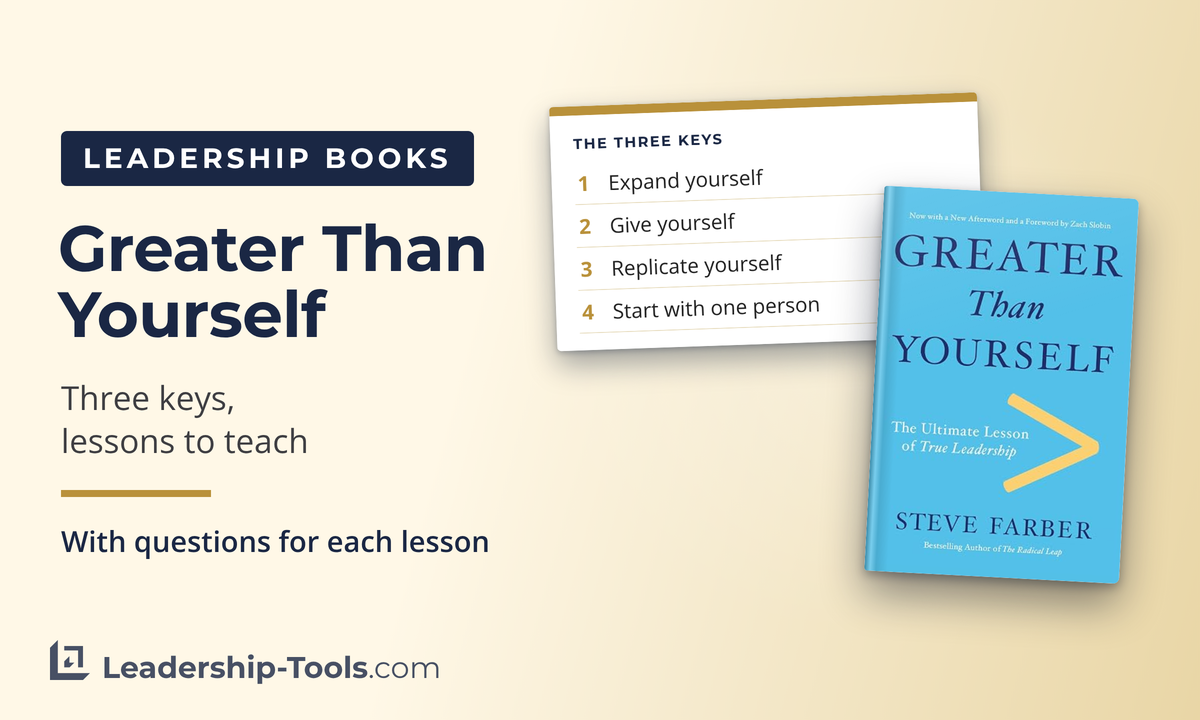
Greater Than Yourself by Steve Farber teaches that the greatest leaders make others greater than themselves, and it gives managers a simple way to start, by choosing one person and helping them grow past you. Farber calls that person your GTY project, and the book walks through three keys to doing it well.
Farber starts from the Golden Rule. He points out that some version of it shows up in nearly every religion and school of thought, and none of them carries a footnote saying it doesn’t apply from 9 to 5 or wherever a paycheck is involved. At work, though, it can feel like the exception, and many of us have been taught that someone else’s success takes something away from ours.
Teachers and coaches already see it the other way. A high school football coach counts it as a win when a former player makes the NFL, even while the coach is still on the same high school field, and Farber asks managers to measure their own success the same way. The leaders he’s met who built a reputation for turning out star after star rarely put the spotlight on themselves.
The lessons on this page work for any manager with someone on the team who’s ready to grow. They also work for the mentor, because one of the fastest ways to master something is to help someone else learn it.
The book first came out in 2009, and the current edition adds a foreword by Zach Slobin and a new afterword on the social science behind the idea. You’ll find Greater Than Yourself on Amazon.
Greater Than Yourself Summary
Farber tells the book as a story built around a forward-thinking and very successful CEO, and he mixes in real examples from people who practice the idea. Along the way, the story lays out three keys to making someone greater than yourself:
- Expand Yourself: keep growing your knowledge and your network, so you have more to give. Farber’s twist is that you grow for the other person’s advancement as well as your own.
- Give Yourself: share what you know, who you know and what you’ve learned, the way a philanthropist gives to a cause. Farber notes that philanthropy comes from the Greek for love of mankind, and this kind of giving doesn’t take money.
- Replicate Yourself: ask the person you’re lifting up to do the same for someone else later. It’s the one string attached, and it’s how the values get passed on.
A GTY project comes with a few conditions. You pick one person and tell them what you’re doing, they agree to it, and they agree to do the same for someone else down the road.
Farber says the leaders he studied were great mentors, but he saw something more personal in what they did. With a GTY project you set out to raise one person above yourself, you tell them that's the goal, and the one thing you ask in return is that they do the same for someone else.
Farber’s Overview of Greater Than Yourself
In this four-minute overview, Farber explains the idea in his own words, from the Golden Rule to choosing your first GTY project. He adds a warning, too. A GTY project can backfire if the person uses what you’ve given them against you, so give the choice the thought it deserves.
What a GTY Project Looks Like
A GTY project starts with one name and one conversation. The example below follows a credit union manager through her first six months.
DANA'S GTY PROJECT
The choice: Dana runs the member service team at a credit union, with eight member service reps. She chose Luis, two years into the job, because he’d started helping new hires on his own and kept asking how the lending side worked.
Telling him: Over coffee, she told Luis she wanted to help him grow past her own job and asked if he was in. He said yes, and she asked for one thing back, which was that someday he’d do the same for someone else.
Expand and give: Dana signed up for the consumer lending class she’d been putting off, so she’d have more to teach him. They met for 30 minutes every other Thursday, she brought him to her monthly meeting with the lending manager, and she let him run the Monday huddle twice a month.
Six months later: Luis was promoted to lead member service rep, and by spring he’d chosen Kayla, a new rep, as his own GTY project.
Dana gave her time and her contacts, and Luis passed the same thing on to Kayla.
"The greatest leaders make others greater than themselves."
- Steve Farber
Leadership Lessons From Greater Than Yourself
Each lesson below includes a clip of Farber talking with Jack Canfield on his podcast, set to start and stop where the lesson does.
Click on the (+) sign below to expand each lesson. Click the (-) sign to collapse it again.
Make Someone Greater Than You
Phase: Leading People
Objective: Choose one person and set out to help them grow past you, asking nothing back except that they do the same for someone else.
The story: Farber noticed that the greatest leaders he’d worked with became great by making others greater than themselves, and they rarely took credit for the results. He walks through his three keys and suggests starting with one person, who becomes your GTY project. The only thing you ask in return is that they pass it on to someone else.
Resource: Steve Farber on the Jack Canfield podcast, 33:54 to 39:44
Time: About 6 minutes
Questions:
- Who has helped you grow, and what did they give you?
- Who could you choose as your own GTY project, and what would you share with them first?
Tool to try: Performance Coaching Toolkit
Don’t Wait Until You’ve Arrived
Phase: Leading Self
Objective: You don’t have to finish working on yourself before you help someone else grow.
The story: Farber hears a common excuse for putting off a GTY project, which is “I’m still working on myself.” He points out that if that were the rule nobody would ever help anybody, because we all have further to go. He’s seen middle school students take on other students as GTY projects without stopping to ask whether they were ready.
Resource: Steve Farber on the Jack Canfield podcast, 43:13 to 44:46
Time: About 1½ minutes
Questions:
- What do you know now that someone newer on the team could use?
- What has kept you from mentoring someone?
Tool to try: Growth Roadmap Template
Start With One Person
Phase: Leading People
Objective: When you lift up one person and ask them to pass it on, the effect can reach people you’ll never meet.
The story: Jill Schulen, a middle school principal near St. Louis, asked her teachers to each take on a GTY project, and several chose a student. Halfway through the year, Mr. Woodmore learned that his eighth grader was moving to another state, so before the boy left he explained what their relationship had been about. The first thing the boy did at his new school was take on a sixth grader as his own GTY project.
Resource: Steve Farber on the Jack Canfield podcast, 46:41 to 51:18
Time: About 4½ minutes
Questions:
- Who helped you when you were new, and did you pass it on?
- Who on our team could take a newer person under their wing this quarter?
Tool to try: Succession Planning Template
How to Teach Greater Than Yourself to Your Team
The approach I use with any book is to assign a chapter to a team member, who reads it and leads the discussion at a team meeting. The full steps are on Leadership Books for Managers. Greater Than Yourself is told as a story, so it also works well as a book the whole team reads over a few weeks.
Once people start choosing GTY projects, two free tools help. The Succession Planning Template shows who’s ready for more and what they still need, and the Performance Coaching Toolkit helps you plan the coaching. To plan the team discussion, use the free planner on Leadership Lesson Plans.
Greater Than Yourself FAQ
The questions below address what leaders most commonly ask about Greater Than Yourself.
Click on the (+) sign below to expand each question. Click the (-) sign to collapse it again.
What is Greater Than Yourself about?
Greater Than Yourself by Steve Farber is a leadership book about helping another person become more capable and accomplished than you are. It's told as a story about a successful CEO, and it lays out three keys: Expand Yourself, Give Yourself and Replicate Yourself.
What are the three keys of Greater Than Yourself?
Expand Yourself means growing your own knowledge and network so you have more to give. Give Yourself means sharing what you know and who you know with another person. Replicate Yourself means asking that person to do the same for someone else.
What is a GTY project?
A GTY project is the person you choose to help become greater than yourself. You tell them what you're doing, they agree to it, and they agree to do the same for someone else later.
Can a GTY project backfire?
Farber admits it can, if the person uses what you've given them against you. He puts that down to choosing the wrong person, so he advises giving the choice the thought it deserves.
Is there a new edition of Greater Than Yourself?
Yes. The book first came out in 2009, and the current edition adds a foreword by Zach Slobin and a new afterword on the social science behind the idea.
Who is Steve Farber?
Steve Farber is the founder and CEO of the Extreme Leadership Institute and a leadership speaker. His books include The Radical Leap, The Radical Edge, Greater Than Yourself and Love Is Just Damn Good Business, and Greater Than Yourself was a Wall Street Journal and USA Today bestseller.