Team goal setting is the process of choosing one goal for a team, writing it so every member would describe success the same way, and splitting the work into activities that each have one owner. The team then reviews progress in a short meeting each week until the goal is reached.
- Home
- Leading Teams
- Free Team Building Activities
- Team Goal Setting
Team Goal Setting
Team goal setting starts by asking a few people on your team what success looks like. Would they give you the same answer? It's a simple way to test whether the goals you have set resonate with the people responsible for achieving them. A team goal that passes that test has been clarified by the purpose, assigned to a person or group, with a number and a timeline attached.
A goal that is owned solely by the leader or another individual is limited by that person's time and energy. The same goal spread across a team, with each person owning a piece, has a greater chance for success. The leader spends less time doing the work and more time making sure people have what they need and that each assigned piece is on track.
The free Master Action Plan (M.A.P.) template holds the whole plan on one page, with the outcome, why it matters, the activities that move the goal forward and who owns each one, the barriers you expect, and a five-day planner for the week ahead. It's the same tool taught in our free Goal Setting for Success ebook, and the six steps below show how to use it with a team.
Jump To: 1. Choose a Goal | 2. Write the Outcome | 3. Team Plan | 4. Present the Goal | 5. What’s in It for Them | 6. Weekly Meeting | Activities | Example | Five Mistakes | More on Goals | FAQ
Step 1: Choose the Right Team Goals
When team goal setting happens too quickly or too often, the goal is usually related to whatever made the most noise that week. A customer complaint comes in, and a few days later fixing it is the team's primary focus for the quarter. Sometimes a recent issue does warrant being the urgent thing, but a year of goals chosen that way demonstrates a lack of planning and prioritization, and risks making little progress in the parts of the job that matter most.

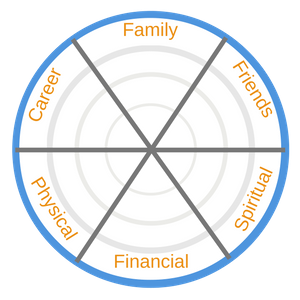
By taking a snapshot of where you are as a leader on the most important priorities for the team, you can confirm areas of strength and where you should invest additional focus. Take a blank Life Balance Success Wheel and replace the personal categories with six categories of your work. Categories might include things such as coaching and development, customer experience, sales performance, operations, training or risk management.
Customize the categories most important in your role, then score each one from 1 to 10. Lena, a sales manager with a team of eight, gives sales performance a 9 and customer experience a 5, after a year when accounts kept leaving at renewal time. The 9 is in good shape, so the goal is to simply maintain that level. The 5 is where a team goal will make the biggest difference, and anything at 6 or below is worth a closer look. Business impact should also influence which goal comes first.
Then turn the low score into something the team can work toward. For Lena, the weak spot is renewals, where the rate has slipped to 82 percent, so her team's goal will be about keeping more of the accounts that come up for renewal. Score the wheel again each quarter for an updated snapshot of performance. When you have the option, talk through the low scores with your team before you settle on a goal, because people who help determine a goal tend to own it.
Step 2: Write an Outcome Everyone Understands
Write the goal down, then ask each team member what success would look like by the due date. If one team member says happier customers and another says fewer complaints, the outcome needs to be clarified for all.
| Fails the test | "Improve customer satisfaction." Two people could read this and picture two different results, and there's no date that tells anyone when to check. |
| Passes the test | "Raise our renewal rate from 82 percent to 87 percent over the next 90 days, across all accounts assigned to the team." Anyone on the team can pull the renewal report on day 90 and see whether the team got there. |
The passing version has a number, a timeline and a scope, and scope matters more on a team than it does for one person, because it tells everyone whose results count. If the goal covers only the accounts your team manages, say so in the outcome.
Step 3: Turn the M.A.P. into a Team Plan
The Master Action Plan (M.A.P.) has the same five fields whether the goal is yours or the team's. What changes on a team is who owns each piece and how the action plan gets used between meetings.
- Outcome. Write the stated goal from Step 2, at the top of the page where everyone sees it.
- Motivation. A team goal has two reasons behind it. The organization's reason goes on the shared M.A.P., where it shows how the team goal aligns with what the department or company is working toward. Each person's own reason gets added to their own copy, somewhere they'll see it on a regular basis.

- High Impact Activities. Every activity gets one name in the owner column, even when others help. On Lena's team, calling every account that renews in March is James's assignment, and sending the renewal quotes is Maria's responsibility. If two names end up sharing a line, split the activity until each piece belongs to one person, because shared ownership lets each person assume someone else is taking the lead. If you do allow two or more owners, make sure each of them understands they're fully responsible for the result.
- Barriers & Solutions. Ask the team to name the barriers in a planning meeting rather than filling them in yourself. Someone on the front line may name an obstacle you wouldn't have guessed, such as a system that doesn't flag an account until two weeks before it expires. It's the barriers perceived by the people responsible for the goal that matter the most. Write down each barrier and its planned response on the M.A.P. before the meeting ends.
- 5-Day Planner. Each person keeps a planner for the activities they own, and you keep one for yours. The weekly meeting is where the planners are used to report on progress for each area of ownership.
Step 4: Present the Goal to Your Team
Once all the plans are drafted, review with the entire team to ensure everyone is aligned on who is responsible for what. Everyone on the team should understand the desired outcome of the team goal setting process. Lena presented her draft in the following five sentences.

ANNOUNCING A TEAM GOAL
"Over the next 90 days, our goal is to raise our renewal rate from 82 percent to 87 percent across all accounts. We chose this because keeping current customers is the fastest way to grow the business, and it protects the team. We'll get there by improving our follow-up process, responding to support tickets within two business hours, and checking in with key accounts once a month. The company will support us with updated tools and a half day of training next week. If we hit this together, it means more stability for the team, real evidence on each of your performance records, and a stronger foundation for next year."
Each sentence answers one important question: what the goal is, why it was chosen, how you'll reach it, what support is coming, and what it means for the team. Change the words to fit your situation, but the order presented here holds up well in most cases.
Expect most of the questions to come at the first weekly meeting after the goals are finalized, once people have had a few days to think. Leave room for those discussions on the agenda that week. If additional barriers are identified, write them onto the M.A.P. and work quickly to solve them.
Step 5: Ask What’s in It for Them
In the days after announcing the team goal, ask each person in a one-on-one meeting what changes for them if the team reaches the goal. "When we hit this goal and you are successful in your areas of ownership, what changes for you that you'd want?"
This time use the Life Balance Success Wheel to help guide the discussion. Hand them a wheel with six common work-related categories filled in. Work with each team member to score each one from 1 to 10, asking how achieving the team goal will impact each of the six categories.
- Compensation: how much money the person will make.
- Professional Development: skill building and preparing for future opportunities.
- Recognition: whether their work gets noticed and credited.
- Autonomy: how much say they have over how they do their work.
- Workload: whether the amount of work, and the parts that wear them down, feel manageable.
- Team Member Relationships: how well they work with the people around them.
Pay close attention to scores rated less than 6. Lower scores reflect areas of opportunity that require additional focus and coaching. Maria scored professional development a 4, and she'd like to learn how to run the quarterly account reviews Lena handles now. James scored compensation a 4, and for him it's the renewal bonus. Write each answer on that person's own copy of the M.A.P., in their words, somewhere you both will see it regularly during your one-on-one discussions.
A goal presented with only the organization's reason behind it tends to get compliance, with people doing what's asked of them, but not much more. The extra effort taken late in the day or the follow-up call nobody asked you to do usually comes from a personal commitment, which is why it's so important to help your team define what's in it for them.
Some people will understand and support the goal without naming a personal reward, and that’s fine.
Step 6: Keep the Goal Alive Each Week
Review progress on goals as a team weekly. Each team member shares with the group how it's going in their assigned area(s) of ownership.

Each person answers four questions: whether the goal is on track or off track, what they committed to last week, what got done and what didn't, and what they're committing to next week. James might say he's on track; he committed to calling the 12 accounts that renew in March, reached nine of them, and will call the other three before the next meeting.
As each person reports out, ask if there are any new barriers. When someone names a barrier, the team helps think through a response, and you update the M.A.P. before anyone leaves the room.
Keep the meeting moving along to ensure everyone has time to report out. Twenty to thirty minutes is typically sufficient time for everyone to share their update, but adjust the allotted time to your situation. A long meeting tends to turn into a round of updates nobody wants to sit through, so manage the time closely.
"Talent wins games, but teamwork and intelligence wins championships."
- Michael Jordan
Team Goal Setting Activities
Both of these team goal setting activities work as goal setting exercises for teams, and each fits inside a regular team meeting. Run one at the meeting where you introduce a new goal, or use one to restart a goal that's lost momentum.
Details for Results
Ask everyone to write down a vacation they'd like to take, and give them a few minutes to list everything that has to happen for it to go well. Walk them through it in order. Start with what needs to be done before they leave their home, such as booking travel, arranging care for a pet and handing off their work. Next, have them list what they'll plan for while they're away, like meals and activities, along with a daily budget that leaves a little room for extras. Finish with what has to happen when they get back, from unpacking to catching up on email. Ask the team to be as detailed as possible.
Most lists will run longer than people expect. Ask the group how many of those details would have caused a problem if nobody had written them down. Then take one of the High Impact Activities from your M.A.P. and have the group list its details the same way, from what has to happen first to what has to happen once it's done.
Doing this exercise will highlight the importance of thinking through the details to ensure a successful outcome.
Play-It Backward, Flip-It Forward
Write the team goal at the top of a whiteboard and ask the group a backward question. What could we do that would guarantee we miss our goal? Let the answers come fast and expect a few laughs, such as skipping the weekly meeting for a month or letting everyone assume someone else is calling the key accounts. Write every answer down on the left side of the board.
Then go back through the list and flip each answer into something the team will do. "Skip the weekly meeting" becomes "hold the meeting every week, even when it's a short one." "Assume someone else has it" becomes "every activity is assigned an owner." The flipped list goes onto the M.A.P., with the most useful items added as High Impact Activities and the rest as barriers with their solutions.
People usually find it easier to name what would go wrong than to describe a perfect plan, and a team that has called out a potential pitfall will be prepared to handle it quickly when it occurs.
For an activity that looks at the risks in a project before it starts, try What Went Wrong? from the free team building activities guide.
Team Goal Example: Cutting Turnover from 18 to 10 Percent
David is a new department head at a mid-sized technology firm, and he inherited a team of 12. Voluntary turnover in the department had been 18 percent over the previous year, against a company average of 9 percent, and the exit interviews kept pointing to two things. People felt invisible to leadership, and they couldn't see a path for career development.
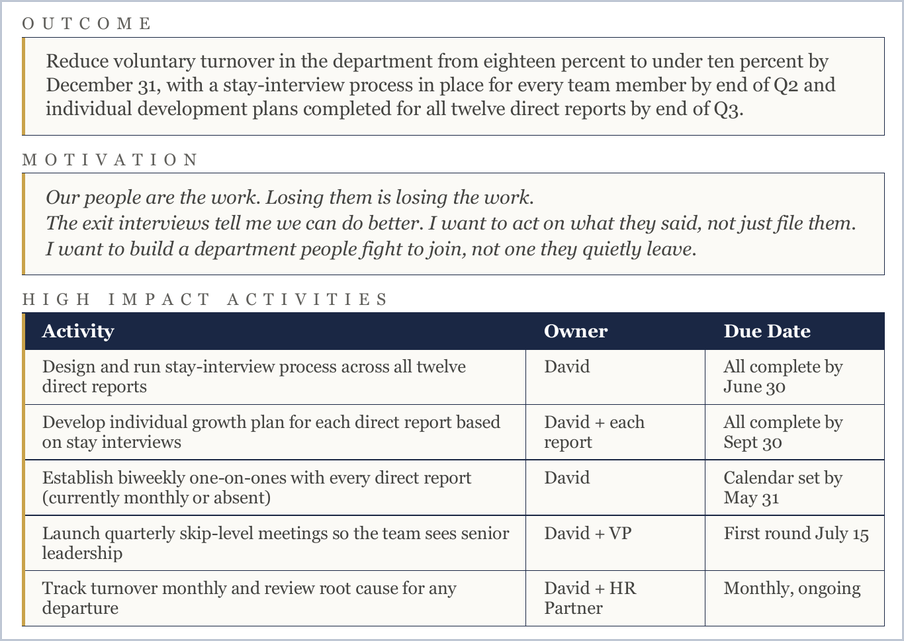
Each High Impact Activity answers one of the exit interview themes. Biweekly one-on-ones and quarterly skip-level meetings with his VP give people more time with leadership. The stay interviews feed a growth plan for each person, and those plans give everyone a path for career development. Three activities carry a second name for ownership next to David's: his VP on the skip-levels, his HR partner on tracking turnover, and each direct report on their own growth plan. Co-ownership works there because each person treats the result as fully theirs, and David carries the stay interviews and the one-on-ones on his own.
Turnover is the organization's reason, and the reason each person carries is their own. In every stay interview David asks the same question, "If this department becomes the kind of place you wish to stay at, what changes would you want to see?" One person wants a defined path to promotion. Another wants to have more input over technical decisions, and a third wants to build coaching skills for a future role. Those answers go into each person's development plan next to the team outcome.
His first week's planner starts small. He drafts the stay-interview questions and shares them with his HR partner, puts all 12 conversations on the calendar, holds the first one with his longest-tenured person, and sets up the biweekly one-on-ones as recurring meetings.
Five Team Goal Setting Mistakes
| Mistake | What to do instead |
| Choosing the goal that made the most noise this week | Score your role on the Life Balance Success Wheel first, and set the goal where a category sits at 6 or below. |
| Writing an outcome only you understand | Ask each team member what success looks like. If their answers differ, add the number, deadline or scope that's missing. |
| Putting two names on one activity | Split it until each piece has one owner, or make sure both owners treat the result as fully theirs. |
| Presenting only the organization's reason | Ask each person what changes for them if the team hits the goal, and have them write it on their own copy of the M.A.P. |
| Announcing the goal and moving on | Hold a 20 to 30-minute meeting each week where progress on the goal is reviewed, and update the M.A.P. with any changes. |
More on Goals and Team Building
A team building activity can help a team agree on what to change, and a team goal setting exercise gives that change a number and a deadline. Start, Stop, Continue is a good activity to run before you set the next goal.

Free Team Building Activities
12 short exercises for a regular team meeting, with a free Leader's Guide to download.

Personal Goal Setting
For the goals you set for yourself, using the free Goal Setting for Success course.
Life Balance Success Wheel
For scoring your role before you choose a goal.

Accountability Team Building Activities
Activities that help a team keep its commitments to each other, with the setup, timing and follow-up for each one.

Team Building Lesson Plan
A complete 60-minute team building session with an objective, materials, a timed agenda and debrief questions.
Frequently Asked Questions
The questions below address what leaders most commonly ask about the team goal setting process.
Click on the (+) sign below to expand each question. Click the (-) sign to collapse it again.
What is team goal setting?
What are some examples of team goals?
A sales team might aim to raise its renewal rate from 82 percent to 87 percent over the next 90 days, across all accounts. A department with high turnover might aim to reduce voluntary turnover from 18 percent to under 10 percent by December 31. Both have a number, a deadline and a clear scope.
How do team goals connect to individual goals?
Each person owns one or more of the activities behind the team goal, and those activities become their individual goals. Each person also writes their own reason for caring about the goal on their copy of the M.A.P., so the team outcome stays the same while the motivation is personal.
How often should a team review its goals?
Once a week, in a 20 to 30-minute meeting where goal progress is reviewed. Each person reports whether the goal is on track or off track, what they committed to last week, what got done and what didn't, and what they're committing to next week, and the M.A.P. is updated during the meeting. Choose the next goal once a quarter with the Life Balance Success Wheel.
What if a team member can't see a personal benefit in the goal?
Treat it as useful information. Sometimes the goal doesn't serve that person, and thanking them for saying so, then asking what would make their part of the work more worthwhile, builds trust. Other times they haven't thought about what they want yet, and asking, "If we hit this goal, what changes for you that you'd want?" helps them start.
How do I set a goal with people I don't manage?
Bring a draft M.A.P. to the conversation with the outcome, the reason behind it, and the activities you'd like them to own, then ask them to mark up what doesn't fit and add what you've missed. People who help shape a goal tend to commit to it more readily. You can't require a weekly meeting, but you can propose a short one with a specific time and length.
Do team goals need to be SMART?
A SMART goal works, but a simpler test catches most problems. Ask a few people on the team what success looks like. If they'd describe it the same way, and the goal has a number and a deadline, it's ready to plan.
Free Tools for Setting and Tracking Goals



Richard Gorham has led teams in financial services for more than 30 years, from retail branches and operations to investments and insurance, and he still leads a team today.
He founded Leadership-Tools.com in 2002 to give managers free, practical tools like the ones he used in his various leadership roles. Every tool here has been used in a real workplace and comes with a filled-in example you can follow.

Contact Information:
phone
(503) 970-9777
Email Customer Service
helpsupport@leadership-tools.com
Email Richard
richard@leadership-tools.com

By Richard Gorham
Leadership-Tools.com
2879 Riverwalk Loop, Eugene, Oregon, 97401
Copyright (c) 2002 - 2026 All Rights Reserved