A balance sheet shows what a business owns and what it owes on one particular day. Assets are listed on one side, liabilities and the owner's equity on the other, and the two sides always match. It's a snapshot of a single date rather than a record of a period.
- Home
- Leading Teams
- Business Plan Template
- Balance Sheet Template
Balance Sheet Template (Free Excel, Sheets & PDF) with an Annotated Example
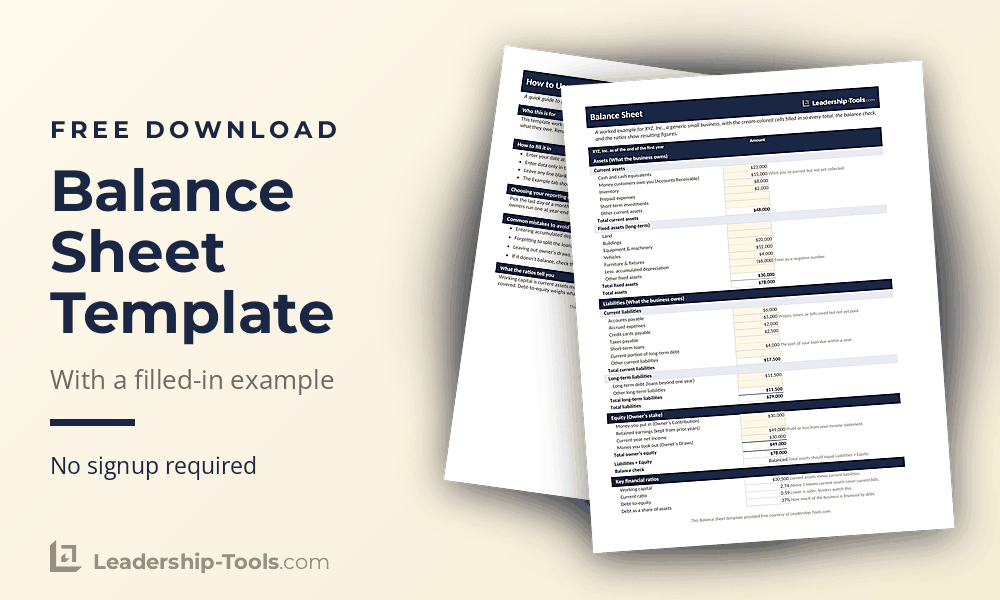
Our balance sheet template helps you answer one question: what does the business own, and what does it owe, on at a single point in time? This free template answers it for you. Fill in the cream-colored cells and every subtotal, the balance check and four lender ratios calculate automatically.
Download Free Balance Sheet Template
It's built for a small business rather than a corporation, and it's laid out in the way a lender will expect to see it. Every line carries a plain-English note beside it, so you'll know what belongs in "accrued expenses" without needing to look it up.
Free, with no signup and no password. The template is comprised of three tabs: a short How to Use guide, the blank Balance Sheet template, and a finished Example for XYZ Company at the end of its first year.
Jump To: Which Format to Pick | An Annotated Example | Assets | Liabilities | Equity | The Four Ratios | What If the Numbers Aren't Working | How the Three Statements Connect | Common Mistakes | The Full Toolkit | FAQ | Download Template
Which Format to Pick (Excel, Sheets, or PDF)
All three versions contain the same balance sheet. The difference is what you can do with it.
Excel is the one most people want. It calculates results automatically as you enter data, the ratios update on their own, and you can save a copy for each year end. Pick this one if you have Excel and plan to use the balance sheet template more than once.
Google Sheets works the same way and runs free in any browser, with nothing to install. Click the link, choose File then Make a Copy, and you have your own version. Pick this one if you don't have Excel.
PDF doesn't calculate, so you'd be adding up the columns yourself. It's still worth having, because it includes the finished example and reads well on paper or on a phone. Pick this one to read through before you start, or to print and fill in by hand.
Whichever you choose, start on the Example tab. Seeing a finished balance sheet with real numbers takes about two minutes and gives you a solid sense of what you'll be getting after completing the template.
An Annotated Balance Sheet Example
This is XYZ Company at the end of its first year, and every line carries a note explaining what it means. These notes help direct new business owners on how to properly complete the balance sheet.
The business owns $78,000. Of that, $48,000 is current assets, meaning cash or things that turn into cash within a year: $23,000 in the bank, $15,000 customers still owe, $8,000 of inventory and $2,000 of prepaid expenses. The other $30,000 is fixed assets, which is the equipment, vehicles and furniture, already reduced by $6,000 of accumulated depreciation.
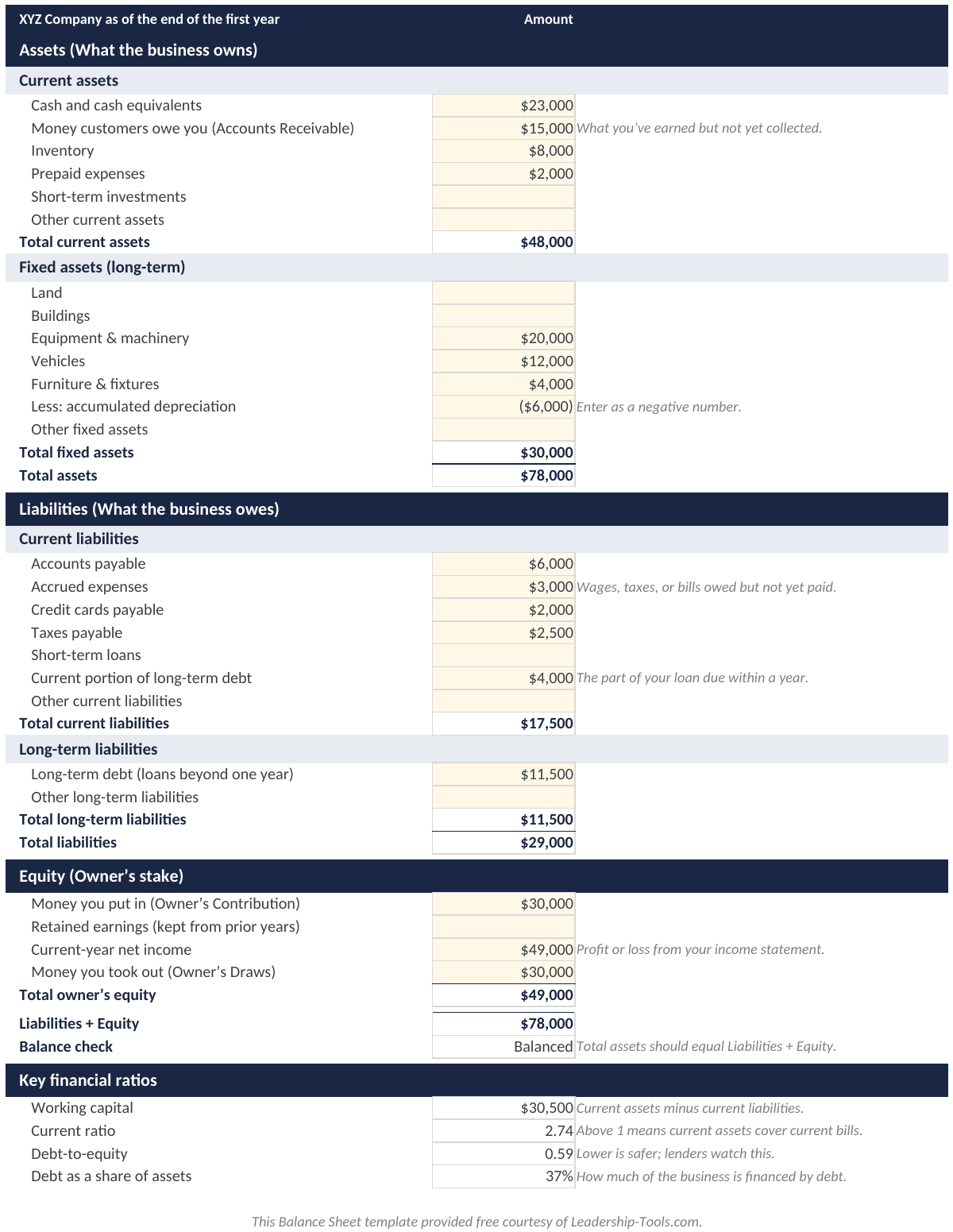
It owes $29,000. Most of that, $17,500, is due within the year, covering supplier bills, credit cards, taxes and the next twelve months of loan payments. The remaining $11,500 is long-term debt.
Subtract what it owes from what it owns and $49,000 is left. That's the owner's equity, and it's the number that tells you what the business is worth to the person who owns it.
Notice the equity section, because it explains where that $49,000 came from. The owner put in $30,000, the business earned $49,000 during the year, and the owner took $30,000 back out as draws. Those three add up to the $49,000 that remains.
At the bottom you'll see the balance check. Total assets of $78,000 against liabilities plus equity of $78,000, and the balance sheet template confirms it says Balanced. If yours ever doesn't say that, something above it needs to be corrected. They call it a balance sheet for a reason. It has to balance.
Assets: What the Business Owns
Assets are everything the business owns, and the template splits them into two groups for a good reason that lenders care about.
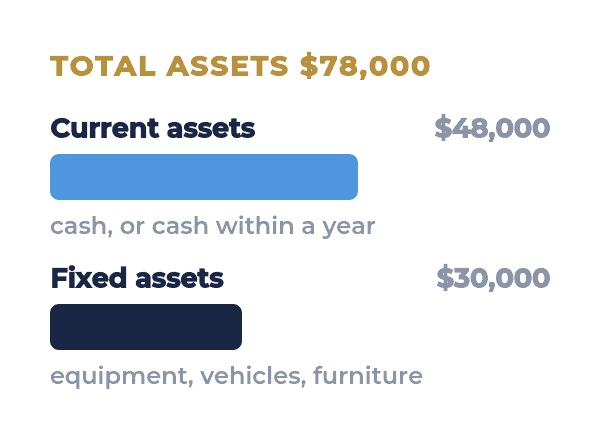
Current assets are cash, or things that turn into cash within a year. The balance sheet template gives you six common line items: cash and cash equivalents, money customers owe you, inventory, prepaid expenses, short-term investments, and a spare line for anything else. XYZ had $48,000 here, and the largest single piece after cash was the $15,000 customers still owed.
That receivables line is worth pausing on. It counts as an asset because the money is yours, but while it's owed to you it can't spend it until it arrives, which is why a business can look good on paper and still struggle to make payroll.
Fixed assets are the things you bought to run the business, not things you're looking to sell anytime soon: land, buildings, equipment, vehicles, furniture. These stay on the balance sheet for years, so they sit in their own block as fixed assets.
Below them comes accumulated depreciation, the only line on this tab you enter as a negative number. It represents the value your equipment has at this point in its life cycle. XYZ bought $36,000 of equipment, vehicles and furniture, recorded $6,000 of depreciation in its first year, and shows $30,000 of fixed assets as a result.
Add the two groups and you have total assets. For XYZ, $78,000.
A balance sheet reflects values on one specific day, so pick a date and use the same one for every figure on the balance sheet. Most owners use the last day of a month, a quarter or the year. Mixing a cash figure from Friday with an inventory count from three weeks ago produces a number that will not balance.
Liabilities: What the Business Owes
Liabilities are everything the business owes, and the template splits them by when the money is due rather than who it's owed to.
Current liabilities are due within the next twelve months: accounts payable for supplier bills, accrued expenses for wages and taxes owed but not yet paid, credit cards, taxes payable, short-term loans, and one line that catches people off guard, the current portion of long-term debt.
If XYZ owes $15,500 on a five-year loan and will pay $4,000 of it in the coming year, that $4,000 belongs in current portion of long-term debt and the remaining $11,500 goes below. Splitting it that way is what lets a lender see how much of your debt is due in the coming year.
Long-term liabilities are everything due beyond a year. For most small businesses that's a term loan, a vehicle loan, or money borrowed from the owner.
XYZ owed $29,000 in total, $17,500 of it is due within the year. The timing of when payments are due matters. A business with $29,000 of debt due next month is in a very different position from one with the same debt spread over five years.
Two things to watch for when preparing your balance sheet. Record only the principal here and put the interest portion of your loan payments on your income statement as an expense, because a payment reduces what you owe rather than costing you anything. And if you've personally guaranteed a loan, it still belongs on the business balance sheet, though a lender will usually ask about the guarantee separately.
Equity, and Why It Has to Balance
Equity is what's left when you take what the business owes away from what it owns. It's the owner's stake, and on a small business balance sheet it's built from four things.
- Money you put in is your own cash contribution, the capital you started with or added later.
- Retained earnings is profit the business kept from prior years, which will be blank in your first year.
- Current-year net income comes straight off your income statement.
- Money you took out is your draws, and the balance sheet template subtracts it for you.
XYZ's equity came to $49,000. The owner contributed $30,000, the business earned $49,000 during the year, and the owner took $30,000 back out. Those figures leave $49,000 as the owner's stake at year end.
The owner's draws line can confuse some people. Money you take home never appears on your income statement, because it isn't a cost of running the business, and it reduces your equity here instead. Take out more than the business earns and your equity falls, even in a profitable year.
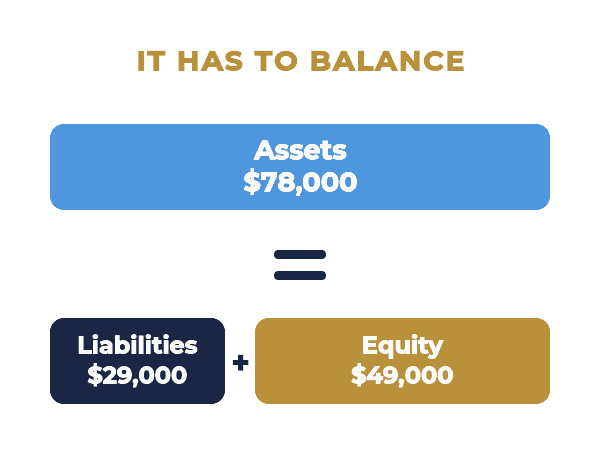
At the bottom sits the reason the statement is called a balance sheet. Total assets must equal total liabilities plus equity, because everything the business owns was paid for either by borrowing or by the owner. XYZ's $78,000 of assets matches $29,000 of liabilities plus $49,000 of equity exactly, and the balance sheet template checks it for you and says Balanced.
When it doesn't balance, the cause is almost always a missing line, inconsistent timing of values, or human error. A loan recorded as an asset, depreciation entered as a positive number, or an owner contribution left out will all produce an unbalanced report.
The Four Ratios a Lender Checks First
The balance sheet template calculates four ratios for you at the bottom, and they're the numbers a lender keys in on when reading your balance sheet.
Working capital: $30,500. Current assets minus current liabilities. It's the cushion between what's due soon and what you have available to pay it with. XYZ has $48,000 coming in within the year against $17,500 going out, so $30,500 of room. A negative number here means the next twelve months are already tight before anything goes wrong.
Current ratio: 2.74. The same comparison expressed as a multiple. Above 1 means current assets cover current bills. Most lenders want to see somewhere between 1.5 and 3. Below 1 is a warning, and a very high number can raise a different question, because it may mean cash is sitting idle rather than being put to work.
Debt-to-equity: 0.59. What the business owes against what the owner has in it. XYZ owes 59 cents for every dollar of the owner's stake, which is comfortable. As this climbs past 2 or 3, a lender starts seeing the business as financed mostly by other people's money, and the terms they offer change accordingly.
Debt as a share of assets: 37%. How much of everything the business owns was paid for with borrowed money. The other 63 percent belongs to the owner.
These four numbers say more together than separately. A business can have healthy working capital and still carry too much debt, or a low debt ratio with no cushion for next month. All four calculate automatically and sit at the bottom of the balance sheet template so you can view them together.
One thing worth knowing before a meeting. A lender will compare these against typical figures for your industry rather than against an absolute standard, because a restaurant and a consulting firm carry very different balance sheets. If your numbers look unusual compared to others in the same industry, being able to explain why is key to being perceived as knowledgeable business owner.
"Your wealth can only grow to the extent that you do!"
- T. Harv Eker
What If the Numbers Aren't Working
A balance sheet provides a way to test a decision before you make it, and the levers here work differently from the ones on an income statement.
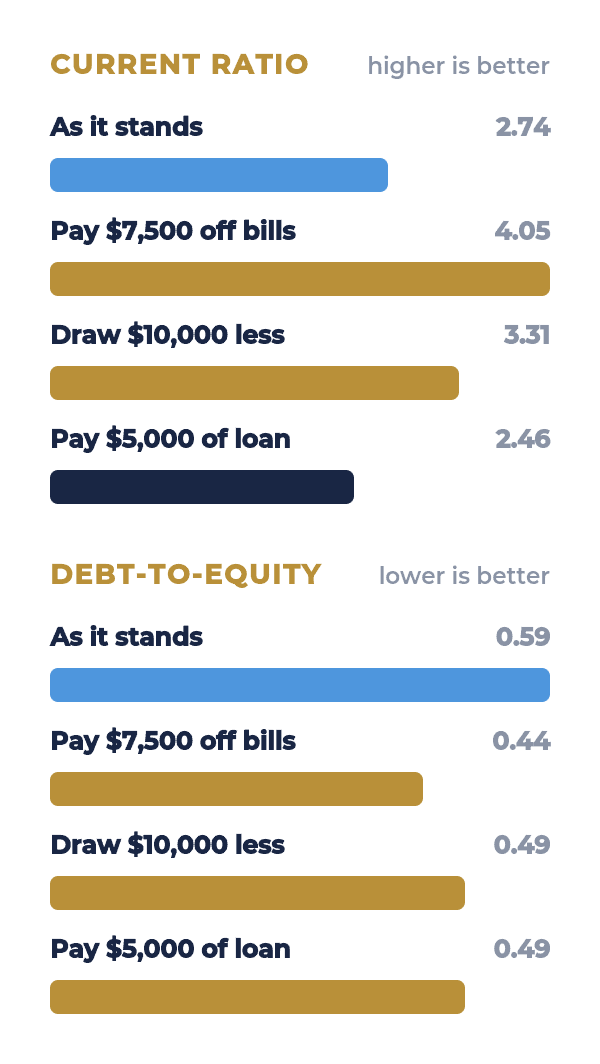
Start with the two actions that don't do what people expect. Collecting half of XYZ's $15,000 in receivables changes nothing. Neither does clearing $4,000 of slow inventory. Both turn one current asset into another, so working capital, the current ratio, debt-to-equity and the debt share all finish exactly where they started. That surprises owners who've been told chasing invoices fixes the balance sheet. It fixes your bank account, which matters enormously, but the ratios don't move.
What moves the balance sheet is using that cash rather than just holding it.
Pay down current bills. Take $7,500 of collected cash and clear supplier invoices with it. Both sides fall together, so working capital stays at $30,500, but the current ratio climbs from 2.74 to 4.05 and debt-to-equity drops from 0.59 to 0.44. This is the strongest single move on the page, and it means doing something you were going to have to do eventually anyway.
Draw less. If XYZ's owner had taken $20,000 instead of $30,000, equity would finish $10,000 higher and every ratio improves: working capital up to $40,500, current ratio 3.31, debt-to-equity 0.49. Leaving profit in the business is the simplest way to strengthen a balance sheet.
Repay long-term debt, with one caution. Putting $5,000 of cash against the loan improves debt-to-equity to 0.49, but working capital falls from $30,500 to $25,500 and the current ratio slips to 2.46. You've made the business less indebted and less liquid at the same time. Worth doing when your cushion is comfortable, worth delaying when it isn't.
That tension is the point of reading all four ratios together. Almost every decision improves one and costs another, and knowing which trade you're making before you make it is what the balance sheet template is for.
How the Three Statements Work Together
The balance sheet is where the other two statements, income and cashflow, end up. Reading the balance sheet on its own will result in you missing half of what you need to know.
Two key numbers arrive at the balance sheet here from the other two statements. XYZ's $49,000 of net income comes straight off the income statement and sits in the equity section as current-year income. The $23,000 of cash at the top comes off the bottom of the cash flow statement.
If either of those numbers don't match, one of the three is wrong. It's the first thing an accountant checks and a useful check to run yourself.
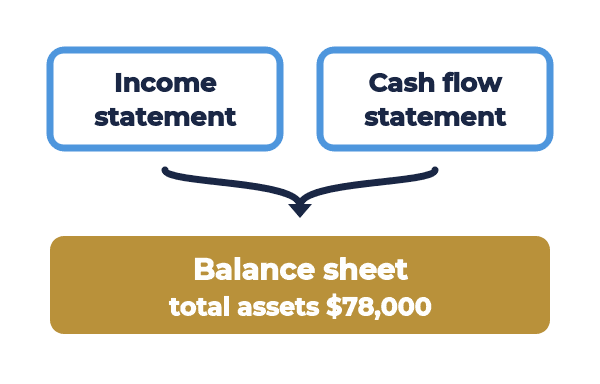
The three financial statements answer different questions. The income statement says whether the year made money. The cash flow statement says whether that profit turned into money you can spend. This balance sheet shows what you're left with at the end of the time period, and what you owe against it.
Our XYZ example shows why all three matter. It earned $49,000 and finished with $23,000 in the bank. The difference is sitting in the $15,000 customers still owe, the inventory on the shelf, and the $30,000 the owner drew out during the year. A profitable business, a healthy balance sheet, and a bank balance less than half the reported profit. None of those three facts contradicts the others, and no single statement would have shown you all of them.
It's important to understand why a lender is asking for all three statements. They want to assess how well you understand your business, and they want to see the entire picture and ensure all the numbers add up properly. If they don't, they may view your request at a higher risk.
Common Mistakes on a Balance Sheet
Most of what goes wrong on a small business balance sheet comes from a handful of errors, and each one is easy to spot once you know to look.
- Mixing dates. A balance sheet describes one specific day. A cash figure from Friday next to an inventory count from three weeks ago produces a number that describes nothing. Pick a date, use it everywhere, and write it at the top.
- Entering depreciation as a positive number. It reduces the value of your fixed assets, so the balance sheet template expects it as a negative. Enter it the wrong way and your assets inflate and the sheet stops balancing.
- Recording the whole loan on one line. Split it. The next twelve months of payments belong in current liabilities and the rest goes below, because that split is how a lender judges whether your debt is manageable.
- Treating an owner draw as an expense. It never appears on your income statement. It comes out of equity here, which is why a profitable year can still leave your equity lower than it started.
- Leaving out money owed to you. Invoices you've sent but not been paid for are an asset and skipping them understates the business. The same applies to bills you've received but not yet paid, which belong in accounts payable whether or not the money has left.
- Valuing assets at what you think they're worth. Equipment goes on at what you paid, reduced by depreciation. A lender will assume that's what the figure means, and a number based on a hopeful estimate is the kind of thing that unravels a conversation.
- Forgetting the business owns things you bought personally. If you put your own laptop or vehicle into the business, it belongs on this sheet, and the contribution belongs in equity.
- Ignoring it between year ends. A balance sheet built once a year for a lender is a chore. One built quarterly is a tool, and the ratios at the bottom tell you something different every time you run it.
The Rest of the Business Planning Toolkit
The balance sheet template is one of seven free tools built to work together on a complete business plan.
- Business Plan Template and Guide: The written plan these numbers belong in, with a step-by-step guide to every section. Your balance sheet figures go into its Business Financials section.
- Business Plan Financial Workbook: Projects a new business's first year from three input tabs and builds all three statements for you. Use this one if the business hasn't opened yet.
- Income Statement Template: Whether the year made money, and where each dollar of revenue went. Its net income lands in your equity section.
- Cash Flow Statement Template: Where the year's profit went, and whether it turned into money you can spend. Its ending cash is the first line of your assets.
- Mission Statement Template: The short statement of purpose that opens your business plan and gives the numbers behind it a reason to exist.
- Business Plan Appendix: Where your supporting documents go, including the full financial statements a lender may ask to see rather than summarised.
All three statement templates use the same business, XYZ Company, and the same figures, so you can follow a single number across all three and watch where it lands.
If you're opening a new business, start with the workbook. These three statement templates earn their place once you're running, when you're reporting what happened rather than projecting what you hope will.
Frequently Asked Questions
Questions most often asked about the balance sheet.
Click on the (+) sign below to expand each question. Click the (-) sign to collapse it again.
What is a balance sheet?
Is the balance sheet template free?
Yes. The template downloads free in PDF, Excel, and Google Sheets, with no email or signup required. Subscribing to the newsletter is optional and gets you the whole tool library on one page.
What are the three parts of a balance sheet?
Assets, liabilities and equity. Assets are what the business owns, liabilities are what it owes, and equity is what's left over for the owner. Assets always equal liabilities plus equity, which is where the name comes from.
What date should I use?
One specific day, and the same one for every line. Most owners use the last day of a month, a quarter or the year. Mixing figures from different dates produces a total that doesn't describe anything.
What's the difference between current and fixed assets?
Current assets are cash or things that turn into cash within a year, such as money customers owe you and inventory. Fixed assets are what you bought to run the business, like equipment and vehicles, and they stay on the sheet for years.
Why won't my balance sheet balance?
It's almost always a missing or misplaced line rather than bad arithmetic. The usual causes are depreciation entered as a positive number, a loan recorded as an asset, an owner contribution left out, or net income that doesn't match the income statement.
Does the owner's draw go on the balance sheet?
Yes, in the equity section, where the template subtracts it for you. It never appears on your income statement, because money you take home isn't a cost of running the business. Draw more than the business earns and your equity falls, even in a profitable year.
How do I record a business loan?
Split it by when it's due. The next twelve months of payments go in current liabilities, and the rest goes in long-term liabilities. Record only the principal here; the interest portion is an expense on your income statement.
What ratios does the template calculate?
Four: working capital, the current ratio, debt-to-equity, and debt as a share of assets. They calculate on their own once the sheet is filled in, and they're the numbers a lender works out before they finish reading.
What is a good current ratio for a small business?
Most lenders want to see somewhere between 1.5 and 3. Below 1 means current assets don't cover current bills, which is a warning. A very high number isn't automatically good either, since it can mean cash is sitting idle.
How often should I update it?
Once a year is the minimum, and quarterly is far more useful. The ratios at the bottom tell you something different each time you run it, and a balance sheet built regularly becomes a tool rather than a chore.
How does the balance sheet connect to the other two statements?
Two numbers arrive here from elsewhere. Net income comes from the income statement and lands in the equity section, and the cash figure at the top comes from the bottom of the cash flow statement. If either doesn't match, one of the three statements is wrong.
Download Balance Sheet Template

Want the entire leadership tools library? Subscribe to our free newsletter and we'll send you a link to every tool on this site, all on one page, sorted by leadership phase. Every tool is free to download on its own page. The library just puts them in one place. Plus, you'll never miss out on updated or new tool announcements.
Your privacy is important to us. We never share or sell email addresses.
More Business Planning Tools & Information




Contact Information:
phone
(503) 970-9777
Email Customer Service
helpsupport@leadership-tools.com
Email Richard
richard@leadership-tools.com

By Richard Gorham
Leadership-Tools.com
2879 Riverwalk Loop, Eugene, Oregon, 97401
Copyright (c) 2002 - 2026 All Rights Reserved