An income statement shows whether a business made money over a period of time. It starts with your revenue, subtracts the cost of delivering the work and the cost of running the business, and ends with net income. It's also called a profit and loss statement, or a P&L.
- Home
- Leading Teams
- Business Plan Template
- Income Statement Template
Income Statement Template (Free Excel, Google Sheets & PDF)
Use our income statement template to answer one key question: did the business make money over a period of time? This free tool answers it for you.
Download Free Income Statement Template
Enter your revenue and your costs in the cream-colored cells, and every subtotal, the gross profit, the operating income and the net income at the bottom will calculate automatically.
Free, with no signup and no password. The Excel and Google Sheets versions calculate totals for you, and the PDF includes both the blank income statement template and the finished example if you'd rather quickly print to read it through or work on paper.
Jump To: What's Included | The Formula | A Filled-In Example | Revenue | Cost of Goods Sold | Operating Expenses | What a Lender Reads First | What If the Numbers Aren't Working | How the Three Statements Connect | This or the Workbook | Common Mistakes | The Full Toolkit | FAQ | Download Template
What's Included in This Income Statement Template
There are only three tabs, and you only need to complete one of them.
- How to Use: a short guide covering who the income statement template is for, how to choose your reporting period, the four mistakes that cause most common problems, and how to read the percent of revenue column.
- Income Statement: a blank statement template, with formulas to calculate every subtotal and percentage already built in for your convenience.
- Example: a finished statement for XYZ Company, a small business at the end of its first year, so you can compare your file against a completed example.
The statement itself covers what a lender expects to see, and in the proper order:
- Revenue, split into sales, service and other
- Cost of goods sold, covering materials, direct labor and other direct costs
- Gross profit, calculated for you
- Operating expenses, twelve named lines from wages and rent through to depreciation and travel (additional lines can be added if needed)
- Operating income, your profit before interest and taxes
- Interest and taxes, kept separate the way an accountant would expect
- Net income, your bottom line
- A percent-of-revenue column on every line, showing where each dollar went
Cream-colored cells are yours to fill in. Everything else calculates on its own, and you can leave any line blank if it doesn't apply to your business. Edit as you see fit.
The Formula: Sales, Minus Cost of Goods Sold, Minus Expenses
Every income statement, from a one-person business to a listed company, is measured by one simple formula.
You start with the amount sold, minus what it cost to deliver it, then take away what it cost to keep the business running. What's left at the bottom is your net income, and that number is critical for running a successful business long-term.
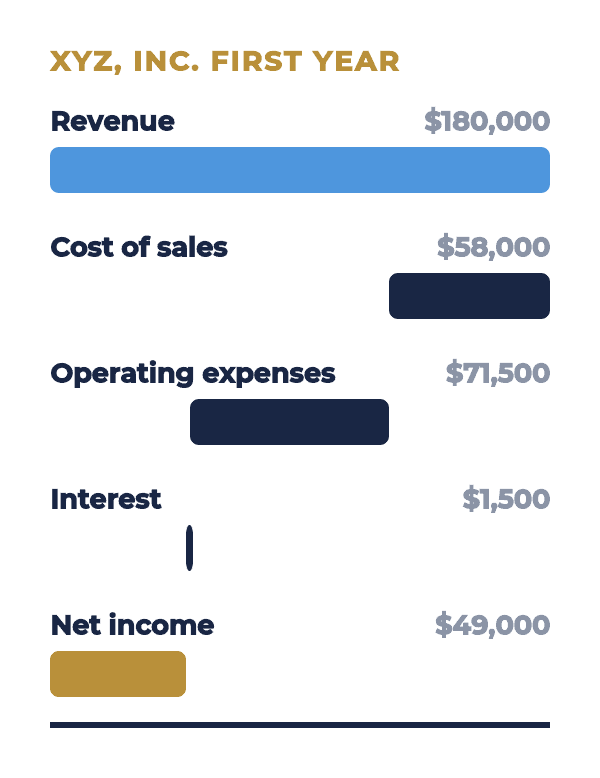
Written out, the formula is sales minus cost of goods sold minus expenses equals net income. The income statement template does it in four steps rather than one, because each step answers a question of its own:
- Total revenue minus cost of goods sold gives you gross profit. This is what's left after the cost of delivering the work, before any overhead expense.
- Gross profit minus operating expenses gives you operating income. This is the profit your core business makes, before interest expense from loans and tax get involved.
- Operating income minus interest expense gives you income before taxes.
- Income before taxes minus tax gives you net income. Your bottom line.
Running XYZ's figures through it: $180,000 in revenue, less $58,000 to deliver the work, leaves $122,000 in gross profit. Take off $71,500 of operating expenses and you have $50,500 of operating income. The loan interest takes $1,500, and with no tax at the business level, net income comes to $49,000.
Those four steps are why the income statement is worth more than the single number at the bottom. A business can have healthy gross profit and still lose money if its overhead is too high, and by reviewing each step you'll quickly identify where things went wrong and what to correct if necessary.
A Filled-In Income Statement Example
The Example tab of the income statement template shows a complete statement for XYZ Company, a small business at the end of its first year.
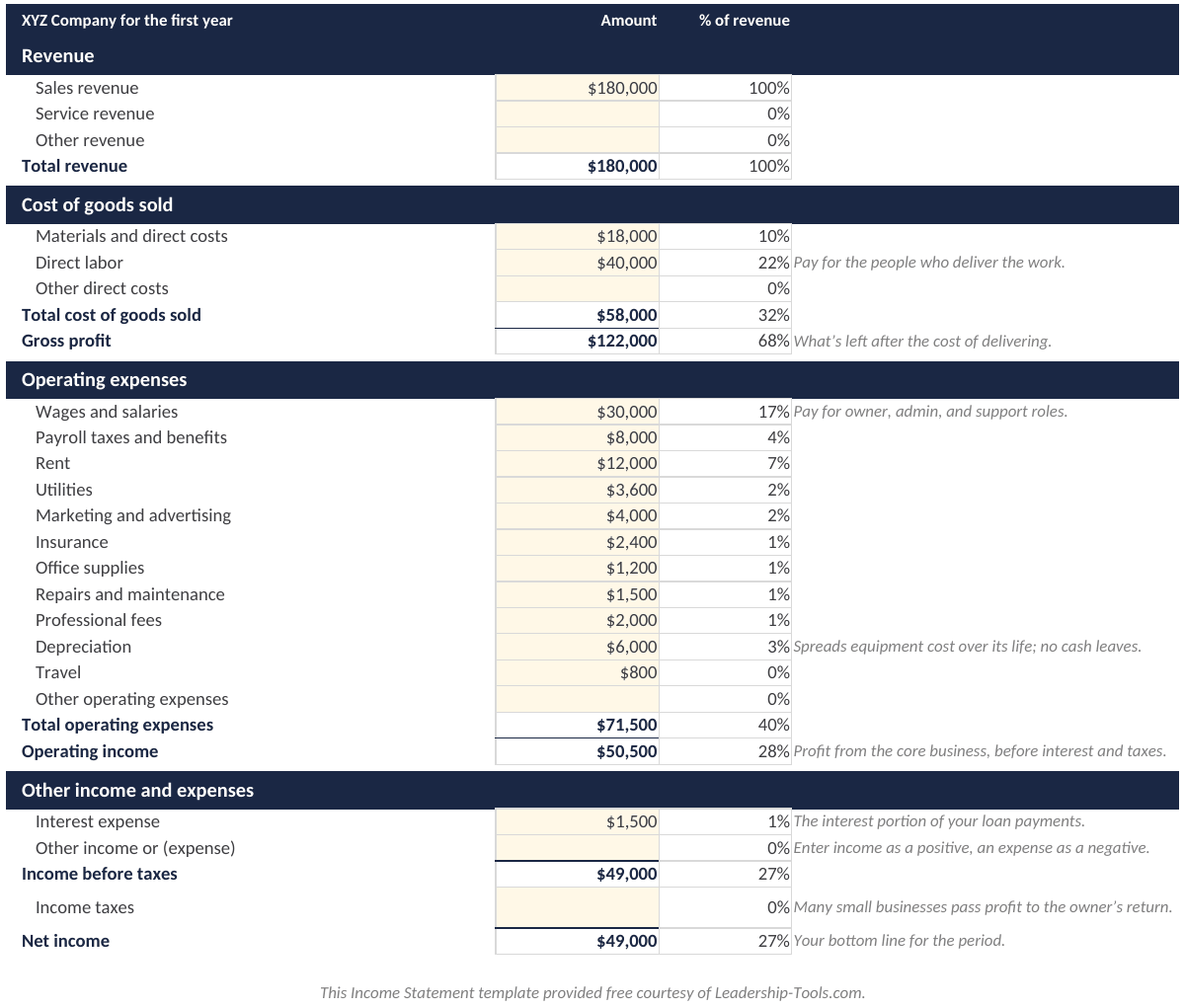
XYZ brought in $180,000, all of it from sales. Delivering that work cost $58,000, split between $18,000 of materials and $40,000 of direct labor, which leaves $122,000 of gross profit. Operating expenses came to $71,500 across twelve expense categories, from $30,000 of wages down to $800 of travel. After $1,500 of loan interest, the business finished the year with $49,000 of net income.
Read the percent column beside those numbers and the business starts to make sense. The cost of delivering the work took 32 percent of revenue, which leaves a gross margin of 68 percent. Operating expenses took another 40 percent. What survived is a net margin of 27 percent, and that's a healthy first year profit margin for most small businesses.
Prospective lenders are going to zero in on those percentages in a first pass review of your business plan. They'll know what healthy percentages look like for similar businesses in the same industry.
Revenue: What Came In
Three revenue lines sit at the top of the income statement template. Of course, you can customize the names if you wish, but for now Sales Revenue, Service Revenue, and Other Revenue catches everything you need.
The first line covers products or goods sold, the second covers work you delivered, and the third catches anything else outside the first two, such as a commission or a one-time license fee. XYZ used only the Sales Revenue line, which is normal for a lot of businesses.
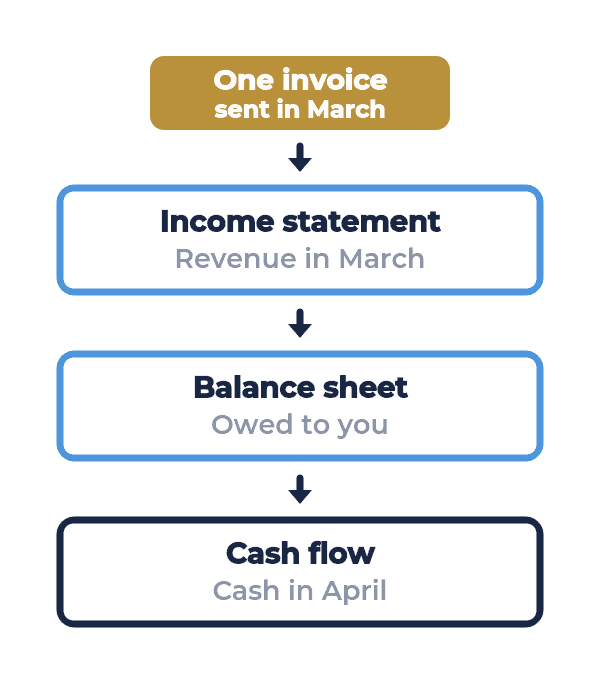
The rule that trips some business owners up on the incomes statement is the timing of revenue. Revenue is recorded when you earn it, not when the money arrives, so if you invoice a client in March and get paid in April, that sale belongs to March on your income statement. The cash shows up in April on your cash flow statement, and the amount owed in between sits on your balance sheet as accounts receivable.
That's the biggest difference between how money is tracked in financial statements versus your bank account, and it's the reason a profitable business can still be short of cash.
Cost of Goods Sold and Gross Profit
Cost of goods sold is what it costs you to deliver the thing you sold. Nothing else belongs here.
The income statement template gives you three lines. Materials and direct costs cover whatever physically goes into the product or the job, while direct labor is pay for the people doing the work itself. This means you'll include labor costs for the technician on site, but not for the bookkeeper in the office. Other direct costs account for subcontractors and delivery.
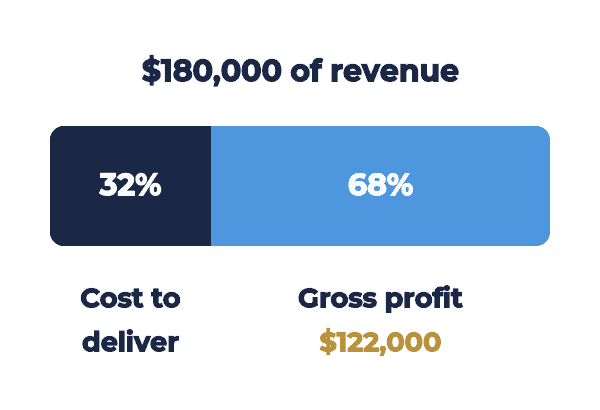
XYZ spent $18,000 on materials and $40,000 on direct labor, so $58,000 to deliver $180,000 of work.
Labor expense is something that's easy to get wrong. If someone's time is billed to a customer or spent making the product, they're a direct cost, and if they answer the phone, do the books or run the business, they belong in operating expenses further down the page. Putting the wrong person in the wrong place doesn't change your net income, but it does change your gross margin, and gross margin is one of the first things a lender looks at.
Gross profit is what's left once those costs come out, and the income statement template calculates it for you. XYZ's $122,000 is a 68 percent gross margin. That's the money available to cover everything else, from rent and wages to insurance, the loan, and whatever profit you're hoping to keep.
Operating Expenses, Interest and Taxes
Operating expenses are the costs of being open, whether or not you sold anything this month.
The income statement template lists twelve expense categories, and these are common for most small businesses: wages and salaries for the people who aren't delivering the work, payroll taxes and benefits, rent, utilities, marketing, insurance, office supplies, repairs, professional fees, depreciation, travel, and a catch-all line at the bottom. Leave any of them blank if they don't apply.
XYZ's came to $71,500, with wages at $30,000 the largest single line by some distance, which is typical for most businesses.
Depreciation deserves a call out, because it's the line owners most often skip. It spreads the cost of equipment or a vehicle across the years you use it, and no cash leaves your bank account in the month you record it so thing of it as a cashless expense. It's still a real expense. Leaving it out overstates your profit and puts your income statement out of step with your balance sheet.
Below operating income sit interest and tax. These are kept separate on the income statement for a reason. Interest is the cost of how you financed the business rather than how you ran it, so a lender wants to see operating income before it comes out. Enter only the interest portion of your loan payments here. The principal isn't an expense at all; it reduces what you owe on the balance sheet.
Tax is often zero on a small business statement, since many owners pass profit through to a personal return. XYZ shows nothing here, which is why its income before taxes and its net income are the same $49,000.
What a Lender Reads First
A lender doesn't start at the top of your income statement. They start with these three numbers and then work backwards.
- Net income, and whether it's positive. A loss in year one isn't fatal, and plenty of good businesses post one. What matters is whether you can explain the loss and show when the business will become profitable.
- Gross margin, as a percentage. This tells them whether your pricing works before overhead is even considered. A thin gross margin means there's very little room for anything to go wrong.
- Operating income. Profit from the business itself, before borrowing. If this is healthy and net income isn't, the problem is how the business is financed rather than how it's being run, and that's an important conversation worth having.
After those three items are reviewed, lenders look for consistency with everything else you've handed them. If your business plan says you'll add two clients a month and your revenue line adds five, they'll notice the discrepancy. If your balance sheet shows equipment but your income statement has no depreciation, they'll notice that too.
The statement is also a test of whether you understand your own business. Being able to say why your gross margin is what it is, and which line you'd change first if you needed more profit, goes to your credibility as a knowledgeable business owner.
"The longer you’re not taking action the more money you’re losing."
- Carrie Wilkerson
What If the Numbers Aren't Working
An income statement isn't only a financial report. It's also a tool you can use to test decisions before you make them. There are four levers that you can leverage to move the bottom line.
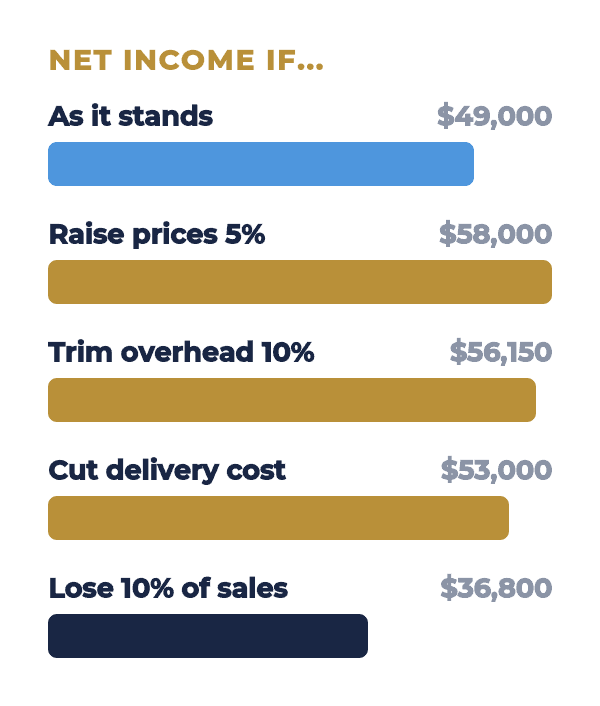
Price. XYZ raised prices five percent and kept every customer, so revenue climbs $9,000 to $189,000. The cost of delivering that work doesn't change, because the volume is the same, so almost all of it drops through to profit. Net income goes from $49,000 to $58,000, an eighteen percent rise in profit from a five percent rise in price. Price is the strongest lever most businesses have and the one owners are slowest to pull due to fear of losing business.
The cost of delivering the work. Bringing the cost of goods sold from 32 percent of revenue down to 30, through better buying or less waste, is worth $4,000 a year, taking net income to $53,000. Smaller than the price lever and can be difficult to negotiate but can also be well worth the effort.
Overhead. Cutting operating expenses by ten percent saves $7,150, taking net income to $56,150. That's real money, though it's worth remembering that overhead is mostly rent, insurance and people, none of which are easy to shrink, and may come with some risk.
Volume falling. This is the one to understand before it happens. If XYZ loses ten percent of its sales, the cost of delivering the work falls with it, but rent, insurance and salaries don't. Net income drops from $49,000 to $36,800, a twenty-five percent fall in profit from a ten percent fall in sales.
That last figure is why the percent column matters. A business with high fixed costs amplifies every change, up and down, and knowing your own multiplier tells you how much cushion you need before a slow quarter becomes a problem.
How the Three Statements Work Together
Your income statement doesn't stand alone. The number at the bottom of it appears on both of the other two statements, and a lender reads all three as one set.
XYZ's $49,000 of net income leaves this page and lands in two places. On the balance sheet it shows up as earnings kept in the business, part of what the owner has built up. On the cash flow statement it's the very first line, the starting point for working out how much cash the year produced.
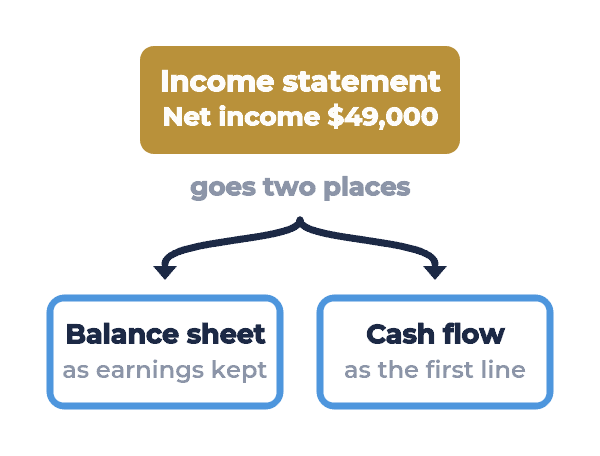
The three financial statements answer different questions, which is exactly why lenders want to review all of them. This income statement tells you whether the year made money. The balance sheet tells you what you own and owe at a specific point in time. The cash flow statement tells you whether the profit is only on paper or if its actual cash in hand that you can now spend.
A business can look healthy on one and be in trouble on another. XYZ earned $49,000, but $15,000 of that was still sitting in customers' hands as unpaid invoices at year end, which is why the cash in the bank came to $23,000 rather than $49,000. Nothing on the income statement would tell you that.
Understanding each statement on its own is the first step. Understanding how a change in one moves the other two is what lets you look at a set of financials and know whether the business is healthy, and it's the reason all three templates here use the same company and the same numbers.
Do You Use This Template or the Business Plan Financials Workbook
Both tools build the same three statements, and which one you want depends on whether you're looking forward or backward.
The Business Plan Financial Workbook projects a business that hasn't opened yet. You enter your startup costs, a twelve-month sales forecast and your running expenses, and it builds a month-by-month cash flow projection alongside an income statement and balance sheet for the whole first year. It works in cash terms, it doesn't model depreciation, and its job is to tell you what to expect in year one only if all your assumptions are correct.
This income statement template records a period that has already happened. It works on an accrual basis, so revenue is counted when it's earned rather than when it's paid, and it includes depreciation the way an accountant would. Its job is to tell a lender, a partner or yourself what has happened.
If you're writing a plan for a business that doesn't exist yet, start with the workbook. If you're reporting on a year that has closed, use this template. Plenty of owners end up with both, one for planning and one for reporting.
Common Mistakes on an Income Statement
Most of what goes wrong on a small business income statement comes from a handful of oversights, and each one is easy to correct once you know to look.
- Mixing direct costs with operating expenses. The cost of delivering the work belongs in cost of goods sold, and the cost of running the business belongs below it. Putting them in the wrong place leaves your net income unchanged but ruins your gross margin, which is one of the numbers a lender checks first.
- Recording the owner's draw as an expense. Money you take home isn't a cost of running the business, so it never appears here. It reduces your equity on the balance sheet instead.
- Skipping depreciation. It's the only expense that never leaves your bank account, which is exactly why people forget it. Leaving it out overstates your profit and puts this statement out of step with your balance sheet.
- Entering the whole loan payment as interest. Only the interest portion is an expense. The principal reduces what you owe, and it belongs on the balance sheet.
- Recording revenue when the money arrives. A sale belongs to the month you earned it. If you record the sale only once the cash is received, your income statement quietly turns into a cash flow statement, and the financials will not match up properly.
- Forgetting the cost of employing people. Wages are only part of it. Payroll taxes, workers' compensation and benefits can add sixteen percent or more on top, and leaving them out understates your costs across the whole statement.
- Mixing periods. Twelve months of revenue against nine months of expenses will still produce a number, and it will be wrong. Pick a period, use the same one on every line, and label it at the top.
- Numbers that contradict your other statements. If this statement shows depreciation and your balance sheet shows none accumulated, or your net income doesn't match what appears in equity, a lender will see the error.
The Rest of the Business Planning Toolkit
The income statement is one of seven free tools built to work together on a complete business plan.
- Business Plan Template and Guide: The written plan these numbers belong in, with a step-by-step guide to every section.
- Business Plan Financial Workbook: Projects your first year from three input tabs and builds all three statements for you.
- Balance Sheet Template: What the business owns and owes on a single date, with the ratios a lender calculates built in.
- Cash Flow Statement Template: Where the year's profit went, and whether it turned into money you can spend.
- Mission Statement Template: The short statement of purpose that opens your business plan.
- Business Plan Appendix: Where your supporting documents go, including full financial statements a lender may ask to see.
All three statement templates use the same business, XYZ Company, and the same figures, so you can follow one number across all three and see how they fit together.
Frequently Asked Questions
Click on the (+) sign below to expand each question. Click the (-) sign to collapse it again.
What is an income statement?
What is the income statement formula?
Sales minus cost of goods sold minus expenses equals net income. The template works through it in four steps: revenue less cost of goods sold gives gross profit, less operating expenses gives operating income, less interest gives income before taxes, and less tax gives net income.
Is the income statement template free?
Yes. The template downloads free in PDF, Excel, and Google Sheets, with no email or signup required. Subscribing to the newsletter is optional and gets you the whole tool library on one page.
Do I need Excel to use it?
No. The Google Sheets version calculates the same way and runs free in any web browser. The PDF includes both the blank statement and the finished example if you'd rather work on paper.
What period should my income statement cover?
Pick a consistent length and stick to it. A month, a quarter or a full year all work, as long as every line covers the same period. Most small businesses produce one monthly and one at year end, and lenders usually ask for the annual version.
What's the difference between gross profit and net income?
Gross profit is what's left after the cost of delivering the work, before any overhead. Net income is what's left after everything, including rent, wages, interest and tax. A business can have strong gross profit and still finish with a loss if its overhead is too high.
What belongs in cost of goods sold?
Only what it costs to deliver the thing you sold: materials, the labor of the people doing the work, and direct costs like subcontractors or delivery. Anyone who answers the phone, does the books or runs the business belongs in operating expenses instead.
Should the owner's draw go on the income statement?
No. Money you take out for yourself isn't a cost of running the business, so it doesn't appear here and doesn't affect your net income. It reduces your equity on the balance sheet.
How do I record a loan payment?
Split it. Only the interest portion is an expense, and it goes near the bottom of the statement below operating income. The principal isn't an expense at all; it reduces what you owe on your balance sheet.
Why does the template include depreciation?
Depreciation spreads the cost of equipment or a vehicle across the years you use it, so the expense lands in the same periods as the benefit. No cash leaves your account when you record it, but it's a real expense, and leaving it out overstates your profit.
Is an income statement the same as a profit and loss statement?
Yes. Income statement, profit and loss statement and P&L all describe the same document. Some lenders and accountants prefer one term over another, but they're asking for the same thing.
How does the income statement connect to the other two statements?
Net income appears on all three. It sits at the bottom of this statement, arrives on the balance sheet as earnings kept in the business, and forms the first line of the cash flow statement. That's why a lender asks for all three together rather than one on its own.
Download Income Statement Template

Want the entire leadership tools library? Subscribe to our free newsletter and we'll send you a link to every tool on this site, all on one page, sorted by leadership phase. Every tool is free to download on its own page. The library just puts them in one place. Plus, you'll never miss out on updated or new tool announcements.
Your privacy is important to us. We never share or sell email addresses.
More Business Planning Tools




Richard Gorham has led teams in financial services for more than 30 years, from retail branches and operations to investments and insurance, and he still leads a team today.
He founded Leadership-Tools.com in 2002 to give managers free, practical tools like the ones he used in his various leadership roles. Every tool here has been used in a real workplace and comes with a filled-in example you can follow.

Contact Information:
phone
(503) 970-9777
Email Customer Service
helpsupport@leadership-tools.com
Email Richard
richard@leadership-tools.com

By Richard Gorham
Leadership-Tools.com
2879 Riverwalk Loop, Eugene, Oregon, 97401
Copyright (c) 2002 - 2026 All Rights Reserved