Yes. This personal goal setting course is free to download with no email required. The wider free tools library, including editable templates in Word, Excel, and Google formats, is available to newsletter subscribers at no cost.
- Home
- Leading Self
- Goal Setting for Success Course
Personal Goal Setting Course You'll Finish (Free PDF + Templates)
Most goal setting advice tells you what to want. This personal goal setting course shows you how to finish what you started. The free Goal Setting for Success eBook is a practical, 93-page system for new leaders, solopreneurs, and small-business owners who want a plan they can follow on a busy week.

Download our free Goal Setting for Success eBook:
You'll learn a clear personal goal setting framework, get free templates you can use today, and build an action plan you can track without overcomplicating your life.
At the most basic level, goal setting is how you decide what you want out of life, and how you want to spend the next 30 days, the next year, or the next decade.
It's part of our mission to publish free leadership tools and resources that are ready to use, not just nice ideas. Use this for self-leadership, and if you manage others, the same approach works for setting goals with your team.
Jump To: Overview | Who Is This For | What is Personal Goal Setting | Why It Matters for Leaders | 8-Step Framework | Goal Examples | What's Different | Course Roadmap |Free Tools | Common Pitfalls | FAQ | Get Updates Free | Download eBook
Overview (What You Get)
This page is your starting point for the Goal Setting for Success personal goal setting course. It includes a free downloadable eBook (PDF) and an on-page summary, so you can get value in the next ten minutes even if you don't download anything else today.
The core idea is simple. Goals aren't wishes. Goals are decisions supported by a plan you can follow. This personal goal setting course helps you make those decisions in a balanced way, not just "work harder," and then translate them into actions you can put on your calendar.
What you get inside this personal goal setting course:
- A clear personal goal setting framework you can reuse each quarter or year
- The Master Action Plan (M.A.P.), a one-page tool that organizes any goal
- Personal goal setting templates and worksheets you can print or fill in digitally
- Worked examples in three real domains: fitness, finances, and leadership
- Practical guidance for tracking progress and staying consistent
- A specific approach to obstacles, perspective loss, and the messy middle stretch of any long goal
By the end of this course, you'll have a short list of priorities, a realistic timeline, and a working action plan you can follow week after week.
Who This Personal Goal Setting Course Is For
This course is designed for people who want structure without complexity. If you feel overwhelmed by your goals, it doesn't mean you're behind or doing it wrong. It usually means you don't have a system yet. The fix isn't more pressure to "power through." It's a clear system you can follow with confidence.
This personal goal setting course will fit you well if you are:
- A new or aspiring leader. You want to build self-leadership habits, show consistent follow-through, and stop feeling like you're always reacting to whoever's loudest.
- A solopreneur or small-business owner. You want goals that respect your capacity, protect your focus, and connect to business results without burning you out.
- An HR or L&D professional, or a leadership coach. You want a ready-to-use resource you can assign as pre-work, plug into coaching engagements, or share as the "do this first" foundation.
If you're looking for a quick motivational read, this might feel more structured than you want. If you're looking for a practical plan you can execute, you're in the right place.
What Is Personal Goal Setting?
Personal goal setting is the deliberate process of deciding what you want your life to look like, and then building a clear plan to make it happen.
At its most basic level, personal goal setting helps you answer questions like:
- How do I want to spend the next 30 days, the next year, the next decade?
- What kind of leader, partner, parent, or business owner do I want to become?
- What specific results will show I'm moving in the right direction?
Personal goal setting is an important life skill, and once you learn it, it becomes a source of mental and emotional support. It helps you persist when the work gets boring, recover when progress slows, and stay focused when life gets busy.
By creating clearly defined personal and professional goal plans, you can:
- Monitor and track your progress
- Adjust quickly when circumstances change
- Take genuine pride in each milestone along the way
New and aspiring leaders who invest time in goal planning are more confident, less stressed, and better prepared to serve others. Working through this personal goal setting course will give you clarity of purpose so you can spend your time and energy on what matters most.
Why Goal Setting Matters for Leaders (Not Just for “Personal Growth”)
Before you can effectively lead others, you have to lead yourself first. Self-leadership means knowing who you are, what you stand for, and where you're going, and then aligning your daily actions with that direction.

Goal setting supports self-leadership in three practical ways:
- It reduces decision fatigue. When you know what matters this month, it's easier to say no to distractions, scope creep, and the "urgent" requests that aren't important.
- It builds credibility. People trust leaders who are consistent. Not perfect. Consistent. A simple goal plan helps you do what you said you would do.
- It creates calmer momentum. You stop relying on motivation. You rely on a process. That means fewer abandoned goals and more steady progress.
And if you manage others, your own goal setting habits set the tone for the team. You model what good planning looks like. You make it normal to track progress. You make it safe to adjust plans when reality changes. Our structured personal goal setting course gives you the language and the framework to do that consistently.
If you want team-focused resources, explore our Leading People tools and the rest of our free leadership tools library.
How to Set Personal Goals: An 8-Step Framework
This section is your on-page quick-start guide. It summarizes the core process taught in Goal Setting for Success, so you can begin without downloading anything. Use it as a checklist as you work through the chapters and tools.
Step 1: Clarify the Big Picture
Ask Yourself: “What kind of life and leadership do I want 3–5 years from now?”
Write a short vision statement that describes your ideal future in a few key areas:
- Personal growth and learning
- Career or business
- Health and energy
- Finances
- Relationships and family
- Contribution / community / faith
Don't try to make it perfect. Capture an honest picture of the life and leader you want to become.
Step 2: Balance Your Life Areas
Great goals create a great life, not just a great career.
Use our Life Balance Tool (Success Wheel) to:
- Rate your current satisfaction in each life area
- Identify which areas are over- or under-emphasized
- Choose two or three priority areas to focus on first
Step 3: Choose Specific Outcomes
For each priority area, ask: “What would success look like 12 months from now?”
Turn your answers into outcome statements. For example:
- “Increase my annual sales by 20% while maintaining healthy work–life boundaries.”
- “Exercise at least 3 times per week and lose 10 pounds by November 30.”
- “Have a weekly one-on-one with each team member to support their development.”
These outcomes become the foundation for your goals.
Step 4: Write Your Goals as SMART Goals
Strong personal goals are SMART:
- Specific: You know exactly what “done” looks like
- Measurable: You can track progress with numbers or clear evidence
- Achievable: the goal is realistic given your situation
- Relevant: it connects to your responsibilities and values
- Time‑bound: there's a date attached
SMART is a useful checklist, but it isn't enough by itself. A SMART goal you don't care about is still a SMART goal, and those are the goals people quietly abandon. Make sure each goal sits on top of a personal reason that will still feel meaningful in month five, not just in week one.
Some examples of well-formed leadership goals:
- Career or business: "By December 31, I will increase my annual sales by 20% through improved prospecting and better follow-up, without working more than 45 hours per week."
- Leadership communication: "Within the next six months, I will hold a structured 30-minute one-on-one with each direct report every month, using a simple agenda (wins, challenges, next steps) and capturing action items in writing."
- Skill development: "Over the next 90 days, I will complete one online course on coaching or feedback, practice at least one technique per week with my team, and request feedback from two colleagues on how my coaching is improving."
- Personal productivity: "For the next eight weeks, I will end each workday with 15 minutes of planning for the next day (top three priorities, key meetings, prep), and I will review my weekly goals every Monday morning."
Step 5: Prioritize and Sequence Your Goals
You can't do everything at once.
- Highlight your top three to five goals for the next 12 months.
- Decide what must happen first, second, and third.
- Identify any never-ending goals (health, learning, relationships) that will always be part of your life.
This keeps your plan achievable and focused.
Step 6: Build Your Master Action Plan (M.A.P.)
Great goals fail without a concrete action plan. That’s where our Master Action Plan (M.A.P.) comes in.
The M.A.P. is a one-page document with five fields:
- Outcome: what must be achieved, written specifically and measurably
- Motivation: the personal reason this goal matters, in your own words
- High Impact Activities: the six or so things that will produce the Outcome
- Barriers & Solutions: the obstacles you can prepare for, with planned responses
- 5-Day Planner: your current week, mapped out concretely
For each priority goal, fill in those five fields. The Motivation field lives at the top of the page, in plain view, every time you open the document. That's the part that carries you through the middle stretch of any long goal, when the early excitement has worn off and the work has become routine.
The M.A.P. turns ideas into a daily and weekly plan you can execute. This is the central tool of the course, and it's also free.
Step 7: Anticipate Obstacles & Troubleshoot
Every meaningful goal will encounter obstacles. Plan for them.
Ask yourself:
- “What could get in the way of this goal?”
- “What will I do when (not if) that happens?”
Common challenges for new and aspiring leaders include:
- Feeling overwhelmed by competing priorities
- Fear of failure or fear of looking “inexperienced”
- Loss of motivation after early enthusiasm fades
- Unexpected changes at work or at home
For each obstacle you can see coming, write an if-then response: "If [the obstacle] happens, then I will [planned response]." The if-then format takes the decision out of the heat of the moment and makes it automatic.
Add three to five of these to the Barriers & Solutions section of your M.A.P.
Step 8: Review Weekly, Adjust Monthly, Celebrate Progress
Leadership is a long journey. Tracking is what keeps you honest and on track. Celebration is what keeps you energized.
Use this simple review process:
- Weekly (15 minutes): What moved forward? What didn't? What's the next action?
- Monthly (30 minutes): Adjust timelines, remove unrealistic tasks, recommit.
- Quarterly (1 hour): Revisit priorities, refresh goals, choose the next focus.
Take time to mark small wins along the way. A finished High Impact Activity. A streak you didn't break. A tough conversation that landed well. The small acknowledgments compound across months and keep the goal feeling alive.
This is how you build momentum and confidence as a self-leader.
Examples of Personal & Professional Goals for New and Aspiring Leaders
As you think about the most important areas of your life, you'll want to set clear goals in each category.
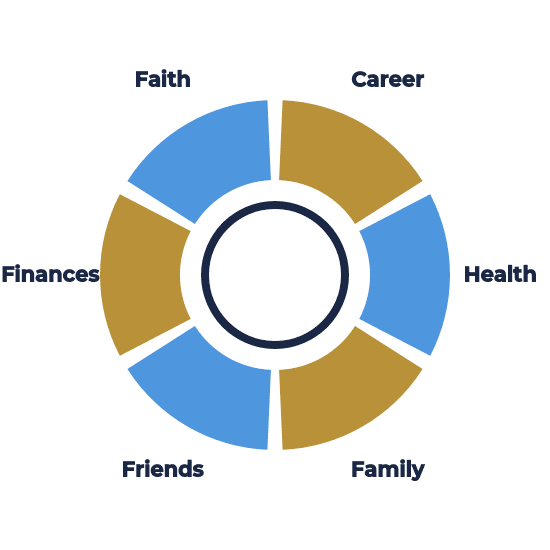
Here are a few examples to get you started. Adapt them to your own situation:
Personal Development
- “Read one leadership or personal growth book per month and capture key insights in a simple journal.”
- “Join a mastermind or peer group and attend at least one meeting each month.”
Health & Energy
- “Walk 7,000–10,000 steps per day, 5 days per week, for the next 90 days.”
- “Be in bed with screens off by 10:30 p.m. on weeknights.”
Career & Leadership
- “Have monthly 1:1 coaching conversations with each direct report, focused on their goals and growth.”
- “Lead at least two team meetings per quarter that incorporate a short leadership lesson or motivational story.”
Finances
- “Build an emergency fund equal to three months of personal expenses within 12 months.”
- “Increase my savings rate by 5% within the next six months.”
Relationships
- “Plan a weekly ‘no‑work‑talk’ dinner with my spouse/partner or a family member.”
- “Schedule a monthly coffee or lunch with a mentor or role model.”
Use the course chapters and tools below to refine these examples into specific, realistic goals that fit your life.
What Makes This Personal Goal Setting Course Different
There's no shortage of goal setting advice on the internet. Most of it tells you to write SMART goals and review them weekly. The advice isn't wrong; it just isn't enough.
This course is built around three ideas that most goal setting books skip:
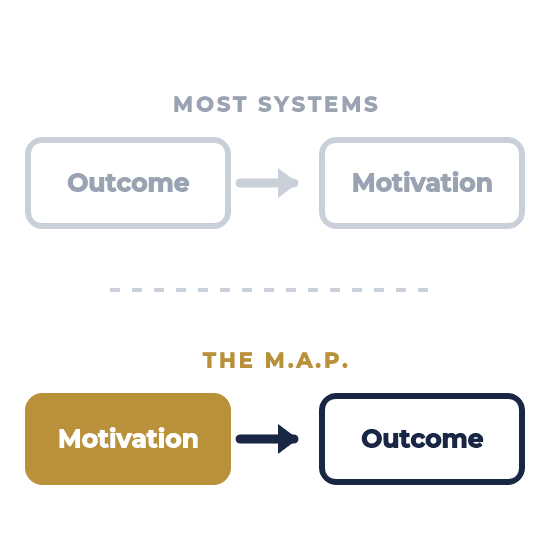
- The Motivation comes before the Outcome. Most planning systems start with what you want to achieve. The M.A.P. starts with why it matters to you, written in your own words. The reason lives at the top of the page every time you open it. When the work gets boring in month four, the reason why you're doing it, the primary purpose, is what keeps you going.
- Goals have a price, and the price matters. Every meaningful goal costs you time, money, comfort, relationships, or some part of your identity. Most people commit to goals without doing the math, then quietly abandon them when the bill arrives. The course teaches a short pre-commitment conversation that clearly identifies the real cost before you start. As a result, you know what you're signing up for and you will expect challenging times before you experience them.
- Belief is built, not summoned. Motivation fades over time. What keeps a goal in focus is a series of small completed actions that prove you can do this. The course shows you how to start smaller than your initial ambition wants and that helps you to build your confidence, which will further fuel your ambition.
If those three ideas resonate, the rest of the course will land well for you.
"We are what we repeatedly do. Excellence, then, is not an act, but a habit."
- Aristotle
Goal Setting for Success - Course Roadmap
The complete Goal Setting for Success eBook is one downloadable PDF. Below is the full roadmap of this personal goal setting course, so you can see how the chapters fit together before you download.
Part One: Clarity (Chapters 1–3)
Introduction. Why Most Goals Fail: The design problem behind most abandoned goals, and what the rest of the book does about it.
Chapter 1. Goals That Matter to You: The personal-meaning test that comes before SMART. Why a SMART goal you don't personally care about is still a goal you'll abandon.
Chapter 2. A Balanced Life, Not Just a Productive One: Use the Life Balance Wheel to choose where to focus next, before you write any new goals.
Chapter 3. Time Is the Resource, Not the Enemy: The five-step process from a big goal to today's schedule, including how to choose three actions per day that actually move the goal forward.
Part Two: Planning (Chapters 4–6)
Chapter 4. From Idea to Plan with the M.A.P.: The Master Action Plan in depth, with two complete worked examples (an eliminate-credit-card-debt plan and a customer-service training program).
Chapter 5. Knowing What Your Goal Will Cost: The five currencies every meaningful goal draws on, and the pre-commitment conversation that surfaces the real price before you start.
Chapter 6. Belief Through Small Wins: The streak strategy that builds evidence you can do the work, and the WOOP framework for preparing in advance for the obstacle most likely to break your streak.
Part Three: Action (Chapters 7–9)
Chapter 7. Overcoming What's in the Way: How to tell an internal obstacle from an external one, and the right response for each kind.
Chapter 8. Keeping Perspective When Things Get Hard: The zoom-out and zoom-in tools for recovering perspective when the current week feels worse than the work warrants.
Chapter 9. Build a Network to Support Your Goals: The three roles a support network plays, and how to ask for help in a way that gets a yes.
Part Four: Follow-Through (Chapters 10–12)
Chapter 10. Goal Setting with Your Team: Using the M.A.P. with the people you lead, including how to surface each team member's personal reason for caring.
Chapter 11. Tracking, Adjusting, and Sticking With It: The weekly review cadence and the discipline of adjusting without quitting.
Chapter 12. Celebrate to Motivate: Right-sizing celebration to the size of the win, and closing the loop on finished goals so each one feeds the next.
Appendix: Worked Examples
Three filled-out M.A.P. plans, one each from a different domain:
- Example 1. A Fitness Goal: Training for a half-marathon with a stretched schedule.
- Example 2. A Financial Goal: Saving $50,000 for a down payment over 18 months.
- Example 3. A Leadership Goal: Reducing voluntary turnover on a 12-person team.
Use these as models when building your own Master Action Plan.
The Two Free Tools You'll Use Throughout the Course
The Goal Setting for Success eBook walks you through a complete goal setting system. Two of our free tools are referenced throughout, and it helps to have them open as you read.
1. Life Balance Success Wheel
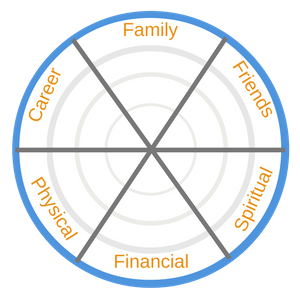
Use this tool to:
- Score your current satisfaction in each area of your life
- Identify the categories that need attention this season
- Choose two or three priority areas before you write any new goals
When your goals come from a full view of your life rather than from whatever's loudest this week, the goals you set tend to be the ones worth finishing.
2. Master Action Plan (M.A.P.)

Use this tool to:
- Capture the Outcome, Motivation, and High Impact Activities for any goal
- Prepare for obstacles in advance with the Barriers & Solutions section
- Plan and run your week from the 5-Day Planner
The Life Balance Wheel and the M.A.P. work together. The Wheel tells you what to work on next. The M.A.P. tells you how.
Common Pitfalls (And How to Avoid Them)
Most goal plans fail because the plan is unrealistic, vague, or too big. The course takes you step by step through the process, but it's still possible to drift off track. Here are the most common pitfalls and a practical fix for each.
Pitfall: Too many goals
Fix: Pick fewer goals and go deeper. If everything is a priority, nothing is. Three to five priority goals for the year is plenty for most people.
Pitfall: Goals with no calendar
Fix: Convert each goal into specific weekly actions. If you can't name the next action, the goal is still a wish. Block the actions on your actual calendar with specific start times.
Pitfall: Goals that are not aligned with your values or season of life
Fix: Test each goal before you commit to it. Ask whether the reason behind it will still feel true in month five, not just week one. If you can't write a personal reason in your own words, the goal should be reconsidered or adjusted. Your M.A.P.'s Motivation field is where that reason lives so take the time needed to get it right.
Pitfall: Motivation disappears
Fix: Use a review routine instead of relying on feelings. Fifteen minutes once a week beats two hours "someday." The M.A.P.'s 5-Day Planner is designed for exactly this.
Pitfall: Progress is invisible
Fix: Track one simple metric or proof point. Number of one-on-ones held. Workouts completed. Sales calls made. Hours protected for deep work. Invisible progress is the same as no progress.
Frequently Asked Questions (FAQ)
This section answers the questions people usually have before they download our personal goal setting course, Goal Setting for Success.
Is this really free?
How long does it take to complete?
You can build a working personal goal plan in 60 to 90 minutes using the on-page framework. The deeper benefit comes from a weekly 15-minute review applied across the months of a real goal. The Goal Setting for Success eBook itself is about a two-hour read, organized so you can read it in order or jump to the chapter that fits where you're stuck.
What's the difference between this course and SMART goals?
SMART is part of what we teach (you'll find it in Chapter 1), but SMART by itself is incomplete. A SMART goal you don't personally care about is still a SMART goal, and those are the goals most people quietly abandon. This course adds a personal-meaning test before SMART, a five-field planning document (the M.A.P.) for after SMART, and a follow-through system to keep the goal alive across months.
What is the M.A.P. (Master Action Plan)?
The M.A.P. is the central tool of the course. It's a one-page document with five fields: Outcome, Motivation, High Impact Activities, Barriers & Solutions, and a 5-Day Planner. The Motivation field sits at the top of the page, in plain view, every time you open it, so the reason for the goal stays connected to the work. You can download the M.A.P. template here.
Do I need to be a leader for this to help?
No. The course is accessible for anyone working on meaningful personal or professional goals. It's written with new leaders, solopreneurs, and small-business owners in mind, because they tend to carry multiple goals at once and need a system that scales. Experienced leaders often use it as a reset when they feel overloaded.
Can I use this with my team, or is it only for personal goals?
Both. Chapter 10 of the eBook is dedicated to using the M.A.P. with a team you lead. It covers how to choose the right team goal, how to translate each M.A.P. field for a group, how to present a goal so people commit rather than just comply, and how to run a short weekly cadence that keeps team goals alive between meetings.
How often should I review my plan?
The eBook prescribes a specific cadence: a five-minute daily check-in to set the day's top three actions, and a 15-minute weekly review to update the M.A.P. and plan the coming week. Once a month, take 30 minutes for a longer adjustment pass. Once a quarter, run a right-sizing check to make sure the goal still fits your season of life.
What if I lose motivation halfway through?
Almost every meaningful goal has a middle stretch where the early enthusiasm has worn off and the finish line still feels far away. Chapter 6 (Belief Through Small Wins) and Chapter 8 (Keeping Perspective When Things Get Hard) are written specifically for that stretch. The short version: shrink the next step to something you can complete in 30 minutes, protect your streak at the smallest possible level, and re-read the Motivation at the top of your M.A.P.
What if I fall behind?
That's normal. Revisit your plan, reduce the scope, choose the next smallest action, and restart your weekly review. The rule that helps most is simple: if you miss a day, don't miss two in a row. One missed day is normal life. Two missed days in a row is the beginning of an abandoned goal.
Is the content religious or faith-based?
The course is secular and practical. There are no affirmations, no manifesting, no mindset chapters. The teaching is grounded in what works for busy adults trying to make real progress on real goals. If faith is part of your life, the Life Balance Wheel includes it as one of the categories you can use, but the framework itself doesn't depend on it.
Download Goal Setting for Success Course

Want the entire leadership tools library? Subscribe to our free newsletter and we'll send you a link to every tool on this site, all on one page, sorted by leadership phase. Every tool is free to download on its own page. The library just puts them in one place. Plus, you'll never miss out on updated or new tool announcements.
Your privacy is important to us. We never share or sell email addresses.
Leadership Tools Newsletter
Subscribe Free - See All Tools on One Page - Get New Tool Alerts
More Self-Leadership Tools


Richard Gorham has led teams in financial services for more than 30 years, from retail branches and operations to investments and insurance, and he still leads a team today.
He founded Leadership-Tools.com in 2002 to give managers free, practical tools like the ones he used in his various leadership roles. Every tool here has been used in a real workplace and comes with a filled-in example you can follow.

Contact Information:
phone
(503) 970-9777
Email Customer Service
helpsupport@leadership-tools.com
Email Richard
richard@leadership-tools.com

By Richard Gorham
Leadership-Tools.com
2879 Riverwalk Loop, Eugene, Oregon, 97401
Copyright (c) 2002 - 2026 All Rights Reserved