- Home
- Leading Self
- Goal Setting for Success Course
- Section 5.2, Responding To Failure
How to Respond to Failure and Keep Pursuing Your Goals
Section 5.2: Responding To Failure
Failure is guaranteed on any meaningful goal - the difference is how you respond. In this chapter of the Goal Setting for Success personal goal setting course, you’ll learn how to respond to failure in a way that keeps you moving toward your personal and business goals.
Whether you’re a new or aspiring leader, a frontline manager, or a solopreneur, you’ll discover how to reframe setbacks, take ownership, and use every disappointment as fuel for your next step forward.
Download Free: Goal Setting for Success eBook
This lesson is part of our complete Goal Setting for Success personal goal setting course, which walks you step-by-step from clarifying your vision to creating a Master Action Plan.
When a Goal Fails: 5 Immediate Steps
Failure never feels good, especially when it touches your income, your reputation, or your confidence. But your first few minutes after a setback can either lock you into shame and frustration or put you back in the driver’s seat.
Use this simple 5‑step response any time a personal or business goal falls apart. It works whether you missed a sales target, broke a health commitment, or fell behind on an important project.
1. Acknowledge What Happened
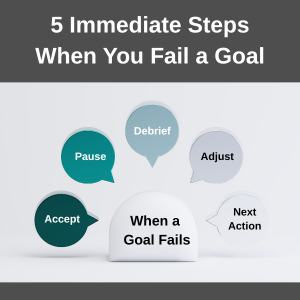
Be honest and specific about what went wrong, without beating yourself up.
- “We fell $5,000 short of our quarterly revenue goal.”
- “I missed three days in a row on my daily writing habit.”
- “I didn’t follow through on the client proposal I promised.”
You can’t respond to failure in a healthy way if you’re not willing to see it clearly.
2. Breathe and Give Yourself a Short Pause
Before you react, pause. Take a few slow, deep breaths. Notice the disappointment or frustration without acting on it.
Tell yourself: “This hurts, but it’s not the end. I can learn from this and respond differently.”
Even a brief pause helps you avoid emotional reactions like blaming others, quitting early, or making impulsive decisions you’ll regret later.
3. Debrief the Situation and Extract One Key Lesson
Now, step back and review the failure like a coach analyzing game footage.
Ask yourself:
- What exactly led to this outcome?
- What was within my control, and what wasn’t?
- What would I do differently if I could replay this?
Look for one clear lesson instead of trying to fix everything at once. For example:
- “I didn’t schedule time for outreach, so sales activity was too low.”
- “My goal wasn’t realistic given my current schedule.”
- “I relied on willpower instead of building a simple, repeatable habit.”
4. Adjust the Goal, Plan, or Habits
Responding to failure as a leader means making intelligent adjustments instead of walking away.
Depending on what you’ve learned, you might:
- Keep the same goal but extend the deadline.
- Break a big goal into smaller, weekly milestones.
- Change your strategy (for example, focusing on warm referrals instead of cold outreach).
- Add structure: reminders, checklists, accountability partners, or better tools.
The key is to change something concrete about how you’re pursuing the goal, not just promise yourself you’ll “try harder.”
5. Reset with One Clear Next Action
Finally, decide on one specific action that moves you forward within the next 24 hours.
- “I will block 30 minutes tomorrow morning to review my sales funnel.”
- “I will send five follow‑up emails to warm prospects by 11:00 a.m.”
- “I will schedule my next three workouts on my calendar.”
Write it down. Put it in your calendar. Then follow through.
This is how to respond when a goal fails: acknowledge the setback, pause, learn, adjust, and take one clear step forward. Over time, that pattern builds resilience, confidence, and real momentum in both your business and personal life.
Why Your Response to Failure Matters
Everyone loves the idea of success. Few people are willing to face what comes with it: risk, discomfort, and the very real possibility of failure along the way. If your goals are big enough to excite you, they are big enough to scare you - and they will occasionally knock you down.
This is true for both personal and business goal setting. You will miss targets, lose opportunities, and fall short of your own expectations. The question is not, “Will I fail?” The real question is, “How will I respond to failure when it happens?”
Your success as a leader, entrepreneur, or professional isn’t determined by how perfectly you avoid failure. It’s determined by how you handle those moments when things don’t go according to plan.
- Do you react and give up control?
- Or do you respond and grow stronger?
Failure as Feedback, Not Final Judgment
When you see failure as a final judgment on your worth or ability, you stop trying. You protect yourself by setting smaller goals, taking fewer risks, or avoiding new challenges altogether.
High achievers think differently. They understand a powerful truth:
Failure is feedback. It’s information. It’s a message that says, “Something in your approach needs to change.”
When you treat failure as feedback, you can:
- Learn what’s working and what isn’t
- Adjust your personal and business goals to be more effective
- Improve your strategy, habits, and mindset
- Come back stronger and smarter
Instead of asking, “Why did I fail?” ask, “What is this failure trying to teach me?”
The Cost of Reacting vs. the Power of Responding
You can’t always control what happens, but you can always control how you choose to respond. That choice makes all the difference in your goal setting for success strategy.
Most people never think about the difference between reacting and responding. Yet this simple distinction is one of the most important self-leadership tools you will ever learn.
How to Respond to Failure Instead of Reacting
You will face unexpected obstacles while pursuing your goals. Projects will fall behind, sales will be lost, key relationships may shift, and life will sometimes get in the way.
In those moments, leaders who win in the long term know how to respond to failure instead of simply reacting to it.
A Simple 5-Step Process to Respond to Failure
Here is a practical, repeatable process you can use the next time you experience a setback with any personal or business goal:
1. Pause before reacting
Take a breath. Don’t send the angry email. Don’t quit your goal in the heat of the moment. Give yourself a short pause to cool down.
2. Name what happened
Describe the failure in neutral, factual language -no drama, no blame.
- “We missed our revenue goal by 20%.”
- “I didn’t complete the course module I promised myself.”
3. Extract the lesson
Ask: “What is this failure trying to teach me about my goal, my plan, or my habits?”
- Was the goal realistic?
- Did I have a clear plan?
- Did I follow through on my commitments?
- What changed that I didn’t account for?
4. Adjust the goal or plan
Responding to failure in goal setting means you make intelligent adjustments instead of walking away. You might:
- Revise the timeline
- Break the goal into smaller steps
- Change your strategy or tools
- Ask for help or training
5. Take one clear next action
Decide on a specific, immediate step that moves you forward again.
Not “I’ll try harder”- but “I will make 5 sales calls before noon tomorrow,” or “I will spend 30 minutes tonight updating my action plan.”
This is how to respond to failure in business and life: pause, learn, adjust, and act.
React vs. Respond: Clarifying the Difference
When a goal falls apart, most people slip into an automatic pattern without even noticing it. Some lash out, shut down, or walk away; others pause, think, and deliberately choose their next move. That quiet moment of decision is where the real difference lies.
In this section, we’ll clarify what it truly means to “react” versus “respond,” so you can recognize your own pattern and start choosing the one that consistently moves you closer to your goals.
To React – Giving Up Control
To react is to give up control of the situation - and of yourself. Reactions are driven by emotion, not intention.
When you react to failure, you might:
- Blame others or circumstances
- Get defensive or angry
- Feel ashamed and hide from the situation
- Quit on your goal altogether
In goal setting, reacting turns a temporary setback into a permanent defeat.
To Respond – Taking Ownership and Moving Forward
To respond is to stay in control - of your choices, your attitude, and your future.
When you respond to failure, you:
- Take responsibility for your part in the outcome
- Look honestly at what happened, without excuses
- Learn the lesson and keep your long-term vision in sight
- Choose the next best step to move forward
In personal and business goal setting, responding means you recognize:
“You can recover from anything, no matter how difficult it may be, when you choose to respond with courage, responsibility, and action.”
Your response to failure becomes one of your greatest self-leadership strengths.
"Failures do what is tension relieving, while winners do what is goal achieving."
- Dennis Waitley
Handling the Emotions of Missed Goals

When a goal doesn’t work out, the hardest part often isn’t the result itself – it’s the emotions that come with it. Shame, frustration, fear, and self‑doubt can make even the most capable leader want to hide or give up.
Learning how to respond to failure isn’t just about strategy and planning. It’s also about handling your emotions in a way that keeps you moving instead of shrinking your goals to avoid discomfort.
Use the following practices to process those emotions and rebuild your confidence after a setback.
1. Name What You’re Feeling Without Judgment
Instead of pushing your feelings aside or pretending they don’t matter, take a moment to name them.
- “I feel embarrassed that I missed this target.”
- “I feel anxious about what this means for my business.”
- “I feel disappointed in myself for not following through.”
Naming the emotion reduces its power. It reminds you that feelings are information, not a final verdict on your future.
2. Practice a Brief Self‑Compassion Script
Many high achievers speak to themselves in a harsh, critical tone after failure. That may feel like “tough love,” but it usually erodes confidence and motivation.
Try this simple self‑compassion script instead:
- “This is hard, and it’s okay to feel upset.”
- “Every leader and entrepreneur fails sometimes – this is part of the journey.”
- “I can learn from this and choose a better response starting now.”
You are more likely to stay engaged with your goals when you treat yourself like a respected colleague, not a permanent disappointment.
3. Separate Your Identity from the Outcome
A failed goal does not mean you are a failure.
Remind yourself:
- “This result is feedback on my plan and execution, not proof of my worth.”
- “The outcome is temporary; my character and values are bigger than this one moment.”
- “I can respond to this failure in a way that makes me stronger as a leader.”
This mindset shift helps you stay bold in your business and personal goal setting, instead of shrinking your vision after a setback.
4. Create a Small Confidence‑Rebuilding Win
Confidence is rebuilt through action, not just positive thinking.
Ask yourself: “What is one small, meaningful win I can create in the next 24 hours?”
Examples:
- Complete a simple but important task you’ve been avoiding.
- Have one honest conversation you’ve been putting off.
- Make progress on a key habit for just 10–15 minutes.
Each small win sends a powerful message to your brain: “I can trust myself to show up again, even after a failure.”
5. Share the Lesson with Someone You Trust
Leaders and solopreneurs often carry failures alone, which increases shame and isolation. Instead, choose one trusted person – a mentor, peer, coach, or partner – and share:
- What happened
- What you’re feeling
- What you’re learning
- How you plan to respond
You’ll often discover that your failure is not as unique or catastrophic as it feels in your own head. Supportive accountability also increases the odds that you’ll act on your new plan rather than slipping back into old patterns.
When you learn to handle the emotions of missed goals with honesty, self‑compassion, and courage, you will discover how to respond to failure by transforming failure into a training ground for stronger leadership.
Success Lesson #12: What to Do After a Goal Failure
The real test of character isn’t how you feel when you set a goal. It’s what you do after you don’t hit it.
You set out with excitement. You made plans. You worked hard. And still, the result fell short. Now what?
This is where many people abandon their goals. They tell themselves stories that sound true but keep them stuck:
- “Maybe I’m just not cut out for this.”
- “I’ll never be good with money / business / leadership.”
- “It’s too late for me to change.”
Successful leaders tell themselves a different story. They see a failed goal as a single chapter, not the end of the book.
Quick Reset After a Goal Failure
Use this simple 3-step reset anytime a personal or business goal doesn’t work out the way you hoped:
1. Acknowledge the loss
Be honest about what didn’t work: the missed deadline, the lost client, the broken promise to yourself. Don’t sugarcoat it - but don’t dramatize it either.
2. Review your part
Ask: “What was within my control?”
- Did I prepare fully?
- Did I follow through consistently?
- Did I set a realistic goal based on facts, not just hope?
Write down at least three things you would do differently next time.
3. Reset the goal
Decide whether to:
- Revise the goal
- Adjust the deadline
- Change the strategy
- Or, if the goal itself no longer fits your values, replace it with a better one
The key is this: respond by making a conscious decision, not by drifting away from your goal in silence.
Example – Turning a Failed Goal into Progress
Here’s a simple example of how to respond to failure in business and life:
A solopreneur sets a goal to sign 10 new clients in one quarter, but only signs 3.
If she reacts, she might say:
“I’m terrible at sales. This will never work. I should just quit.”
If she responds, she pauses and reviews:
- She realizes she didn’t reach out to enough prospects.
- Her offer was unclear.
- She waited for people to find her instead of initiating contact.
She extracts the lessons, adjusts her goal and plan, and sets a new weekly action target:
- Contact 10 qualified prospects every week.
- Refine her offer based on feedback.
- Practice her sales conversations 15 minutes a day.
The failure becomes feedback that strengthens her future success.
Quick Reflection – Responding to Your Last Failure
Take a moment to apply this to your own life. Think of a recent failure related to a personal or business goal.
Use this quick reflection exercise:
- What happened? (1–2 sentences, just the facts.)
- What part of the outcome was within your control?
- What lesson does this failure offer you?
- What will you change in your goal, plan, or habits?
- What specific action will you take this week to move that goal forward again?
Write your answers down. This is how you turn failure into a leadership tool rather than a life sentence.
Make Responding to Failure Part of Your Goal-Setting Curriculum
"Defeat is nothing but the first step to something higher."
- Wendell Phillips
Responding to failure is not a one-time event; it’s a core skill in your ongoing goal setting for success. Treat it as a permanent part of your personal and business goal setting curriculum.
Defeat can be a powerful teacher when you stay enrolled in the class.
Your job is to take that step.
Common Excuses That Keep You Stuck
When you don’t yet know how to respond to failure, it’s easy to retreat into excuses. You may hear yourself say things like:
- “I didn’t really want it anyway.”
- “I just don’t have enough time.”
- “People like me never get those opportunities.”
- “The market is too competitive.”
These excuses feel safe in the moment, but they keep you trapped. Each one is a way of reacting instead of responding.
Try replacing them with questions that move you forward:
- Instead of “I don’t have time,” ask: “What can I stop doing so I have time for what matters?”
- Instead of “I’m not good at this,” ask: “How can I practice and improve this specific skill?”
- Instead of “People like me don’t succeed,” ask: “What small win can I create this week?”
Building Your “Respond to Failure” Habit
Learning how to respond to failure in goal setting is like building a muscle. The more you use it, the stronger it gets.
Here are simple ways to build this habit:
Expect obstacles
When you set a goal, assume there will be setbacks. This doesn’t make you negative — it makes you prepared.
Pre-decide your response
Tell yourself in advance: “When I hit a setback, I will pause, learn, adjust, and act.”
Celebrate honest reviews
After each major effort (a project, a quarter, a campaign), schedule a brief review:
- What worked?
- What didn’t?
- What did I learn?
- What will I do differently?
Stay connected to your “why”
Remember why this goal matters to you — for your life, your business, your family, or your team. A strong “why” gives you strength to thoughtfully respond instead of exhibiting an emotional reaction.
Download Goal Setting for Success eBook
Download our free Goal Setting for Success eBook: Download PDF
Inside, you’ll get: The full step‑by‑step course content for all chapters and sections; Motivational Lessons for Success at the end of each chapter; Worksheets and examples you can print or use digitally; and Guidance tailored to both personal life and leadership at work. If you’re ready to reset and strengthen your goals after a setback, download our free Goal Setting for Success eBook.
To access all of our tools simply subscribe to our free newsletter. You will immediately receive a password that grants access to our entire leadership tools library.
Your privacy is important to us. We never share or sell email addresses.
Next Goal Setting for Success Chapters




Contact Information:
phone
(503) 970-9777
Email Customer Service
helpsupport@leadership-tools.com
Email Richard
richard@leadership-tools.com

By Richard Gorham
Leadership-Tools.com
2879 Riverwalk Loop, Eugene, Oregon, 97401
Copyright (c) 2003 - 2026 All Rights Reserved