A master action plan is a focused version of an action plan. A standard action plan often becomes a long list of everything that could be done. A M.A.P. deliberately narrows that down to the critical few actions that actually drive the outcome, then adds clear ownership, deadlines, and a weekly execution rhythm. The difference isn't the format, it's the discipline. A M.A.P. forces you to decide what matters most and protect your attention for it, rather than spreading yourself thin across twenty tasks.
- Home
- Leading Self
- Master Action Plan (M.A.P.)
Free Master Action Plan Template
Use this master action plan template when you want focus and follow-through. Whether you’re building a new habit, leading a small team, improving performance, launching an offer, or completing a personal goal you’ve delayed too long.
Action planning amounts to more than writing a "To Do" list. Using the M.A.P. approach you'll ensure that tasks are identified that match up directly with the goal you have set, and more importantly, the purpose of that goal.
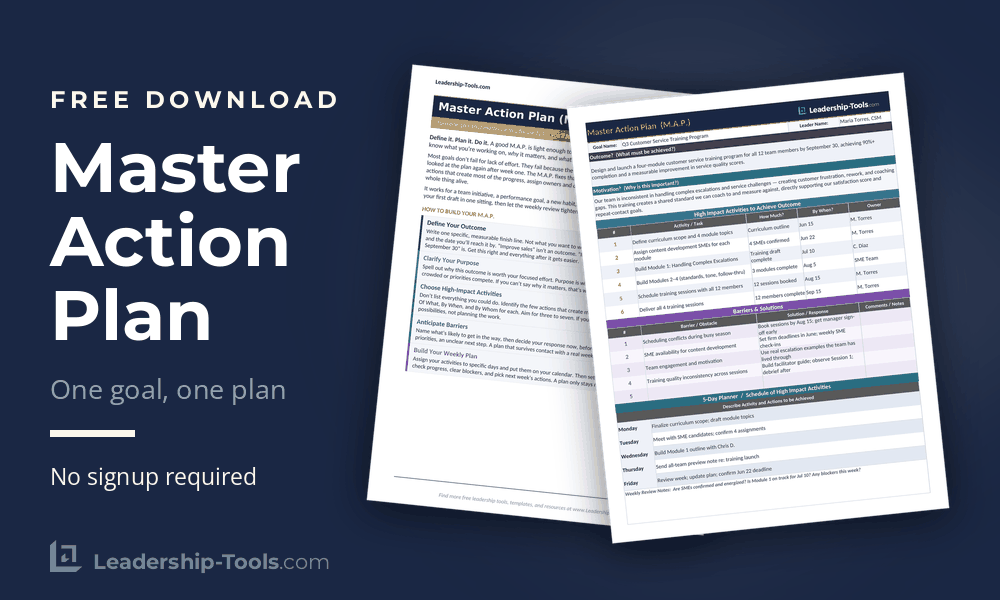
Download Master Action Plan:
Big goals fail for predictable reasons: the actions aren’t specific, the timeline is fuzzy, and the plan isn’t reviewed often enough to stay real. If you’re a new or aspiring leader, a frontline manager, or a solopreneur juggling priorities, you don’t need a longer to-do list. You need a clear, repeatable system that turns one meaningful outcome into a short list of critical actions.
This page gives you exactly what you need. Using your M.A.P., you’ll define your ultimate outcome, clarify your purpose (“why these matter”), choose the highest-impact activities, anticipate barriers, and turn it into a practical weekly action plan template you can execute in real life.
"People who don't have important opportunities to put their talents to good use, wind up frustrated. Strengthen your people by expecting results, and provide them with the tools to plan for success."
By planning out the entire process before initiating any tasks, you'll be certain that your efforts are maximized and will produce the results you expect.
An effective leader will create a solid action plan that is squarely focused on the outcome of each task and how it contributes toward the achievement of the stated goal.
In other words, as you complete the master action plan and write down each task you will effectively answer these critical questions: How Much? Of What? By When? and By Whom?
Jump To: Quick Glance | What is a M.A.P. | Who a M.A.P. Is For | How to Fill Out Template (5 Steps) | Completed Example | Weekly Review (10 Minutes) | Common Mistakes | FAQ | Get Updates Free | Download Free Template
Quick Glance: Master Action Plan Template
Download the free master action plan template (M.A.P.) and follow the steps below to complete it:
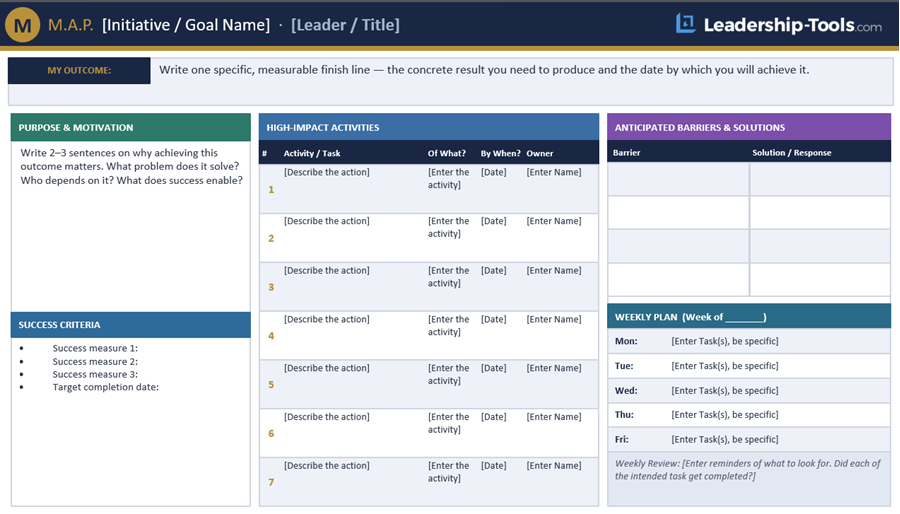 Master Action Plan (M.A.P.)
What you’ll want before you start (optional, but helpful):
- A single goal/outcome you truly care about
- 10–15 minutes for the first draft
- Your calendar (so actions become scheduled commitments, not intentions)
Quick Start (15-minute setup)
- Download the master action plan template.
- Write one “ultimate outcome” (keep it single-sentence).
- Add your purpose (why it matters).
- Choose 3–6 high-impact activities (not 20).
- Add deadlines and owners (even if it’s just you).
- Schedule this week’s actions on your calendar.
- Set a weekly review appointment (10 minutes).
By the end, you’ll have:
- A completed master action plan template you can reuse for any goal
- A SMART action plan template-style set of tasks (clear, specific, measurable)
- A simple weekly review rhythm (so the plan stays alive, not forgotten)
What Is a Master Action Plan (M.A.P.)?
A Master Action Plan (M.A.P.) is a practical action plan template that helps you turn a goal into actions you can actually complete.
You start with the outcome you want, then you narrow it down to a short list of critical tasks, assign ownership, set deadlines, and plan out what you will do this week. It goes beyond a to-do list because it connects your daily actions back to the outcome and includes a simple routine for reviewing and adjusting as you go.
Think of it as your path for getting "clear" on how to achieve the results you seek. You start with this blank Master Action Plan template.

Clear Outcome
You write one specific finish line, or outcome. Not “get in shape,” but “run a 5K by June” or “publish 12 newsletters by year-end.” A clear outcome makes it obvious what success looks like and prevents your plan from turning into a random collection of tasks.
Clear Purpose
You spell out why this goal matters. This is the part that keeps you going when your week gets busy or you hit a rough patch. For solopreneurs and new leaders, "purpose" also helps with decision-making because it becomes your filter for what to say yes to and what to ignore.
Clear High-Impact Actions
Instead of listing everything you could do, you identify the small number of actions that will create most of the progress. This is where momentum comes from. If your plan has 20 actions, it usually turns into a guilt document. If it has 3 to 6 high-impact actions, it becomes executable.
Specific Dates
Each action gets a deadline, even if it is your best estimate at first. Dates create urgency and make planning honest. They also reveal capacity issues early. If you cannot fit the work into your week, you will see it immediately and can adjust before you lose a month.
Simple Weekly Review and Revise Loop
Once a week, you quickly check what you did, what you avoided, and what got in the way. Then you choose the next best actions for the upcoming week and schedule them. This is what keeps your plan alive. You do not have to be perfect; you just have to keep assessing, adjusting and moving forward.
A good M.A.P. should feel lightweight. When you look at it, you should immediately know what you are aiming for, why it matters, and what you are doing this week to move it forward. If it gives you that clarity and helps you follow through, it is working.
Who This Master Action Plan Template Is For
If you have ever made a plan that looked great on day one and then disappeared under the weight of real life, this M.A.P. is for you.
This master action plan template works best for people who want momentum without turning planning into a second job. It is simple on purpose. You are juggling enough already, and a plan only helps if you can actually use it on a busy week.
Use M.A.P. if you are:
- A new or aspiring leader who wants to build consistency and self-discipline without burning out
- A frontline manager who is expected to hit priorities while still handling the daily surprises that pop up
- A solopreneur who needs focus across marketing, delivery, and operations, and cannot afford to chase ten “important” things at once
- Anyone who wants a practical weekly action plan template that keeps a meaningful goal moving forward, even when time is tight
M.A.P. is a strong fit for goals like:
- Launching a new offer or product, especially when you need a clear weekly execution plan
- Improving team performance or customer experience by focusing on the few changes that make the biggest difference
- Building a habit such as fitness, writing, learning, or consistent outreach
- Completing a certification, portfolio, or career step, where steady weekly progress beats occasional bursts
- Paying down debt or hitting a savings milestone by turning good intentions into scheduled actions
If your goal matters and you are tired of starting over, this is a good next step. Download the template, fill in the first draft quickly, and then use the weekly review to keep it realistic as your week changes.
How to Fill Out the Master Action Plan Template (5 Steps)
Here is the simple process I recommend for filling out your master action plan template. Do not try to make it perfect on the first pass. Your first draft is just a starting point. The real value comes from using it, learning what works in your week, and then tightening it up during your weekly review.
Step 1: Define the Ultimate Outcome
Start by getting crystal clear on what you are trying to accomplish. This is the finish line, not a vague direction. If you do nothing else today, do this step. When the outcome is clear, everything that follows gets easier because you are no longer guessing what to work on. Write it in plain language, the way you would explain it to a friend.
What to write:
- A single sentence describing what “done” looks like
- Make it measurable if possible with a date, number, or milestone
Helpful prompts:
- What does success look like in one sentence?
- How will I know I achieved it?
Step 2: Clarify Your Purpose (Your “Why”)
This step is about motivation, but not the fluffy kind. It is about meaning and leverage. When your schedule gets crowded or you feel tired, your purpose is what helps you keep your commitment instead of letting the goal slide.
Take a minute to write what is genuinely at stake here, for you and for the people you serve or lead.
What to write:
- One to three reasons the outcome matters
- Who benefits if you follow through (you, your family, your team, your customers)
- What improves when you stick with it
Step 3: Choose High-Impact Activities (Your Critical Few)
This is the part that separates a master action plan template from a giant to do list. Most plans fail because they try to cover everything. You do not need everything. You need the few actions that actually create progress.

Be honest with yourself here. If you are tempted to list ten or fifteen items, you are probably mixing “nice to do” tasks with the work that truly moves the needle.
What to write:
- Three to six high-impact activities that drive the outcome
- If you have more than six, you are probably listing busywork or steps that are too small
How to choose the critical few:
- Pick actions that still create progress on an imperfect week
- Prefer actions that build something compounding, such as a skill, an asset, or a simple system
Mini Check: Is this action high impact?
Ask Yourself:
- If I only did this one thing for a week, would it move the needle?
- Does this create an asset, a skill, or a measurable result?
Step 4: Identify Barriers (and Pre-Decide Your Response)
Now we plan for reality. You already know what usually gets in your way. Time. Energy. Distractions. Unclear next steps. Other people’s priorities.
Instead of hoping those barriers will not show up, assume they will. Then decide ahead of time what you will do when they appear. This is one of the most powerful parts of the M.A.P. because it keeps a bad day from turning into a bad month.
What to write:
- Three likely barriers (time, energy, fear, unclear next step, competing priorities)
- One response for each barrier that you can actually do in the moment
Example barrier responses:
- Barrier: No time. Response: Block 30 minutes Monday, Wednesday, and Friday before email.
- Barrier: Low energy. Response: Do the smallest version, just 10 minutes.
- Barrier: Unclear next step. Response: Define the next physical action before stopping.
Step 5: Set Deadlines, Ownership, and This Week’s Plan
This is where your M.A.P. turns into a weekly action plan template. You are not just “making a plan.” You are deciding what gets done, by whom, and by when.
If you are a solopreneur, ownership still matters because it forces clarity. If you are a manager, this step prevents the plan from living only in your head. Then, you choose the one to three actions you will execute this week and schedule them so they have a real place in your calendar.
What to write:
- “By when” for each high-impact activity, even if it is your best estimate
- “By whom” for each activity (even if the answer is you)
- The one to three actions you will execute this week
Execution rule:
- If it is not scheduled, it is only a wish. Put this week’s actions on your calendar and commit to it.
"Team members feel strong and capable when they know their input makes a positive difference in the final outcome."
- Sanjay Bali
Filled-Out Master Action Plan Example (M.A.P.)
Before you start filling in your own master action plan template, take a minute to study the example below.
As you read, notice how everything stays connected to one clear outcome, how the actions are few and specific and time-bound, and how the weekly plan turns good intentions into something you can actually execute this week.
Use this structure after entering an outcome that matters to you. In the end you'll create a Master Action Plan that resembles the example shown below.
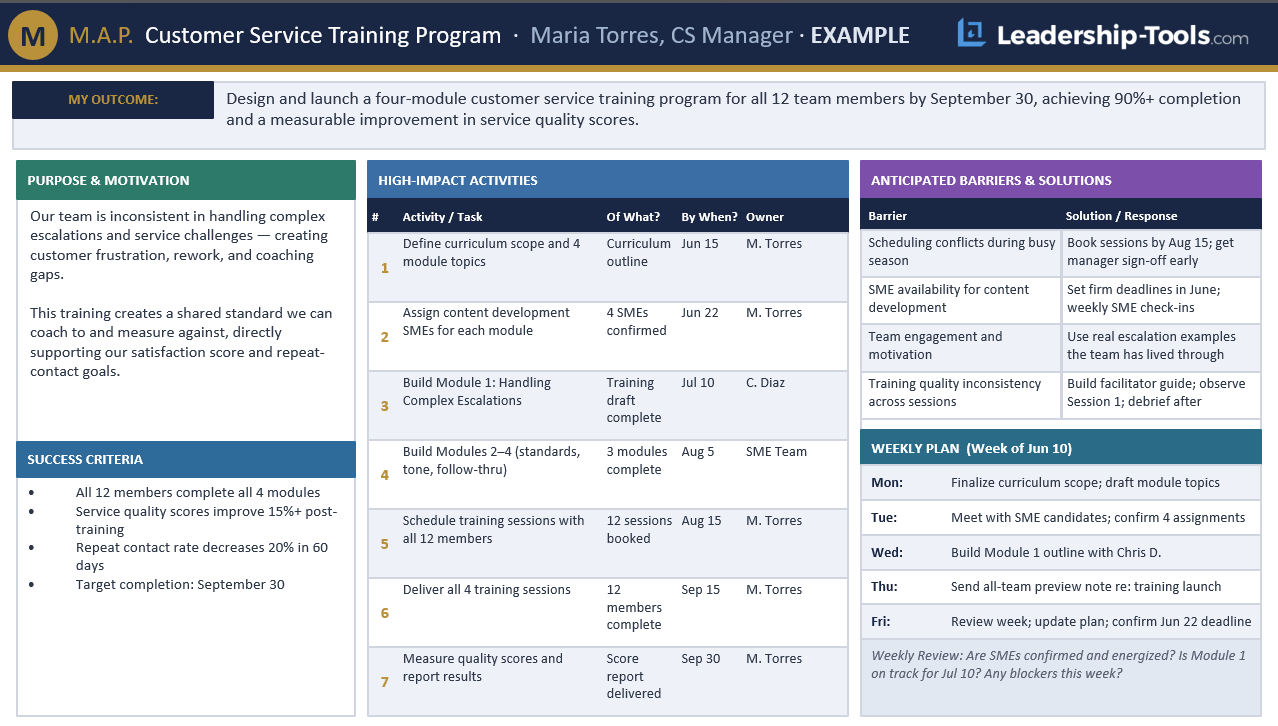 Master Action Plan (M.A.P.) - Example
Outcome
- "Design and launch a four-module customer service training program for all 12 team members by September 30, achieving 90%+ completion and a measurable improvement in service quality scores."
Purpose (Why it matters)
- "Our team is inconsistent in handling complex escalations and service challenges, creating customer frustration, rework, and coaching gaps. This training creates a shared standard we can coach to and measure against, directly supporting our satisfaction score and repeat-contact goals."
High-Impact Activities (Critical few)
- Define curriculum scope and 4 module topics — Curriculum outline complete by Jun 15 — Owner: M. Torres
- Assign content development SMEs for each module — 4 SMEs confirmed by Jun 22 — Owner: M. Torres
- Build Module 1: Handling Complex Escalations — Training draft complete by Jul 10 — Owner: C. Diaz
- Build Modules 2–4 (standards, tone, follow-thru) — 3 modules complete by Aug 5 — Owner: SME Team
- Schedule training sessions with all 12 members — 12 sessions booked by Aug 15 — Owner: M. Torres
- Deliver all 4 training sessions — 12 members complete by Sep 15 — Owner: M. Torres
Barriers (and responses)
- Barrier: Scheduling conflicts during busy season → Response: Book sessions by Aug 15; get manager sign-off early
- Barrier: SME availability for content development → Response: Set firm deadlines in June; weekly SME check-ins
- Barrier: Team engagement and motivation → Response: Use real escalation examples the team has lived through
- Barrier: Training quality inconsistency across sessions → Response: Build facilitator guide; observe Session 1; debrief after
Success Criteria
- All 12 members complete all 4 modules
- Service quality scores improve 15%+ post-training
- Repeat contact rate decreases 20% in 60 days
- Target completion: September 30
This week’s plan (weekly action plan)
- Mon: Finalize curriculum scope; draft module topics
- Tue: Meet with SME candidates; confirm 4 assignments
- Wed: Build Module 1 outline with Chris D.
- Thu: Send all-team preview note re: training launch
- Fri: Review week; update plan; confirm Jun 22 deadline
Use this filled-out example as your guide, complete your first draft in one sitting, and then focus on one good week of execution rather than trying to fix everything at once.
Small, consistent wins quickly create momentum. Keep your outcome clear, keep your activities few, schedule this week's steps, and come back for your weekly review. That is how goals stop being ideas and start becoming results.
Weekly Review (10 Minutes): Keep Your M.A.P. Alive
A master action plan template only works if it remains a priority after you fill it out. This weekly review is the habit that makes that happen.
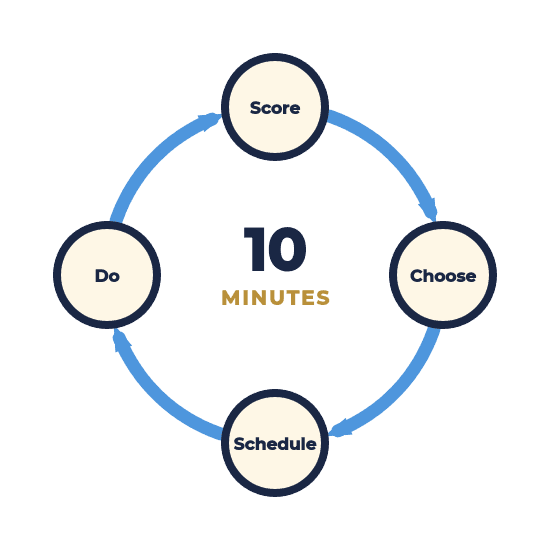
In just ten minutes, you step back, see what actually happened, reset your focus, and choose the next small set of actions that will move your goal forward.
If you are a solopreneur or a busy manager, this is where your plan becomes a tool that allows you to make meaningful progress on a consistent basis.
With a plan in place, achieving your goal will feel like a realistic endeavor. You stop relying on self-motivation and start leading yourself using a simple system that shows you what needs to be done, by whom and by when.
This 10-minute check-in is such a small amount of time, but provides a high level of impact.
Pick one day/time and make it a recurring appointment.
Weekly review checklist:
- Score last week: What got done? What didn’t?
- Identify the constraint: time, energy, clarity, fear, or competing priorities.
- Choose this week’s critical few (1–3 actions).
- Schedule them on your calendar right now.
- Remove one blocker (a message, a purchase, a decision, a delegated task).
- Adjust deadlines if needed, without abandoning the outcome.
Simple rule for solopreneurs:
- If your week is chaotic, reduce scope, not commitment. Keep the outcome; shrink the actions. It's okay to take a pause when other responsibilities must take priority. Just make sure you get back on track the following week. A pause should be the exception, not the rule.
If you do nothing else, protect this 10-minute appointment with yourself. It is the difference between “I have a plan somewhere” and “I am making progress every week.”
Over time, you will notice something encouraging: you do not need perfect weeks to get real results. You just need to keep showing up, adjusting, and taking the next best step. That is how your M.A.P. stays alive, and how your goal becomes something you finish.
"There are seven days in the week, and SOMEDAY isn't one of them."
- Shaquille O'Neal
Common Mistakes (and Quick Fixes)
If you have ever built a plan and then stopped using it, you are not alone. Most of the time it is not a motivation problem. It is a design problem.
Here are the most common issues, along with quick fixes that keep your M.A.P. simple and usable.
Mistake: Too many tasks
Quick fix: Cut it down to 3 to 6 high-impact activities. If you feel resistance here, that is normal. Ask yourself, “What are the few actions that would make me proud if they were done by Friday?” Put everything else on a separate “later” list so it does not clutter your M.A.P.
Mistake: Actions are not measurable
Quick fix: Add numbers so you can tell if you did it. Use minutes, reps, pages, calls, drafts, outreach messages, or deliverables. For example, change “work on marketing” to “write one email draft” or “send 10 outreach messages” or “spend 30 minutes improving my landing page.”
Mistake: No deadlines
Quick fix: Add a “by when” for every activity, even if it is an estimate. Deadlines are not there to punish you. They help you plan honestly. Without dates, your M.A.P. turns into “someday,” and someday is where goals go to disappear.
Mistake: The plan is not reviewed
Quick fix: Schedule a 10-minute weekly review event on your calendar and treat it like a real meeting. If you are a solopreneur, this is one of the highest ROI habits you can build because it keeps your priorities from drifting and helps you make steady progress even when client work gets busy.
Mistake: You rely on motivation
Quick fix: Write barrier responses in advance and use minimum viable actions on hard days. Motivation is great when it shows up, but it is not dependable. A better plan is, “If I am tired, I will do 10 minutes,” or “If I am stuck, I will define the next physical step and stop there.”
You do not need a perfect M.A.P. You need a usable one. If your plan feels heavy, simplify it. If it feels vague, measure it. If it keeps getting postponed, date it. If it keeps fading away, review it weekly.
Make these small fixes, and your master action plan stops being a document you meant to follow and becomes a tool that quietly keeps you moving forward.
Frequently Asked Questions (FAQ) | Master Action Plan (M.A.P.)
These are the most commonly asked questions related to the Master Action Plan template.
Click on the (+) sign below to expand each question. Click the (-) sign to collapse it again.
Is a master action plan the same as an action plan?
How many tasks should be on a M.A.P.?
Usually 3 to 6 high-impact activities. If you list 15 to 30 tasks, you've built a project list, not a master action plan. The whole point is to identify the small number of actions that create most of the progress, so you can actually execute them on a busy week. If you feel resistance trimming your list, that's normal. Move everything that didn't make the cut to a separate "later" list so it's captured without cluttering your plan. A short M.A.P. gets done. A long one becomes a guilt document.
How often should I update my master action plan?
Review it weekly. That 10-minute weekly review is what keeps the plan alive instead of forgotten. Update your actions when your reality changes: a new constraint, new information, a shift in priorities. What you generally don't change week to week is the ultimate outcome. Keep that stable unless it truly no longer matters, because constantly rewriting the finish line is how goals quietly disappear. Adjust the path freely; protect the destination.
Can I use this as a SMART action plan template?
Yes. The M.A.P. is built to work as a SMART action plan template. Make each activity specific, measurable, and time-bound, which the template already prompts you to do with its "by when" and "by whom" fields. The weekly review covers the achievable and relevant side of SMART, because it's where you check whether your targets still fit your real capacity and adjust before you fall a month behind. Fill it out with concrete numbers and dates and you've effectively got a SMART plan.
What's the difference between an outcome and a goal on the M.A.P.?
They're close, but the M.A.P. treats the outcome as your single, specific finish line, written in one sentence with a date or number attached. "Get in shape" is a goal. "Run a 5K by June 30" is an outcome. The distinction matters because a clear outcome makes it obvious what to work on and what to ignore. If you can't tell whether a task moves you toward your outcome, the outcome probably isn't specific enough yet.
What if I miss a deadline on my plan?
Treat it as information, not failure. A missed deadline usually tells you one of three things: the action was too big, the week was overloaded, or the deadline was optimistic to begin with. In your weekly review, ask which it was, then adjust. Shrink the action, reschedule it, or move the date without abandoning the outcome. The M.A.P. is designed to flex this way. What matters is that you keep the plan honest and keep moving, not that every date holds perfectly.
Can I use the Master Action Plan template for a team goal, not just a personal one?
Yes, and the "by whom" column is what makes it work for teams. On a personal Master Action Plan, ownership is always you, so it's easy to skip. On a team M.A.P., assigning a clear owner to each high-impact activity prevents the plan from living only in your head and removes the "I thought someone else had it" gap. The completed example on this page is a team goal, a customer service training program, so you can see exactly how ownership, deadlines, and the weekly plan work across several people.
How is the M.A.P. different from the other tools on this site?
The M.A.P. is the "now turn it into action" tool. Several of our other tools help you figure out what to work on: the Leadership Assessment and the 10 Key Questions surface where to focus, and the Life Balance Wheel shows you which area of life needs attention. The M.A.P. is what you reach for once you know your goal and need a structured way to actually achieve it. Many people run an assessment first, pick one priority, then build a M.A.P. around it.
Download Master Action Plan (M.A.P.) Tool

Want the entire leadership tools library? Subscribe to our free newsletter and we'll send you a link to every tool on this site, all on one page, sorted by leadership phase. Every tool is free to download on its own page. The library just puts them in one place. Plus, you'll never miss out on updated or new tool announcements.
Your privacy is important to us. We never share or sell email addresses.
Leadership Tools Newsletter
Subscribe Free - See All Tools on One Page - Get New Tool Alerts
More Self-Leadership Tools




Richard Gorham has led teams in financial services for more than 30 years, from retail branches and operations to investments and insurance, and he still leads a team today.
He founded Leadership-Tools.com in 2002 to give managers free, practical tools like the ones he used in his various leadership roles. Every tool here has been used in a real workplace and comes with a filled-in example you can follow.

Contact Information:
phone
(503) 970-9777
Email Customer Service
helpsupport@leadership-tools.com
Email Richard
richard@leadership-tools.com

By Richard Gorham
Leadership-Tools.com
2879 Riverwalk Loop, Eugene, Oregon, 97401
Copyright (c) 2002 - 2026 All Rights Reserved