For a work team, 30 to 60 minutes fits most schedules. The plan on this page runs 60 minutes, with two 25-minute activities and five minutes at each end, and any single activity from the Leader's Guide works on its own in 25 or 30 minutes inside a regular team meeting.
- Home
- Leading Teams
- Free Team Building Activities
- Team Building Lesson Plans
Team Building Lesson Plan
You're at the right place if you're looking for a team building lesson plan that is written on one page and easy to implement in one session. After you review our plan, you'll know what you want your team to come away with, what to bring, what to say and how long each part should take. Our lesson plans are written for a work team and fit in a single 60-minute meeting.
The plan pairs two activities from our free Team Building Activities Leader's Guide. In Who Knew? people learn something about each other beyond their job titles, and in Lost in Translation they see how easily an instruction gets lost between the person giving it and the person hearing it. You'll only need about 10 minutes to get ready for the session, plus time to print drawing cards and a short list of questions, which we provide.
Read the steps through once or twice before the meeting and keep an eye on the clock to keep things moving along. The full steps for both activities, the question bank and the drawing cards are in the guide, and the guide is a free download on the team building activities page.
Jump To: At a Glance | 60-Minute Agenda | Before the Session | Part 1: Who Knew? | Part 2: Lost in Translation | Closing | Swap an Activity | Example | Build Your Own | More Ideas | FAQ
Team Building Lesson Plan at a Glance
| Team building lesson plan: Know Each Other, Hear Each Other | |
| Objective | Help teammates know each other beyond their job titles and give clearer instructions when work changes hands |
| Best for | A work team with new members, or handoffs that keep coming back incomplete |
| Time | 60 minutes |
| Preparation | About 10 minutes, a few days before the session |
| Group size | Up to about 15 people, in pairs for the second activity |
| Materials | Six to eight questions, one set of drawing cards per pair, blank paper, pens and a timer |
| Outcome | Each person learns something new about a teammate and leaves with one question to ask at their next handoff |
The 60-Minute Agenda
The hour has four parts as shown in the table below. Each activity includes time for a debrief, which is an important part of the learning experience for participants. Keep a timer where you can see it, and if one part runs long, take the time back from the close rather than from either debrief.
| Start | Part | Time | What happens |
| 0:00 | Welcome | 5 min | Say why you're meeting and what the hour holds, without giving away the point of either activity. |
| 0:05 | Who Knew? | 25 min | People answer a question or two about themselves, then talk about what they discovered. |
| 0:30 | Lost in Translation | 25 min | Pairs try two drawing rounds, the first without questions and the second with them, then connect it to work. |
| 0:55 | Close | 5 min | Each person names one thing they'll take back to work, and the next activity goes on the calendar. |
Before the Session: How to Plan a Team Building Event
Marcus Hale runs an eight-person insurance claims team. Two people joined in January, and files handed from one adjuster to another kept coming back with details missing, so the first two activities on his six-month schedule were Who Knew? and Lost in Translation. This lesson plan puts both of those activities into one hour.
- Start with what the team needs. Write one sentence about what you want people to come away with. Marcus wrote one for each activity, "Two people recently joined the team and nobody knows them beyond their job title" and "Files handed between adjusters keep coming back for missing detail." Don't worry if your needs don't match this example, we'll show alternative team building lesson plans later in the swap section. For now, follow this example.
- Book a full hour. A regular team meeting works well, because nobody has to give up other work to attend, and an hour leaves time for both activities without rushing the debriefs.
- Get the materials ready a few days ahead. Choose six to eight questions from the Who Knew? question bank and send them to the team so people can think about their answers. Print one set of drawing cards for each pair, and put blank paper, pens and a timer where you'll run the session. Marcus posted the question list in the team chat, and Priya, from his team, brought the drawing cards and paper.
- Set up the room for pairs. Lost in Translation works best with partners sitting back to back, so arrange the room so people can move their chairs during the activity. For a virtual team, set up breakout rooms and plan to send each describer the drawing card in a private message.
- Tell the team what to expect, and keep the lesson to yourself until later. Something like "We'll spend the hour on two short activities, and the only prep is a look at the questions I sent" is enough information to share prior to the meeting. If people know ahead of time that the drawing exercise is about the importance of being able to ask questions to ensure understanding, the first round loses its impact.
Part 1: Who Knew? (25 Minutes)
Who Knew? gets people talking about something other than work, and it gives the newest people on the team a chance to be known by their peers for more than just their job title. Run it first, because a room that has spent 25 minutes talking and laughing tends to be more relaxed going into the Lost in Translation drawing rounds.
- Set the stage, 5 minutes. Open with something like, "We spend a lot of time working alongside people without discovering the interesting things that make them who they are. Today we're going to change that a little." Let people choose a question they'd enjoy answering, and steer away from topics that can be sensitive, like family circumstances, beliefs or health.
- Pick a question, share a story, 10 minutes. Answer one question yourself first, briefly, then invite a teammate to answer. Each person chosen gets to pick who goes next, preferably someone who hasn't spoken yet. Keep answers to about 30 to 45 seconds and allow anyone to choose a different question or pass if they prefer not to answer.
- Connect the dots, 5 minutes. Ask, "Who heard something they didn't know before?" and "Did anyone identify an interest or experience they share with someone else?"
- Bring it back to teamwork, 5 minutes. Ask, "What might we miss when we only know our teammates by their roles?" Close the activity by asking everyone to remember one thing they learned about a teammate.
When someone mentions an unexpected talent, give the room a moment to enjoy it before you move on, because the stories are the most important part of the activity. The full steps and the question bank are on pages 10 to 12 of the Leader's Guide, and the Who Knew? write-up on the team building activities page explains why it works.
Part 2: Lost in Translation (25 Minutes)
Lost in Translation is a two-round drawing challenge, and it shows how much changes when the person receiving an instruction is allowed to ask questions. Nobody needs to be able to draw well, and a few odd-looking first-round drawings are part of the fun.
- Set the stage, 5 minutes. Open with, "Have you ever given instructions that seemed completely clear, only to discover the result was nothing like what you pictured?" Pair everyone up and explain that nobody looks at the other person's page until the round ends.

- Round one, no questions allowed, 5 minutes. Partner A describes the Shape Challenge card in words for two minutes, and Partner B draws without asking questions or seeing the card. Reveal the original and let the room enjoy the differences.
- Round two, questions welcome, 10 minutes. Partners switch roles with the Work Handoff card, and this time the drawer can ask as many questions as they need. Allow four minutes to draw, then ask, "What changed when you were allowed to ask questions?"
- Bring it back to work, 5 minutes. Ask, "Where do we give one-way instructions without realizing it?" and "What's one question we could ask more often to make expectations clearer?"
Hold back the point of the exercise, which is the importance of having a conversation to ensure clarity, until after round one, so people discover it for themselves in round two. The drawing cards are on page 15 of the Leader's Guide, and the Lost in Translation write-up has more details on what to watch for.
"Trust men and they will be true to you: treat them greatly and they will show themselves great."
- Ralph Waldo Emerson
Closing the Session (5 Minutes)
Use the last five minutes to ask each person for one thing they'll take back to work, either something they learned about a teammate or a question they'll ask to ensure alignment of expectations. Keep it to a sentence each, and again, it's okay if someone wishes to pass.
Before people leave, put the next activity on the calendar. The six-month scheduler on page 48 of the guide gives you a place to plan it, and Marcus's own schedule on page 49 shows a filled-in schedule for your reference.
Keep the follow-up light. Neither activity needs a written action plan.
Swap In a Different Activity
If your team needs something different, keep the same agenda and change the activities. The pairs in the table below turn this one agenda into seven team building lesson plans, so pick the pair that matches the sentence you wrote about what your team needs.
A few pairs run slightly past an hour, so either shorten the welcome and close sections to two or three minutes each or book a longer meeting.
| Team need | Activities | Minutes | With welcome and close |
| Connection and communication | Who Knew? + Lost in Translation (this plan) | 25 + 25 | 60 min |
| Working preferences | The Way I Work + Lost in Translation | 25 + 25 | 60 min * |
| Problem solving | What Went Wrong? + Crazy Enough to Work? | 25 + 25 | 60 min |
| Sharing information for decisions | The Missing Piece + Lost in Translation | 30 + 25 | 65 min |
| Accountability | Who's All-In? + Start, Stop, Continue | 25 + 30 | 65 min |
| Alignment and purpose | Team Battle Cry + The Ripple Effect | 30 + 30 | 70 min |
| Recognition | The Difference You Make + What Great Looks Like | 25 + 25 | 60 min |
* The Way I Work also asks each person to fill in part of a worksheet before the meeting.
The purpose, time and group size for all 12 activities are in the activity picker on page 4 of the Leader's Guide, and the free team building activities page has a short write-up of each one.
Team Building Lesson Plan Example
In the Leader's Guide, Marcus runs these two activities a month apart, as the first two rows of his six-month schedule. As you just learned, you can also pair up activities to fill an hour and create a more meaningful event for your team. Shown below, Marcus created a one-hour agenda for his claims team.
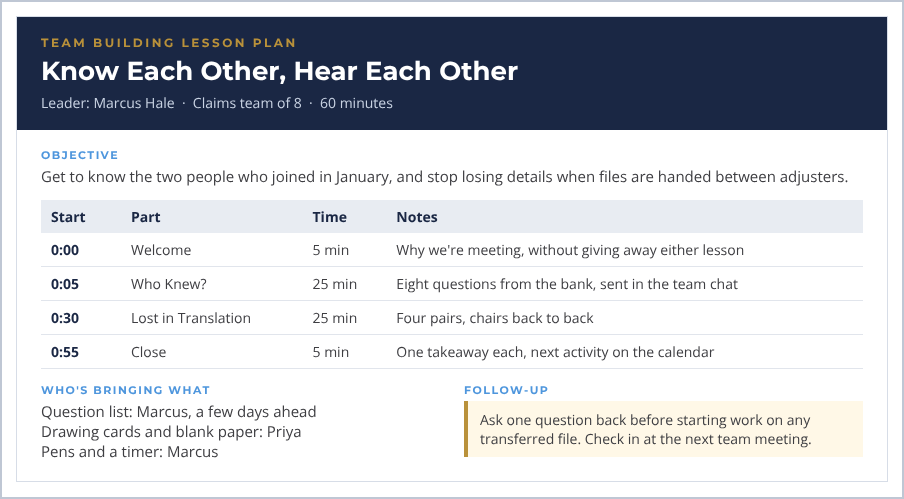
When he ran the activities, Nina told the group she'd rebuilt a motorcycle engine and Theo talked about teaching English in Chile, and people were still talking about it at lunch. In Lost in Translation, round two took half as long as round one, and the team agreed to ask more questions before starting work on any file transferred from another adjuster.
That agreement was the only follow-up the session needed. A quick question at the next team meeting, asking whether anyone has used it, is enough to keep the questions going.
Build Your Own Team Building Lesson Plan
Once you've run a session or two, you may want to write team building lesson plans of your own, built around something specific to your team, such as a new process or a change in who does what. The Leader's Guide takes you through how to build a team building lesson plan in five steps on page 44 and gives you two fill-in worksheets on pages 46 and 47. The first covers the activity itself, and the second covers how you'll lead it.
Before you use the plan, go through the seven-question checklist on page 45. One of the questions is "Will people experience something rather than simply listen?" and it's a good test for any lesson plan. Ask someone you trust to read it too, since a second reader will often spot a direction that's hard to follow or a step that won't fit the time allotted. The Build Your Own section of the team building activities page has more on each step.
More Team Building Ideas
Each of these pages looks at one part of building a stronger team. All 12 activities and the free Leader's Guide are on the free team building activities page.
Accountability Team Building Activities
Activities that help a team keep its commitments to each other, with the setup, timing and follow-up for each one.

Leadership Team Building
Activities that build leadership skills in your team members, and the part you play as their leader in each one.

Fun Team Building Activities
Short games for a team meeting, such as Team Jeopardy and Pet Match, with small prizes that add energy.

Team Goal Setting
Six steps for setting a goal with your team and keeping it moving each week, plus two team goal setting activities.
Frequently Asked Questions
The questions below address what leaders most commonly ask about a team building lesson plan.
Click on the (+) sign below to expand each question. Click the (-) sign to collapse it again.
How long should a team building lesson plan be?
What should a team building lesson plan include?
An objective, who it's for, the time and preparation needed, the materials, a timed agenda, what to say to open each activity, debrief questions, and a short close with any follow-up. The at-a-glance box and the agenda on this page cover each of those.
Can I run this lesson plan with a virtual team?
Yes. Post the Who Knew? questions in the meeting chat and ask for volunteers, then use breakout rooms for the Lost in Translation pairs and send each describer the drawing card in a private message. The drawer uses paper or a digital whiteboard and shares it only when the round ends.
What if someone doesn't want to participate?
Let them pass without explaining why. In Who Knew? anyone can choose a different question or skip a turn, and in Lost in Translation a person can join a pair as an observer. Invite people in, and keep the activities away from personal stories, public ratings and anything that feels like a test.
Is there a team building lesson plan template?
Yes. The free Team Building Activities Leader's Guide includes two fill-in worksheets on pages 46 and 47, one for planning an activity and one for leading it, along with a seven-question checklist on page 45 to go through before the session.
Can I use this lesson plan in a classroom?
It's written for workplace teams, so the examples and debrief questions are about handoffs, meetings and coworkers. Both activities can work with older students if you rewrite the questions for school, but teamwork lesson plans for a classroom usually need learning objectives and assessment that this plan doesn't include.
Free Tools for Leading Your Team



Richard Gorham has led teams in financial services for more than 30 years, from retail branches and operations to investments and insurance, and he still leads a team today.
He founded Leadership-Tools.com in 2002 to give managers free, practical tools like the ones he used in his various leadership roles. Every tool here has been used in a real workplace and comes with a filled-in example you can follow.

Contact Information:
phone
(503) 970-9777
Email Customer Service
helpsupport@leadership-tools.com
Email Richard
richard@leadership-tools.com

By Richard Gorham
Leadership-Tools.com
2879 Riverwalk Loop, Eugene, Oregon, 97401
Copyright (c) 2002 - 2026 All Rights Reserved